
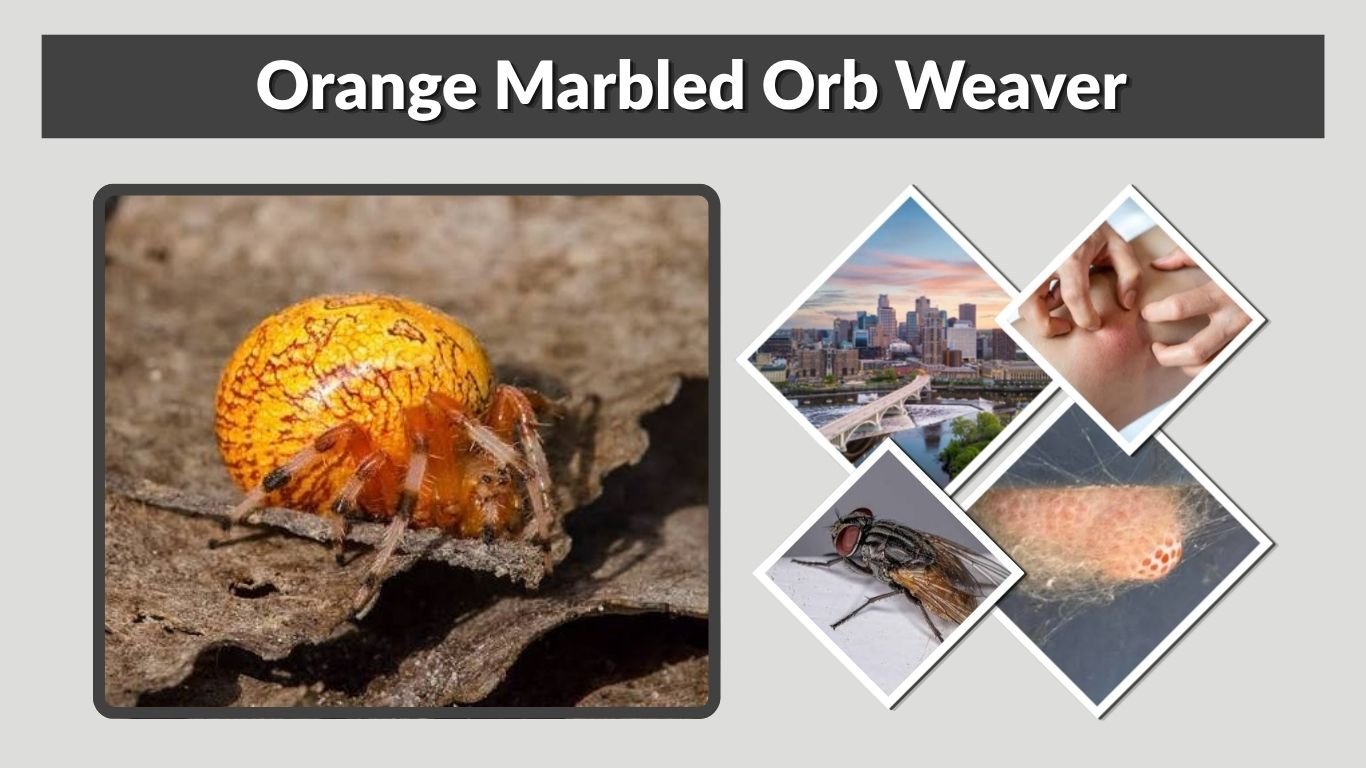
The orange marbled orb weaver is a colorful woodland spider recognized by its rounded abdomen, pumpkin-orange coloring, and intricate marbled markings. Although its bright appearance can make it seem dangerous, this spider is generally shy and presents little risk to people. It spends most of its time building circular webs and capturing insects around forests, gardens, and other vegetated areas. Learning its appearance, behavior, range, and bite risk can help you identify it without unnecessary concern.
What Is an Orange Marbled Orb Weaver?
The orange marbled orb weaver is a color form of the marbled orb-weaver spider, scientifically known as Araneus marmoreus. It belongs to the family Araneidae, a large group of spiders known for constructing wheel-shaped orb webs.
The word “orange” does not identify a separate species. Marbled orb weavers vary considerably in color. Their abdomens may be orange, yellow, cream, white, brown, or combinations of these colors. Orange individuals are especially noticeable during late summer and fall.
Quick Facts
| Feature | Description |
| Scientific name | Araneus marmoreus |
| Family | Araneidae |
| Common names | Marbled orb weaver, orange marbled orb weaver, pumpkin spider |
| Main colors | Orange, yellow, cream, brown and black |
| Diet | Flying and crawling insects |
| Web type | Circular orb web |
| Temperament | Shy and nonaggressive |
| Human danger | Very low |
Orange Marbled Orb Weaver Identification
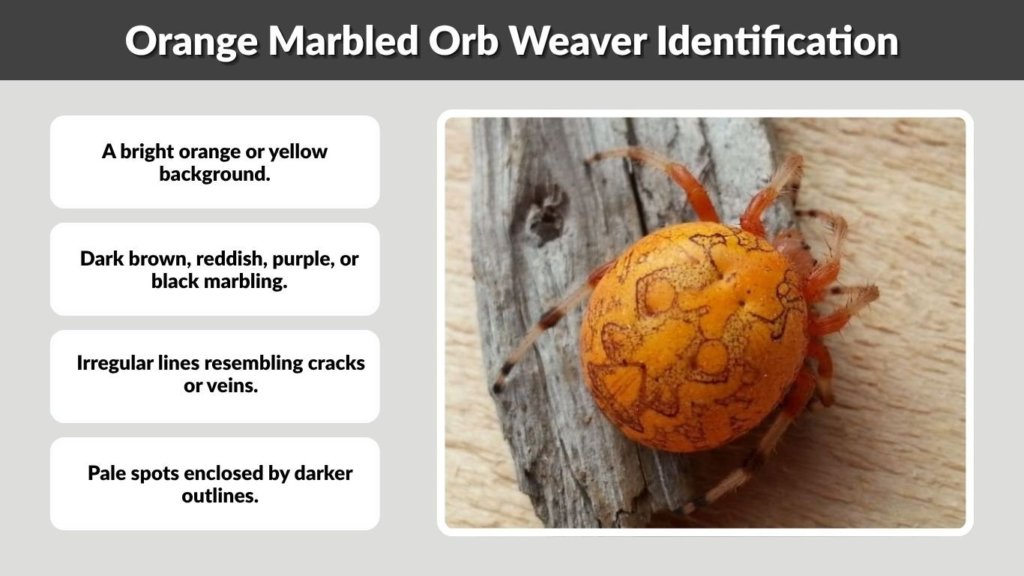
The most recognizable feature is the spider’s large, rounded abdomen. On orange individuals, the abdomen may resemble a miniature pumpkin covered with dark veins, blotches, or marble-like patterns.
However, color alone should not be used for identification because the species is extremely variable. BugGuide records individuals ranging from bright orange and yellow to pale cream or almost white.
Abdomen
Adult females have a broad, nearly spherical abdomen that appears much larger than the front portion of the body. Its surface commonly displays:
- A bright orange or yellow background
- Dark brown, reddish, purple, or black marbling
- Irregular lines resembling cracks or veins
- Pale spots enclosed by darker outlines
Some spiders have extensive dark markings, while others are almost entirely orange.
Legs
The legs are usually orange, reddish brown, or pale yellow near the body. Dark bands or black tips may be visible toward the ends. Fine hairs and small spines cover the legs.
The phrase red-legged orange marbled orb weaver spider generally describes an ordinary color variation rather than a separate species.
Size
Female marbled orb weavers are noticeably larger and more rounded than males. Their large abdomen makes them appear more intimidating than they really are. Males are smaller, slimmer, and less frequently noticed.
Size can vary depending on age, sex, nutrition, and whether a female is carrying eggs.
Why Are Some Marbled Orb Weavers Orange?
Orange is one of several natural colors found within this species. Genetics, age, maturity, diet, and seasonal changes may influence an individual’s appearance.
Some marbled orb weavers become particularly bright as they mature during autumn. Older females may also change shape after producing eggs because their abdomens lose body mass. Observations have documented especially vivid orange adults near the end of the season.
Their autumn coloring has earned them the nickname pumpkin spider. Orange adults are often seen during September and October, when fallen leaves and Halloween decorations make their coloring especially appropriate.
Orange Marbled Orb Weaver Range
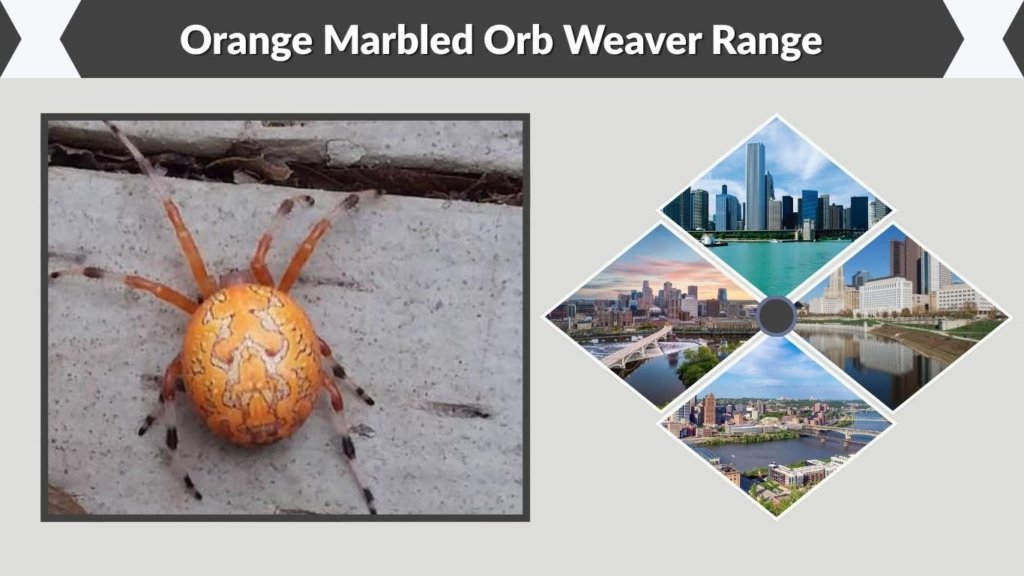
Marbled orb weavers occur across a broad portion of the Northern Hemisphere. In North America, they are found throughout much of the eastern United States and southern Canada, with observations extending into parts of the central United States.
They are regularly reported in states including:
- Illinois
- Minnesota
- Ohio
- Pennsylvania
- New Jersey
- North Carolina
- Tennessee
- Virginia
- Alabama
Their presence in Illinois and Minnesota is therefore normal and does not usually indicate that the spider has recently expanded its range.
These spiders favor moist, vegetated environments rather than dry, exposed locations. They are commonly encountered along forest edges, beside streams, in meadows, around shrubs, and near shaded gardens.
Habitat and Web-Building Behavior
Orange marbled orb weavers usually build vertical, wheel-shaped webs between branches, tall plants, weeds, or other low vegetation. The circular web is designed to intercept insects moving through the area.
The spider may sit near the center of its web at night. During daylight, it often hides in a retreat made from a curled leaf secured with silk. A signal thread connects the retreat to the web, allowing the spider to detect vibrations caused by captured prey.
Common Web Locations
You may discover a web:
- Between shrubs in a shaded yard
- Along woodland trails
- Near ponds, creeks, or marshy areas
- Among tall grasses and wildflowers
- Around porch lights where insects gather
- Between low tree branches
Their webs may occasionally cross pathways overnight. Walking into one can be startling, but the spider normally attempts to escape rather than attack.
Orange Marbled Orb Weaver Diet and Ecological Benefits
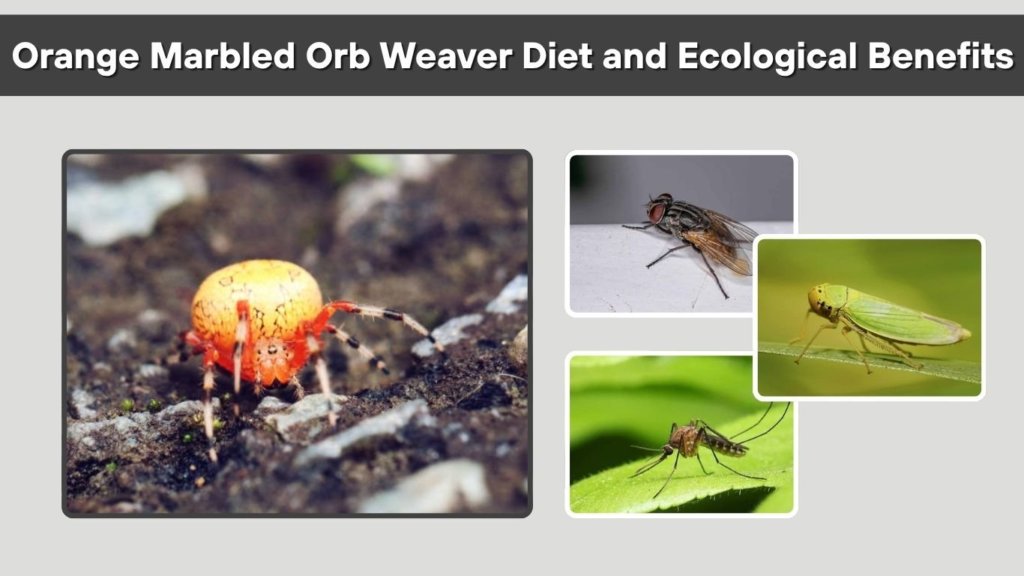
The orange marbled orb weaver is a predator of insects. It uses its web to capture moths, flies, mosquitoes, leafhoppers, beetles, and other small arthropods.
After an insect becomes trapped, the spider approaches, immobilizes it with silk, and delivers venom through its fangs. The venom helps subdue prey and begins breaking down its tissues.
By consuming insects, marbled orb weavers contribute to natural pest control. They may reduce the number of flying insects around gardens and wooded properties without damaging plants, homes, or stored food.
Is the Orange Marbled Orb Weaver Poisonous?
The orange marbled orb weaver is not poisonous. Poisonous animals cause harm when they are eaten or touched. This spider is technically venomous because it injects venom through its fangs.
However, its venom is designed for small insects and is not considered medically significant to humans. Bright orange coloring does not mean the spider is highly dangerous. Mississippi State University notes that marbled orb weavers can bite when mishandled but are slow to do so, and their bites are not seriously venomous.
For most people, simply seeing one in a yard does not require pest control.
Does an Orange Marbled Orb Weaver Bite?
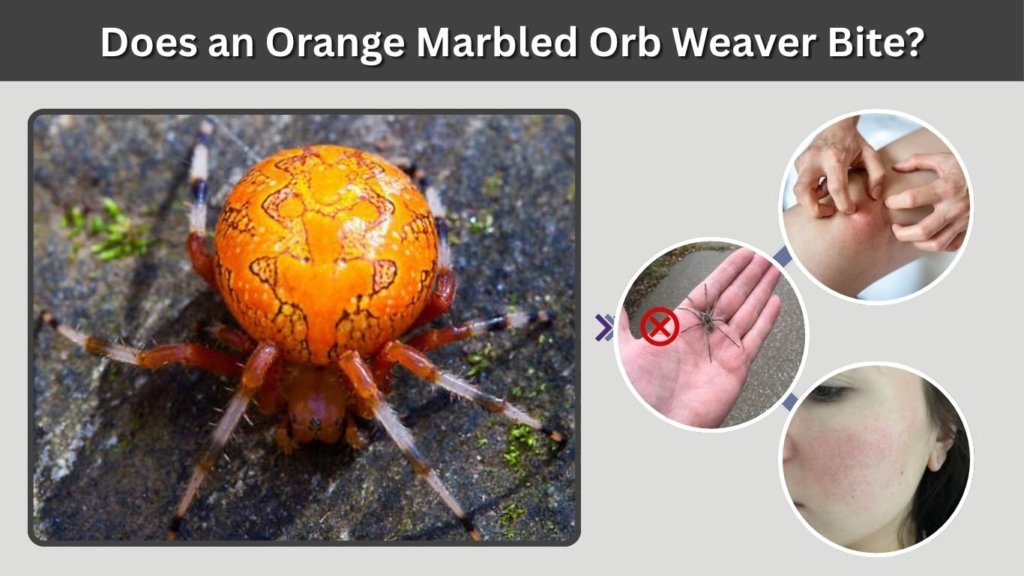
A bite is possible, but it is uncommon. Marbled orb weavers are not aggressive and usually respond to disturbance by hiding, dropping from the web, or remaining still.
Bites are most likely when someone:
- Picks up the spider with bare hands
- Traps it against the skin
- Reaches into its retreat
- Handles a female guarding an egg sac
- Accidentally presses it inside clothing or gloves
Penn State Extension reports that bites are unlikely unless a spider—particularly a female associated with an egg sac—is handled. Even then, the effects are expected to be relatively mild.
Possible Bite Symptoms
A bite may cause:
- Brief pain or stinging
- Mild redness
- Local swelling
- Itching or tenderness
- Temporary irritation around the bite
Wash the area with soap and water and apply a wrapped cold pack for short intervals. Avoid scratching the skin. Seek medical attention if symptoms become severe, spread rapidly, involve breathing difficulty, or suggest an allergic reaction.
Orange Marbled Orb Weaver vs. Similar Spiders
Several colorful orb weavers may be confused with the orange marbled orb weaver.
| Spider | Main identifying features |
| Orange marbled orb weaver | Round orange abdomen with complex dark marbling |
| Shamrock orb weaver | Rounded abdomen with pale spots resembling a cross or shamrock |
| Cross orb weaver | Distinct white cross-shaped pattern on the abdomen |
| Spotted orb weaver | Brown or orange abdomen with smaller spots and markings |
| Yellow garden spider | Long oval abdomen with bold black-and-yellow coloring and a zigzag web decoration |
The yellow garden spider is especially easy to distinguish because it has an elongated body rather than the pumpkin-shaped abdomen of a marbled orb weaver.
Life Cycle and Egg Sacs
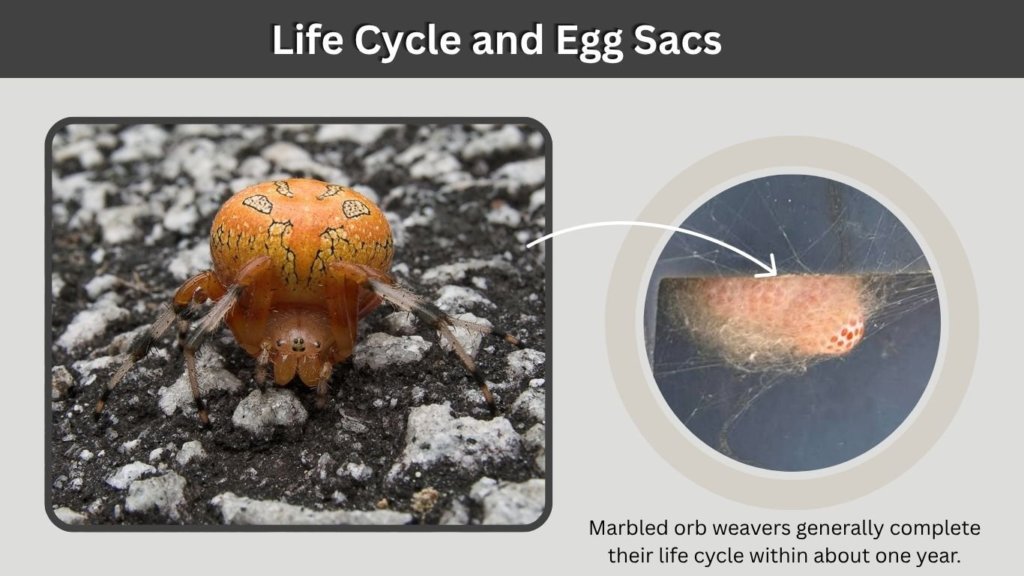
Marbled orb weavers generally complete their life cycle within about one year. Young spiders emerge from overwintering egg sacs and develop through spring and summer.
Adults become most noticeable in late summer and fall. After mating, a female produces one or more silk-covered egg sacs in a protected location. The eggs remain sheltered through winter, while most adults die after cold weather arrives.
Spiderlings emerge when conditions become favorable. They disperse and begin building small webs, gradually increasing the size of their webs as they grow.
Should You Remove One?
Removal is usually unnecessary. Orange marbled orb weavers do not infest houses, reproduce indoors in large colonies, or damage structures. A spider living in a garden is likely helping control insects.
When a web blocks a doorway or walkway, gently relocate the spider without touching it. Place a container over it, slide a stiff piece of paper underneath, and release it among shrubs away from regular foot traffic.
Avoid spraying broad-spectrum insecticides. These products can kill beneficial spiders and other harmless organisms while providing little long-term benefit.
FAQs
Are orange marbled orb weaver spiders dangerous?
Orange marbled orb weavers are not considered dangerous to people. They possess venom for capturing insects, but their venom is not medically significant in typical circumstances. They are shy spiders that normally retreat when disturbed and rarely bite unless trapped or handled.
Why does a marbled orb weaver look like a pumpkin?
Its rounded abdomen and vivid orange coloring create a pumpkin-like appearance. The resemblance becomes especially noticeable when adults appear during autumn. This seasonal look is why marbled orb weavers are sometimes informally called pumpkin spiders.
Where do orange marbled orb weavers live?
They live in moist forests, woodland edges, meadows, gardens, and vegetation near streams or ponds. Their circular webs are normally constructed between shrubs, branches, weeds, or tall grasses where flying insects are likely to pass.
Can an orange marbled orb weaver live inside a house?
One may accidentally enter a garage, basement, porch, or home, but it is not adapted to establishing a household infestation. It generally does better outdoors, where it can construct a large web and find sufficient insect prey.
What should I do after finding one in my yard?
Leave it alone unless its web blocks a frequently used area. It poses little threat and helps capture insects. When relocation is necessary, use a container and a piece of cardboard rather than handling the spider directly.
