
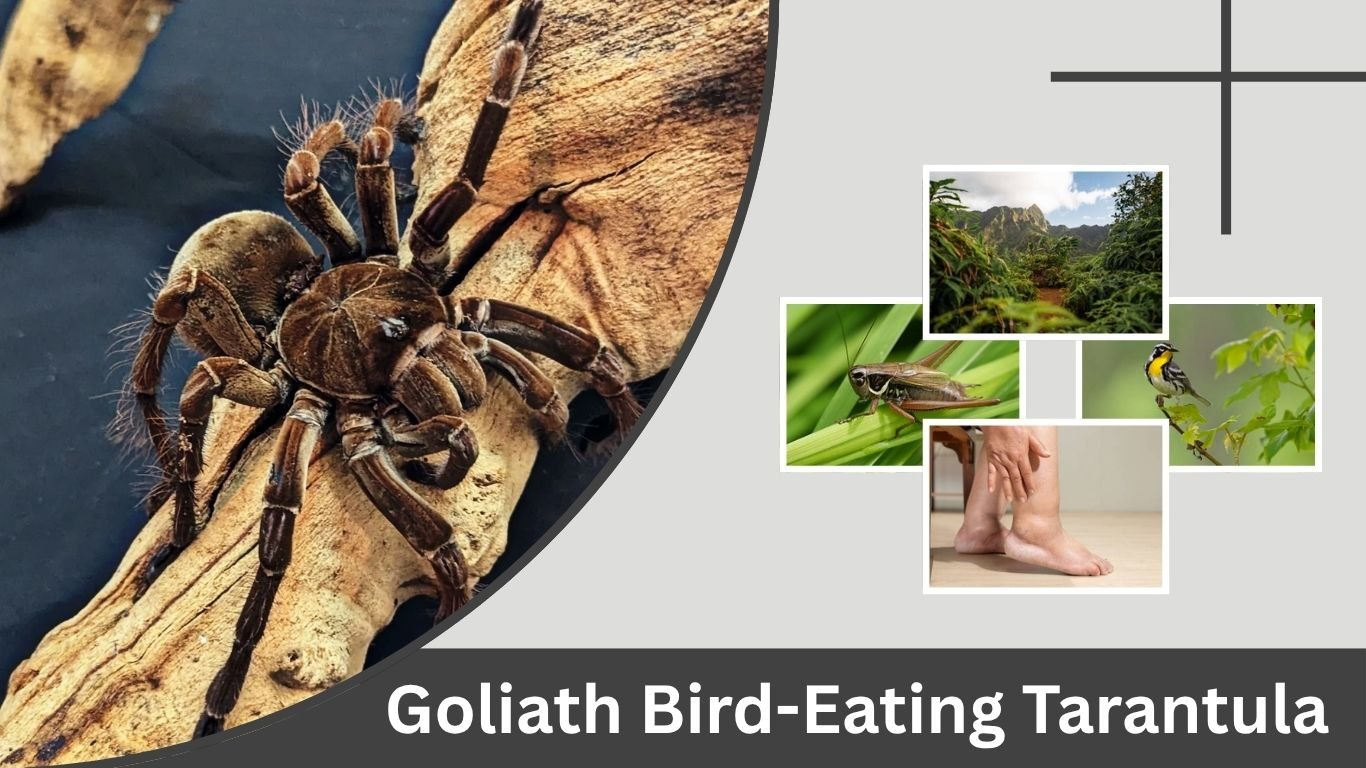
The Goliath bird-eating tarantula is one of the largest and most impressive spiders on Earth. Known scientifically as Theraphosa blondi, this giant tarantula lives in the warm, humid rainforests of northern South America. Despite its frightening name and enormous fangs, it rarely eats birds and usually hunts insects, worms, frogs, and other small animals. Its heavy body, defensive hairs, hissing sound, and remarkable size make it unlike almost any other spider.
Goliath Bird-Eating Tarantula Overview
The Goliath birdeater belongs to the tarantula family, Theraphosidae. It is often called the Goliath bird eater, Goliath bird-eating spider, or giant Goliath tarantula.
Although the giant huntsman spider can have a wider leg span, the Goliath birdeater is generally recognized as the world’s largest spider by body mass and body length. Its scientific name is commonly written as Theraphosa blondi.
| Feature | Description |
|---|---|
| Scientific name | Theraphosa blondi |
| Family | Theraphosidae |
| Common color | Dark brown, reddish brown or golden brown |
| Habitat | Humid rainforest floors and burrows |
| Activity | Mainly nocturnal |
| Diet | Insects and small vertebrates |
| Temperament | Solitary and defensive |
| Native region | Northern South America |
How Big Is a Goliath Bird-Eating Tarantula?
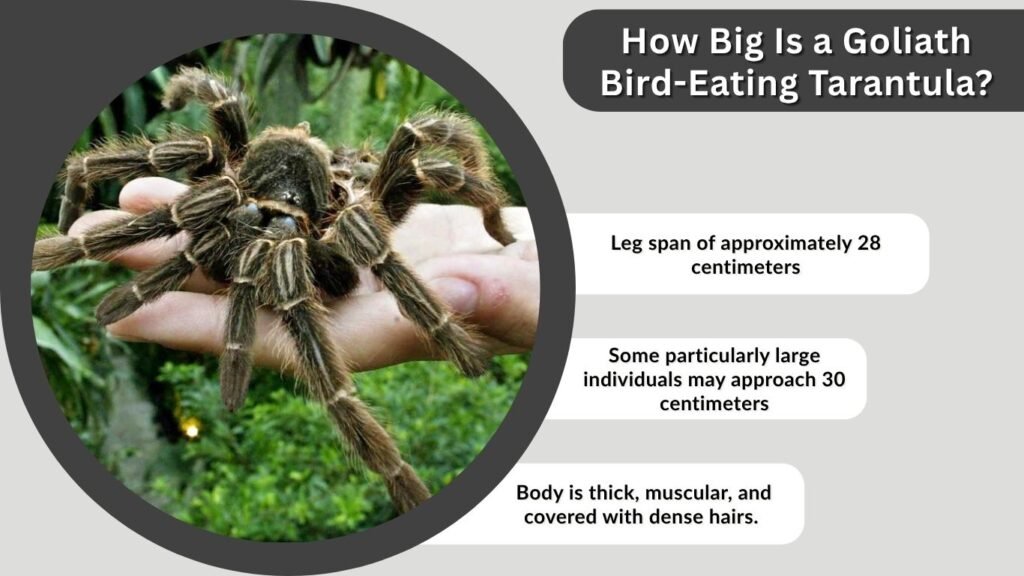
A full-grown Goliath bird-eating tarantula can have a leg span of approximately 28 centimeters, or about 11 inches. Some particularly large individuals may approach 30 centimeters when their legs are fully extended.
Its body is thick, muscular, and covered with dense hairs. Unlike spiders that look large mainly because of their long, thin legs, the Goliath birdeater has a truly heavy body.
Goliath Bird-Eating Tarantula Size Comparison
Its leg span may be comparable to the width of a large dinner plate. The spider’s body can be roughly the size of an adult human fist, although individual size varies according to age, sex, nutrition, and species identification.
Females are generally heavier and more strongly built than mature males. Adult males may have longer, slimmer legs, while adult females usually retain the broader body associated with the species’ enormous weight.
Is It the Biggest Spider in the World?
The answer depends on how “biggest” is measured.
The Goliath birdeater is commonly described as the heaviest living spider and one of the longest by body size. However, the giant huntsman spider may exceed it in total leg span. Therefore, the Goliath birdeater holds the strongest claim when weight and body bulk are considered.
Where Does the Goliath Bird-Eating Tarantula Live?
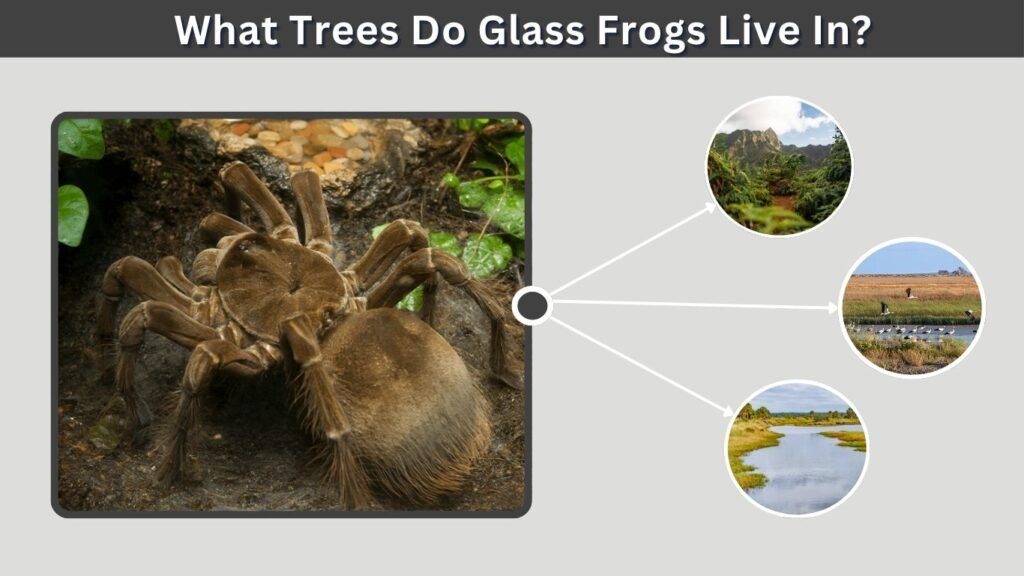
The Goliath bird-eating tarantula is native to northern South America. Its range includes parts of Guyana, Suriname, French Guiana, Venezuela, Brazil, and nearby rainforest regions.
It is not naturally found in Australia, Africa, Europe, or North America. Reports of an “Australian Goliath bird-eating tarantula” usually refer to a different large spider or an animal kept in captivity.
Goliath Bird-Eating Tarantula Habitat
This tarantula prefers warm, humid environments with soft soil and abundant ground cover. It is strongly associated with rainforest floors, marshy areas, swamp edges, and other places where moisture remains available.
The spider spends much of its time inside a deep burrow. It may dig its own shelter or occupy a suitable burrow abandoned by another animal. The entrance is sometimes surrounded by silk, which may help the spider detect vibrations from approaching prey or danger.
Because it is primarily nocturnal, the Goliath birdeater usually remains hidden during the day and emerges after dark to hunt.
What Does the Goliath Bird-Eating Tarantula Eat?
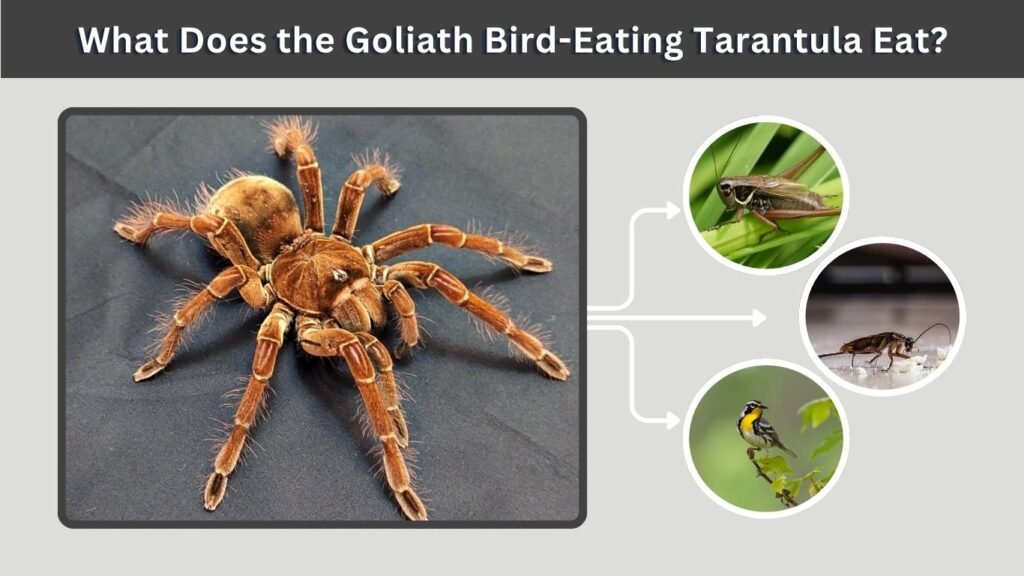
Despite its name, birds are not its normal food. The spider is an opportunistic predator that attacks animals small enough for it to overpower.
Its typical diet includes:
- Large insects
- Cockroaches
- Beetles
- Crickets
- Earthworms
- Other spiders
- Frogs and toads
- Small lizards
- Small rodents
- Occasionally small snakes or birds
The Smithsonian’s National Zoo reports that the species can consume various invertebrates and small vertebrates, while captive individuals at the zoo are fed cockroaches.
Does the Goliath Birdeater Really Eat Birds?
It can eat a small bird, but this appears to be uncommon. The famous name originated partly from an old illustration showing a large South American spider feeding on a hummingbird.
In the wild, ground-dwelling prey is easier for the tarantula to catch. Worms, insects, amphibians, and small reptiles are therefore more realistic everyday food sources than birds.
How Does It Hunt?
The Goliath birdeater does not build a large aerial web to catch prey. Instead, it waits near its shelter and detects movement through vibrations.
When an animal comes within reach, the tarantula rushes forward, grabs it with its legs, and delivers a bite with its large fangs. Venom helps immobilize the prey, while digestive fluids break down its internal tissues. The spider then consumes the liquefied material.
Is the Goliath Bird-Eating Tarantula Poisonous?
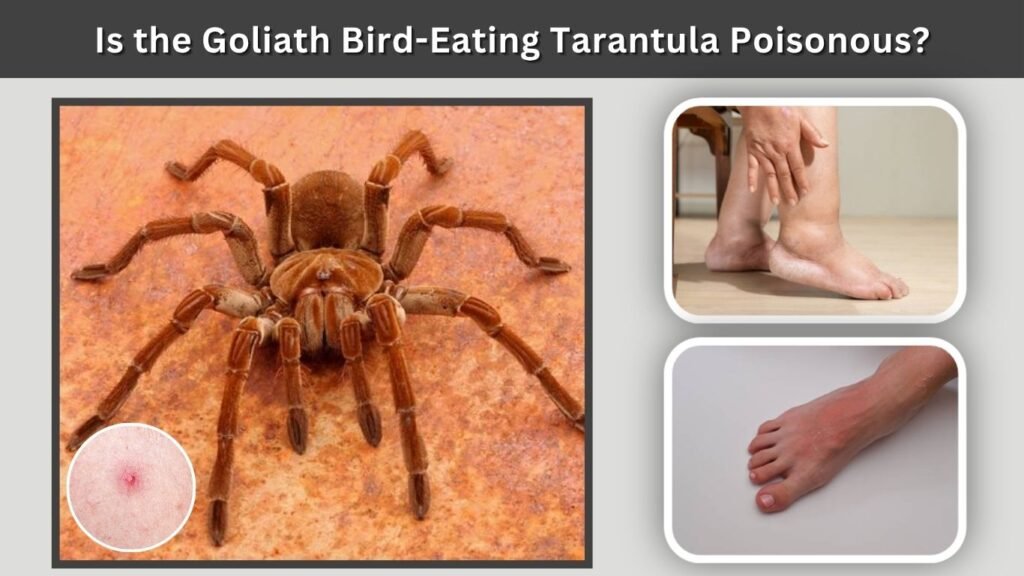
The more accurate word is venomous, not poisonous. It injects venom through its fangs when biting prey or defending itself.
Its venom is not generally considered highly dangerous to a healthy adult human. However, the bite can still be extremely painful because the spider has very large fangs capable of puncturing the skin deeply.
Possible bite symptoms may include:
- Immediate pain
- Swelling
- Redness
- Tenderness
- Muscle discomfort
- Nausea in some cases
A bite should be cleaned carefully and monitored. Medical advice is appropriate when pain or swelling becomes severe, symptoms spread, breathing problems occur, or the injured person has a known allergy.
Goliath Bird-Eating Tarantula Defense Mechanisms
Biting is not this tarantula’s only form of protection. It has several ways to discourage predators.
Urticating Hairs
The abdomen is covered with specialized defensive hairs called urticating hairs. When threatened, the spider may rub its hind legs against its abdomen, releasing these tiny hairs into the air.
The hairs can irritate the skin, nose, throat, and eyes. Eye exposure can be especially serious and may require medical treatment. The hairs are one reason handling the spider is discouraged.
Hissing Sound
A threatened Goliath birdeater may make a noticeable hissing or rasping noise through a process called stridulation. It produces the sound by rubbing specialized structures on its legs and mouthparts together.
This warning tells a predator to move away before the spider uses stronger defenses.
Threat Posture
The tarantula may raise its front legs, display its fangs, strike toward the threat, or retreat into its burrow. These behaviors often provide clear warning before an actual bite occurs.
Goliath Bird-Eating Tarantula Lifespan
Females can live much longer than males. A well-kept female may survive for approximately 15 to 20 years, and some reports suggest even longer lifespans under favorable conditions.
Males normally have much shorter lives. Once mature, they focus on finding females and may live only a few additional years.
Like other tarantulas, the Goliath birdeater grows by molting. During a molt, it sheds its old outer skeleton and emerges with a larger, soft body that gradually hardens. The spider is extremely vulnerable during this period and should not be disturbed or fed.
Can You Keep a Goliath Bird-Eating Tarantula as a Pet?
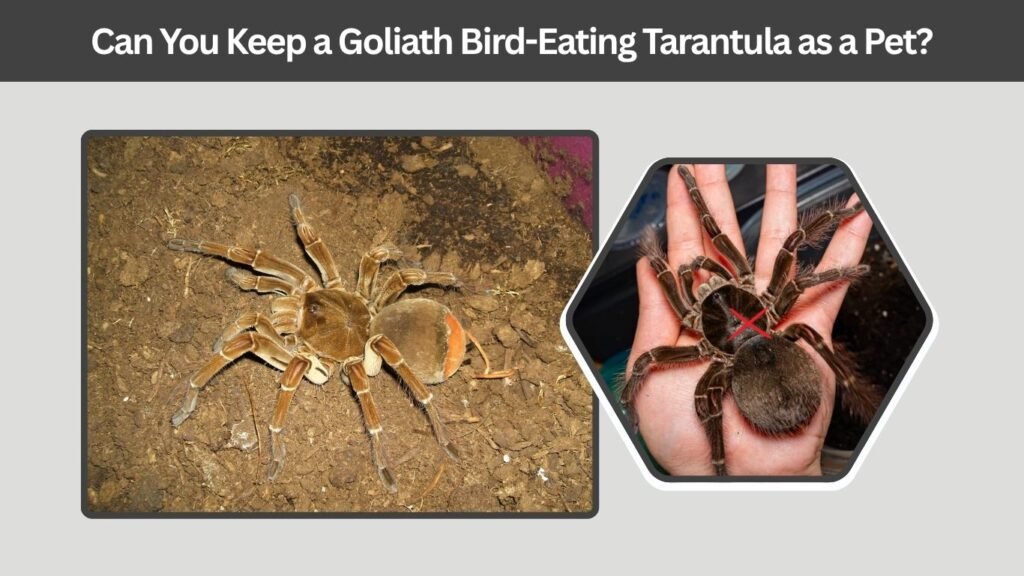
Goliath birdeaters are available in the exotic-pet trade, but they are not suitable for most beginners. Their enormous size, defensive behavior, humidity requirements, irritating hairs, and powerful fangs make them challenging animals to maintain.
They are display animals rather than pets that should be touched or handled.
Enclosure Requirements
An adult needs a secure, horizontally oriented enclosure with enough floor space to move naturally. Because this is a heavy terrestrial spider, excessive enclosure height can be dangerous. A fall onto a hard object could rupture its abdomen.
Important enclosure features include:
- Deep, compact substrate suitable for burrowing
- A secure hide
- A wide, shallow water dish
- High humidity without stagnant conditions
- Good ventilation
- No sharp decorations
- A tightly secured lid
The substrate should remain appropriately moist but not flooded. Poor ventilation combined with excessive moisture can encourage mold and unhealthy conditions.
Feeding in Captivity
Captive individuals are generally offered appropriately sized invertebrates such as large cockroaches, crickets, and locusts. Uneaten prey should be removed, especially when the spider is preparing to molt.
Feeding frequency varies with the tarantula’s age, body condition, temperature, and prey size. Overfeeding can lead to an overly swollen abdomen, increasing the risk of injury after a fall.
Handling
Handling a Goliath bird-eating tarantula is not recommended. Even when it does not bite, it may release irritating hairs. Handling also puts the spider at risk because a sudden movement or short fall can cause fatal damage.
Owners should use long tools and safe transfer containers when performing enclosure maintenance.
Goliath Birdeater Reproduction and Babies
Mature males leave their shelters to search for females. Courtship must be cautious because a female may treat the male as prey when communication fails.
After successful mating, the female produces an egg sac and guards it inside her burrow. The number of young can vary. Newly hatched spiderlings are tiny compared with their mother but grow through repeated molts.
Young tarantulas must avoid predators, drying conditions, and food shortages. Only a portion will survive to adulthood in the wild.
Is the Goliath Bird-Eating Tarantula Endangered?
The species does not appear to have a widely published formal global assessment on the IUCN Red List. That means it should not automatically be described as either endangered or secure.
Potential concerns include rainforest destruction, local habitat disturbance, collection for the wildlife trade, and the killing of spiders out of fear. Buying captive-bred animals instead of wild-caught specimens can reduce pressure on natural populations.
Interesting Goliath Bird-Eating Tarantula Facts
- It is one of the heaviest spiders living today.
- It rarely eats birds despite its common name.
- It hunts mainly at night.
- It lives mostly on the ground rather than in trees.
- It can make a hissing warning sound.
- Its defensive hairs may be more troublesome than its venom.
- Females can live several times longer than males.
- It uses a burrow as shelter and an ambush point.
- It relies heavily on vibration to detect nearby activity.
- It is a solitary animal except during mating.
FAQs
Are Goliath bird-eating tarantulas aggressive?
They are better described as defensive rather than naturally aggressive. They generally prefer hiding or warning a threat, but they may release irritating hairs, strike, or bite when cornered, touched, or repeatedly disturbed.
Can a Goliath birdeater kill a human?
A bite is not normally expected to kill a healthy person, but it may cause intense pain and other symptoms. Allergic reactions, infection, eye exposure to defensive hairs, or unusual medical complications require professional attention.
How large are its fangs?
Its fangs can reach approximately two centimeters in very large adults. Their size allows the spider to puncture the bodies of insects and small vertebrates, and they can also produce a deep wound in human skin.
Does the Goliath birdeater eat mice?
It is physically capable of killing and eating a very small rodent. However, insects and other invertebrates form a more regular part of its diet. Captive keepers generally do not need to feed mice.
Is the Goliath bird-eating tarantula good for beginners?
No. Its defensive nature, demanding moisture conditions, irritating hairs, large enclosure needs, and powerful fangs make it better suited to experienced tarantula keepers who understand safe husbandry and enclosure maintenance.
