
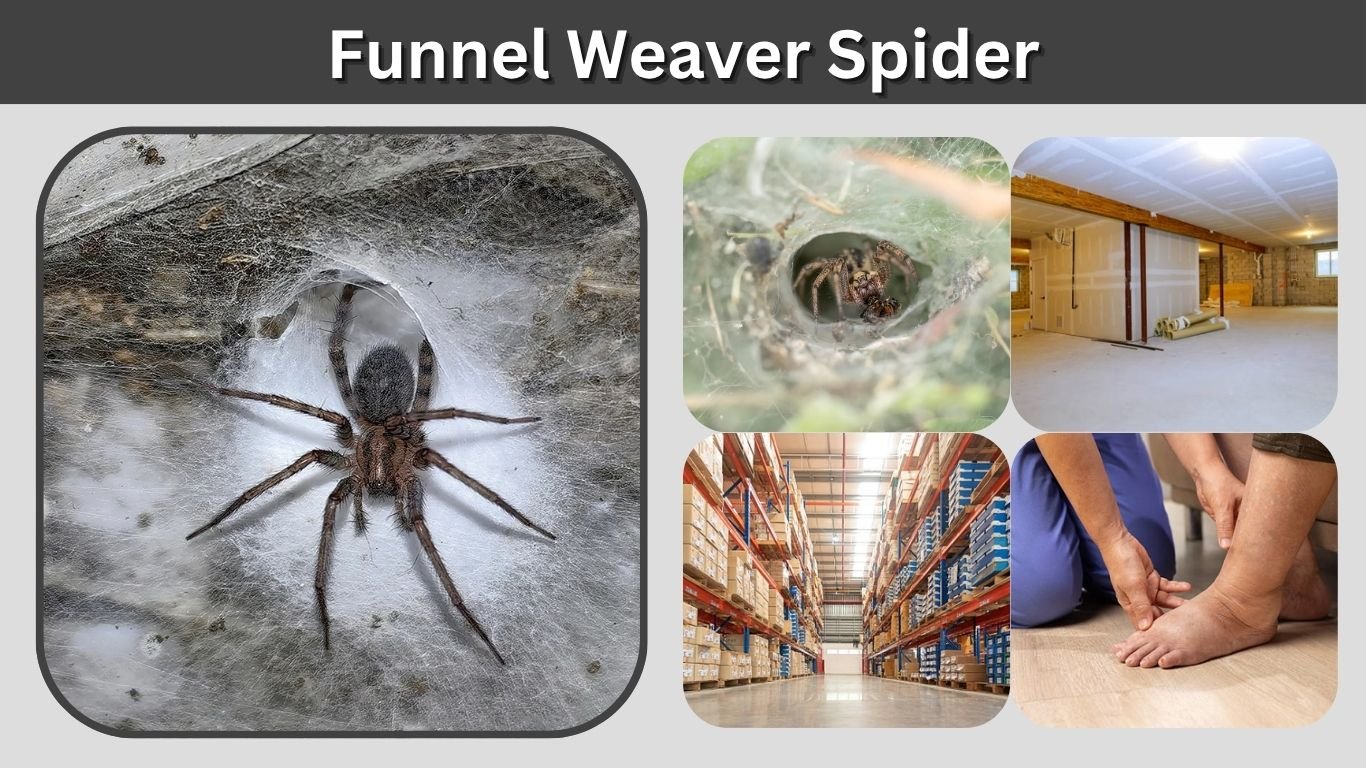
Funnel weaver spiders are fast-moving spiders best known for building flat, sheet-like webs that narrow into a funnel-shaped retreat. They are commonly found in lawns, gardens, barns, basements, and other sheltered areas across North America. Although their appearance can sometimes cause confusion with wolf spiders, hobo spiders, or brown recluses, most funnel weavers are not considered dangerous to people. Understanding their size, web structure, behavior, habitat, and bite risk makes these common spiders much easier to recognize.
What Is a Funnel Weaver Spider?
Funnel weaver spiders are primarily members of the family Agelenidae, a widespread group containing many species of grass spiders and house-dwelling spiders. Their name comes from the distinctive funnel-shaped retreat connected to their web. Rather than using a sticky orb web, these spiders rely on speed to capture insects moving across their silken sheet.
Funnel Weaver Spider Identification
Common characteristics that can help identify a funnel weaver include:
- Body shape: Long, somewhat flattened body with relatively long legs.
- Color: Usually brown, gray, tan, or dark brown.
- Markings: Many species have stripes, spots, or chevron-shaped markings on the abdomen.
- Spinnerets: Noticeably long spinnerets may extend from the rear of the abdomen.
- Legs: Long and slender compared with the heavier legs of many wolf spiders.
- Movement: Funnel weavers can run extremely quickly when disturbed.
- Web: A horizontal sheet of silk leads into a narrow funnel or tunnel.
Identification by appearance alone can sometimes be difficult because several unrelated spiders have similar brown coloration.
Funnel Weaver Spider Size
Size varies considerably between species. Many common funnel weavers have bodies roughly ¼ to ¾ inch long, although their overall leg span can make them appear much larger.
Females are generally larger and more robust than males. Adult males may have longer-looking legs and enlarged pedipalps near their mouthparts. Barn funnel weavers and some house species can become particularly noticeable because of their long legs and fast movement.
Male and Female Funnel Weavers
Female funnel weavers usually spend much of their time inside or near their webs. Their funnel retreat provides protection while allowing them to detect vibrations created by approaching prey.
Males become more active when searching for females. This wandering behavior is one reason funnel weavers may suddenly appear indoors, particularly around mating periods. A roaming male does not necessarily indicate that a large infestation is present.
Funnel Weaver Spider Web and Nest
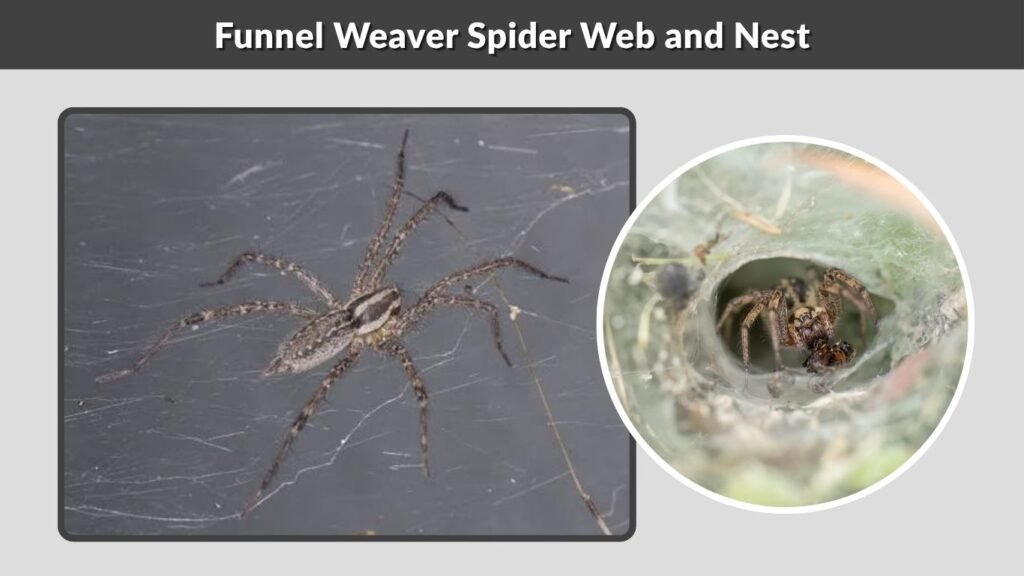
The web is one of the easiest ways to recognize these spiders. Instead of a circular web, a funnel weaver constructs a broad sheet of non-sticky silk. One end narrows into a tubular hiding place where the spider waits. When an insect crosses the surface, vibrations alert the spider, which quickly rushes out to capture it.
What Does a Funnel Weaver Web Look Like?
Look for these characteristics:
- A flat or slightly curved sheet of dense silk
- A clearly visible funnel-shaped opening
- A tunnel leading into grass, cracks, rocks, or vegetation
- Webs positioned close to the ground or in sheltered corners
- A spider waiting near the mouth of the funnel
Unlike an orb-weaver web, the silk generally does not trap insects with sticky droplets.
Where Funnel Weavers Build Their Webs
Funnel weavers often choose places where their web remains protected from wind and physical damage. Outdoors, webs may appear among grass blades, shrubs, logs, rocks, landscape borders, woodpiles, and building foundations.
House and barn funnel weavers can use cracks, window wells, garages, sheds, basements, crawl spaces, and quiet corners. Their presence is usually associated with suitable shelter and an available supply of insects.
Why the Funnel Shape Matters
The funnel serves primarily as a retreat rather than as the entire trap. The spider remains hidden inside it while keeping its legs close enough to the sheet to detect vibrations.
Once prey walks across the web, the spider can rush forward, seize it, and return to its protected tunnel. This hunting method allows funnel weavers to capture insects without producing a sticky web.
Are Funnel Weaver Spiders Poisonous or Venomous?
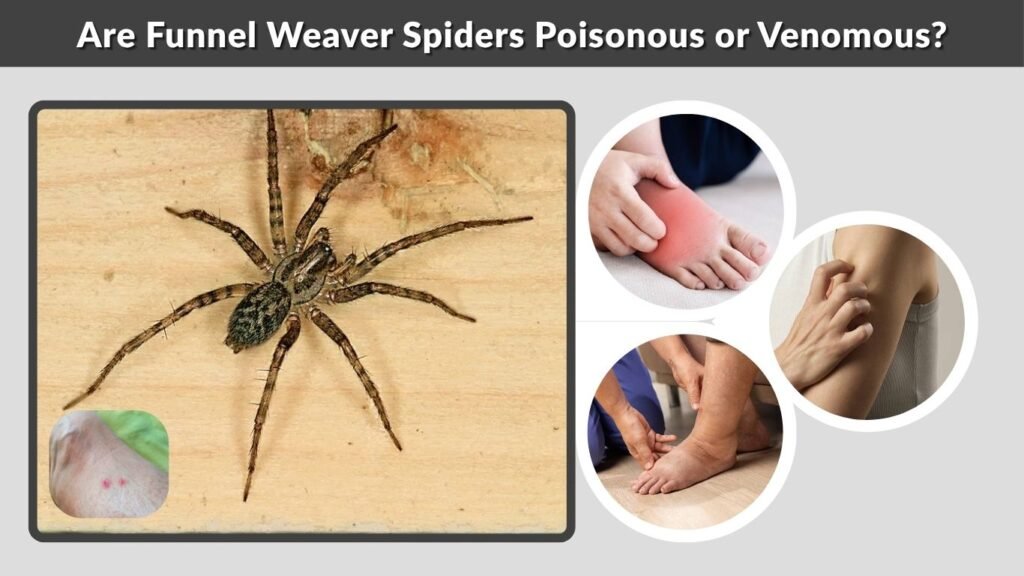
Funnel weavers are venomous in the biological sense because they use venom to subdue their insect prey. However, the common North American funnel weavers encountered around homes and gardens are generally not regarded as medically dangerous to healthy people.
Is a Funnel Weaver Spider Dangerous?
For most people, these spiders pose very little threat. They are not aggressive and typically retreat when disturbed. Their first response is generally to run toward shelter rather than confront a person.
It is also important not to confuse North American funnel weavers with Australian funnel-web spiders. Despite similar common names and funnel-shaped webs, Australian funnel-web spiders belong to different spider groups and can include medically significant species.
Funnel Weaver Spider Bite
A funnel weaver may bite if it becomes trapped against the skin, roughly handled, or otherwise unable to escape. Bites are uncommon because the spider normally relies on speed and hiding behavior for protection.
When a bite occurs, effects are generally expected to remain localized rather than causing the severe systemic effects associated with medically important spiders.
Possible Bite Symptoms
Possible local reactions may include:
- Brief or moderate pain
- Redness around the bite
- Mild swelling
- Itching or irritation
- Tenderness around the affected area
If severe pain, spreading symptoms, difficulty breathing, significant swelling, or other unusual reactions occur, medical evaluation is appropriate. Spider bites can also be difficult to identify unless the spider was actually observed biting.
Barn Funnel Weaver Spider
The barn funnel weaver is one of the funnel-weaving spiders people frequently encounter around human structures. It favors dark, protected spaces where it can build a durable sheet-and-funnel web. Barns, sheds, basements, garages, and exterior cracks can provide suitable conditions.
Barn Funnel Weaver Identification
Barn funnel weavers are generally brown or reddish-brown, with relatively long legs and markings across the body. Like other funnel weavers, they have elongated spinnerets that can sometimes be visible at the rear of the abdomen.
Their appearance may lead people to mistake them for hobo spiders or other brown house spiders. Web style, geographic location, spinnerets, and detailed body markings can all help with identification.
Is a Barn Funnel Weaver Poisonous?
Barn funnel weavers possess venom for capturing prey, but they are not generally regarded as dangerous spiders. They normally remain inside their retreats and quickly move away from disturbances.
A person is most likely to encounter one while moving stored objects, cleaning a garage, or disturbing its web. Avoiding direct handling is the easiest way to prevent an accidental defensive bite.
Barn Funnel Weaver Web
The web typically consists of a dense sheet connected to a funnel retreat. It may be constructed in a corner, gap, crevice, or other protected structure.
Over time, older webs can collect dust and debris, making them particularly noticeable indoors. Removing abandoned webs and reducing insect prey can help discourage repeated web construction in the same location.
Funnel Weaver Spider vs Wolf Spider
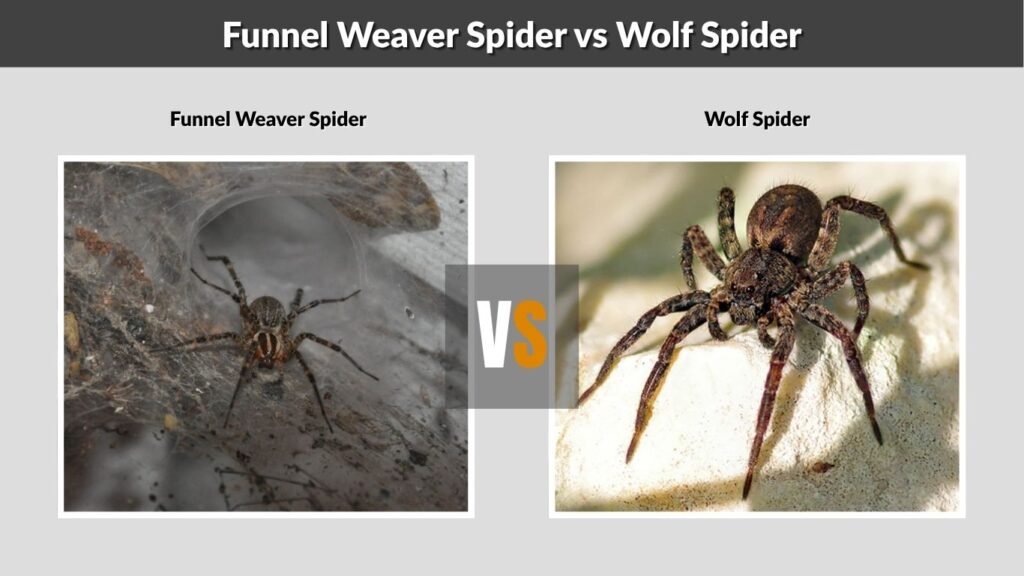
Funnel weavers and wolf spiders are frequently confused because both are fast, brownish hunting spiders. Their lifestyles, however, provide some useful identification clues. Funnel weavers depend heavily on their sheet-and-funnel webs, while wolf spiders usually hunt by roaming across the ground.
Key Differences
- Web: Funnel weavers construct obvious funnel-shaped webs; wolf spiders do not use capture webs.
- Spinnerets: Funnel weavers frequently have longer, more noticeable spinnerets.
- Hunting: Funnel weavers wait for prey at their webs; wolf spiders actively pursue prey.
- Body: Wolf spiders often appear heavier and more robust.
- Eyes: Wolf spiders have a distinctive arrangement that includes two particularly large forward-facing eyes.
- Habitat: Both may occur in yards, gardens, and around buildings.
Funnel Weaver vs Brown Recluse
A brown funnel weaver can occasionally be mistaken for a brown recluse simply because both may appear brown and have relatively long legs. Color alone is not enough for identification.
Brown recluses have six eyes arranged in three pairs and typically lack the prominent elongated spinnerets characteristic of many funnel weavers. Funnel weavers also commonly have more noticeable abdominal patterns and are strongly associated with funnel-shaped sheet webs.
Funnel Weaver vs Hobo Spider
The hobo spider itself belongs to the funnel-weaver family, so this comparison can be confusing. A hobo spider is a particular type of funnel weaver rather than an entirely separate web-building category.
Many other funnel weaver species can resemble it. Reliable species-level identification often requires examination of anatomical characteristics rather than simply judging color, size, or web shape.
Where Do Funnel Weaver Spiders Live?
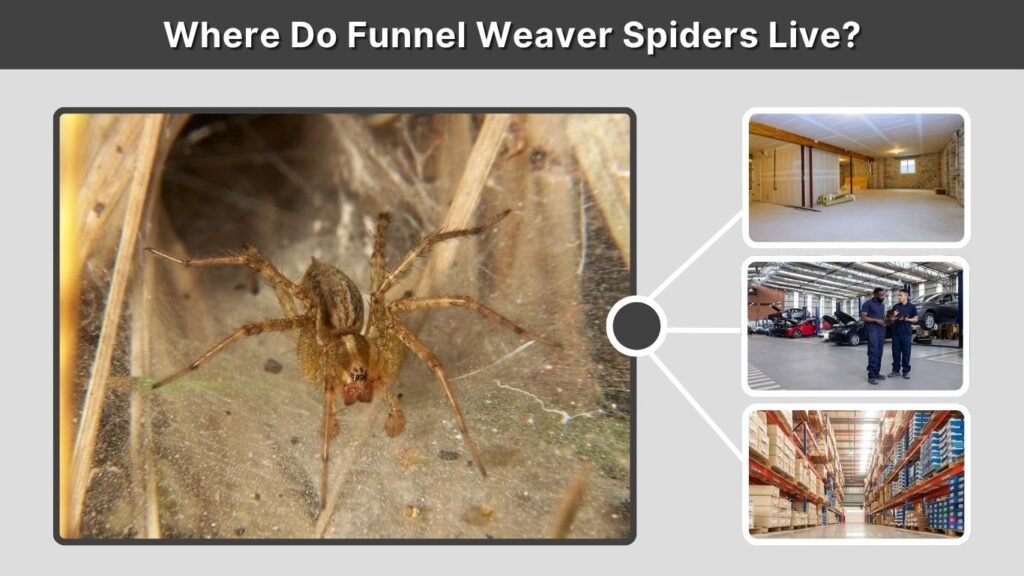
Funnel weaver spiders occur across many regions of North America, with different species found in states such as California, Colorado, Michigan, Ohio, Illinois, Minnesota, Texas, Florida, Virginia, Washington, Oregon, and North Carolina. They are especially successful wherever vegetation, cracks, rocks, or structures provide sheltered places for their webs.
Funnel Weavers Around the House
Finding a funnel weaver indoors is usually accidental or related to the availability of insects. Basements, garages, window wells, crawl spaces, and storage areas provide particularly suitable hiding places.
Sealing gaps around windows and doors, repairing screens, reducing clutter, and controlling insects around the building can make indoor conditions less attractive without requiring direct contact with the spiders.
Funnel Weavers in Grass and Gardens
Grass spiders are among the most familiar outdoor funnel weavers. Their webs often become especially visible early in the morning when dew collects on the silk.
These spiders can be beneficial garden predators because they capture flies, moths, leafhoppers, grasshoppers, and many other small arthropods. Their presence outdoors is generally a normal part of a healthy invertebrate community.
Funnel Weaver Spider Facts
Funnel weavers have several characteristics that make them efficient predators while allowing them to remain relatively unnoticed around people.
Quick Facts
- Funnel weavers belong mainly to the spider family Agelenidae.
- They produce sheet webs ending in a funnel-shaped retreat.
- Their webs generally depend on vibration rather than sticky silk.
- Many species have elongated spinnerets.
- They can run very quickly across their webs.
- Grass spiders are common members of the funnel-weaver group.
- They primarily eat insects and other small arthropods.
- Females commonly remain close to established webs.
- Wandering males may occasionally enter homes.
- Most commonly encountered North American species are not considered dangerous to humans.
FAQs
What is a funnel weaver spider?
A funnel weaver is a spider that constructs a flat sheet of silk connected to a funnel-shaped retreat. Many belong to the family Agelenidae. They usually wait inside the funnel until vibrations from an insect crossing the web signal an opportunity to attack.
Are funnel weaver spiders poisonous?
Funnel weavers have venom used to immobilize their prey, so “venomous” is technically more accurate than “poisonous.” Common North American species are generally not considered medically dangerous to humans, and they normally avoid contact rather than attempting to bite.
What happens if a funnel weaver spider bites you?
A bite may cause localized pain, redness, tenderness, itching, or mild swelling. Serious reactions are not typical of common North American funnel weavers. Seek medical attention if symptoms become severe, spread significantly, or involve breathing problems or another concerning reaction.
Do funnel weaver spiders live in houses?
Some funnel weavers can live around houses, particularly in basements, garages, window wells, crawl spaces, and sheltered exterior cracks. Others primarily inhabit lawns and gardens. Indoor sightings may also involve wandering males searching for mates rather than spiders permanently established inside.
Is a funnel weaver the same as an Australian funnel-web spider?
No. North American funnel weavers and Australia’s medically important funnel-web spiders are different groups. Their similar names mainly describe the funnel-like structure of their webs. Common funnel weavers encountered in North American lawns and homes should not automatically be associated with dangerous Australian funnel-web spiders.
