
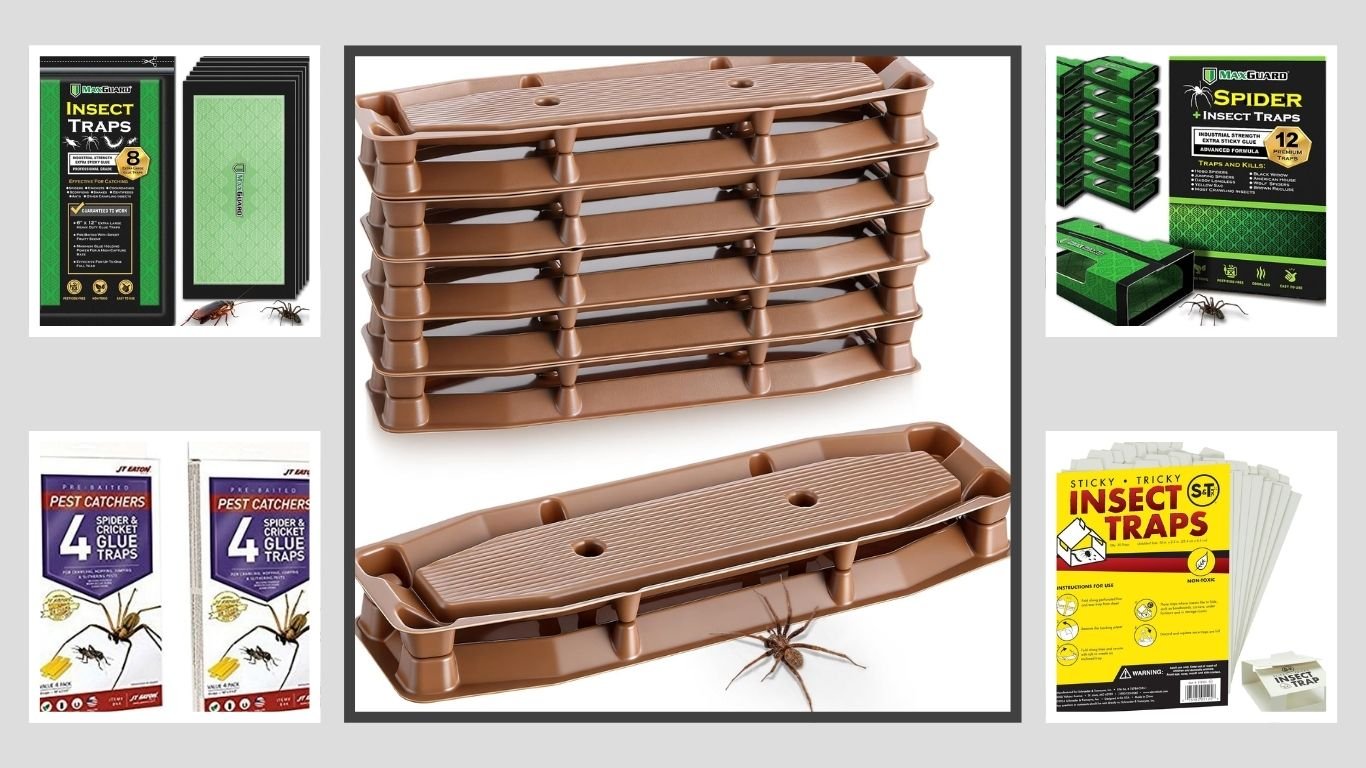
Choosing the best sticky traps for spiders can make it easier to monitor and reduce spider activity around basements, garages, closets, kitchens, and other hidden areas. Glue traps work without spraying chemicals and can also capture crawling pests such as roaches, crickets, centipedes, and scorpions. The most effective options use strong adhesive, low-profile designs, and convenient placement for walls, corners, and furniture edges. In this guide, we review 10 practical spider sticky traps based on holding strength, ease of use, coverage, and suitability for indoor pest monitoring.
1. Catchmaster Spider & Insect Glue Traps
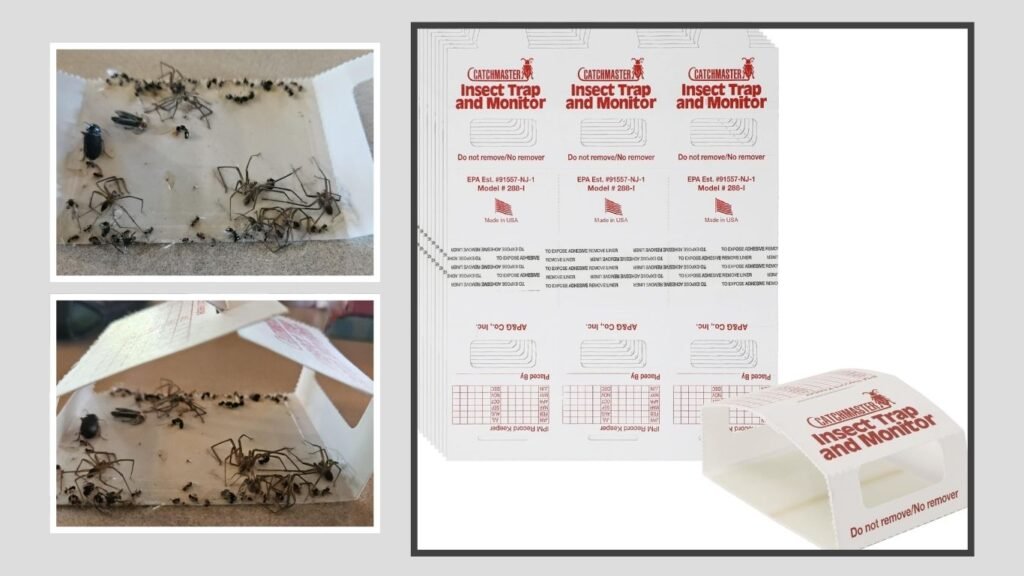
The Catchmaster Spider & Insect Glue Traps are a practical choice for homeowners who want broad indoor monitoring without sprays or powered devices. This pack provides 30 individual traps made from 10 sheets, giving enough coverage for several rooms, garages, basements, sheds, and other spider-prone areas. The traps are designed for spiders as well as roaches, crickets, silverfish, and other crawling pests, making them useful when more than one pest is present.
Key Features
- 30 individual sticky traps
- 10-sheet bulk format
- Designed for spiders and crawling insects
- Foldable trap configuration
- Pesticide-free adhesive
- Suitable for garages, basements, and indoor rooms
- Can be positioned along walls and pest pathways
- Long-lasting adhesive under normal conditions
Why It’s Best For
This Catchmaster option is especially suitable for whole-home spider monitoring. Instead of placing only one or two traps in a problem room, the larger pack makes it possible to cover multiple spider travel routes.
They work particularly well behind furniture, along baseboards, beside garage walls, near storage boxes, and in basement corners. The foldable design is another advantage because the trap can be shaped to protect the glue from dust while creating a tunnel-like space that crawling pests naturally enter.
Performance & Durability
Catchmaster uses professional-strength adhesive designed to remain effective for extended periods under normal indoor conditions. The manufacturer states that some of its spider glue traps can remain effective for up to a year when kept clean and properly positioned.
Performance is strongest in dry, low-dust areas where debris cannot cover the glue surface.
Pros, Cons & Overall Verdict
Pros
- Large 30-trap quantity
- Strong adhesive surface
- No pesticide application required
- Captures several crawling pest types
- Flexible flat or folded placement
Cons
- Dust can reduce adhesive effectiveness
- Must be kept away from pets and children who could touch the glue
Overall Verdict: The Catchmaster 30-pack is one of the strongest options for widespread spider monitoring. Its combination of bulk quantity, flexible placement, and long-lasting adhesive makes it particularly practical for garages, basements, and multi-room pest control.
2. S&T INC. Insect Traps for Brown Recluse Spiders
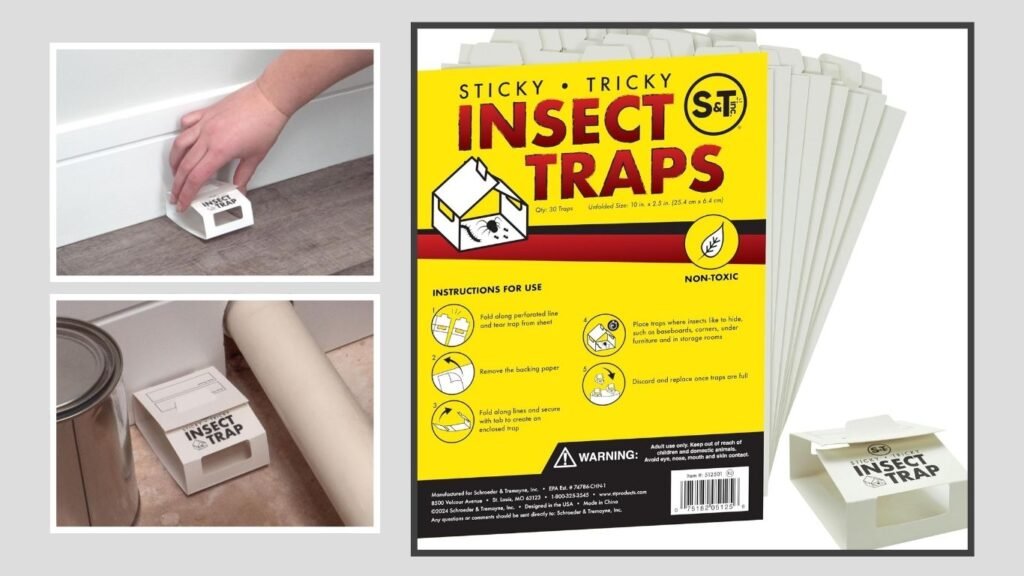
The S&T INC. Insect Traps provide a large 30-count setup designed for spiders, ants, cockroaches, crickets, and other crawling insects. Their simple glue-based construction makes them useful for monitoring spider activity in areas where pesticide sprays may be inconvenient. With enough traps to cover several rooms, this option works especially well for homes with recurring spider sightings in basements, garages, closets, utility rooms, and storage spaces.
Key Features
- 30 glue traps included
- Designed for spiders and crawling insects
- Suitable for brown recluse monitoring
- Non-electric design
- Glue-based trapping surface
- No spraying required
- Suitable for indoor placement
- Useful around basements and garages
Why It’s Best For
This option is best for homeowners who need high trap coverage at an economical scale.
A single spider sighting does not always show where activity is concentrated. Placing several traps along walls, behind furniture, under storage racks, and near suspected hiding places provides a much clearer picture of where spiders are traveling.
The 30-piece quantity also makes it possible to replace contaminated traps without immediately running out.
Performance & Durability
The flat glue-trap format provides straightforward performance with minimal setup. Once placed along spider travel routes, the adhesive surface captures insects when they cross it.
Because there is no electronic mechanism or chemical spray system to maintain, durability mainly depends on keeping the glue clean and dry. Dust-heavy locations may shorten useful trap life, so positioning them beneath furniture or along protected wall edges can improve performance.
Pros, Cons & Overall Verdict
Pros
- Large 30-count pack
- Useful for several crawling pests
- Simple setup
- No electricity required
- Good for distributed monitoring
- Suitable for low-traffic hidden areas
Cons
- Exposed glue can collect dust
- Does not repel spiders or prevent new spiders from entering
Overall Verdict: S&T INC. offers an excellent monitoring solution for homes that need many traps rather than a few premium boards. Its 30-count quantity makes it especially practical for finding spider hotspots before deciding where additional pest-control measures are needed.
3. MaxGuard Non-Toxic Spider & Insect Traps
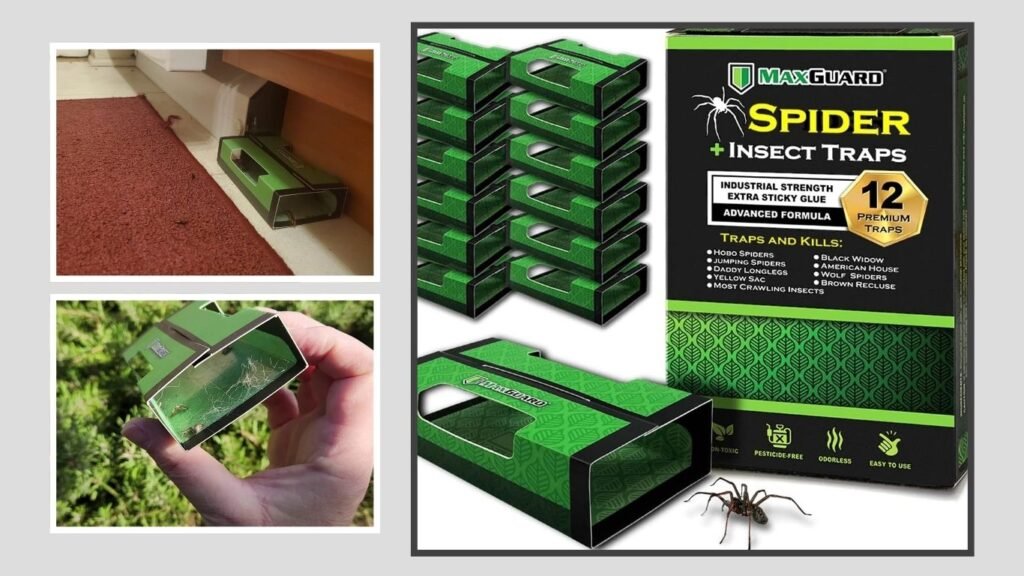
The MaxGuard Spider & Insect Traps use an extra-sticky glue surface in a foldable box-style design. This 12-piece set is intended for spiders and other crawling insects and is particularly useful around dark, sheltered locations where spiders tend to travel. The enclosed configuration can help protect the adhesive from incidental contact while creating a narrow hiding-space effect that suits placement behind furniture, along walls, and around garages.
Key Features
- 12 spider glue traps
- Box-style trap design
- Extra-sticky adhesive
- Designed for crawling insects
- Non-electric operation
- No spray application required
- Suitable for garages and indoor rooms
- Easy fold-and-place setup
Why It’s Best For
The MaxGuard is particularly good for discreet spider trapping in tight indoor areas.
The box-style structure creates a more enclosed trap than a completely flat glue board. This can be useful under furniture, beside walls, behind appliances, around storage areas, and in garage corners where an open sticky board could collect dust or be accidentally touched.
The 12-piece pack also provides enough traps to establish several monitoring stations throughout a typical home.
Performance & Durability
Its adhesive-based design relies on spiders physically crossing the glue surface, so placement has a major impact on results.
For better performance, traps should sit directly along walls and known travel routes instead of in the middle of open floors. Enclosed placement also helps reduce exposure to dust and debris.
Because the traps require no battery or powered mechanism, maintenance mainly involves checking them periodically and replacing boards once they become full or contaminated.
Pros, Cons & Overall Verdict
Pros
- 12 traps included
- Extra-sticky glue
- Enclosed box-style design
- Discreet indoor appearance
- Works for multiple crawling pests
- No electricity or spraying needed
Cons
- Requires assembly or folding
- Placement must be precise for best results
Overall Verdict: MaxGuard is especially suitable for homeowners who want a more enclosed glue-trap design. Its combination of strong adhesive, 12-trap coverage, and compact box format makes it a strong choice for garages, basements, closets, and concealed spider pathways.
4. Catchmaster Spider Traps Glue Boards – 6 Pack
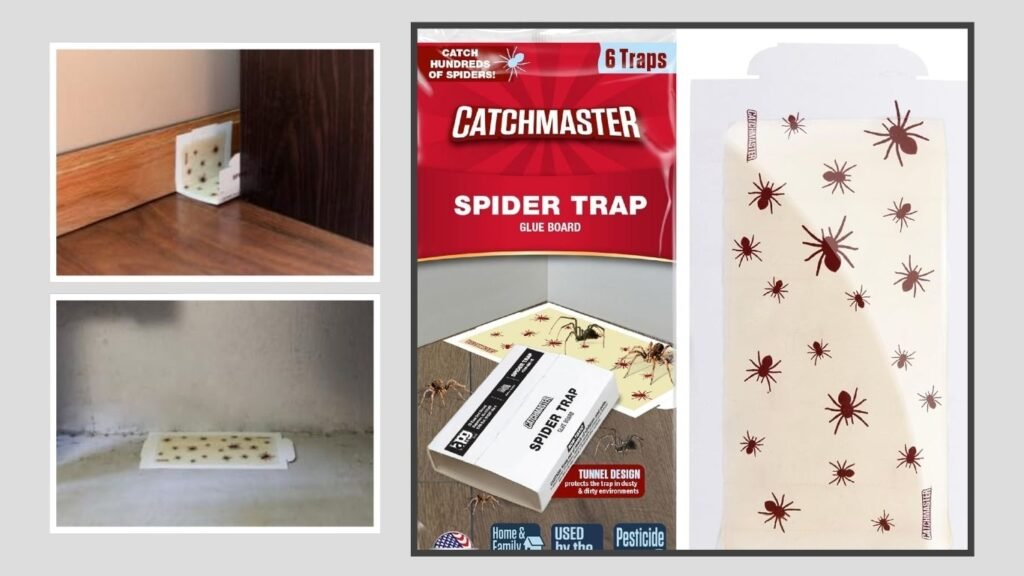
The Catchmaster Spider Traps Glue Boards provide a smaller six-pack designed specifically for spider and crawling-insect monitoring. Each board measures approximately 6.4 by 3.8 inches and can be used as a flat trap or folded into a more enclosed configuration. This makes the set particularly useful for targeted placement when spider activity is limited to a few known areas rather than spread throughout an entire home.
Key Features
- Six glue traps included
- Approximately 6.4 x 3.8 inches each
- Foldable paper-board construction
- Strong adhesive surface
- Designed for spiders and crawling insects
- Suitable for garage and household use
- Can be used flat or folded
- No pesticide spray required
Why It’s Best For
This six-pack is best for targeted spider problem areas.
If spiders repeatedly appear behind one cabinet, beside a garage wall, under a sink, or near a basement doorway, there may be little reason to place dozens of traps throughout the property.
The smaller pack allows homeowners to focus on specific locations while still having enough boards to monitor several entry routes.
The foldable design is also useful when the trap needs protection from dust or when a discreet tunnel shape is preferred.
Performance & Durability
Catchmaster describes its professional-strength adhesive as suitable for long-term pest monitoring, with some products remaining effective for up to a year under normal conditions.
The paper construction is lightweight but performs best in dry indoor environments. Moisture, heavy dust, or debris can reduce overall effectiveness.
Pros, Cons & Overall Verdict
Pros
- Strong Catchmaster adhesive
- Compact six-pack
- Flat or folded setup
- Useful for several crawling pests
- Excellent for targeted monitoring
- Easy disposal
Cons
- Fewer traps than bulk packs
- Paper construction should be kept dry
Overall Verdict: The six-pack is ideal for homeowners who know exactly where spider activity occurs. It provides the same practical glue-board approach in a smaller quantity, making it well suited to focused treatment around garages, storage areas, and individual rooms.
5. J.T. Eaton Pest Catchers Spider & Cricket Glue Boards
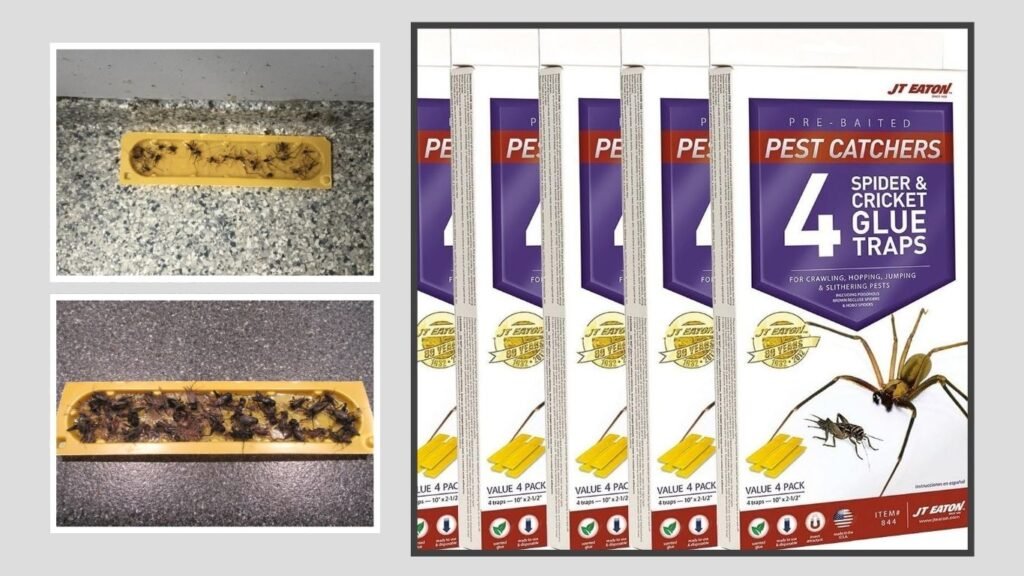
The J.T. Eaton Pest Catchers Spider & Cricket Glue Boards are heavy-duty indoor sticky traps designed specifically for spiders, crickets, and other crawling insects. Each package contains four glue boards, and the manufacturer highlights a non-drying, non-flowing adhesive designed to retain its holding ability while minimizing mess. They are especially useful in garages, basements, kitchens, attics, and other locations where spiders tend to follow walls and hide in tight spaces.
Key Features
- Four glue boards per package
- Designed for spiders and crickets
- Non-drying adhesive
- Non-flowing glue formula
- Non-poisonous trapping method
- Fits tight indoor spaces
- Works across a wide temperature range
- Suitable for garages, basements, kitchens, and attics
Why It’s Best For
J.T. Eaton is particularly strong for garages and variable-temperature areas.
Many garages, utility rooms, and unfinished basements experience greater temperature variation than living rooms. J.T. Eaton specifically states that these traps are designed to work across a wide temperature range, making them a practical option for those conditions.
Their long rectangular shape also allows easy placement along walls where spiders naturally travel.
Performance & Durability
The non-drying, non-flowing adhesive is the most important performance feature. It helps the board retain stickiness without creating excessive glue movement during normal indoor use.
The manufacturer also positions the traps as suitable for spiders, crickets, and other small crawling pests, giving them broader monitoring value beyond spiders alone.
Pros, Cons & Overall Verdict
Pros
- Non-drying adhesive
- Non-flowing glue
- Designed for spiders and crickets
- Works across varied temperatures
- Good for garages and basements
- Simple chemical-free trapping approach
Cons
- Only four traps per package
- Exposed adhesive still needs protection from dust
Overall Verdict: J.T. Eaton Pest Catchers stand out for durable adhesive performance and garage-friendly placement. Their non-drying glue and wide-temperature capability make them especially appealing for basements, garages, utility spaces, and other challenging indoor environments.
6. Catchmaster 288i Insect & Spider Trap
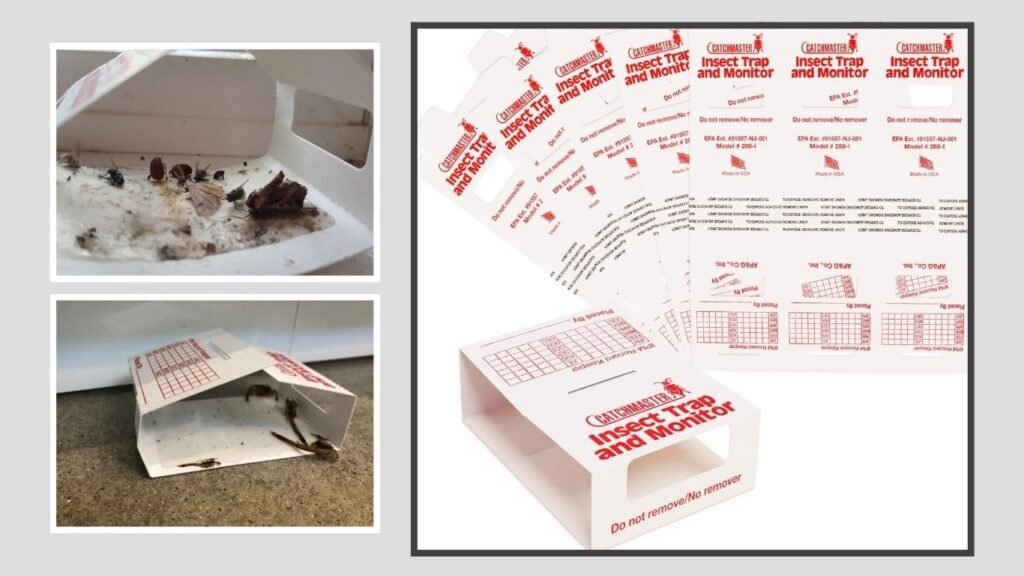
The Catchmaster 288i Insect & Spider Trap is a bulk monitoring option designed for homes, garages, basements, storage areas, and other locations where spiders repeatedly travel. Its glue-board format makes it especially useful when several monitoring points are needed instead of concentrating control in only one location. The boards can be positioned under furniture, behind appliances, along walls, and near darker hiding areas where spiders and their insect prey are commonly active.
Key Features
- Bulk glue-board configuration
- Designed for spiders and crawling insects
- Strong adhesive trapping surface
- Suitable for multiple monitoring locations
- Can fit beneath furniture and appliances
- No electricity required
- No spraying required
- Useful for garages and basements
- Designed for indoor pest monitoring
The 288i configuration is sold with 36 glue boards that can also be divided into smaller monitoring sections, making it particularly useful when broad coverage is required.
Why It’s Best For
This Catchmaster model is best for large-scale spider monitoring. Homes with brown recluse concerns or recurring spider activity often benefit from having many traps positioned in different areas rather than relying on only two or three boards.
Because spiders commonly move along walls and sheltered edges, several smaller monitoring stations can reveal where activity is concentrated.
The bulk format is also valuable for pest-control professionals or homeowners who regularly replace contaminated traps.
Performance & Durability
The adhesive works by physically holding spiders and other insects after they cross the board. Placement is therefore extremely important.
For better performance, traps should be positioned against walls, underneath furniture, behind sofas, near storage boxes, and around known spider pathways rather than in open floor spaces.
Dry and relatively dust-free areas generally help the adhesive remain usable longer.
Pros, Cons & Overall Verdict
Pros
- Excellent bulk quantity
- Strong spider-monitoring potential
- Suitable for several rooms
- Easy placement in hidden spaces
- No pesticide spray required
Cons
- Large number of boards may be unnecessary for small apartments
- Dust and debris can reduce adhesive performance
Overall Verdict: The Catchmaster 288i is one of the most practical choices for extensive spider monitoring. Its bulk format provides enough coverage to identify multiple spider pathways and maintain traps throughout a larger property.
7. J.T. Eaton 844 Spider & Cricket Catchers
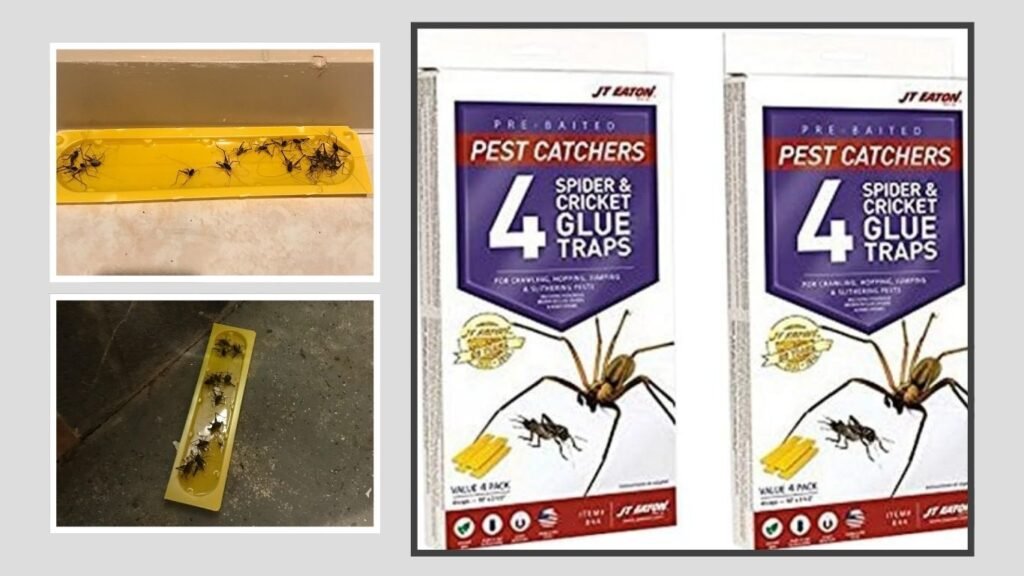
The J.T. Eaton 844 Spider & Cricket Catchers are straightforward glue boards developed for spiders, crickets, and other small crawling insects. Their slim design allows them to fit into narrow areas where spiders often remain hidden, including garages, basements, utility spaces, cabinets, and wall edges. J.T. Eaton uses a non-drying, non-flowing adhesive, helping the traps maintain useful stickiness while reducing the possibility of glue moving beyond the board during normal indoor use.
Key Features
- Four glue boards per package
- Designed for spiders and crickets
- Non-drying adhesive
- Non-flowing glue formulation
- Slim profile for tight spaces
- Non-poisonous trapping method
- Suitable for garages and basements
- No batteries or electricity required
- Useful for other small crawling insects
Why It’s Best For
The J.T. Eaton 844 is particularly suitable for garage and basement spider monitoring.
These areas frequently contain narrow gaps around storage shelves, appliances, pipes, boxes, and wall edges. The low-profile boards can be positioned directly along those travel routes without taking up much floor space.
They are also useful when crickets are present because spiders often move into areas where prey insects are abundant.
Performance & Durability
The non-drying adhesive is the major performance advantage. A glue board becomes much less useful once its surface hardens, so maintaining tackiness is important for ongoing monitoring.
The non-flowing formulation also makes placement more manageable in normal indoor conditions.
For the strongest results, the boards should remain dry and relatively free from sawdust, hair, dirt, and other debris that could cover the adhesive.
Pros, Cons & Overall Verdict
Pros
- Non-drying adhesive
- Non-flowing design
- Compact size
- Good for spiders and crickets
- Useful in garages and basements
- Simple setup
Cons
- Only four boards per package
- Open glue surface can collect dust
Overall Verdict: J.T. Eaton 844 traps are especially strong for targeted monitoring in utility areas. Their durable adhesive and slim design make them a dependable option for garages, basements, and other spider-prone spaces.
8. TERRO T3206 Spider & Insect Traps
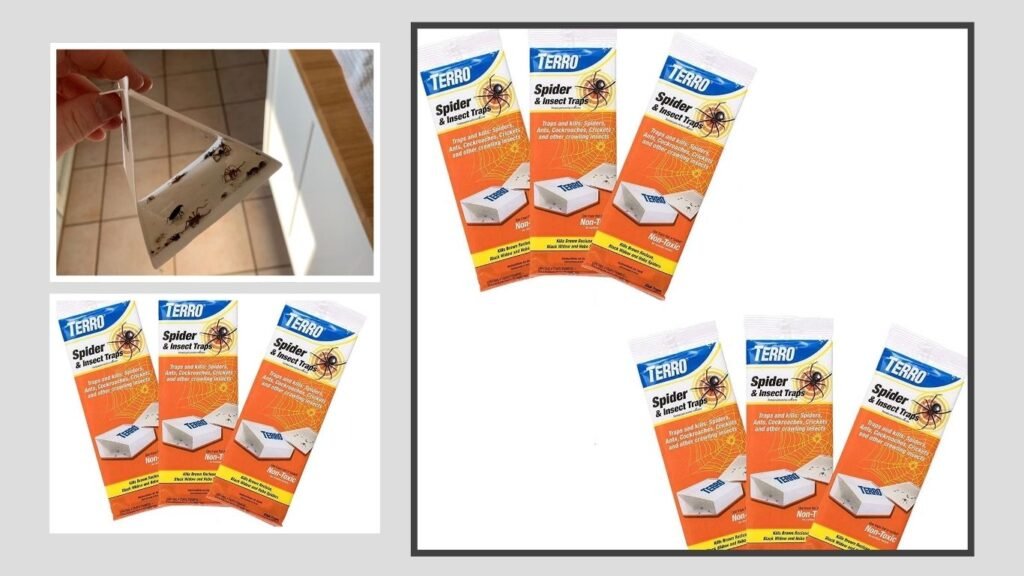
The TERRO T3206 Spider & Insect Traps combine strong adhesive with a flexible design that can be used either flat or folded. This gives homeowners the option of maximizing the exposed catch area or creating an enclosed trap that hides captured insects and limits accidental contact with the glue. TERRO designs the T3206 for spiders, ants, cockroaches, crickets, and other crawling insects, making it useful for broader household pest monitoring.
Key Features
- Four glue traps per package
- Can be used flat or folded
- Sticky glue trapping surface
- No chemical insecticide
- Suitable for spiders and crawling insects
- Designed for brown recluse, black widow, and hobo spiders
- Fits along baseboards and corners
- Useful behind doors and furniture
- Can remain in use for up to three months under suitable conditions
Why It’s Best For
The TERRO T3206 is best for flexible indoor placement.
Using the board flat creates more exposed adhesive area, which can be helpful beneath furniture or in concealed locations. Folding it creates a more discreet tunnel-style trap and reduces access to the sticky surface.
That flexibility makes TERRO suitable for kitchens, bathrooms, basements, closets, garages, and other locations where different trap configurations may be needed.
Performance & Durability
TERRO recommends placing the traps along baseboards, behind doors, beneath furniture, and in corners where crawling pests naturally travel.
The manufacturer recommends replacing them when they become full, covered with dust or debris, or after approximately three months.
Because the trap depends on direct contact, positioning it beside walls generally produces better monitoring value than placing it in the middle of a room.
Pros, Cons & Overall Verdict
Pros
- Flat or folded configuration
- Targets several crawling pests
- No chemical insecticide
- Compact and discreet
- Convenient for household monitoring
Cons
- Only four traps per package
- Adhesive becomes less effective when dusty
Overall Verdict: TERRO T3206 is one of the most versatile choices on this list. Its foldable construction, proven glue-trap design, and broad pest coverage make it particularly convenient for everyday indoor spider monitoring.
9. MaxGuard Extra-Large Pre-Baited Insect Traps
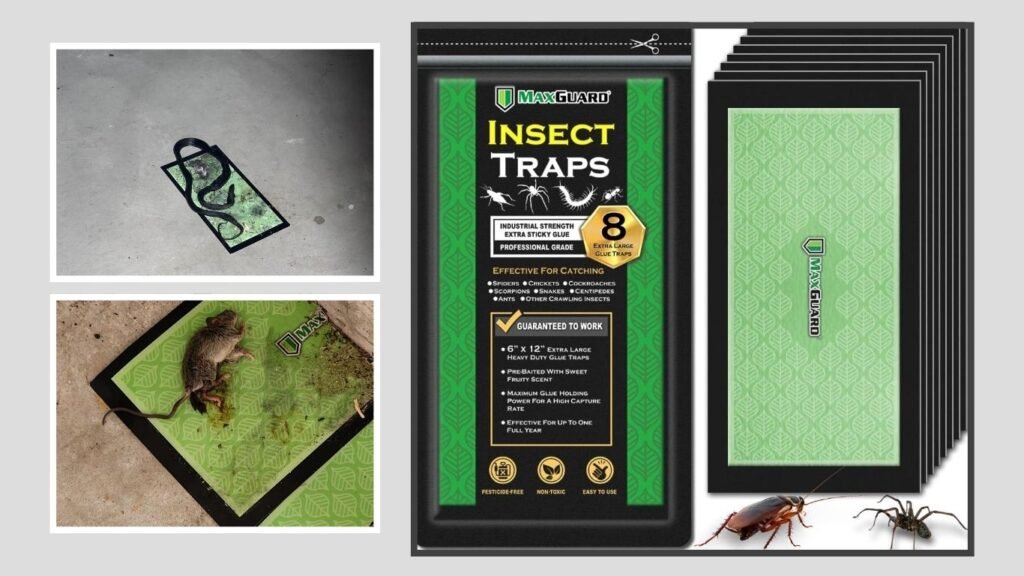
The MaxGuard Extra-Large Insect Traps provide significantly more adhesive area than typical compact spider boards. Each trap measures approximately 6 by 12 inches and uses an extra-sticky adhesive combined with a sweet fruity attractant. The eight-trap package is intended for spiders, cockroaches, crickets, scorpions, centipedes, and other crawling pests, giving it strong versatility for garages, basements, utility rooms, and larger indoor problem areas.
Key Features
- Eight extra-large glue traps
- Approximately 6 x 12 inches each
- Pre-baited design
- Sweet fruity attractant
- Industrial-strength sticky adhesive
- Insecticide-free trapping approach
- Suitable for spiders and other crawling pests
- Large adhesive capture area
- Peel-and-place setup
Why It’s Best For
MaxGuard is best for large crawling pests and high-traffic areas.
The oversized 6 x 12-inch surface provides considerably more room for capturing pests than a small monitoring card. This makes the traps particularly practical along garage walls, basement floors, storage rooms, and areas where multiple pest species are present.
The pre-baited design can also help draw crawling insects onto the board. Because those insects are common spider prey, trapping both may help reduce pest activity within the monitored area.
Performance & Durability
The manufacturer positions these traps as long-lasting and uses a timed-release attractant with a highly sticky adhesive surface.
Their large surface can remain productive even after several small insects have been caught. However, the bigger exposed board can also collect more dust in garages or workshops.
Placing it beside a wall or beneath shelving can help protect the adhesive while keeping it directly in pest travel routes.
Pros, Cons & Overall Verdict
Pros
- Extra-large adhesive area
- Eight traps included
- Pre-baited attractant
- Strong adhesive
- Useful for many crawling pests
- Good for garages and basements
Cons
- Larger footprint than compact spider traps
- Exposed surface may collect dust more quickly
Overall Verdict: MaxGuard Extra-Large traps are an excellent option when small glue cards do not provide enough surface area. They are especially useful for garages, basements, and multi-pest environments where wider coverage provides a technical advantage.
10. Indoor Spider Glue Traps for Brown Recluse & Crawling Insects
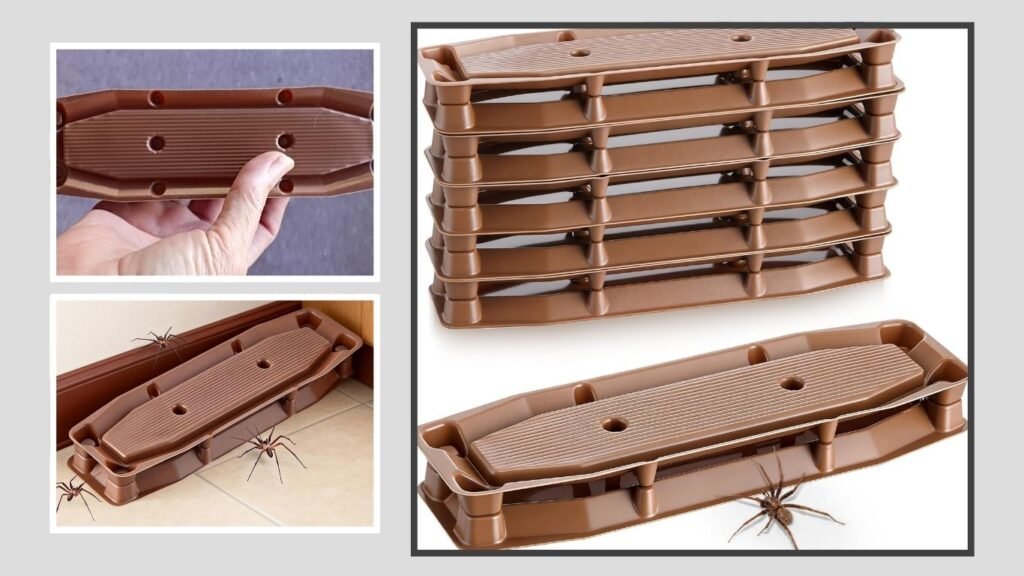
The Indoor Spider Glue Traps for Brown Recluse & Crawling Insects are designed as straightforward sticky monitoring stations for locations where spiders tend to travel unnoticed. They can be positioned along walls, beneath furniture, inside closets, behind storage boxes, and around basement or garage edges. The simple glue-based approach makes them useful for homeowners who want to monitor spider activity without adding sprays, powered devices, or complicated pest-control equipment.
Key Features
- Sticky glue trapping surface
- Designed for indoor spider monitoring
- Suitable for crawling insects
- Useful around brown recluse activity areas
- Fits along walls and corners
- No electrical power required
- No daily setup needed
- Suitable for hidden household spaces
Why It’s Best For
These traps are best for discreet monitoring of hidden spider pathways.
Spiders such as brown recluses tend to favor undisturbed locations, including closets, storage boxes, basement areas, garages, and spaces beneath furniture. A low-profile sticky board can remain in those locations without occupying much usable space.
Using several traps can also help identify which areas have the most activity, giving homeowners better information about where cleaning, exclusion, or professional treatment may be needed.
Performance & Durability
Sticky traps work most effectively when spiders naturally cross them. For that reason, positioning is generally more important than simply adding more traps.
Boards placed flush against walls, beside boxes, behind furniture, or near known hiding areas usually provide better monitoring opportunities than boards placed in open spaces.
Regular inspection is also important. A trap should be replaced once its adhesive becomes covered with dust, insects, hair, or other material.
Pros, Cons & Overall Verdict
Pros
- Straightforward spider monitoring
- No electricity needed
- No spraying required
- Fits concealed areas
- Can capture other crawling insects
- Easy to inspect and replace
Cons
- Effectiveness depends strongly on placement
- Glue boards do not stop spiders from entering the home
Overall Verdict: These indoor spider traps provide a simple solution for monitoring low-traffic hiding areas. They work best as part of a broader spider-control strategy that also includes cleaning, reducing clutter, sealing entry gaps, and limiting insect prey.
FAQs
What are the best places to put sticky traps for spiders?
Place sticky traps directly along walls, in corners, behind furniture, underneath beds, beside storage boxes, beneath cabinets, and around basement or garage edges. Spiders frequently follow structural edges rather than crossing open floor areas, so wall-side placement generally provides better monitoring results.
Do sticky traps attract spiders?
Most spider glue traps primarily capture spiders when they naturally cross the adhesive. Some models include scents or other attractants aimed at crawling insects. Catching insects may indirectly make a location productive for trapping hunting spiders as well. Sticky traps should still be placed along known spider travel routes rather than depending entirely on attraction.
How long can spider sticky traps be left out?
It depends on the product and environmental conditions. Some traps are intended for several months, while certain long-lasting adhesive boards may remain usable longer in clean, dry locations. Replace any trap sooner when it becomes full, dusty, wet, or covered with debris.
Can sticky traps catch brown recluse and black widow spiders?
Yes. A sufficiently strong glue trap can capture brown recluse, black widow, house spiders, and other crawling spiders if they walk across the adhesive. However, traps do not guarantee that every spider in a building will be caught. Multiple traps positioned around likely hiding and travel areas provide better monitoring coverage.
Are spider glue traps enough to control an infestation?
Sticky traps are excellent for monitoring and reducing individual spiders, but they should not be the only measure used for a significant infestation. Vacuum webs and egg sacs, reduce clutter, seal cracks and gaps, control insect prey, and inspect stored items. Persistent activity, particularly involving medically significant spiders, may justify assessment by a qualified pest-control professional.
