
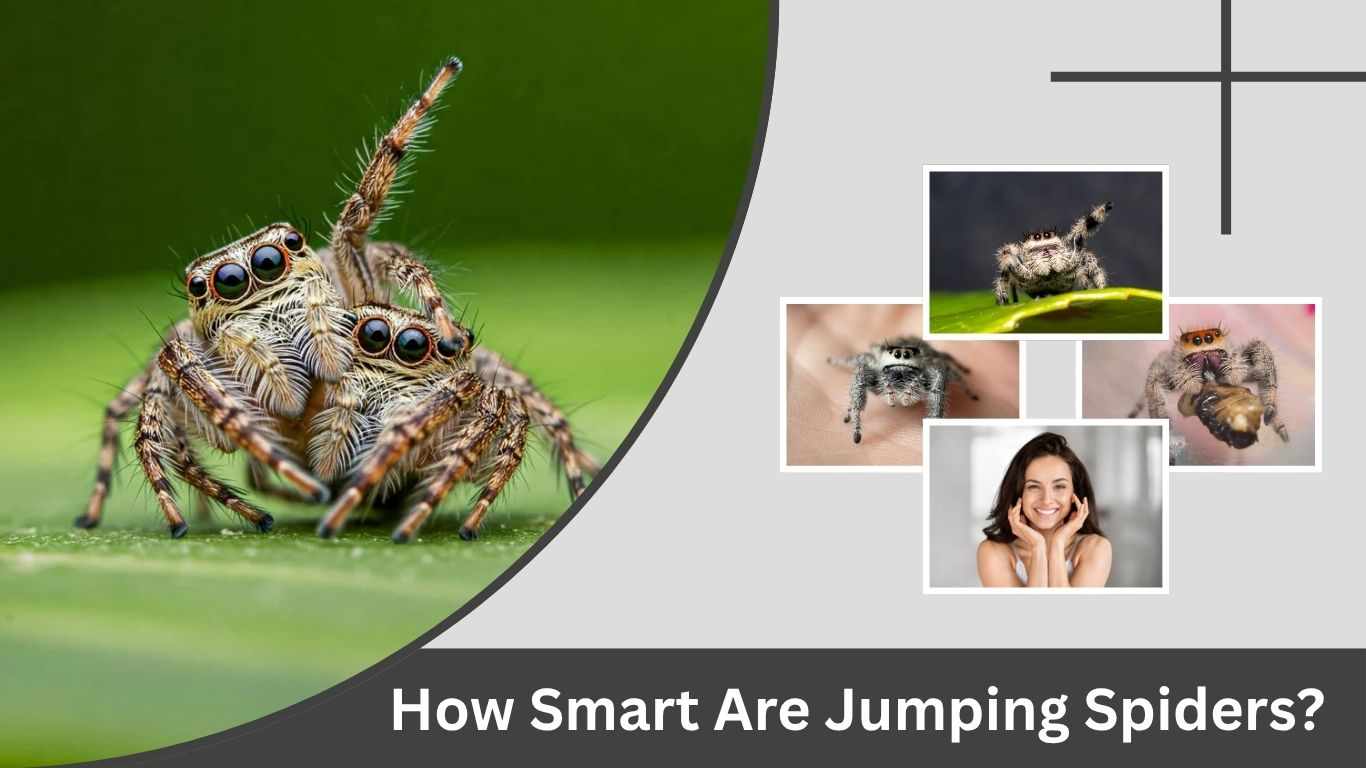
Jumping spiders may be tiny, but they are surprisingly intelligent for their size. They can stalk prey, judge distance, make careful jumps, recognize movement, and sometimes solve simple problems while hunting. Their intelligence is not like human or dog intelligence, but it is advanced for a small arthropod with a tiny brain. This guide explains how smart jumping spiders are, why they seem so clever, and how their abilities compare with other animals.
How Smart Are Jumping Spiders?
Jumping spiders are smart in a specialized way. They are visual hunters, so their intelligence is built around seeing, tracking, planning, and attacking prey. They do not think like mammals, but they can process useful information, make decisions, and adjust behavior. Their intelligence is best understood as practical problem-solving rather than emotional or social reasoning.
They Are Visual Problem Solvers
Jumping spiders rely heavily on vision. Their large front eyes help them inspect objects, judge distance, and focus on prey. This gives them a major advantage over many spiders that mostly depend on web vibrations. Because they actively hunt instead of waiting in a web, they need to decide where to move, when to stop, and when to jump.
They Can Make Hunting Decisions
A jumping spider does not simply leap at everything that moves. It often pauses, watches, adjusts its position, and chooses the best angle before attacking. This behavior makes them look thoughtful. In reality, their brain is processing visual information quickly and turning it into survival decisions.
Their Intelligence Is Small but Efficient
Jumping spiders have tiny nervous systems, but they use them efficiently. Their intelligence is not broad like a dog’s or human’s. Instead, it is highly focused on hunting, navigation, mate recognition, and avoiding danger. That makes them one of the most impressive small predators in the animal world.
Why Are Jumping Spiders So Smart?
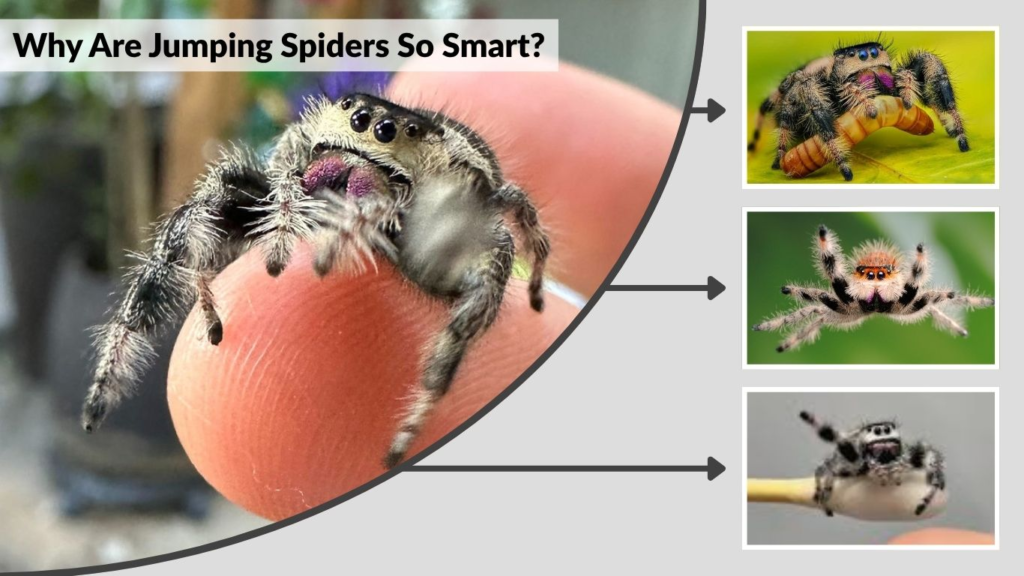
Jumping spiders seem smart because their lifestyle demands more active decision-making than many other spiders. They do not just sit in webs and wait. They explore, stalk, chase, hide, and leap. To survive, they must judge space, distance, movement, and risk. Their intelligence developed around the needs of an active visual predator.
Key Reasons They Seem Intelligent
- They have excellent eyesight compared with most spiders.
- They actively hunt instead of only waiting in a web.
- They can track prey movement.
- They judge distance before jumping.
- They adjust their route when prey is hard to reach.
- Some species show complex stalking behavior.
- They can respond differently to prey, threats, and mates.
- They use memory-like behavior during navigation.
Vision Makes Them Better Hunters
Their forward-facing eyes allow detailed inspection, while their side eyes detect motion. This combination helps them notice movement and then focus on a target. Their visual system is one of the main reasons they appear alert, curious, and aware of their surroundings.
Hunting Requires Planning
When prey is directly in front of them, the decision is simple. But when prey is behind an obstacle, above them, or across a gap, the spider may need a different route. Some jumping spiders can take detours, which suggests they can hold a goal in mind long enough to reach it indirectly.
What Can Jumping Spiders Do?
Jumping spider intelligence is easiest to understand through behavior. Their skills are not based on language, emotions, or human-like thought. Instead, they show intelligence through hunting, movement, attention, and survival. These abilities are impressive because they happen inside a very small body with a very small brain.
Common Smart Behaviors
- Watching prey before attacking
- Moving slowly to avoid detection
- Choosing a better jumping angle
- Using silk as a safety line
- Avoiding dangerous prey
- Recognizing possible mates
- Reacting to motion around them
- Exploring enclosure objects
- Learning from repeated experiences
- Taking indirect routes in some situations
They Can Stalk Like Tiny Cats
Many jumping spiders behave like miniature cats. They crouch, approach slowly, pause, and pounce at the right moment. This hunting style requires timing and body control. They are not acting randomly. They are using sensory information to make accurate attacks.
They Can Notice Patterns
Jumping spiders can respond to visual patterns, shapes, and movement. This helps them identify prey and avoid threats. In pet settings, keepers often notice that jumping spiders seem to watch people, follow movement, or react to feeding routines. That does not mean they understand humans, but it shows strong awareness of nearby activity.
Jumping Spider Intelligence Compared
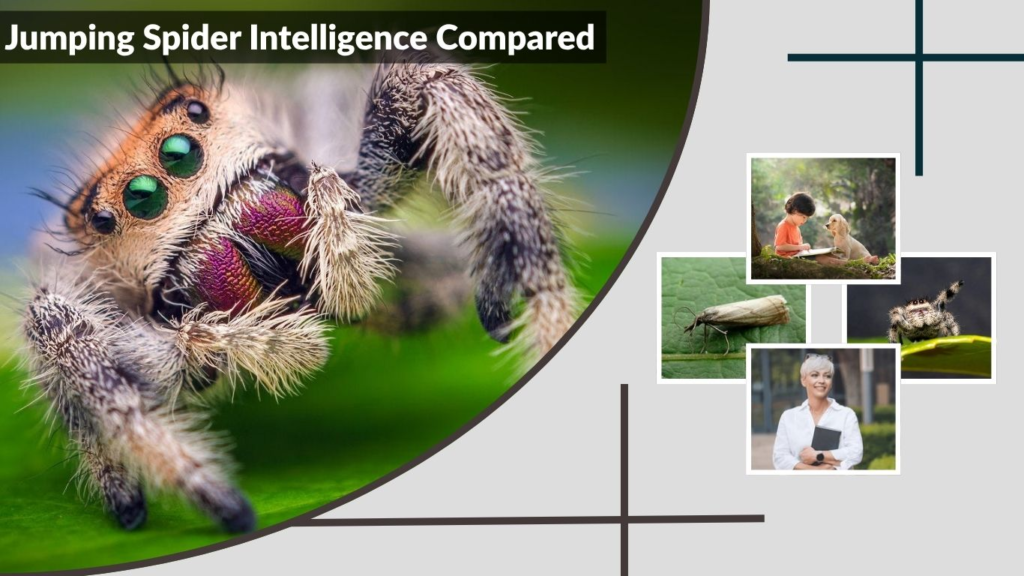
It is tempting to compare jumping spiders with dogs, humans, or other smart animals. However, intelligence depends on what an animal needs to survive. Dogs are social mammals. Humans use language and abstract reasoning. Jumping spiders are tiny visual predators. Their intelligence is narrower but still remarkable for their size.
| Comparison | Are Jumping Spiders Smarter? | Simple Explanation |
| Compared to dogs | No | Dogs have stronger memory, social learning, and emotional understanding. |
| Compared to humans | No | Humans have language, abstract thought, culture, and complex planning. |
| Compared to many insects | Sometimes | Jumping spiders can show impressive vision-based hunting and route planning. |
| Compared to web spiders | Often in active hunting tasks | Jumping spiders rely more on vision, movement, and stalking. |
| Compared to other spiders | Some species are highly advanced | Species like Portia are known for complex predatory strategies. |
Compared to Dogs
Jumping spiders are not as smart as dogs overall. Dogs can understand social signals, learn commands, remember people, and form emotional bonds. Jumping spiders do not have that kind of social intelligence. However, for their brain size, jumping spiders are extremely efficient visual hunters.
Compared to Humans
Jumping spiders are not close to human intelligence. They cannot reason with language, understand abstract ideas, or plan years ahead. Still, they can solve small survival problems in ways that challenge the idea that only large-brained animals can show complex behavior.
Compared to Other Animals
Compared with many small arthropods, jumping spiders are impressive because of their eyesight and hunting flexibility. They may not match bees or ants in social complexity, but they stand out in visual attention, stalking, and spatial decisions.
Are Jumping Spiders Smarter Than Other Spiders?
Jumping spiders are often considered among the smartest spiders because they actively hunt with vision. Many spiders use webs and rely heavily on vibration. Jumping spiders must move through complex spaces, inspect targets, and attack with precision. This gives them more opportunities to show problem-solving behavior.
Web Spiders vs. Jumping Spiders
Web spiders can also be intelligent in their own way. They build structures, detect prey vibrations, and respond to web signals. But jumping spiders show a different kind of intelligence. They are more visually active and often make decisions while moving through their environment.
The Special Case of Portia
Portia is a famous jumping spider genus known for hunting other spiders. These spiders may use slow stalking, detours, and deceptive signals on webs. Their behavior is often discussed in studies of arthropod intelligence because it looks unusually flexible for such a small predator.
Intelligence Depends on Lifestyle
A spider’s intelligence matches its survival needs. Web builders need sensitivity to touch and vibration. Jumping spiders need vision, timing, movement, and spatial judgment. So, jumping spiders are not “better” in every way, but they are especially advanced in active hunting tasks.
Do Jumping Spiders Recognize Humans?
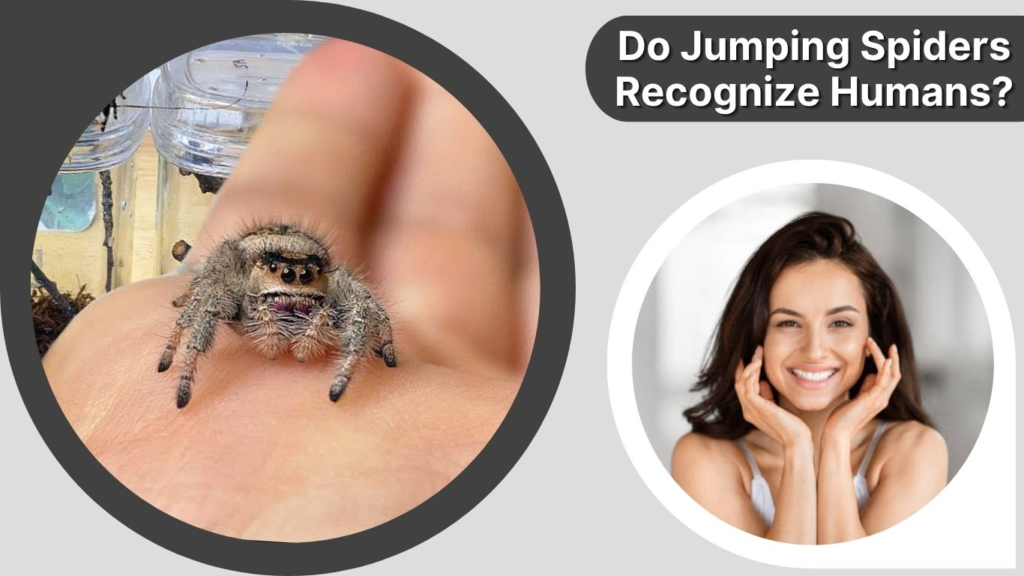
Many owners feel like their jumping spiders recognize them. A spider may turn toward a person, follow movement, or react when the enclosure opens. This can make them seem friendly and aware. However, recognition in jumping spiders is likely much simpler than recognition in dogs, cats, or humans.
They May Recognize Repeated Patterns
A jumping spider may learn that certain movement, light changes, or enclosure activity predicts food. This can look like recognition. For example, a spider may become more active when the keeper approaches with feeder insects. That is a form of learning, but not necessarily personal attachment.
They Are Curious, Not Affectionate
Jumping spiders often look curious because they face objects and inspect them with their large eyes. This creates the impression of personality. They may tolerate gentle observation, but they do not need affection or handling like mammals. Their behavior is better described as alert, responsive, and exploratory.
How Smart Are Jumping Spiders as Pets?
As pets, jumping spiders can seem very interactive. They watch movement, explore their enclosures, respond to food, and sometimes show bold personalities. Their intelligence makes them interesting to observe, but it also means they need a safe, enriched environment with climbing space, hiding spots, and proper feeding routines.
Smart Pet Behaviors Owners Notice
- Watching people outside the enclosure
- Reacting when food is offered
- Exploring new decorations
- Choosing favorite resting spots
- Building silk hammocks
- Avoiding prey when molting
- Moving toward light or activity
- Showing bold or shy temperaments
They Need Mental and Physical Enrichment
A plain enclosure may not support natural behavior. Jumping spiders benefit from climbing surfaces, anchor points, hides, and visual structure. These features allow them to explore and hunt naturally. Enrichment does not need to be complicated, but it should be safe and escape-proof.
Handling Should Be Limited
Even smart jumping spiders are delicate. They can jump suddenly, fall, or become stressed. Observing them is usually safer than frequent handling. Their intelligence is best appreciated by watching how they move, hunt, explore, and respond to their surroundings.
FAQs
How smart are jumping spiders?
Jumping spiders are very smart for their size. They can watch prey, judge distance, plan jumps, and sometimes take indirect routes to reach a target. Their intelligence is specialized for hunting and survival, not emotional bonding or human-like reasoning.
How are jumping spiders so smart?
Jumping spiders are smart because they are active visual hunters. They need excellent eyesight, timing, movement control, and decision-making to catch prey. Their brains are tiny, but their nervous systems are highly efficient for processing visual information and guiding quick actions.
Are jumping spiders smarter than dogs?
No, jumping spiders are not smarter than dogs overall. Dogs have stronger social intelligence, memory, emotional understanding, and learning ability. However, jumping spiders are extremely impressive when judged by brain size and hunting skill.
Are jumping spiders smart compared to humans?
Jumping spiders are not close to humans in intelligence. They cannot use language, understand abstract ideas, or make complex long-term plans. But they can solve small survival problems, which makes them remarkable among tiny arthropods.
Can jumping spiders recognize their owners?
Jumping spiders may learn repeated patterns, such as movement linked to feeding, but they probably do not recognize owners the way dogs or cats do. They may appear curious and responsive because they are highly visual and attentive animals.
