
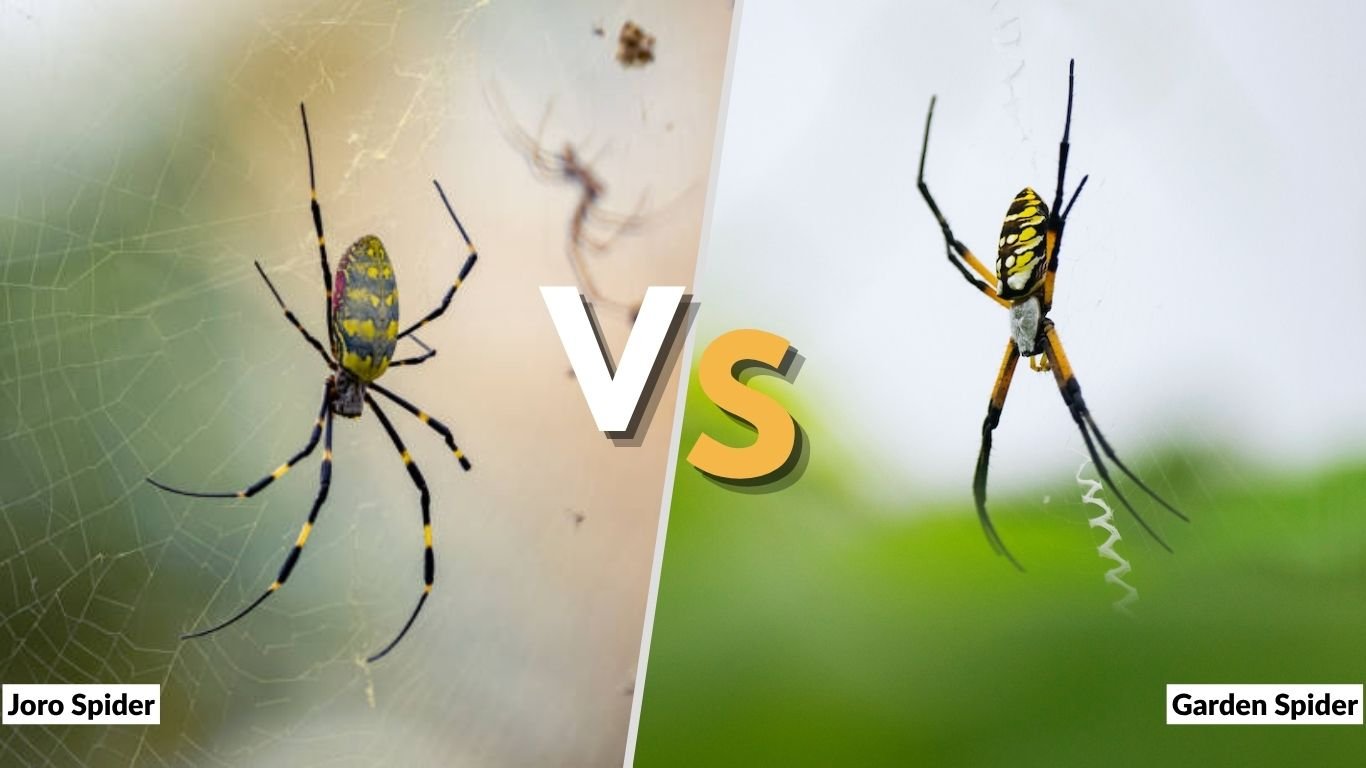
Joro spiders and yellow garden spiders are large, colorful orb-weavers commonly seen in Georgia and other parts of the southeastern United States. Both have yellow-and-black markings and build impressive circular webs, making them easy to confuse. The quickest distinction is the web: a yellow garden spider usually creates a conspicuous white zigzag, while a Joro spider builds a large, golden, multilayered web. Their abdominal patterns, leg markings, origins, and preferred locations also differ.
Joro Spider vs Garden Spider at a Glance
| Feature | Joro spider | Yellow garden spider |
| Scientific name | Trichonephila clavata | Argiope aurantia |
| Status in the U.S. | Introduced from East Asia | Native |
| Abdomen | Yellow with bluish-green horizontal bands | Black with bright yellow or white patches |
| Underside | Prominent red markings | Mostly black with yellow markings |
| Legs | Long, black, with yellow-orange bands | Black and yellow-orange, often appearing two-toned |
| Web | Golden, large, multilayered | Circular with a white zigzag |
| Common location | Trees, buildings, utility lines and porches | Gardens, fields and low shrubs |
| Danger to humans | Low | Low |
How to Identify a Joro Spider
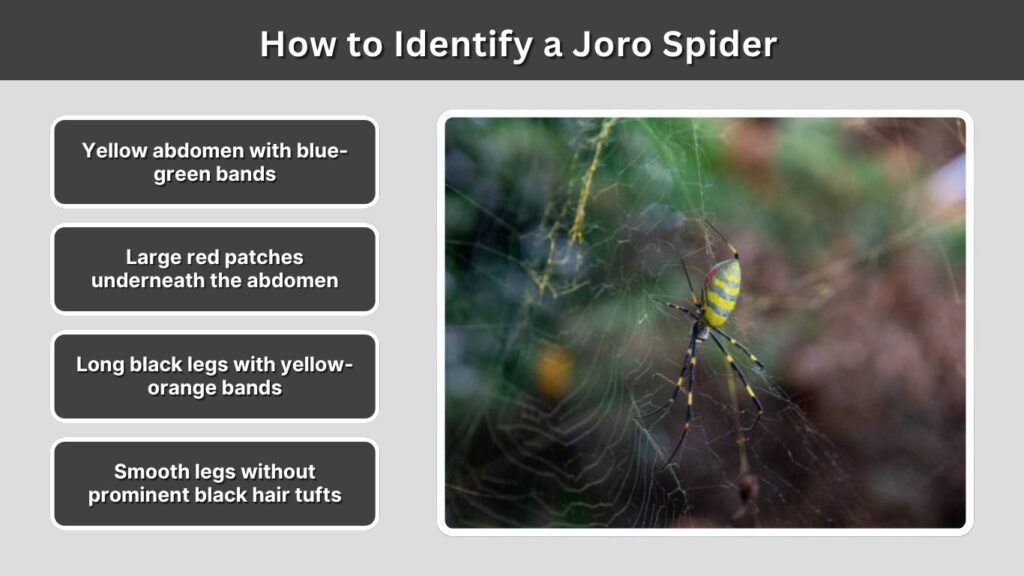
Adult female Joro spiders have long legs and a cylindrical abdomen marked with vivid yellow and bluish-green horizontal bands. The underside commonly has bold red coloration, while the legs are black with yellow or orange bands. Males are much smaller and generally brown, so they look very different from adult females.
Main Joro Spider Features
Look for:
- Yellow abdomen with blue-green bands
- Large red patches underneath the abdomen
- Long black legs with yellow-orange bands
- Smooth legs without prominent black hair tufts
- Golden-colored silk
- Large, complex webs with several supporting layers
- One or more small brown males near a large female
Joro webs can be particularly large and may extend between trees, buildings, porches, power lines, signs, and other elevated structures. Unlike the flatter web of a garden spider, a Joro web may look three-dimensional or slightly disorganized because of its supporting barrier threads.
How to Identify a Yellow Garden Spider
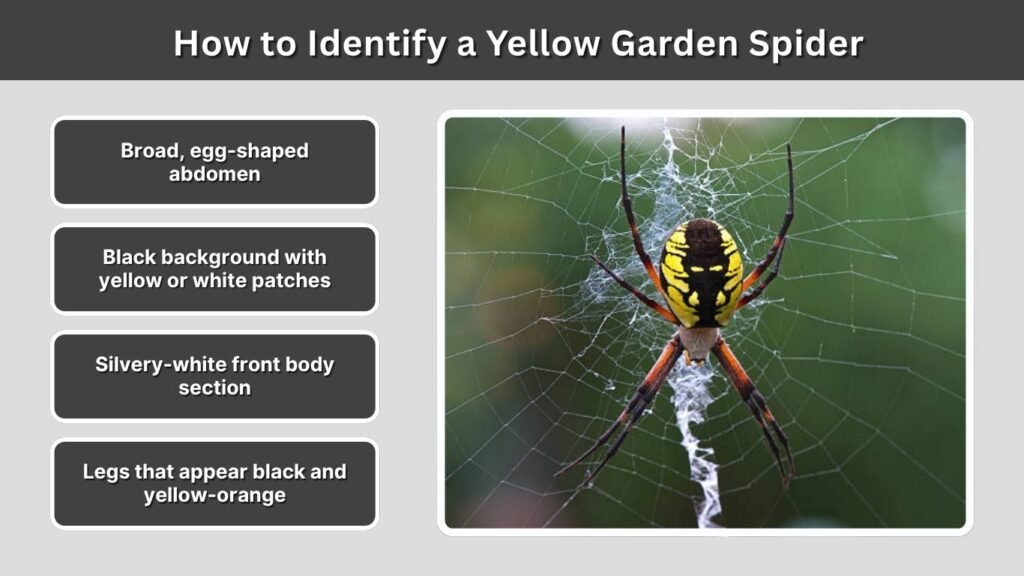
The yellow garden spider, also called the black-and-yellow garden spider, writing spider, zipper spider, or yellow garden orb-weaver, is a native North American species. An adult female has an egg-shaped abdomen with bold black, yellow, and sometimes white markings. Its front body section often looks silvery or covered with short white hairs.
Main Garden Spider Features
Look for:
- Broad, egg-shaped abdomen
- Black background with yellow or white patches
- Silvery-white front body section
- Legs that appear black and yellow-orange
- A flat, wheel-shaped orb web
- A thick white zigzag through the web’s center
- A head-down resting position
The zigzag structure is called a stabilimentum. It is the most convenient field clue for distinguishing a yellow garden spider from an adult Joro. However, not every garden spider produces an identical zigzag, and immature golden silk spiders may occasionally create a similar structure.
Web Differences
Web design can often identify the spider even when its body is difficult to see.
| Web characteristic | Joro spider | Yellow garden spider |
| Silk color | Golden or yellowish | Primarily white or clear |
| Shape | Large orb with extra supporting layers | Flatter, organized circular orb |
| Center decoration | Usually lacks a prominent white zipper | Often has a white zigzag |
| Typical height | Frequently high in trees or on structures | Usually lower in gardens and vegetation |
| Number nearby | Several webs may be connected | More commonly an individual web |
A yellow garden spider normally waits at the center of its web, often holding its legs in pairs. Joros can also occupy the center of their webs, but dense populations may create several connected webs containing adult females, males, and smaller spiders.
Joro Spider vs Banana Spider vs Garden Spider
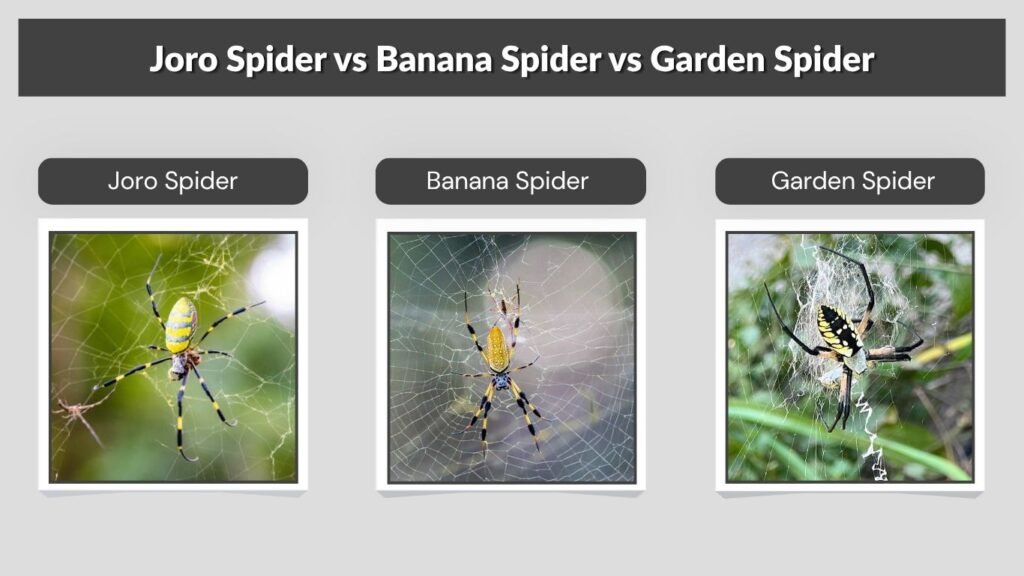
The name banana spider is confusing because it is applied to different spiders in different regions. In the southeastern United States, it commonly refers to the golden silk orb-weaver, Trichonephila clavipes. This species is related to the Joro spider but is separate from both the Joro and yellow garden spider.
| Feature | Joro spider | Golden silk “banana” spider | Yellow garden spider |
| Abdomen shape | Long and striped | Long and cylindrical | Broad and egg-shaped |
| Main colors | Yellow, blue-green, black and red | Orange or yellow with pale spots | Black, yellow and white |
| Legs | Smooth-looking, yellow-banded black legs | Orange-brown legs with black hair tufts | Black and yellow-orange legs |
| Web | Golden and multilayered | Golden and semipermanent | White with a central zigzag |
| U.S. origin | Introduced | Native to warmer southeastern regions | Native and widely distributed |
The black hair tufts on the legs are especially useful for recognizing a female golden silk spider. Female Joros have banded legs but normally lack those prominent brushlike tufts. A yellow garden spider has a wider abdomen and the characteristic zipper pattern in its web.
Which Spider Is Bigger?
All three can look enormous when their legs are fully extended. Joro spiders may approach three to four inches across, while female yellow garden spiders have bodies slightly longer than one inch and a much broader leg span. Golden silk spiders are also comparable in overall size. Differences between individual females can make size alone unreliable for identification.
The body pattern and web structure provide better clues than overall leg span. A large spider is not automatically a Joro, particularly in areas where native yellow garden and golden silk spiders occur.
Are Joro and Garden Spiders Dangerous?
Neither species is considered aggressive toward humans. Both normally remain in their webs, retreat, drop, or freeze when disturbed. A bite is possible if a spider becomes trapped against the skin or is handled carelessly, but ordinary encounters rarely result in bites.
| Safety question | Answer |
| Will either spider chase people? | No |
| Can they bite? | Yes, when severely threatened or trapped |
| Are bites normally medically serious? | No |
| Should they be picked up? | No |
| Must every spider be killed? | No |
| Can an inconvenient web be removed? | Yes |
Wash a suspected bite with soap and water and apply a wrapped cold pack for mild swelling. Seek medical care for breathing difficulty, facial swelling, severe pain, spreading redness, or other significant symptoms.
Which Spider Is Native to Georgia?
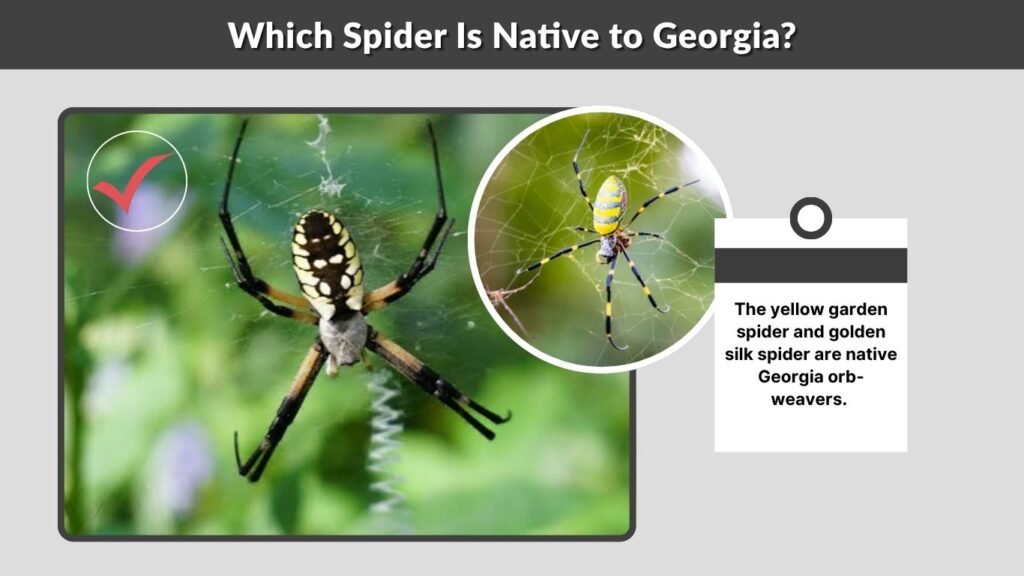
The yellow garden spider and golden silk spider are native Georgia orb-weavers. The Joro spider originated in East Asia and was first confirmed in Georgia during the 2010s. It has since become a highly visible part of many north Georgia landscapes.
Native garden spiders help control insects and do not damage garden plants. UGA researchers continue to investigate how expanding Joro populations affect native spiders, pollinators, and other parts of local ecosystems; the full long-term ecological effect is not yet settled.
Should You Remove Either Spider?
A yellow garden spider should normally be left alone unless its web blocks an entrance or creates an unavoidable problem. It is a beneficial native predator that captures insects around gardens and fields.
A Joro can also be left alone when its web is high in a tree or at an unused property edge. When a web blocks a doorway, porch, walkway, play area, or other busy location, gather the spider and web carefully with a long broom or pole and move them away. Large-scale pesticide spraying is unnecessary for one inconvenient spider and may harm pollinators and native predators.
FAQs
What is the easiest way to distinguish a Joro from a garden spider?
Check the web and abdomen. A Joro typically has yellow and blue-green horizontal abdominal bands and occupies a golden, multilayered web. A yellow garden spider has bold black-and-yellow patches and usually builds a flatter web with a thick white zigzag.
Is a Japanese garden spider the same as a Joro spider?
“Japanese garden spider” is sometimes informally used for the Joro because it is native to parts of East Asia, including Japan. However, Joro spider is the clearer common name. It should not be confused with native American garden spiders in the genus Argiope.
Is a banana spider a garden spider?
The name varies. Some people call yellow garden spiders banana spiders, but in the southeastern United States, “banana spider” more often refers to the golden silk orb-weaver. Using a scientific name or checking the legs, abdomen, and web prevents confusion.
Can Joro and garden spiders live in the same yard?
Yes. Both are orb-weavers and may occupy different web sites on the same property. Joros often use elevated structures and trees, while yellow garden spiders frequently build lower webs among flowers, tall grass, and shrubs.
Which spider has the zipper in its web?
The yellow garden spider is famous for the thick white zigzag or zipper called a stabilimentum. Joro webs are golden and complex but normally lack that bold central white decoration.
