

Michigan has several large-looking spiders, but most are harmless and prefer to avoid people. Fishing spiders and wolf spiders are among the biggest commonly encountered groups. Some can have bodies around an inch long, with legs that make them appear several inches across. Their size can be startling when one runs across a basement floor or rests near a lake. This guide covers five large spiders found in Michigan, how to recognize them, where they live, and what to do if you find one indoors.
How big are Michigan’s largest spiders?
Some of Michigan’s largest spiders have a body about an inch long and a leg span that may reach around four inches. Fishing spiders are especially large, while wolf spiders can also look bulky and hairy. Measurements vary by species and by whether the legs are stretched out or folded close to the body.
Body length versus leg span
Body length measures a spider from the front of its body to the end of its abdomen. It does not include the legs. Leg span measures the distance between the tips of opposite legs when they are extended.
This difference explains why two descriptions of the same spider may sound inconsistent. A fishing spider might have a body around an inch long but take up much more space with its legs spread. When comparing species, check which measurement is being used.
| Spider group | What makes it look large | Where you may see it |
|---|---|---|
| Dark fishing spider | Long legs and a large body | Woodlands, buildings, and areas near water |
| Other fishing spiders | Broad leg span | Ponds, lakes, streams, and wetlands |
| Wolf spiders | Hairy, sturdy bodies and quick movement | Yards, gardens, basements, and crawlspaces |
| Nursery web spiders | Long legs and an elongated body | Plants, shrubs, and woodland edges |
| Black-and-yellow garden spiders | Large, colorful females and prominent webs | Gardens, tall grass, and sunny yards |
Why a spider may look bigger than it is
A spider’s posture can change its apparent size. Fishing spiders and huntsman-like spiders hold their legs out to the sides, creating a wide outline. A dark spider against a pale wall may also stand out more than one on tree bark or soil.
The distance between the spider and the viewer matters, too. A spider close to a camera can appear much larger in a photograph. To judge its size, compare it with a familiar object from a safe distance, such as a leaf or a brick.
1. Dark fishing spider
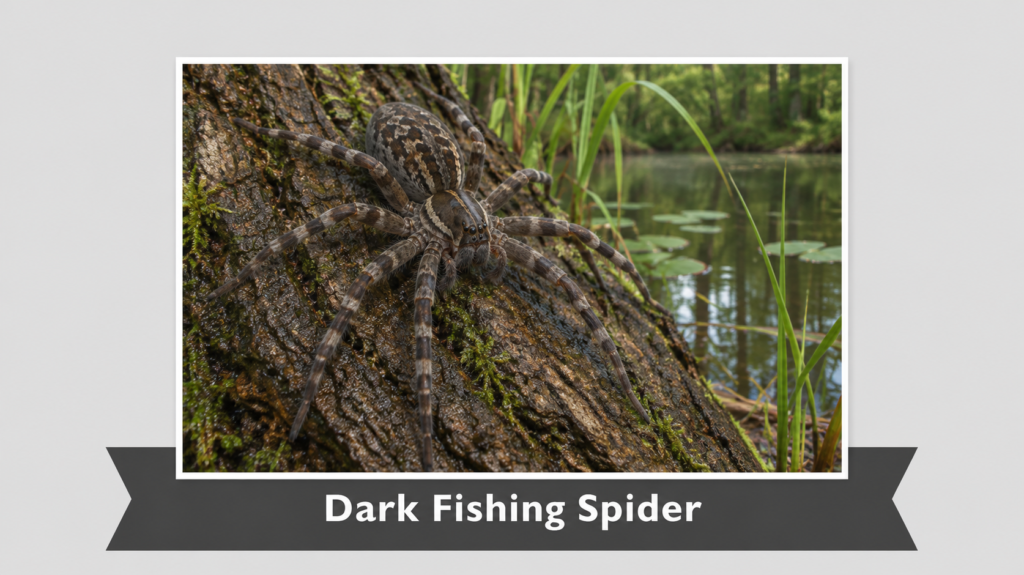
The dark fishing spider (Dolomedes tenebrosus) is one of Michigan’s largest and most frequently noticed spiders. It has a sturdy, brown or gray body and long legs. A large female can have a body close to an inch long, and its outstretched legs can make it appear three or four inches across.
Where dark fishing spiders live
Many fishing spiders live near ponds, lakes, streams, and wetlands. The dark fishing spider is less tied to water than some of its relatives and may wander through woods or enter nearby buildings. It can turn up in basements, garages, crawlspaces, and breezeways, sometimes far from a pond.
Fishing spiders hunt rather than build a web to catch prey. Near water, they can move across the surface and catch aquatic insects. They may also eat small animals such as tadpoles. In a house, a wandering spider is usually looking for shelter or prey, not trying to approach people.
How to recognize one
Look for a large, mottled spider with long, banded legs. Its abdomen may have dark markings, and the overall colors help it blend into bark, rocks, and other natural surfaces. Fishing spiders are often confused with wolf spiders because both can be large, hairy-looking, and fast.
2. Other fishing spiders
Michigan has several fishing spider species, not just the dark fishing spider. Some are more closely associated with water and are often found on docks, rocks, or vegetation near the shore. Their long legs help them move on the water’s surface and across plants.
Where to look
Check around quiet shorelines, ponds, marshes, and slow-moving streams. Fishing spiders may rest on a tree trunk or sit on a dock, waiting for insects or other prey. Their coloring can make them difficult to spot on weathered wood.
A fishing spider may sometimes wander indoors, especially if the building is close to wooded or wet areas. Seeing one inside does not mean a nest or infestation is present. These spiders are generally solitary hunters, and homeowners often encounter only one or a few.
Why they are mistaken for wolf spiders
Both groups can be large and hairy, and both may roam instead of sitting in a prey-catching web. Their eye patterns differ, but these details are difficult to see without a close look. If you are unsure of the identification, avoid handling the spider and take a clear photo from a safe distance.
3. Large wolf spiders
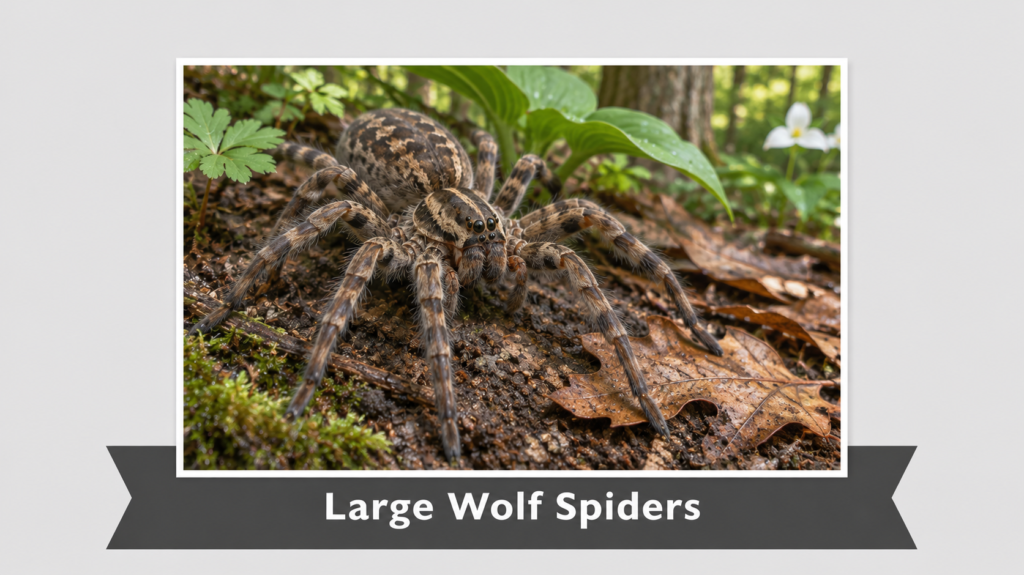
Wolf spiders are active hunters found throughout Michigan. They do not build a web to catch prey; instead, they search along the ground and pounce on insects. Their strong bodies, noticeable hair, and quick movements can make them seem especially large when they appear indoors.
Where wolf spiders are found
Wolf spiders live in yards, gardens, fields, woodlands, and other outdoor spaces. Some shelter under stones or logs, while others use burrows. They may enter homes near ground level and turn up in basements, crawlspaces, garages, and breezeways.
Most wolf spiders are brown, gray, or darkly patterned. Their coloring helps them blend in with soil and leaf litter. Some are small, but larger species can have a substantial body and a leg span that makes them easy to notice.
Mother wolf spiders carry their young
Female wolf spiders have a distinctive way of caring for their young. They carry their egg sacs attached to their bodies. After the spiderlings hatch, the babies may ride on the mother’s back for a time.
If you see a spider carrying what looks like tiny spiders on its back, it may be a female wolf spider with young. Give it space and avoid swatting at it; disturbing the spider can scatter the spiderlings.
4. Nursery web spiders
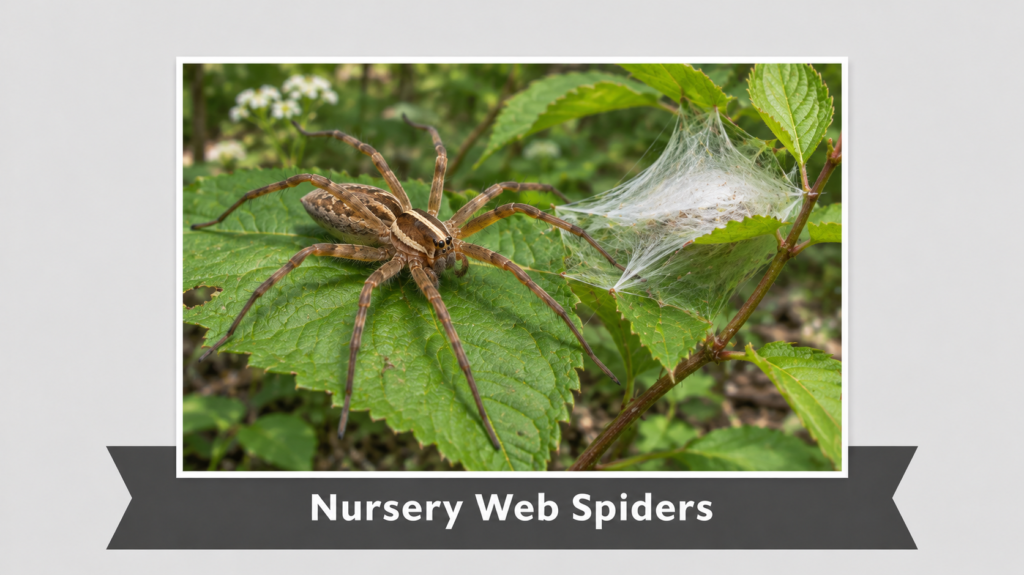
Nursery web spiders are relatives of fishing spiders and can also look large because of their long legs. Their bodies tend to be more slender than those of wolf spiders. They are hunters that roam through vegetation instead of relying on a large web to capture prey.
How females protect their young
A female nursery web spider carries her egg sac with her before placing it in a protective silk structure among leaves. She stays near the nursery as the young develop. The name refers to this protected area for spiderlings, rather than to a web used for catching food.
You may notice nursery web spiders in tall grass, shrubs, gardens, and along woodland edges. They are usually more at home outdoors than inside houses. Their long legs can make them appear larger than their body length suggests.
5. Black-and-yellow garden spiders
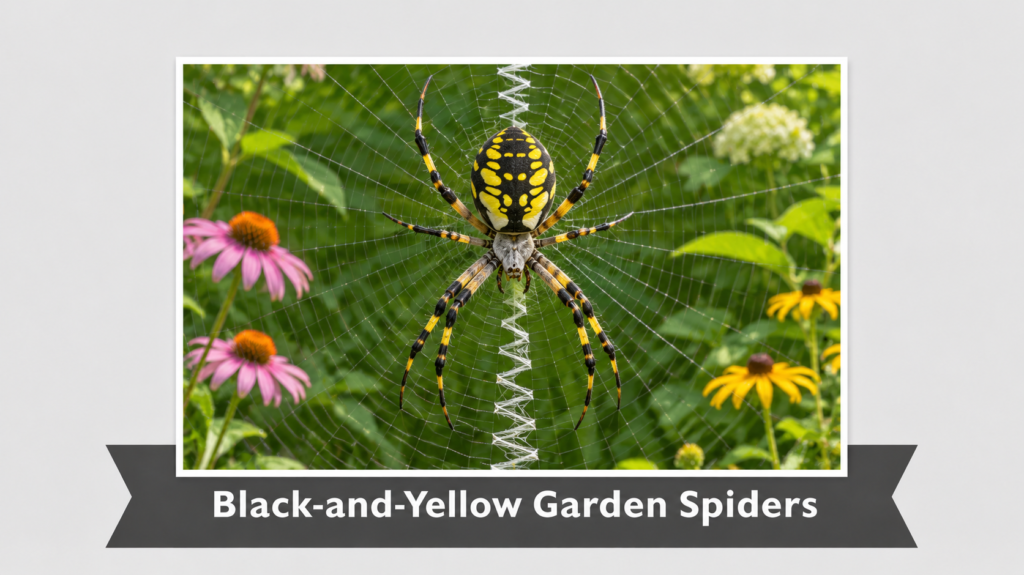
The black-and-yellow garden spider (Argiope aurantia) is one of Michigan’s most recognizable large web-building spiders. Adult females are much larger and more noticeable than the males. They have bold yellow and black markings and build large circular webs among plants.
Where to find garden spiders
Look for them in sunny gardens, tall grass, and other areas with plenty of insects. Their webs may stretch between flower stalks, shrubs, or fence posts. A zigzag band of thicker silk may run through the middle of the web.
A garden spider can look imposing because of its size, bright markings, and large web. It generally stays on or near the web and is not interested in chasing people. Give the web a wide berth when walking through the garden, especially in late summer when the spiders are easier to spot.
Why large spiders enter Michigan homes

Large spiders usually enter buildings by accident or while searching for prey and shelter. A basement, garage, shed, or crawlspace may offer dark, undisturbed places to hide. Spiders can also follow insects indoors, or wander in through gaps around doors and windows.
- Nearby habitat: Homes near woods, ponds, or wetlands may see more wandering spiders.
- Openings: Gaps under doors, damaged screens, and cracks can provide entry points.
- Indoor insects: Spiders may follow the insects they prey on.
- Seasonal movement: Outdoor spiders may become more noticeable as temperatures change.
Finding a single large spider does not automatically mean you have an infestation. Many large hunting spiders live outdoors and do not reproduce inside homes. If one is in a room, you can place a container over it, slide stiff paper underneath, and release it outside—without touching it.
Are big spiders in Michigan dangerous?
Most large spiders in Michigan are not aggressive and prefer to escape. They may bite if trapped, squeezed, or handled, so it is best not to pick one up. A bite can cause local pain or irritation, but the spider’s size alone does not indicate how medically significant it is.
Michigan State University notes that wolf spiders are not known to be aggressive and that their venom is not particularly dangerous. The brown recluse is not established as a Michigan species, so a large brown spider found in the state is much more likely to be another type. Avoid identifying a spider by color or size alone.
What to do if you find one
If you find a large spider indoors, keep a little distance and let it move away if possible. If you want it outside, use a container and stiff paper rather than your hands. Seal obvious gaps and repair screens if spiders are repeatedly entering.
If someone is bitten and develops severe pain, spreading swelling, difficulty breathing, or other concerning symptoms, seek medical care. If possible, take a photo of the spider without handling it; a clear image may help with identification.
FAQs
What is the biggest spider in Michigan?
Fishing spiders and large wolf spiders are among the biggest spiders found in Michigan. The dark fishing spider is often singled out because it has a large body and long legs. Its leg span can make it appear several inches across, though the exact size varies by individual.
How big can a fishing spider get in Michigan?
A large fishing spider may have a body around an inch long and a leg span of roughly three to four inches. These numbers describe different measurements: body length excludes the legs, while leg span measures across the extended legs.
Are wolf spiders common in Michigan homes?
Wolf spiders can wander into Michigan homes, especially basements, crawlspaces, and garages. They usually enter from outdoors and are often seen alone. Finding one does not necessarily mean they are breeding inside or that there is a large infestation.
Is a brown recluse a big spider in Michigan?
Brown recluse spiders are not established in Michigan. A large brown spider found in the state is more likely to be a fishing spider, wolf spider, or another local species. Do not rely on color alone to identify a spider.
Should I kill a large spider in my house?
Usually, there is no need to kill a large spider. You can leave it alone or carefully move it outside using a container and stiff paper. Avoid touching it directly, since any spider may bite if it feels trapped or is handled roughly.
