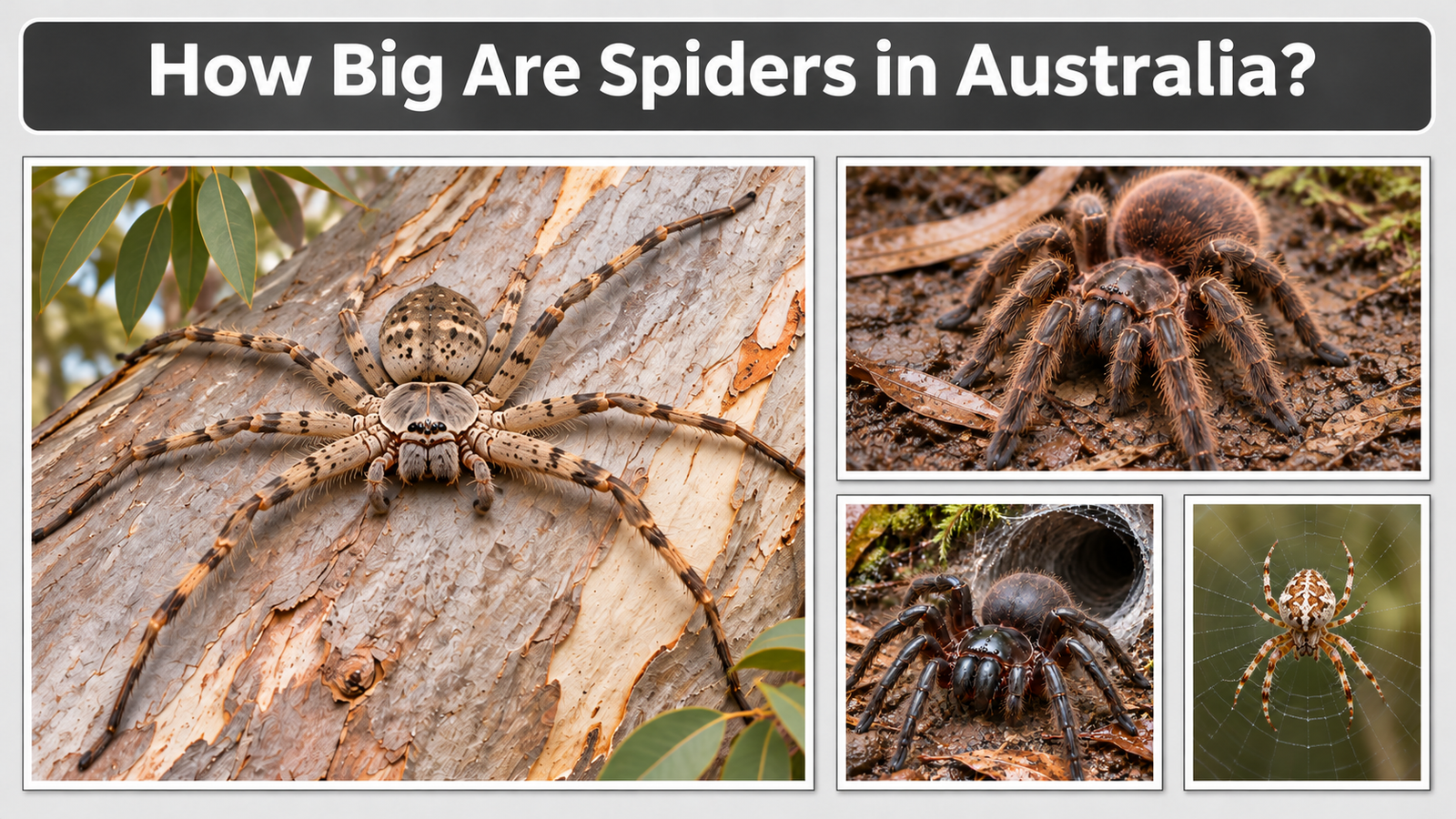
Australian spiders vary enormously in size. Some are less than a millimetre long, while large species can stretch their legs across a hand or more. The number depends on what you measure: a spider’s body length or its full leg span. Huntsman spiders are famous for their wide, flattened shape, while Australian tarantulas can have much heavier bodies. This guide compares the sizes of common and unusually large Australian spiders, explains how spider measurements work, and shows why a spider may look bigger than its body really is.
How spider size is measured
When people ask how big spiders in Australia are, they may mean the body, the legs, or the entire animal with its legs extended. Those measurements can make the same spider sound very different in size. It helps to check whether a figure refers to body length or leg span.
Body length and leg span
Body length measures the spider from the front of its body to the back of its abdomen. It does not include the legs. Leg span measures from the tip of one outstretched leg to the tip of the opposite leg.
A long-legged spider can have a modest body but a surprisingly wide span. Huntsman spiders are a good example: their bodies are relatively short, but their legs extend sideways. Australian tarantulas, by contrast, have bulkier bodies and thicker legs, so they may look stockier even with a similar leg span.
Why size reports can differ
Spider size varies by species, sex, age, and how the specimen was measured. Females are often larger than males in some groups, and a young spider will be smaller than a mature adult. A relaxed spider also takes up less space than one with its legs fully spread.
That is why one source might describe a spider as 4 centimetres long and another might report a span of 15 centimetres. Both figures can be correct: they measure different parts of the spider.
How big are Australian spiders overall?
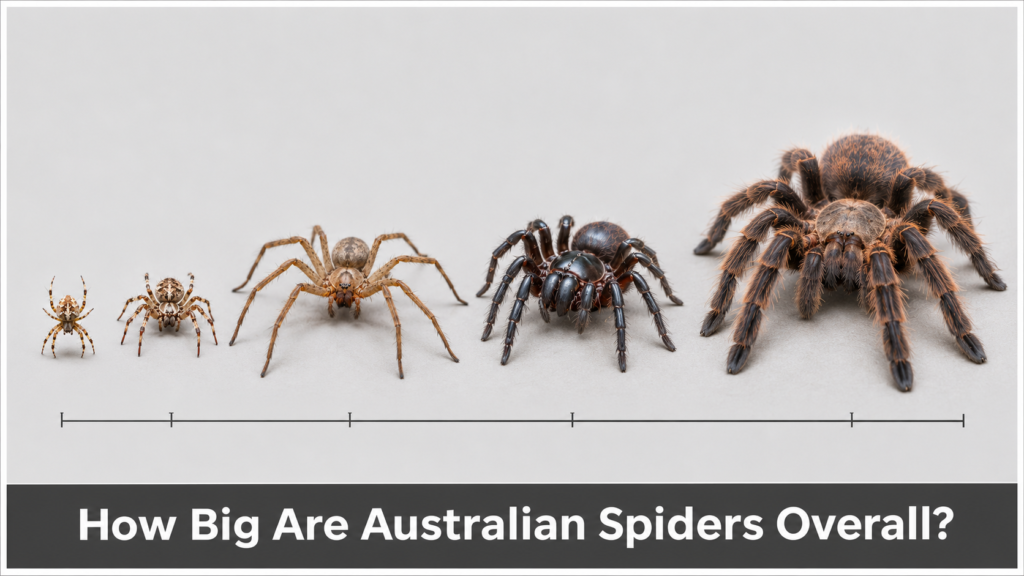
There is no single size that represents every spider in Australia. Small species can measure under a millimetre, while some of the largest have bodies several centimetres long and leg spans reaching around 20 centimetres. Australia has tiny micro orb-weavers as well as large huntsman, tarantula, trapdoor, and funnel-web spiders.
As a quick guide, a house spider or small web-building species may be only a few millimetres across. Many familiar garden spiders are larger, and the broad-legged huntsman can appear especially large on a wall or ceiling. The biggest species are unusual compared with the small spiders people commonly see.
| Australian spider group | Approximate size information |
|---|---|
| Micro orb-weavers | Some have bodies under 1 mm |
| Huntsman spiders | Body around 2 cm in one example; leg span up to 15 cm |
| Australian tarantulas | Body length reported from 2–11 cm; leg span up to 20 cm |
| Funnel-web spiders | About 1–5 cm in body length across the group |
These figures are examples, not exact limits for every species. Measurements vary between species, so treat them as a guide rather than a universal rule.
Most spiders are not giants
Large spiders attract attention, but Australia also has many small species that are easy to overlook. Some live among leaf litter, inside burrows, or in small webs on plants. Their size can be measured in millimetres, and the smallest may be difficult to see without looking closely.
Australia is home to thousands of spider species, and their sizes reflect the variety of habitats they occupy. A spider living in a burrow, a garden web, or a forest canopy may have a very different body shape and size.
How large are huntsman spiders?
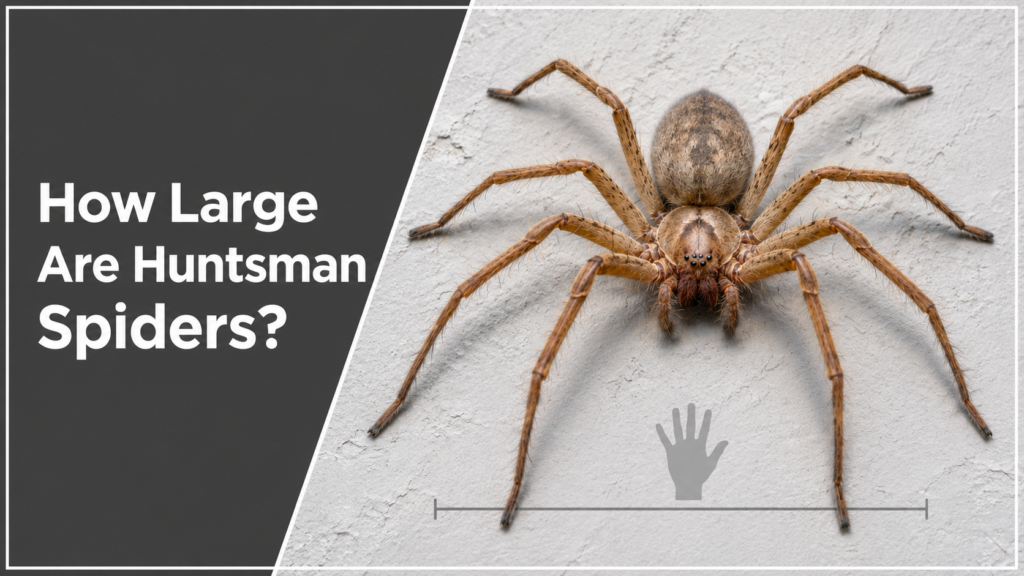
Huntsman spiders are among the Australian spiders people most often describe as “huge.” Their flat bodies and legs that spread out sideways make them look broad. Some huntsman spiders have a leg span of up to 15 centimetres, though other species may be larger.
Why huntsman spiders look so wide
A huntsman’s legs extend outward instead of being held close beneath the body. This crab-like posture increases its overall width. When one is sitting on a wall, its legs can make it seem much larger than a spider with a similar-sized body and legs held closer together.
Huntsman spiders are fast-moving hunters rather than web-builders that wait for prey in a catching web. Their flattened bodies help them shelter in narrow spaces, including under bark and in crevices. People may encounter them indoors, but size alone does not tell you whether a spider is dangerous.
How large are Australian tarantulas?
Australian tarantulas, also called whistling or barking spiders, are among the country’s largest spiders by body size. Their body length can range from about 2 to 11 centimetres, and their leg span can reach around 20 centimetres. The largest examples therefore have both a thick body and a wide spread of legs.
Whistling spiders
Some Australian tarantulas make a hissing or whistling sound by rubbing specialised body parts together. The northern whistling spider, Selenocosmia crassipes, can reach about 6 centimetres in body length and 16 centimetres in leg span. These measurements help explain why it is often mentioned among Australia’s biggest spiders.
Not every Australian tarantula reaches that size. Their appearance and measurements differ across species, and many spend much of their lives in burrows. A large tarantula may look more substantial than a huntsman, even when the huntsman’s legs span a similar distance.
How big are funnel-web spiders?
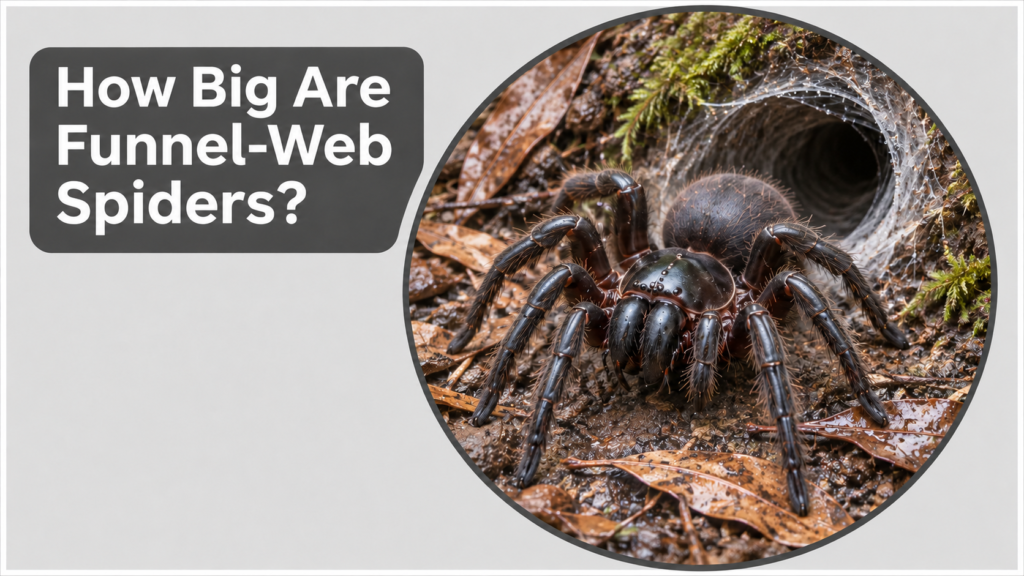
Australian funnel-web spiders are medium to large, heavy-bodied spiders. Across the group, body length ranges from about 1 to 5 centimetres. The northern tree-dwelling funnel-web is considered the largest funnel-web species, with a body length of up to 5 centimetres.
The Sydney funnel-web is generally reported at about 2–4 centimetres in body length. Since funnel-webs have strong bodies and legs, they can look imposing even though their leg span is not usually the measurement people associate with the wide spread of a huntsman.
Size does not identify a funnel-web
A large, dark spider is not automatically a funnel-web. Many unrelated Australian spiders can be dark, thick-bodied, or similar in size. Identifying a spider reliably often requires looking at details such as its shape, location, and features—not size alone.
If you find an unfamiliar spider, avoid handling it. A photo taken from a safe distance may help an expert identify it, but do not try to pick it up or move it with your hands.
What affects a spider’s apparent size?
A spider can seem larger or smaller depending on its posture, surroundings, and viewing distance. A long-legged spider on a plain wall may look enormous because there is nothing nearby for comparison. A larger-bodied spider tucked into a burrow may be harder to notice.
- Leg position: Spread legs increase the apparent width.
- Body shape: A thick abdomen or broad body can make a spider look heavier.
- Sex and age: Adult females are larger than males in some species, and juveniles are smaller.
- Perspective: A spider close to a camera or person can appear bigger than it is.
- Hair and colour: Dense hairs or dark markings may make its outline more noticeable.
When comparing spider sizes, use the body measurement and leg span separately. This avoids mixing up a spider’s actual body length with the distance between its outstretched legs.
Which Australian spider is the biggest?
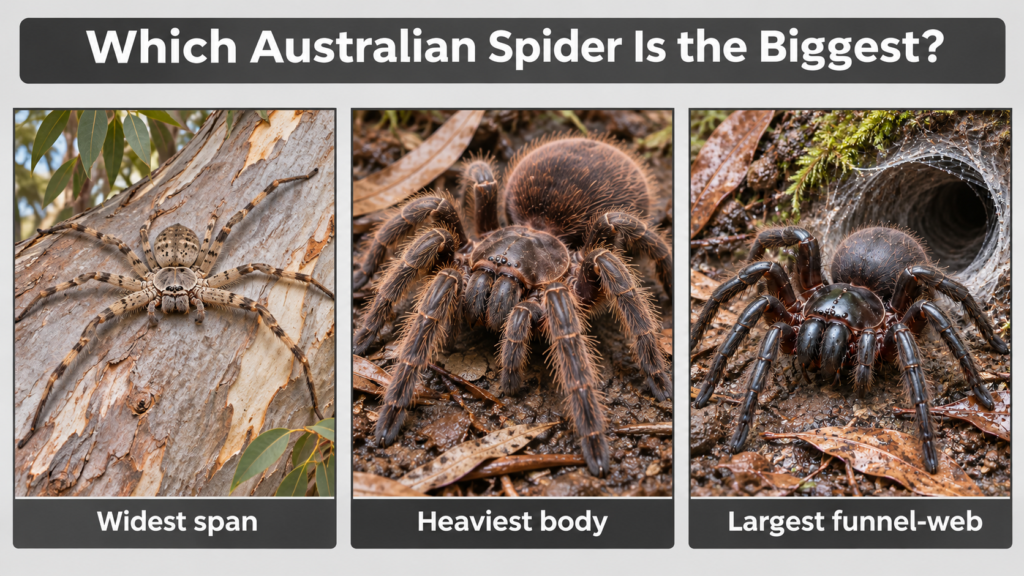
The answer depends on the measurement. Huntsman spiders and giant golden orb-weavers may be contenders for the largest leg span, while tarantulas, some trapdoor spiders, and the tree-dwelling funnel-web may stand out for body size or weight.
So there is not one simple winner across every category. If you mean a spider with a wide leg span, a huntsman is a strong example. If you mean a large, heavy body, Australian tarantulas and some other burrowing spiders deserve attention.
A helpful way to compare them
Think of Australian spider size in three categories:
- Widest-looking: Huntsman spiders, because of their long, sideways-spreading legs.
- Heaviest-bodied: Australian tarantulas and other large burrowing spiders.
- Largest among funnel-webs: The northern tree-dwelling funnel-web, with a body length up to 5 centimetres.
These descriptions refer to different measurements, so they should not be treated as a single ranked list. A spider with the longest leg span may not have the longest body.
FAQs
How big is the average spider in Australia?
There is no single average size for Australian spiders because the country has thousands of species. Many familiar spiders are only a few millimetres to a few centimetres long. Larger groups, such as huntsman spiders and tarantulas, can have leg spans of around 15–20 centimetres.
What is the biggest spider in Australia?
It depends on how “biggest” is measured. Huntsman spiders and giant golden orb-weavers may have very wide leg spans, while Australian tarantulas and certain burrowing spiders have larger, heavier bodies. Several groups may qualify depending on whether you compare span, body length, or weight.
Are huntsman spiders bigger than funnel-web spiders?
Huntsman spiders often have a wider leg span, while funnel-web spiders have a heavier, more compact body. Some huntsman spiders reach a leg span of about 15 centimetres, while funnel-web species range from about 1–5 centimetres in body length.
Are there tiny spiders in Australia?
Yes. Australia has very small spiders, including micro orb-weavers with body lengths under one millimetre. These tiny species are easy to miss and are very different in size from conspicuous spiders such as huntsmen and Australian tarantulas.
Does a large spider mean it is dangerous?
No. Size alone does not determine how dangerous a spider is. Some large spiders are generally not considered medically significant, while some smaller species can cause serious bites. Avoid handling unfamiliar spiders, and seek local medical advice if someone is bitten and develops concerning symptoms.
