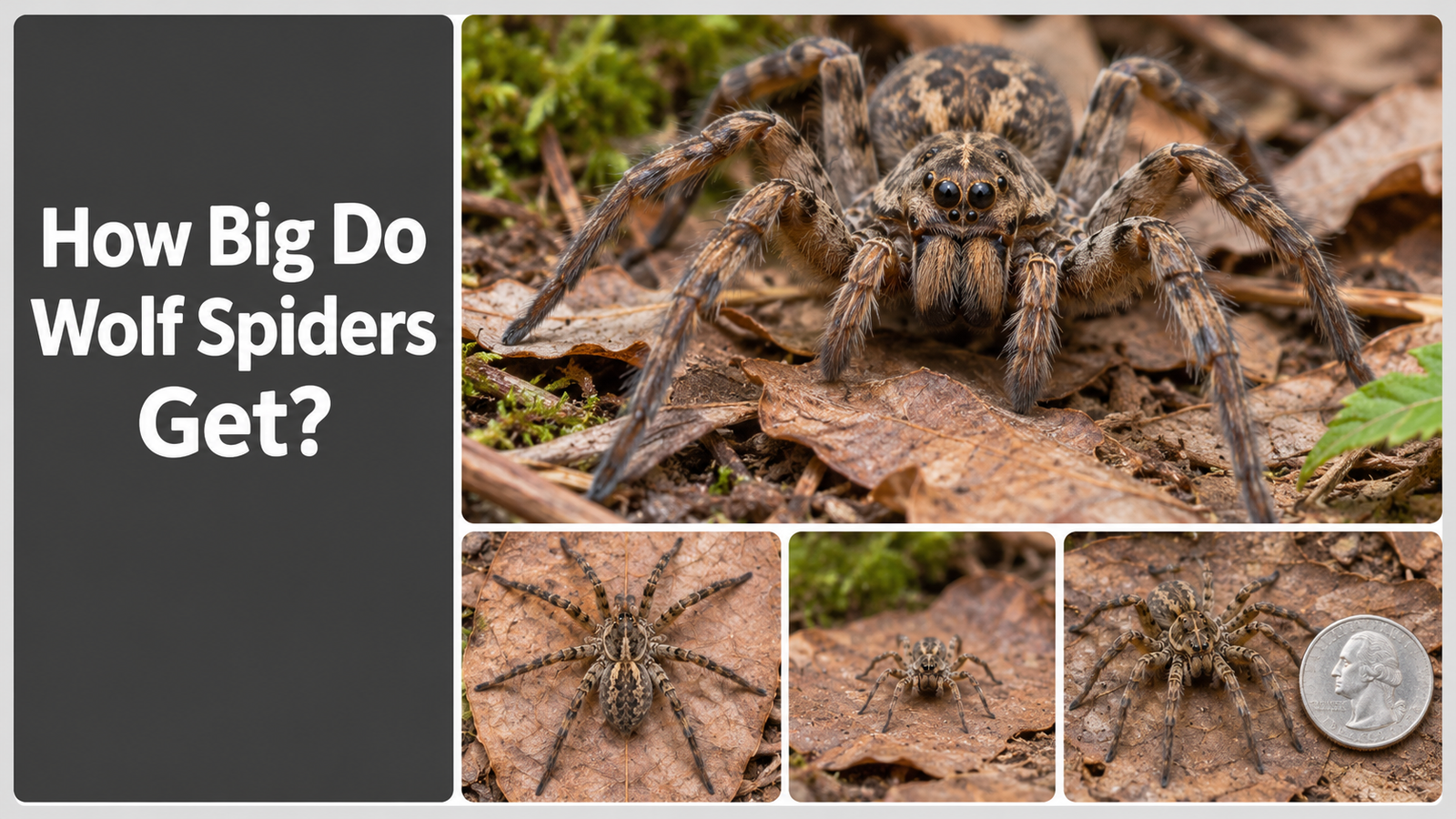
Wolf spiders vary in size depending on the species. Many have bodies about ¼ to 1 inch long (6–25 mm), while some of the largest species can reach around 1.2 inches (30 mm). Their legs add to their overall appearance: larger wolf spiders can have a leg span of 2 inches or more.
There is no single measurement that describes every wolf spider. The family includes many species, from small spiders that are easy to overlook to larger, sturdier ones that may surprise you when they run across a floor. The Carolina wolf spider is among the largest wolf spiders found in the United States. Adult females can grow to about 22–35 mm (roughly ⅞–1⅜ inches) in body length, while males are usually smaller.
When you see a size listed for a wolf spider, check whether it refers to the body or the leg span. Body length is measured without the legs. Leg span measures across the spider with its legs extended. A wolf spider with a body less than an inch long can look much wider when its legs are spread out.
Wolf Spider Size at a Glance
These figures are general estimates. The size of an individual depends on its species, sex, age, and how it is measured.
| Measurement | Approximate size |
|---|---|
| Body length of many wolf spiders | ¼–1 inch (6–25 mm) |
| Body length of some large species | Up to about 1.2 inches (30 mm) |
| Leg span of larger wolf spiders | Around 2 inches or more |
| Carolina wolf spider female body length | About ⅞–1⅜ inches (22–35 mm) |
A spider’s body is much shorter than the full distance across its legs. This is why size descriptions can appear inconsistent. One source might describe a wolf spider as one inch long, while another says it can span two inches or more. Both may be accurate if one measurement refers to body length and the other includes the legs.
Why Wolf Spiders Look So Large
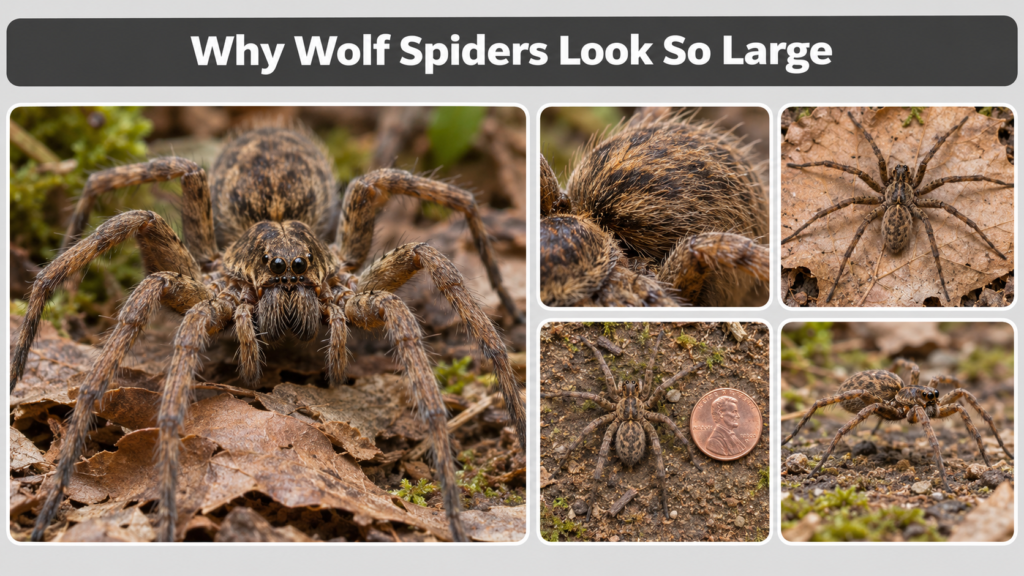
A wolf spider has a compact, sturdy body and eight legs that spread outward. The legs make the spider look wider than its body measurement suggests. Some larger individuals may appear to cover a noticeable area when they are sitting still with their legs extended.
Their bodies are often hairy and robust, which can make them look bulkier than slimmer spiders. They are active hunters, so people may see them moving quickly across the ground, a garage floor, or a room. Sudden movement can make it harder to judge their actual size and can make an otherwise modest-sized spider seem larger.
Lighting and viewing distance can affect how large a spider appears, too. A spider seen close up may look enormous, while one photographed from farther away may seem much smaller. To understand its size, focus on the body and compare it with a familiar object. Remember that most size guides list body length without the legs.
How Wolf Spider Size Varies by Species
“Wolf spider” refers to a large family of spiders rather than one single species. Different species have different adult sizes. Some are only a fraction of an inch long, while larger species can have bodies close to an inch or more in length.
The Carolina wolf spider, Hogna carolinensis, is a well-known large species in the United States. Adult females can be noticeably larger than males. However, size alone does not confirm that a spider is a Carolina wolf spider. Other species may also look large, hairy, or brown, and their ranges can overlap.
Wolf spiders are found in many habitats, including fields, gardens, woodlands, and areas around homes. A wolf spider found in one region may not be the same species as one seen elsewhere. This geographic variation is one reason general wolf spider size ranges are broad.
Are Female Wolf Spiders Bigger Than Males?
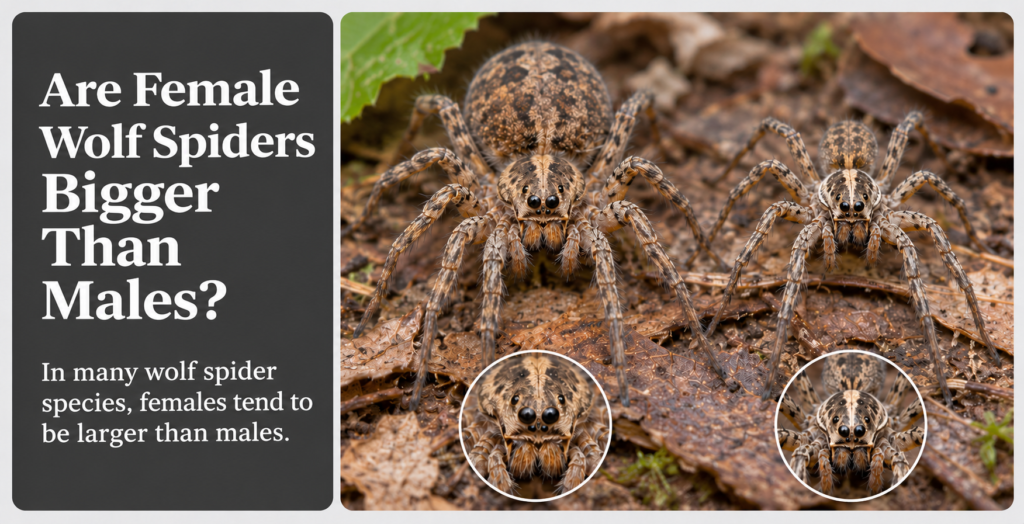
In many wolf spider species, females tend to be larger than males. The difference can be especially noticeable in some of the larger species. Female Carolina wolf spiders can reach around 22–35 mm in body length, while males are usually about 18–20 mm long.
Still, size is not a reliable way to tell the sex of an individual spider. Wolf spiders vary between species, and juveniles are smaller than adults. A small adult female of one species could be shorter than a male of another. To identify a spider’s sex accurately, an expert may need to examine features that are difficult to see without magnification.
How Big Are Wolf Spiders in a House?
A wolf spider found indoors may have a body from about ¼ inch to around 1 inch long, depending on its species and age. Its legs can make it appear larger. Some larger wolf spiders may have a leg span of 2 inches or more.
Finding one indoors does not necessarily mean there is an infestation. Wolf spiders hunt other small animals rather than relying on a web to catch prey. They may wander inside by accident, especially when searching for food or shelter. Their size and quick movement can be startling, but size by itself does not mean a spider is dangerous.
A large spider in the house is not automatically a wolf spider. Other spider families can also include large or hairy species. If you need to identify one, consider its markings, body shape, eye arrangement, behavior, and location instead of relying only on its size.
Do Wolf Spiders Grow Throughout Their Lives?
Wolf spiders hatch as spiderlings and grow by shedding their outer covering, a process called molting. They become larger as they pass through successive stages of development. A young wolf spider may be much smaller than an adult of the same species.
Growth takes place over time, and it is not identical for every spider. The rate can depend on the species, temperature, food supply, and local conditions. Some wolf spider spiderlings hatch during the warmer months and continue growing into the next season. They may still be only partway to their adult size after several months.
Because wolf spiders grow in stages, seeing a small one does not tell you exactly how large it will become. It may be a young spider with more molts ahead, or it may belong to a species that naturally stays small. A large adult and a tiny spiderling can look very different even if they belong to the same species.
How to Estimate a Wolf Spider’s Size
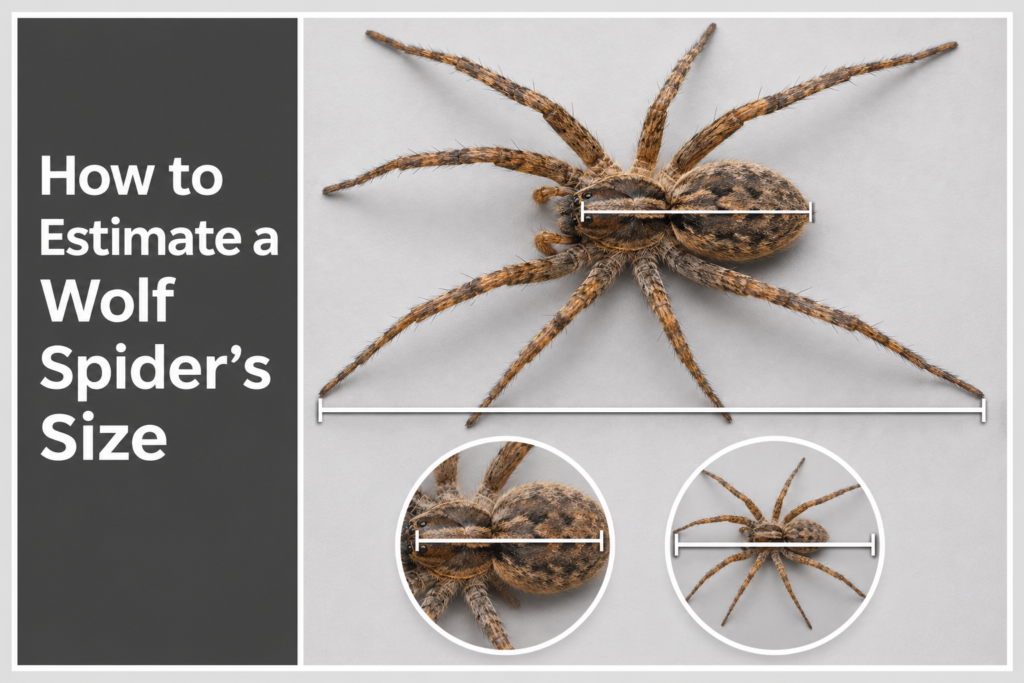
To estimate a wolf spider’s size, first distinguish its body length from its leg span. Body length is measured from the front of the body to the back of the abdomen, leaving out the legs. Leg span measures across the spider when its legs are extended. The two measurements describe different parts of the spider, so they should not be compared as if they were the same.
If you are observing a spider, avoid handling it or trapping it against your skin. You can estimate its body length from a safe distance or take a photo next to a familiar object without disturbing it. Keep in mind that a photo’s angle can distort proportions, especially when the spider is close to the camera.
Size can help narrow down an identification, but it should not be the only clue. Wolf spiders are hunters and do not build capture webs. They often have brown or gray bodies and may look hairy, but their colors and markings vary. A very large spider could belong to another family, so its location and other physical features also matter.
Are Wolf Spiders Bigger Than They Look?
Often, yes. A wolf spider’s body may be less than an inch long, while its legs spread much farther out. That can make it seem larger at a glance. Movement also affects perception: a fast spider crossing a room may appear more alarming than one sitting still.
The easiest way to compare size descriptions is to check which measurement is being used. A “one-inch body” and a “two-inch leg span” describe different things and could refer to the same spider. The second measurement includes the legs.
Frequently Asked Questions
What is the maximum size of a wolf spider?
Some of the largest wolf spiders reach about 1 to 1.2 inches in body length. Their legs can make their overall span more than 2 inches. Exact size depends on the species and individual spider.
How big is a wolf spider’s leg span?
Larger wolf spiders may have a leg span of around 2 inches or more. The exact span depends on the species and how far the legs are extended. Leg span is wider than body length, so check which measurement a size description gives.
Are female wolf spiders larger than males?
Females are often larger than males of the same species. The difference varies, though, and size alone is not enough to identify a spider’s sex.
Can a wolf spider be smaller than half an inch?
Yes. The wolf spider family includes many species, and some adults are small. A spider shorter than half an inch could still be a wolf spider.
Does a large spider in the house mean it is a wolf spider?
No. Size alone is not enough to identify a spider. Other types of spiders can also be large or hairy. Look at additional features, such as its markings, body shape, and behavior.
