
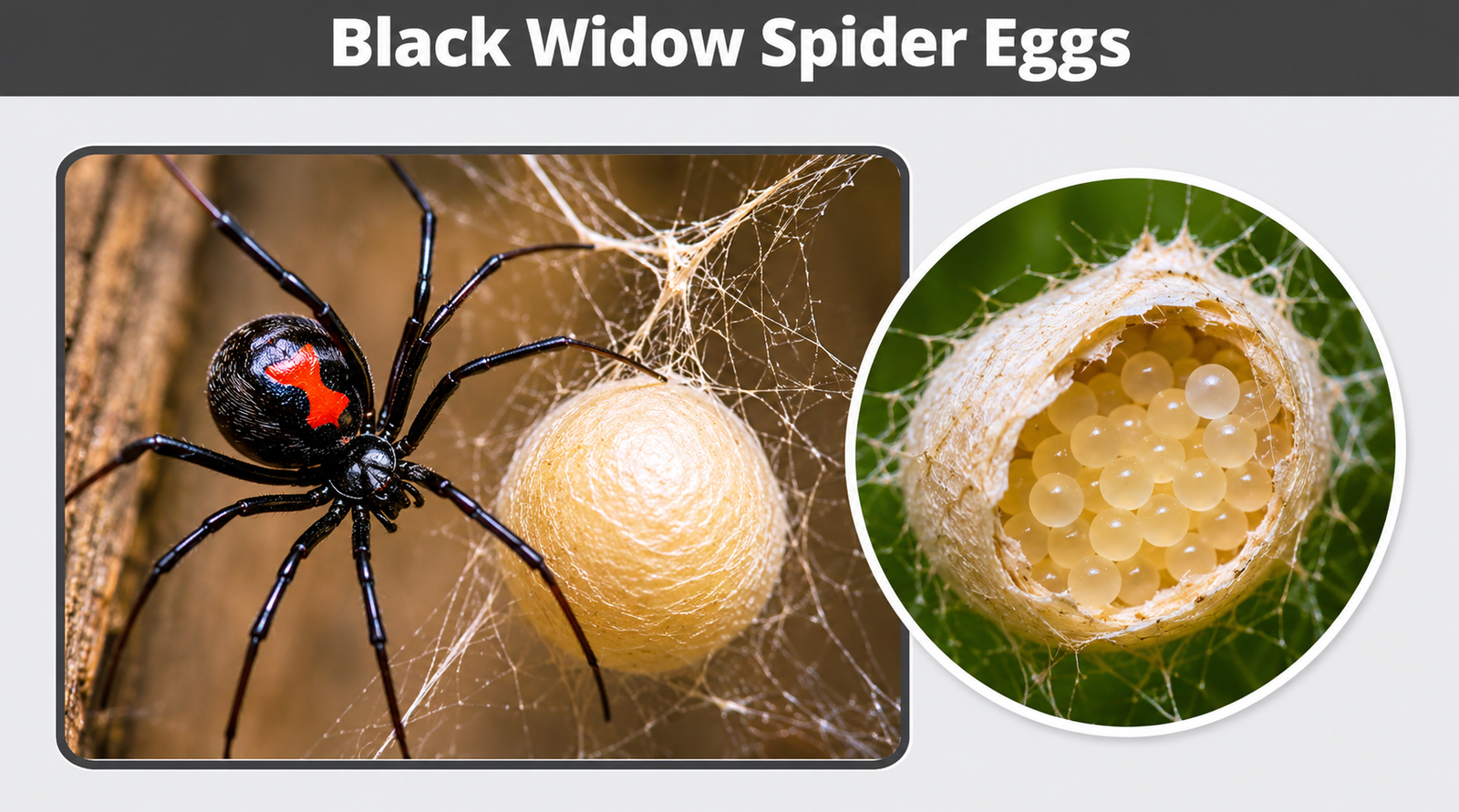
Black widow spider eggs are enclosed in small, protective silk sacs commonly found in dark, sheltered areas around homes and gardens. A female black widow can produce several egg sacs, each containing hundreds of developing spiders. These sacs are usually cream, yellowish, or tan, with a smooth, rounded appearance. Understanding what black widow spider eggs look like, how many spiderlings hatch, and where females lay their eggs can help homeowners identify potential infestations. Learning about their reproduction and life cycle also helps you handle egg sacs safely.
What Do Black Widow Spider Eggs Look Like?
Black widow spider eggs are tiny and usually hidden inside a protective silk covering rather than exposed individually. The female creates a strong, enclosed egg sac that helps protect developing embryos from environmental conditions and predators. These sacs are generally round or pear-shaped, depending on the species, and may resemble small cotton balls hanging within an irregular spiderweb.
Black Widow Egg Sac Size, Color, and Shape
Black widow egg sacs generally measure about half an inch across, although their exact dimensions vary between species. They usually appear creamy white, pale yellow, grayish, or light tan. Their outer covering has a relatively smooth, firm, papery texture.
Western black widow egg sacs may have a distinctive teardrop shape, while southern black widow sacs are often more rounded. The individual eggs remain enclosed within the protective silk and are not normally visible.
How to Identify a Black Widow Egg Sac
Several characteristics can help distinguish black widow egg sacs from other spider egg cases.
- Color: Cream, pale yellow, gray, or light tan.
- Shape: Rounded, oval, or slightly pear-shaped.
- Size: Usually around half an inch.
- Texture: Smooth, firm, and papery.
- Location: Attached to irregular webs in sheltered spaces.
- Nearby spider: Often guarded by a female black widow.
These characteristics are useful identification clues, although an egg sac alone may not establish the exact species.
How Many Eggs Do Black Widow Spiders Lay?
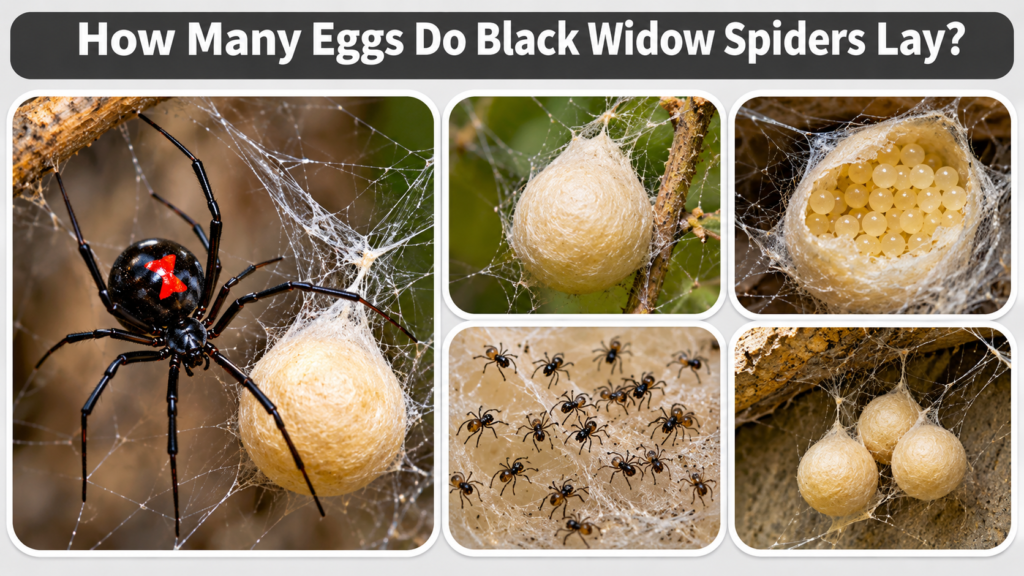
Female black widow spiders are capable of producing hundreds of eggs within a single reproductive cycle. Rather than depositing eggs individually around their environment, females enclose them inside silk sacs. The exact number varies by species, female size, food availability, and environmental conditions. A healthy female may produce several sacs during her lifetime, creating substantial numbers of offspring.
How Many Eggs Are in a Black Widow Egg Sac?
A typical black widow egg sac may contain approximately 200–400 eggs, although the number varies considerably. Some species average around 200 eggs per sac, while others commonly produce approximately 300.
Under certain conditions, individual sacs can contain considerably fewer or more eggs. Each viable egg normally develops into one spiderling, meaning a single egg does not release hundreds of baby spiders.
How Many Baby Spiders Hatch From One Egg Sac?
A single black widow egg sac can potentially produce hundreds of spiderlings. However, the number successfully emerging depends on egg fertility, incubation conditions, and survival during early development.
Some spiderlings die before leaving the sac, and cannibalism can occur among young spiders. Many more die after dispersal, so hundreds of eggs do not necessarily result in hundreds of surviving adult black widows.
Black Widow Spider Egg-Laying and Hatching Life Cycle
Black widow spiders reproduce through mating, egg development, and the production of silk-covered egg sacs. Females may store sperm after mating, allowing them to produce additional fertile egg sacs without mating again. Temperature, seasonal conditions, and the availability of food influence reproductive activity. Understanding this process explains how black widow populations develop around homes and outdoor structures.
How Do Black Widow Spiders Lay Eggs?
After mating, the female produces a protective silk structure and deposits her eggs inside it. She then completes the covering, creating a durable egg sac suspended within her irregular web.
The female often remains nearby and guards the sac against disturbance. She may produce additional sacs over several weeks or months when conditions are favorable.
How Long Do Black Widow Eggs Take to Hatch?
Black widow eggs generally hatch within approximately two to four weeks, although timing depends on the species and temperature. Warmer conditions can accelerate embryonic development, while cooler weather may slow the process.
After hatching, the spiderlings often remain inside the sac for several days and undergo an early molt. They eventually emerge and disperse, sometimes releasing silk threads that allow them to travel on air currents.
When Do Black Widow Spiders Lay Eggs?
Black widow egg-laying activity commonly occurs during spring and summer in temperate regions. Females often reproduce when warmer weather increases insect activity and provides favorable conditions for developing offspring.
A female may produce several egg sacs during one breeding season. In warm climates or protected indoor environments, reproduction can continue over a longer period.
Where Do Black Widow Spiders Lay Their Eggs?
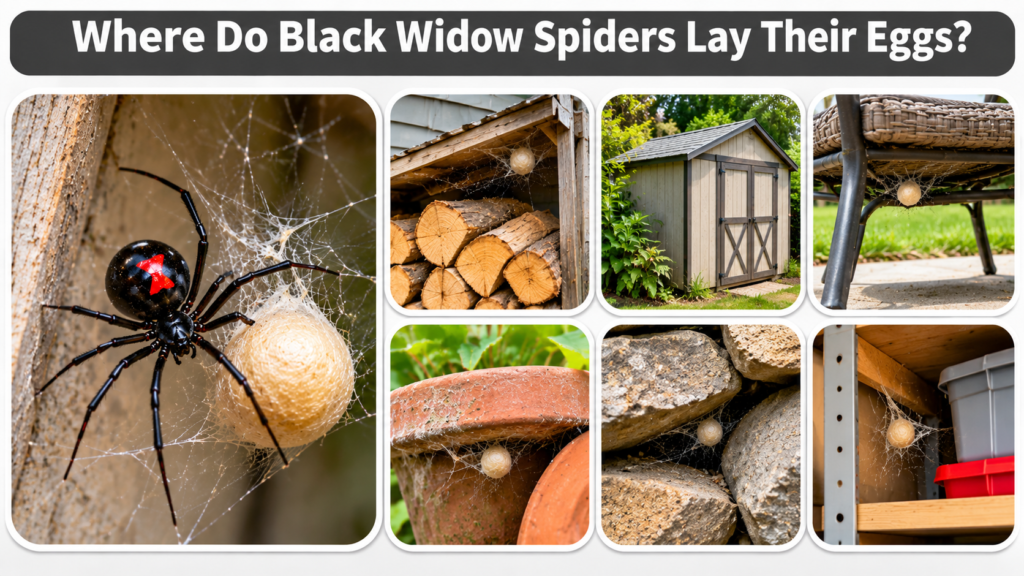
Black widow spiders generally choose secluded areas where their egg sacs remain protected from disturbance, harsh weather, and predators. Females usually attach their sacs to existing webs rather than leaving them exposed on open surfaces. These webs are typically irregular and positioned near the ground, although their locations vary with habitat and environmental conditions.
Common Outdoor Egg-Laying Locations
Black widow spiders frequently establish their webs in sheltered outdoor spaces where insects are available.
Common nesting locations include:
- Under rocks, stones, and fallen logs.
- Inside firewood piles and stacked lumber.
- Beneath outdoor furniture and flowerpots.
- Around storage sheds and garages.
- Inside unused containers and equipment.
- Within cracks in retaining walls.
- Near meter boxes and foundation openings.
Female spiders often remain close to these locations while protecting their egg sacs.
Black Widow Egg Sacs Inside Homes
Black widow spiders sometimes build webs in basements, crawl spaces, garages, and storage rooms. They favor quiet, undisturbed areas with suitable hiding places.
Egg sacs may appear behind stored boxes, beneath shelves, or near structural gaps. Finding one indoors warrants caution because a female spider may be hiding nearby.
Black Widow Egg Sac vs. Other Spider Egg Sacs
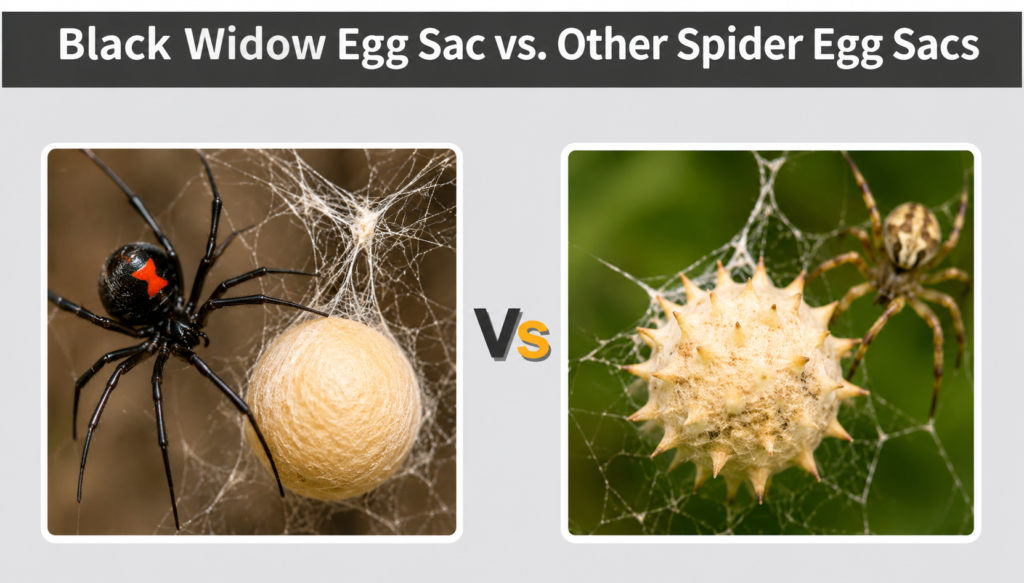
Black widow egg sacs can resemble those produced by other cobweb-building spiders. However, their surface texture and shape offer important identification clues. Brown widow spiders, in particular, produce distinctive egg sacs that differ noticeably from those of black widows. Comparing these characteristics can help prevent confusion when identifying spiders around homes.
Black Widow vs. Brown Widow Egg Sacs
The most noticeable difference is the outer surface. Black widow egg sacs usually have a smooth appearance, while brown widow egg sacs are covered with numerous pointed silk projections.
| Feature | Black Widow | Brown Widow |
| Shape | Round or pear-shaped | Round |
| Color | Cream, yellow, or tan | Cream or tan |
| Surface | Relatively smooth | Spiky |
| Appearance | Small cotton-like or papery ball | Resembles a spiky seed |
| Eggs per sac | Often 200–400 | Often around 120–150, depending on the population |
Brown widow egg sacs are particularly recognizable because of their spiky appearance. Nevertheless, professional identification may be necessary when species are uncertain.
Do Black Widow Spiders Die After Laying Eggs?
Female black widow spiders do not automatically die immediately after laying eggs. They can survive long enough to produce several egg sacs during their adult lives. Their lifespan depends on species, temperature, food availability, and environmental conditions. Although some older females die after the breeding season, egg-laying itself does not necessarily cause their death.
Do Female Black Widows Protect Their Eggs?
Female black widow spiders frequently remain near their egg sacs, protecting them within their webs. Their presence can discourage some predators and help keep the developing offspring within a sheltered environment.
A guarding female may bite defensively if trapped or disturbed. For this reason, homeowners should avoid directly touching suspicious egg sacs or placing unprotected hands into occupied webs.
How to Remove Black Widow Spiders and Egg Sacs Safely

Discovering black widow spider eggs around a home can be concerning, especially in areas regularly used by children or pets. Although black widows generally avoid people, their bites can cause serious symptoms. Safe management focuses on preventing direct contact, reducing suitable hiding places, and controlling established spider populations when necessary.
Safe Egg Sac Removal and Prevention
When a black widow egg sac is found in a frequently used location, professional pest control is the safest option, particularly if multiple spiders or sacs are present.
To reduce future spider activity:
- Seal openings around windows, doors, and foundations.
- Remove unnecessary clutter from storage areas.
- Keep firewood and unused materials away from buildings.
- Wear protective gloves when working in concealed areas.
- Vacuum ordinary cobwebs in accessible, unoccupied locations.
- Reduce insects that attract spiders.
Avoid handling suspected black widow egg sacs with bare hands.
Does Spraying a Black Widow Egg Sac Kill the Eggs?
Spraying an egg sac does not necessarily kill the developing spiders inside. Its tightly woven silk covering can prevent some water-based insecticides from penetrating effectively.
Pesticide performance depends on the formulation, application, and approved use. Do not assume that an ordinary household insect spray will destroy all eggs. Follow product labels carefully and consult a qualified pest management professional for suspected black widow infestations.
FAQs
1. How Many Spiders Are in a Black Widow Egg?
One viable black widow egg typically develops into one baby spider. However, a single egg sac may contain hundreds of individual eggs, often approximately 200–400, depending on the species. Not every egg necessarily produces a surviving spiderling.
2. How Often Do Black Widow Spiders Lay Eggs?
Female black widows can produce multiple egg sacs during a reproductive season. The frequency varies with temperature, food availability, and species. Some females produce several sacs over the warmer months, while others reproduce over longer periods in favorable environments.
3. Are Black Widow Spider Eggs Dangerous?
The eggs themselves do not bite or inject venom. However, a female black widow may guard the egg sac and bite when disturbed or trapped. Handling suspected black widow egg sacs is therefore not recommended.
4. Can Black Widow Eggs Hatch Inside a House?
Yes. Black widow eggs can hatch indoors when a female establishes her web in a protected location. Basements, garages, crawl spaces, and undisturbed storage areas may provide suitable conditions. Spiderlings may eventually disperse from the original web.
5. What Happens to Baby Black Widows After Hatching?
Newly hatched black widows initially remain inside the protective egg sac. After emerging, many disperse to find suitable habitats. Some travel using airborne silk threads, while others move into nearby sheltered locations. Only a small proportion survive to adulthood.
