
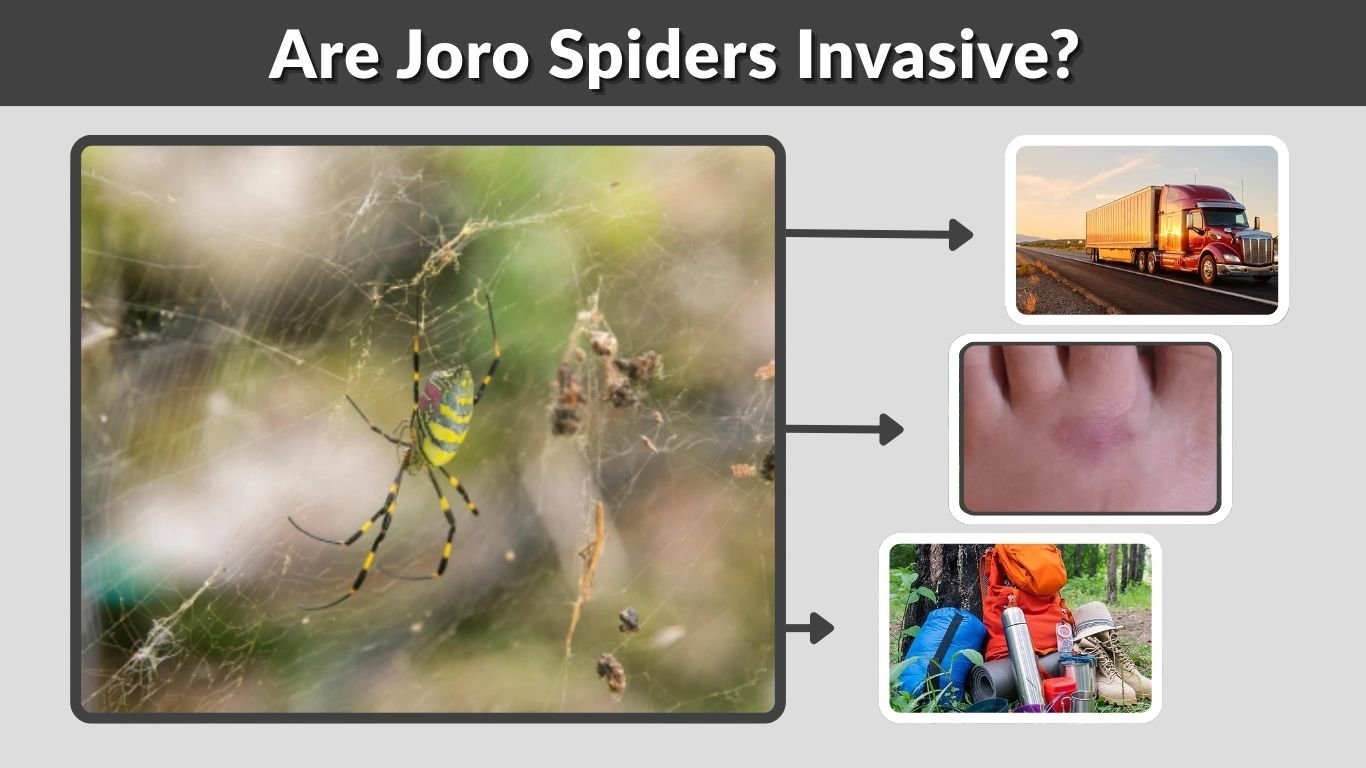
Are Joro spiders invasive? Yes, the Joro spider (Trichonephila clavata) is a nonnative species established and spreading in the United States, and University of Georgia resources classify it as an invasive species. However, scientists are still studying how seriously it affects native spiders, insects, and ecosystems. Originally from East Asia, Joro spiders were first documented in northeast Georgia in 2014. Since then, they have expanded across the Southeast and appeared in additional eastern states, aided by natural dispersal and accidental human transportation.
Are Joro Spiders Really Invasive?
Joro spiders are unquestionably nonnative and established in the United States. UGA Extension also categorizes them among invasive species. The important nuance is that “invasive” is sometimes used specifically for nonnative organisms proven to cause substantial harm. The Joro’s full ecological impact is still being investigated, so scientists continue studying whether it significantly displaces native species.
Why Joro Spiders Are Called Invasive
Several characteristics contribute to that description:
- They are native to East Asia, not North America.
- They have established reproducing U.S. populations.
- Their geographic range continues to expand.
- Young spiders can disperse through ballooning.
- Egg sacs or spiders may also travel with vehicles or cargo.
- Females can produce hundreds of eggs.
- They tolerate a broad range of environmental conditions.
Their successful establishment does not automatically prove that they are causing severe ecological damage, but it does make them an important introduced species to monitor.
Nonnative vs Invasive
A nonnative species occurs outside its historical natural range because of human activity, whether intentionally or accidentally.
An invasive species is generally a nonnative organism that spreads and causes, or has the potential to cause, ecological, economic, or other harm.
For Joro spiders, nonnative status and continued spread are well established. Exactly how much ecological harm they will cause over the long term remains less certain.
Where Did Joro Spiders Come From?
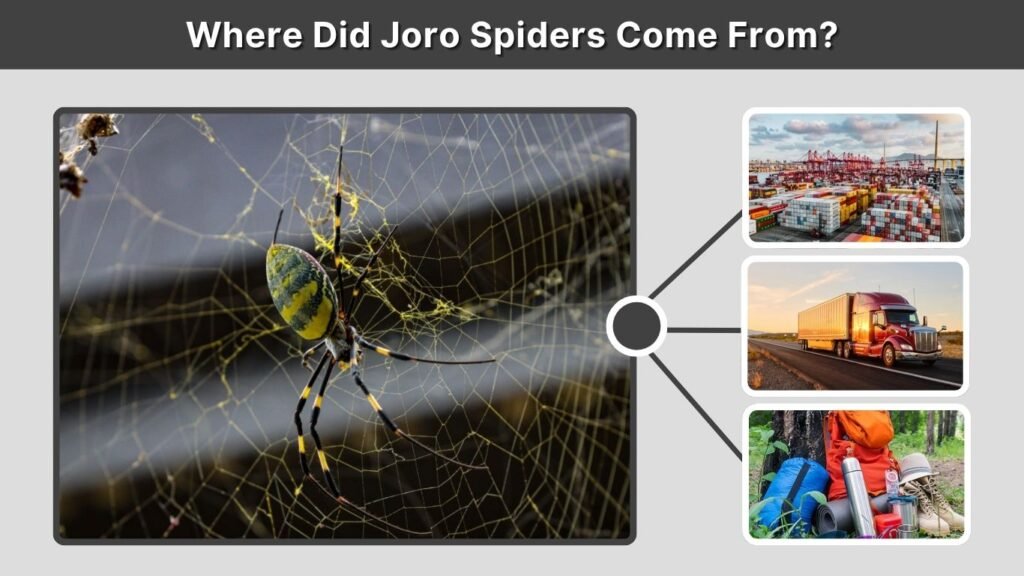
Joro spiders are native to a broad region of Asia. Their natural range extends through parts of East and Southeast Asia, including China, Korea, Japan, and areas farther west toward India and the Himalayan foothills. Their ability to survive across such varied climates helps explain why researchers believe they could occupy a much larger portion of the eastern United States.
How Did Joro Spiders Get to America?
Scientists cannot reconstruct the exact first journey, but accidental transportation associated with international trade is considered a likely explanation.
Spiders or egg sacs can potentially hitchhike on shipping containers, vehicles, outdoor equipment, or other transported materials.
The first confirmed U.S. population was documented in northeast Georgia in 2014, although the spiders may have been present for some time before being formally recognized.
How Did Joro Spiders Get to Georgia?
The earliest recognized population was concentrated near Braselton and Hoschton in northeast Georgia, close to Interstate 85.
UGA researchers reported that by 2022, Joro spiders had spread roughly 75 miles outward from the initial detection area. Their rapid establishment made northern Georgia one of the best-known regions for observing the species.
Where Are Joro Spiders Spreading?
Their U.S. range has continued expanding since the first Georgia record. As of 2026, UGA Extension reports established populations in several southeastern states and isolated populations farther north. Because observations continue to change, any range map represents a snapshot rather than the species’ final distribution.
Established and Reported Areas
UGA currently reports established populations in:
- Georgia
- North Carolina
- South Carolina
- Tennessee
- Alabama
Isolated populations have also been reported in:
- Virginia
- Maryland
- Pennsylvania
Additional observations may appear beyond these areas as monitoring continues.
Could Joro Spiders Spread Farther North?
Probably.
The spider’s native Asian distribution includes climates considerably colder than Georgia. UGA Extension states that there appears to be little climatic obstacle preventing the species from eventually spreading through much of the Southeast and potentially much of the eastern United States.
That does not mean every location will develop equally dense populations, but cold winters alone are unlikely to restrict them to Georgia.
Why Are Joro Spiders Spreading So Successfully?
Joro spiders have several biological characteristics that make expansion relatively easy. They reproduce annually, produce large egg masses, occupy many human-modified landscapes, and disperse effectively as spiderlings. Their ability to tolerate conditions around roads, houses, parks, woodland edges, and utility corridors provides many opportunities for populations to establish.
Ballooning Spiderlings
Young Joro spiders can disperse through ballooning.
A spiderling releases silk that catches air currents and helps carry it away from the place where it hatched. Most may travel relatively short distances, but this process allows populations to expand gradually without relying entirely on human transportation.
Ballooning is a normal dispersal behavior among many spiders, not a unique adaptation of the Joro.
Large Egg Masses
Female Joro spiders lay their eggs during fall.
UGA Extension reports that egg sacs commonly contain about 400–500 eggs. Earlier observations have sometimes reported even larger batches. Eggs survive winter and begin hatching during spring, generally around April and May.
Only a fraction survive to adulthood, but high egg production helps populations persist and expand.
Are Joro Spiders Harming Native Spiders?
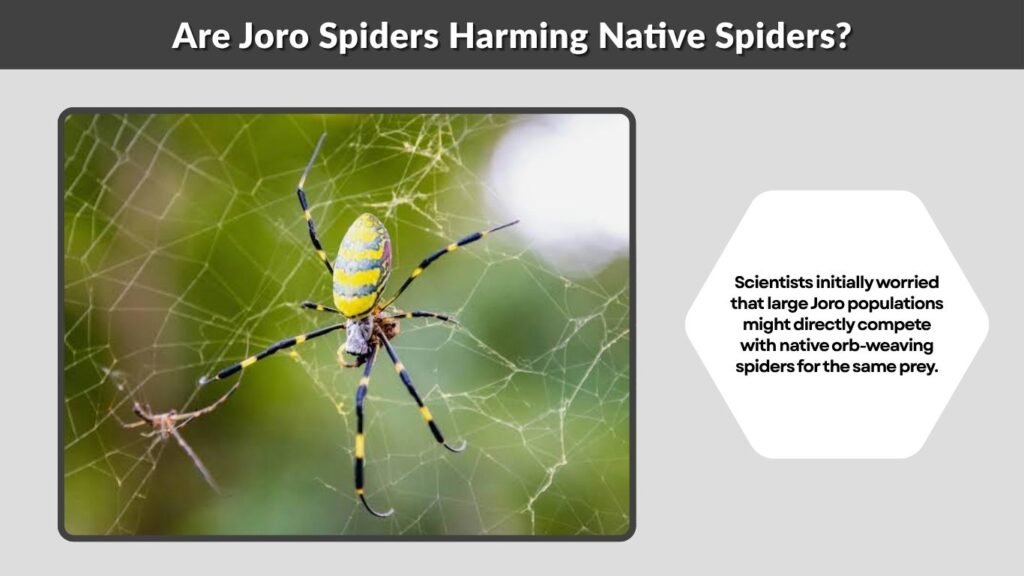
This is one of the most important unanswered questions. Scientists initially worried that large Joro populations might directly compete with native orb-weaving spiders for the same prey. New research suggests the situation may be more complicated and potentially less competitive than originally feared.
What Recent Research Found
A 2026 University of Georgia study compared the diets of Joro spiders with native orb weavers.
Researchers found that Joros ate a broader variety of insects, and there was relatively little direct dietary overlap between them and the native spiders studied. That suggests competition for food may be lower than some scientists initially expected.
This does not prove that Joros have no ecological impact. Food competition is only one possible interaction.
What Scientists Still Need to Learn
Researchers continue examining questions such as:
- Whether Joros reduce native spider abundance
- Whether they alter local insect communities
- How much they consume pollinators
- Whether native predators readily eat them
- How populations change over many years
- Whether their ecological effects differ between regions
UGA Extension therefore advises against assuming either that Joro spiders are harmless or that they are causing ecological disaster. More long-term evidence is needed.
Do Joro Spiders Eat Native Insects?
Yes. Like other orb-weaving spiders, Joros are generalist predators. Their webs capture many flying insects, including flies, beetles, moths, bees, and other arthropods. This means they can consume both insects people consider pests and beneficial species such as pollinators.
Their Broad Diet
The 2026 UGA research found Joro spiders consumed a wider diversity of prey than the native orb weavers sampled in the study.
Some prey types detected in Joros were not found in the native spiders that researchers examined.
This flexibility probably contributes to the Joro’s ability to establish populations in varied environments.
Are Joro Spiders Dangerous to People?
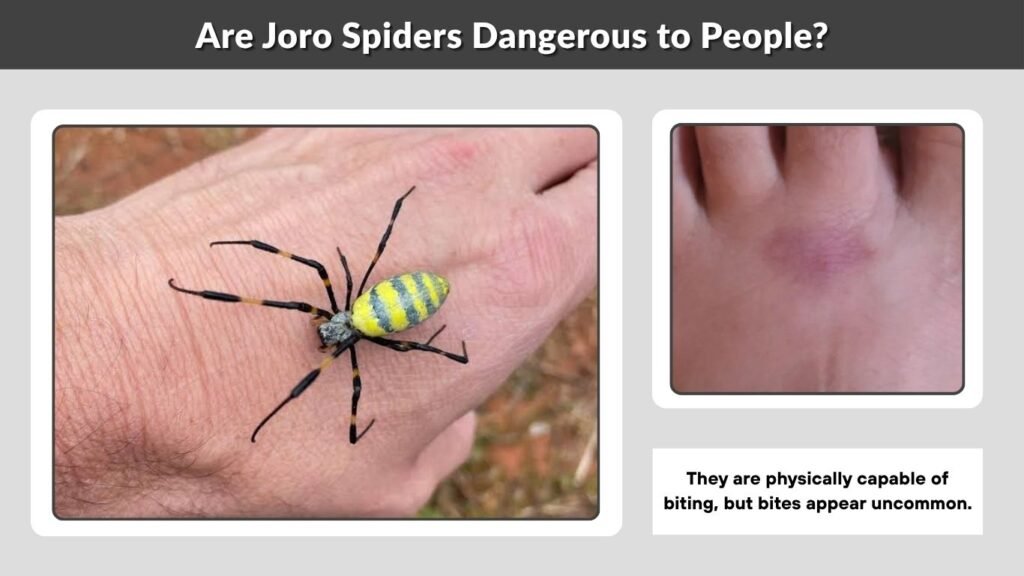
Despite their appearance, Joro spiders are not considered a significant threat to humans. Adult females are large and brightly colored, but they generally remain in their webs and are reluctant to bite. Their venom is designed for subduing insect prey rather than attacking people.
How Big Do Joro Spiders Get?
Adult females are dramatically larger than males.
Females can have bodies over an inch long, with long legs making the entire spider span several inches. Males are much smaller, more slender, and less brightly colored.
Their giant webs can make them seem even more intimidating because mature females may construct structures spanning many feet between trees, buildings, or utility lines.
Do Joro Spiders Bite?
They are physically capable of biting, but bites appear uncommon.
Joro spiders usually remain defensive rather than aggressive when disturbed. Their large size does not mean they actively pursue humans.
As with any wild spider, handling them directly is unnecessary.
Should Joro Spiders Be Killed?
UGA Extension currently advises against large-scale insecticide treatment simply to eliminate Joro spiders. Scientists still do not fully understand their ecological effects, and broad-spectrum pesticides can kill native spiders, butterflies, pollinators, predators, and other beneficial organisms at the same time.
When Removal Makes Sense
Removal can be reasonable when webs occur:
- Across frequently used walkways
- Around doors
- Across porches or decks
- Near children’s play areas
- Around beehives
- Directly around pollinator gardens
- In other high-contact locations
UGA recommends leaving spiders alone in out-of-the-way areas where they are not interfering with people.
Avoid Area-Wide Spraying
Large-scale pesticide spraying may create more ecological harm than simply tolerating the spiders.
Broad-spectrum insecticides kill many insects and spiders indiscriminately. Removing beneficial predators can even contribute to increases in pests such as aphids, scales, mites, and mealybugs.
Physical removal is generally more targeted when individual Joro webs create a nuisance.
Will the Joro Spider Invasion Stop?
There is currently little reason to expect Joro spiders to disappear naturally from the United States. They are already reproducing successfully across a growing region and appear capable of surviving climates well beyond Georgia.
A Species Likely Here to Stay
UGA monitoring continues to document expansion.
The 2025 Joro Watch project received thousands of verified observations across more than 100 counties, helping researchers map continued movement through the Southeast and farther north.
Rather than attempting complete eradication, research and management increasingly focus on tracking their distribution and understanding their ecological impact.
FAQs
1. Are Joro spiders an invasive species?
Yes. University of Georgia resources classify Joro spiders as an invasive, nonnative species in the United States. However, the severity of their long-term ecological impact is still being studied.
2. Why are Joro spiders considered invasive?
They are native to Asia, have established self-sustaining U.S. populations, and continue spreading into new regions. Their potential effects on native ecosystems remain an active research topic.
3. Are Joro spiders invasive in Georgia?
Yes. Georgia was the first U.S. state where they were documented, in 2014, and the species is now firmly established there.
4. Are Joro spiders harmful to native spiders?
Current research has not established major food competition. A 2026 UGA study found relatively little dietary overlap between Joros and the native orb weavers examined, although other ecological effects remain under investigation.
5. Will Joro spiders spread across the United States?
Their eventual range is uncertain, but researchers consider substantial additional expansion possible. Their Asian range suggests they can tolerate climates across much of the eastern United States.
