
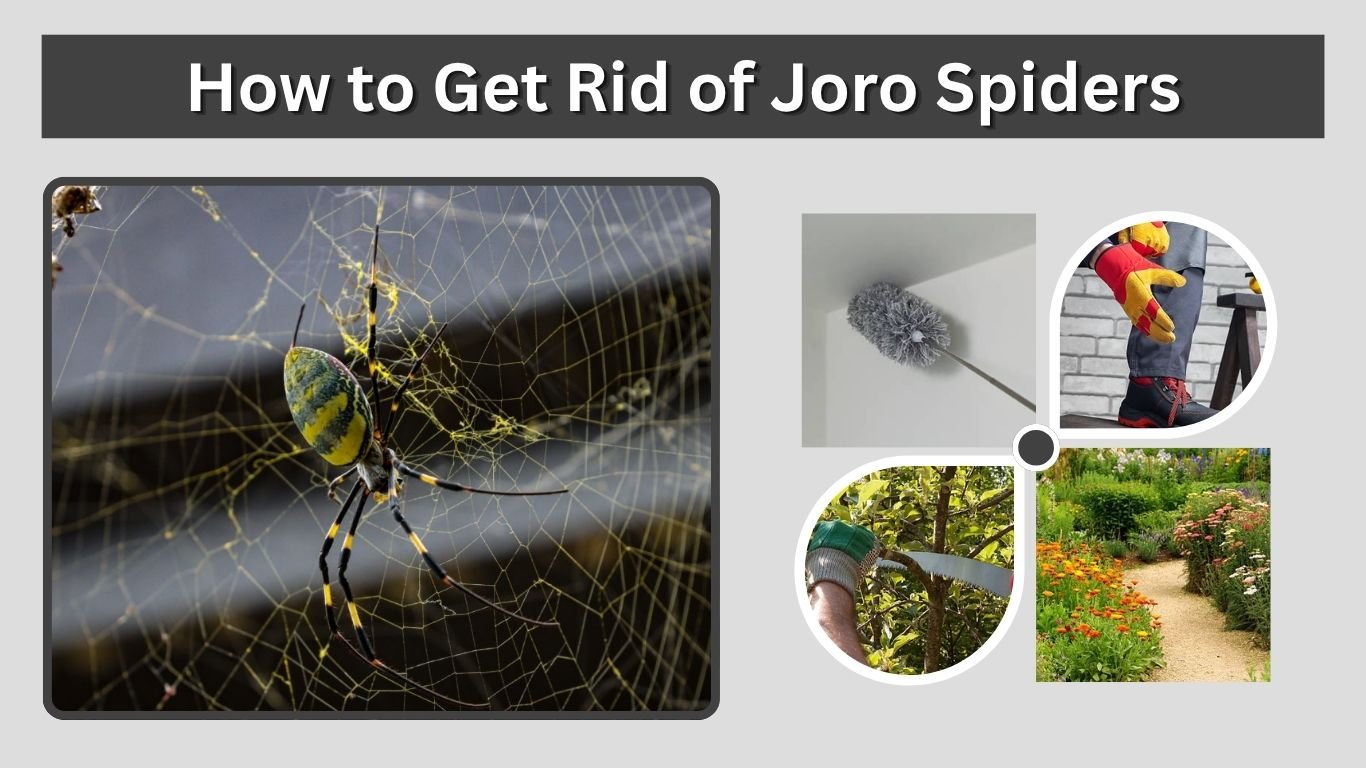
Learning how to get rid of Joro spiders can help when their huge golden webs begin covering porches, decks, walkways, trees, or other frequently used outdoor areas. Joro spiders (Trichonephila clavata) are large invasive orb-weavers now established in parts of the southeastern United States. Although they look intimidating, they are generally timid and rarely create a medical concern for people. Effective control focuses on physically removing problem spiders and webs, reducing attractive web-building locations, managing egg sacs where practical, and using pesticides only when necessary.
What Are Joro Spiders?
Joro spiders are golden orb-weavers native to East Asia. They were first documented in the United States in northeast Georgia in 2014 and have since become established across several southeastern states, with additional populations farther north. Their enormous golden webs make mature females especially noticeable from late summer through fall.
How to Identify a Joro Spider
Adult females are distinctive and may have:
- Yellow and dark blue-black markings
- Long legs with yellow bands
- A red patch on the underside
- Large yellow or golden orb webs
- An elongated abdomen
- A leg span reaching several inches
- Much smaller brownish males nearby
Mature female bodies can exceed one inch in length, while their overall leg span may approach about four inches.
Why Are Joro Spiders Around Homes?
Joros build webs wherever suitable anchor points and flying insects are available.
Trees, shrubs, porch columns, gutters, decks, utility lines, fences, and roof edges can all provide attachment points. Their webs become increasingly large and strong as females mature.
University of Georgia Extension reports that mature webs may span 10 feet or more, with support strands stretching beyond 20 feet.
How to Get Rid of Joro Spiders
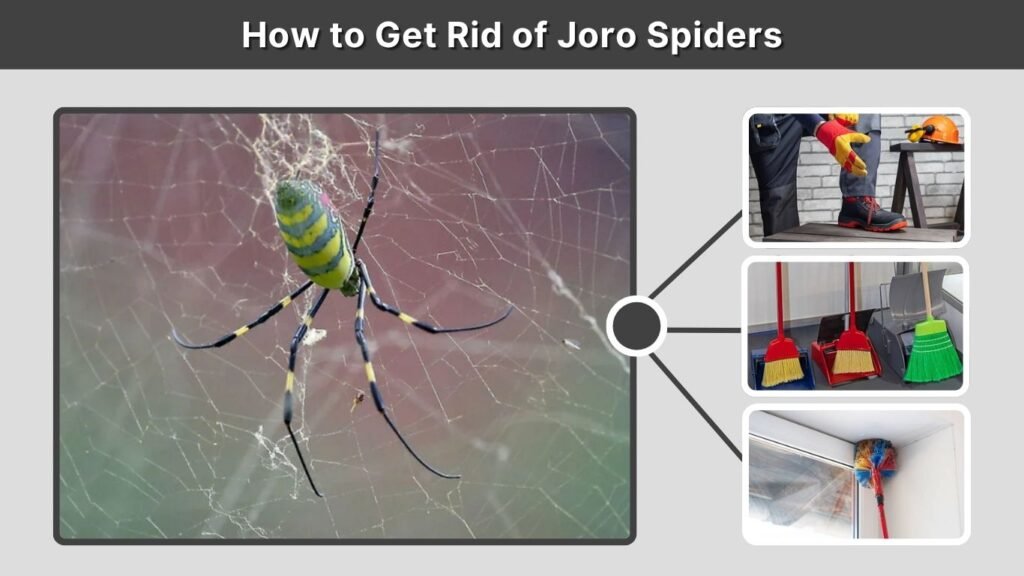
The best approach depends on where the spider is located. A Joro high in a tree generally does not require control, while one repeatedly stretching a web across a doorway or walkway can become an obvious nuisance. UGA Extension recommends concentrating control on spiders occupying places where people will inevitably encounter their webs.
Step-by-Step Joro Spider Removal
For accessible spiders:
- Wear gloves and closed-toe shoes.
- Use a long broom, rake, or stick.
- Gather the web toward the spider.
- Remove both the spider and web together.
- Relocate the spider well away from the problem area if desired.
- Clear remaining web strands from the structure.
- Check the area over the following days.
- Repeat if another spider establishes a web.
Simply destroying the web while leaving the spider nearby is often ineffective because Joros can rebuild quickly.
Should You Remove Every Joro Spider?
Usually not.
A spider living at the edge of a property, high in a tree, or in vegetation that people rarely enter can often be ignored.
UGA specifically suggests focusing on webs near porches, decks, walkways, and doorways instead of attempting to eliminate every spider in the landscape.
How to Get Rid of Joro Spiders Naturally
Physical removal is the simplest pesticide-free control method. Because Joros spend most of their time in webs, homeowners can often deal with a small number without chemical treatment. Natural management is especially appropriate where children, pets, pollinator plants, or beneficial insects make broad insecticide applications undesirable.
Natural Control Methods
Try these approaches:
- Remove accessible spiders with a broom or long tool.
- Take down webs in frequently used areas.
- Relocate spiders away from patios and entrances.
- Remove accessible egg sacs before spring hatch where practical.
- Reduce unnecessary outdoor lighting near problem locations.
- Keep vegetation from directly touching porches or doorways.
- Monitor favorite web-building locations regularly.
Joros overwinter as eggs, which hatch mainly in April and May. Females deposit silk-covered egg masses in fall on bark, leaves, and structures. Removing an accessible egg mass can therefore reduce the number emerging at that immediate location, although it cannot prevent spiders from arriving from surrounding areas.
Will Removing the Web Get Rid of the Spider?
Not by itself.
A Joro can rebuild an orb web rapidly if it remains in the same location.
For better results, remove or relocate the spider together with the web. If the location continues to provide excellent attachment points and plenty of insects, another spider may eventually occupy it.
How to Keep Joro Spiders Away From Your House
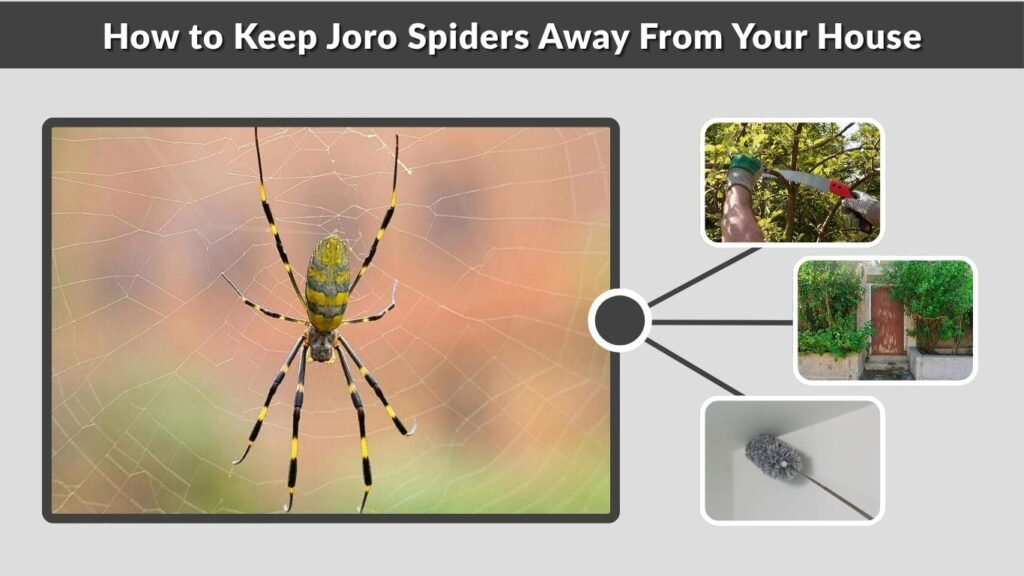
Completely preventing Joro spiders from entering a yard is unrealistic once they are established in the surrounding region. Young spiders disperse naturally, and adults build webs wherever conditions are favorable. Prevention therefore means making high-traffic parts of the property less convenient for web building rather than trying to create a spider-free landscape.
Reduce Web-Building Areas
Around frequently used areas:
- Trim branches touching decks and porches.
- Cut back vegetation around doorways.
- Remove abandoned webbing regularly.
- Keep shrubs from forming narrow gaps across walkways.
- Check eaves and porch corners during summer.
- Relocate newly established spiders early.
- Reduce insect-attracting lights where practical.
Removing a young web and spider is generally easier than dealing with a mature female and a web stretching many feet between structures.
Should You Use Insecticide on Joro Spiders?
Insecticides can kill Joro spiders, but chemical treatment is rarely necessary for every spider in a yard. UGA testing found that several products specifically labeled for spiders killed Joros when sprayed directly. However, dried residues are less useful against web spiders because the spiders spend relatively little time contacting treated surfaces.
When Chemical Control May Be Considered
A labeled spider-control product may be considered when an individual spider cannot be conveniently removed from an important location.
Always follow the current product label, including directions about where it may be applied and precautions around people, pets, plants, and water.
Avoid treating large areas simply because several Joros are present.
Avoid Broad Yard Spraying
Area-wide pesticide applications can kill far more than Joro spiders.
Broad-spectrum treatments may affect pollinators, predatory insects, parasitoids, and other beneficial organisms. UGA Extension specifically cautions that widespread spraying or fogging has broader ecological effects.
Targeted physical removal is therefore preferable for a few nuisance spiders.
How Did Joro Spiders Get to Georgia?
The exact route of the original introduction cannot be proven, but scientists believe Joro spiders probably reached the United States accidentally through international commerce. Their first confirmed U.S. population was found in northeast Georgia, close to the Interstate 85 corridor.
Arrival in the United States
Joro spiders are native to East Asia, including Japan, Korea, and parts of China.
UGA researchers consider accidental transport in shipping materials or containers a likely explanation for their arrival. After becoming established, the spiders expanded outward from northeast Georgia.
How Do Joro Spiders Spread?
Young spiders can disperse through a behavior called ballooning.
Spiderlings release silk that catches moving air and carries them to new locations. Human transportation may also move spiders or egg sacs between areas.
By 2026, UGA listed established populations in Georgia, North Carolina, South Carolina, Tennessee, and Alabama, with isolated populations farther north.
How Big Do Joro Spiders Get?
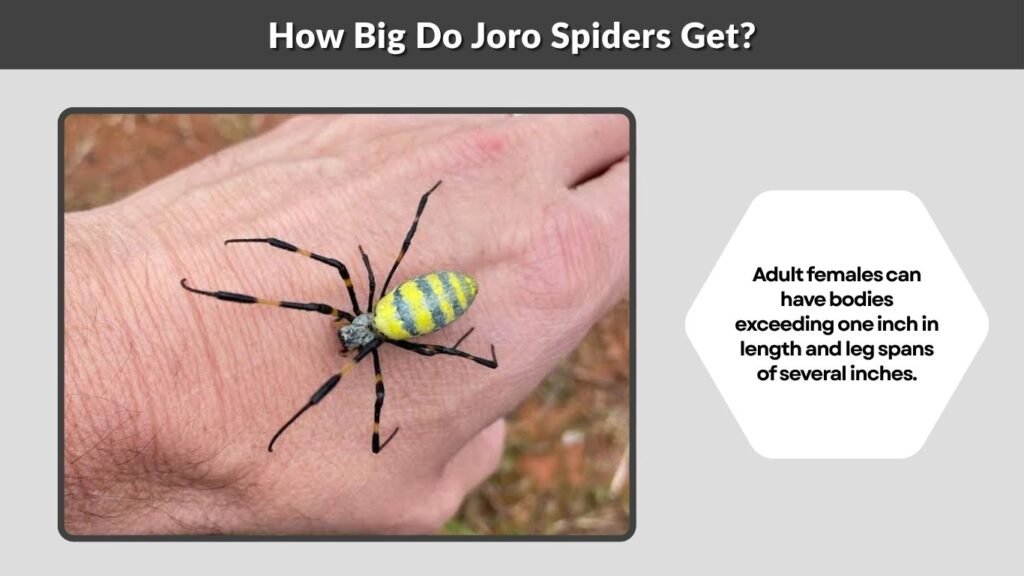
The dramatic appearance of adult females is one reason Joro spiders attract so much attention. Females are many times larger than males and become easiest to notice toward the end of summer.
Female vs Male Joro Spider
Adult females can have bodies exceeding one inch in length and leg spans of several inches.
Males are much smaller, with brown bodies and dark legs, and may be difficult to notice even when occupying the same web system as a female.
Joros grow gradually during summer before adults become particularly conspicuous around August, September, and October.
Are Joro Spiders Dangerous?
Their size and bright colors can make Joros look threatening, but current evidence suggests they pose little danger to most people. They are timid spiders whose first response to disturbance is generally to retreat rather than attack.
Do Joro Spiders Bite?
They are capable of biting, but bites appear uncommon.
UGA researchers report that even when Joros were handled roughly during field work, they generally did not bite.
As with any wild spider, avoid intentionally handling one with bare hands. People who experience significant pain, swelling, breathing difficulty, or other concerning symptoms after any suspected spider bite should seek appropriate medical care.
When Should Joro Spiders Be Left Alone?
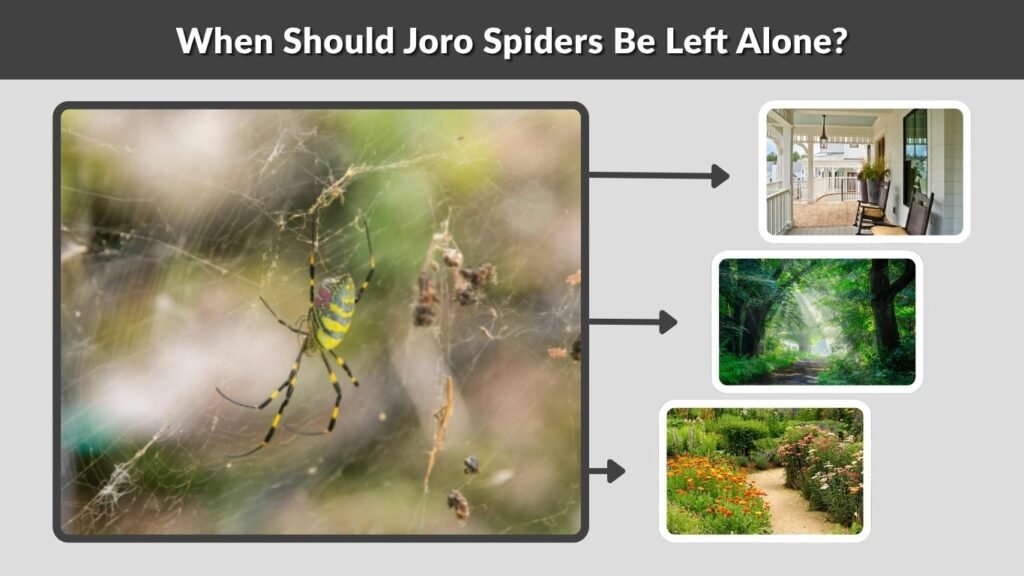
Not every web requires removal. Joro spiders capture many insects, and their ecological effects in North America continue to be studied. Recent UGA research found that their prey can differ considerably from that of some native orb-weaving spiders.
Choose Control Based on Location
A practical approach is to remove spiders that interfere with doors, porches, walkways, decks, flower gardens, or beehives while tolerating individuals in less-used areas.
This reduces nuisance webs without relying on broad pesticide applications.
Because Joros are already established across a growing region, eliminating a few spiders from one yard will not eliminate the species locally.
FAQs
1. What is the best way to get rid of Joro spiders?
For a small number of nuisance spiders, physically removing the spider together with its web is one of the simplest methods. Removing only the web is less effective because the spider can rebuild it quickly.
2. How do I get rid of Joro spiders naturally?
Use a long broom or rake to remove accessible spiders and webs, relocate spiders away from high-traffic areas, manage accessible egg sacs, and reduce convenient web-building sites near porches and doorways.
3. How did Joro spiders get to Georgia?
They were first documented in northeast Georgia in 2014. Researchers believe the original spiders were probably transported accidentally through international shipping or commerce.
4. How big can Joro spiders get?
Adult females can have bodies longer than one inch and an overall leg span approaching several inches. They are dramatically larger than adult males.
5. Can Joro spiders be permanently eliminated from a yard?
Probably not in areas where they are already well established. New spiderlings can disperse naturally into the property. The practical goal is to remove spiders from high-traffic locations and manage webs where they create a nuisance.
