
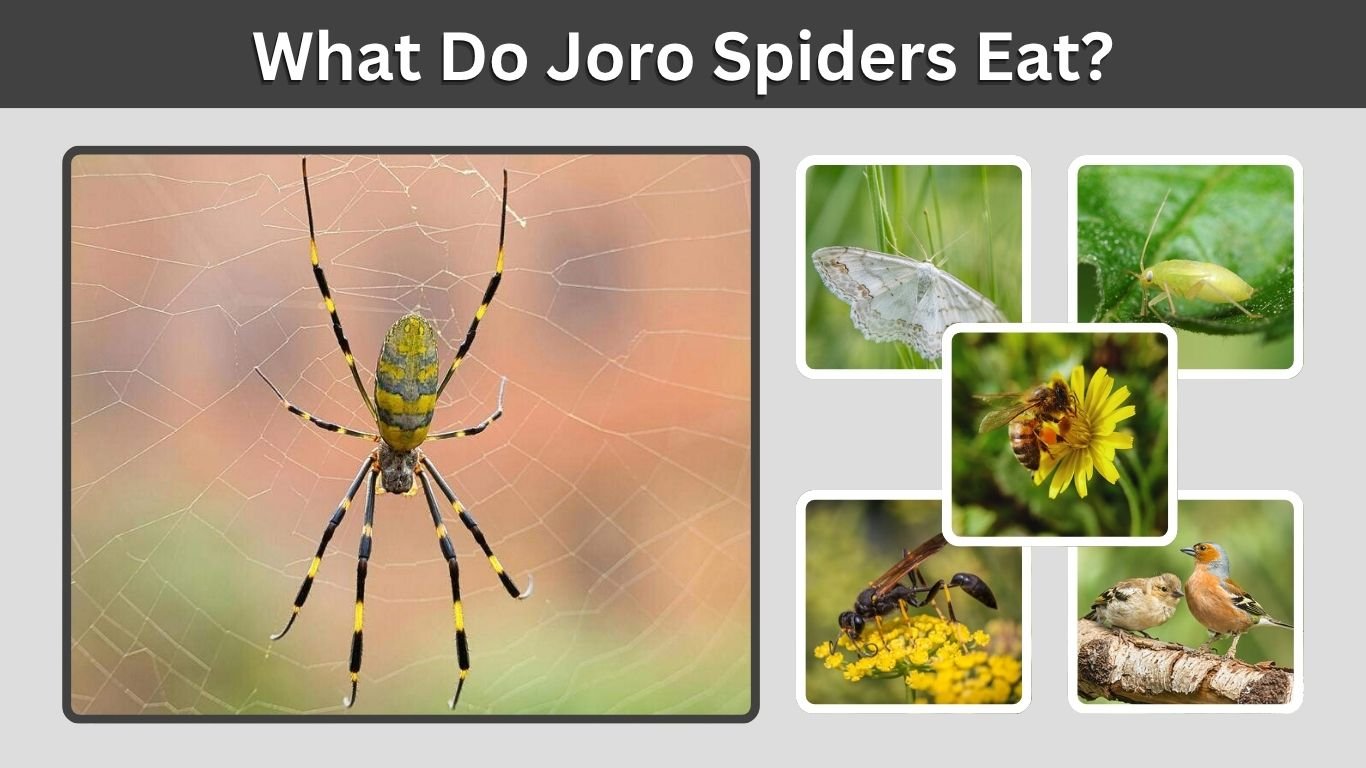
What do Joro spiders eat? Joro spiders (Trichonephila clavata) are generalist predators that mainly capture flying insects in their large golden orb webs. Their diet can include flies, moths, mosquitoes, beetles, stink bugs, bees, wasps, grasshoppers, and other available arthropods. They may even catch invasive pests such as spotted lanternflies. Rather than actively chasing prey, Joro spiders wait for insects to become trapped in their silk, then immobilize and feed on them. Their exact diet changes according to prey availability, season, and habitat.
What Do Joro Spiders Eat?
Joro spiders are opportunistic carnivores. They do not specialize in one particular insect but instead consume suitable prey that becomes trapped in their large aerial webs. Research suggests their menu can be surprisingly diverse. A recent UGA study analyzing digestive material from more than 200 Joro spiders found that they consumed a broader variety of prey than nearby native orb-weaving spiders.
How Joro Spiders Catch Food
Joro spiders construct large orb webs containing strong, sticky silk.
When a flying insect hits the web, vibrations alert the spider. It moves toward the prey, uses silk to restrain it, and may bite it with its fangs.
Venom helps immobilize the animal while digestive fluids break down tissues so the spider can consume the liquefied material.
Their large webs allow them to intercept insects of many sizes.
What Do Joro Spiders Eat? 10 Best Foods
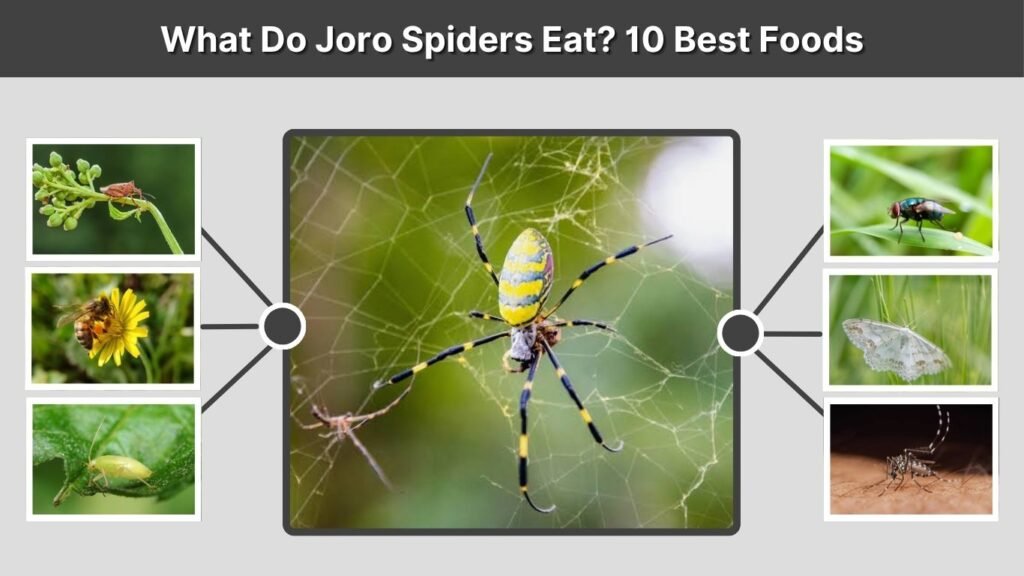
There is no scientific ranking showing that Joro spiders prefer exactly ten foods. However, observations, research, and knowledge of orb-weaver feeding behavior identify several important prey groups. Their actual meals depend largely on which insects happen to encounter the web. UGA researchers describe Joros as generalists capable of consuming numerous common insects.
1. Flies
Flies appear to be an important part of the Joro spider’s diet.
In the 2026 UGA dietary study, researchers reported that Joro spiders preyed heavily on flies and detected a diverse selection of prey species in their digestive systems.
Flying behavior makes flies particularly vulnerable to orb webs stretched between trees, shrubs, buildings, and power lines.
Small and medium-sized flies can become entangled quickly, giving the spider time to approach and subdue them.
2. Moths
Moths are another natural food source.
Many moths fly at dusk or nighttime through the same vegetation where Joro webs are suspended. Once the wings touch sticky silk, escaping can become difficult.
Research on large golden orb-weavers indicates that moths and other Lepidoptera can form an important part of their prey base, and extension sources specifically list moths among insects Joros are likely to consume.
3. Mosquitoes
Do Joro spiders eat mosquitoes? Yes, mosquitoes can become prey if they fly into a Joro web.
University of Georgia Extension includes mosquitoes among common insects these generalist spiders are likely to capture.
However, it would be misleading to think Joro spiders provide reliable mosquito control. A large web may catch individual mosquitoes, but many other flying insects are also captured.
4. Brown Marmorated Stink Bugs
Stink bugs are one of the most interesting Joro spider prey items.
UGA Extension has specifically documented Joro spiders capturing and feeding on adult brown marmorated stink bugs, an invasive pest that some native predators may avoid.
Their ability to consume these relatively tough insects has attracted attention because brown marmorated stink bugs can damage fruit, vegetables, and other crops.
5. Beetles
Joro spiders can capture beetles when they fly into their webs.
UGA has documented an immature Joro feeding on a scarab beetle, demonstrating that these spiders can handle relatively substantial beetle prey.
Beetles vary greatly in size and defensive ability, so not every species will become a successful meal.
Japanese beetles are also scarab beetles and could potentially become trapped, but this does not mean Joros specifically prefer them.
6. Bees
Bees can unfortunately become Joro spider prey.
This is important because Joros do not distinguish between insects humans consider pests and beneficial pollinators. UGA has photographed a bee almost as large as the spider itself trapped in a Joro web and recommends avoiding webs near beehives and pollinator gardens when practical.
This illustrates why Joro spiders should not simply be viewed as natural pest-control machines.
7. Wasps
Wasps and other Hymenoptera can also become trapped.
Large orb-weavers generally consume a variety of flying hymenopterans, and UGA Extension includes wasps among the common insect groups likely to be eaten by Joro spiders.
The outcome may depend on the wasp’s size and ability to defend itself. Some wasps are themselves spider predators, creating a predator-prey relationship that can work in either direction.
8. Grasshoppers
Joro spiders can eat grasshoppers and similar insects if they become trapped.
Rutgers specifically lists grasshoppers among arthropods consumed by Joro spiders.
A grasshopper’s relatively large body can create powerful web vibrations, allowing the spider to detect it quickly.
Large prey can struggle strongly, however, so the spider may use substantial silk before attempting to bite and feed.
9. Leafhoppers and Aphids
One of the most interesting findings from recent research involves much smaller plant-feeding insects.
The 2026 UGA study found DNA from insects including leafhoppers and aphids in Joro spiders and reported 26 prey species that were not detected in the native orb weavers examined in the same research.
This suggests Joro diets may be broader than obvious observations of large insects hanging in their webs would indicate.
10. Spotted Lanternflies
Joro spiders can consume spotted lanternflies, another invasive Asian insect now established in parts of the United States.
Rutgers identifies the spotted lanternfly as prey of Joro spiders, and observers have documented this interaction.
However, Joros should not be expected to control lanternfly populations. Experts caution that they may eat individual lanternflies without making a meaningful population-level reduction.
Do Joro Spiders Eat Other Spiders?
Joro spiders are primarily known for catching insects, but interactions with other spiders occur. Their huge webs may contain several spiders, including small males and kleptoparasitic species that steal food. Researchers are still studying how Joros interact with native spider communities and whether direct predation is ecologically significant.
Do Joro Spiders Eat Each Other?
Cannibalism can occur among spiders, and very small Joro spiderlings may potentially become prey for other spiders.
However, seeing several Joros associated with one web does not automatically mean they are hunting each other.
Adult female webs commonly contain one or more much smaller males. UGA researchers have observed as many as ten males associated with one female’s web.
Do Female Joro Spiders Eat Males?
Sexual cannibalism is possible in spiders, but it should not be assumed that every female Joro eats her mate.
Male Joros are dramatically smaller than females and approach females cautiously for mating.
Their size difference is extreme: UGA notes that adult females can be up to roughly 500 times heavier than males.
Do Joro Spiders Eat Birds or Hummingbirds?
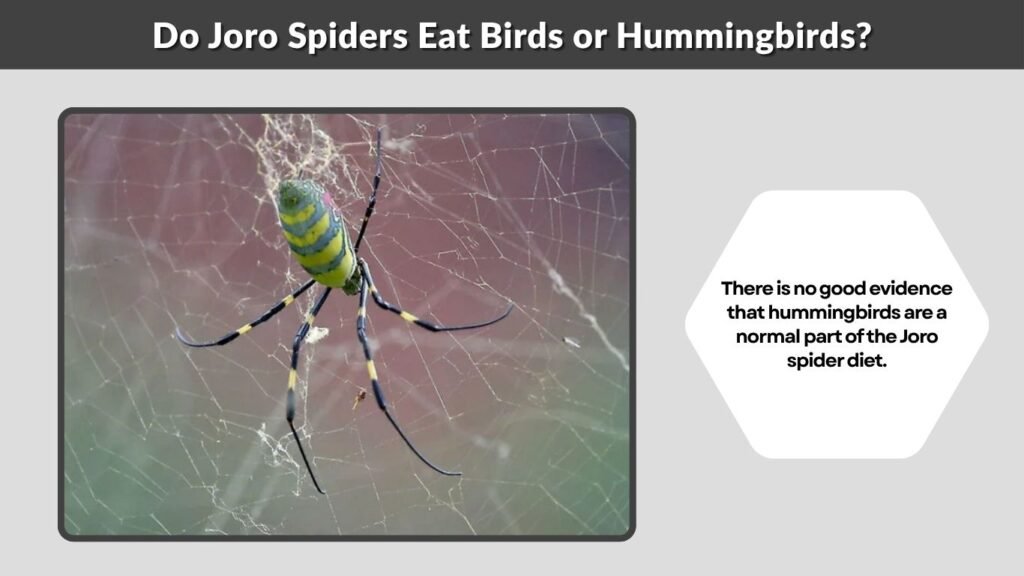
Their enormous webs sometimes create dramatic stories about birds becoming spider food. Joro silk is remarkably strong, but birds are not normal prey for this species. Joro spiders primarily feed on insects and other relatively small arthropods rather than vertebrates.
Can a Joro Spider Eat a Hummingbird?
There is no good evidence that hummingbirds are a normal part of the Joro spider diet.
A small bird might accidentally contact a large web, but encountering silk is very different from being successfully captured, killed, and eaten by the spider.
Research describes Joros primarily as predators of flying insects and potentially other small animals, not bird specialists.
Do Joro Spiders Eat Ticks?
Ticks are unlikely to represent a significant Joro spider food source. Joros usually build aerial webs designed to intercept flying or jumping arthropods. Ticks spend most of their time on vegetation, hosts, or the ground and therefore have little reason to encounter these webs.
Why Ticks Are Uncommon Prey
A tick could conceivably become trapped by accident, but there is currently little evidence that ticks make up an important part of Joro diets.
Claims that Joro spiders provide meaningful tick control should therefore be treated cautiously.
Their feeding ecology is much more strongly associated with flying insects.
What Eats Joro Spiders?
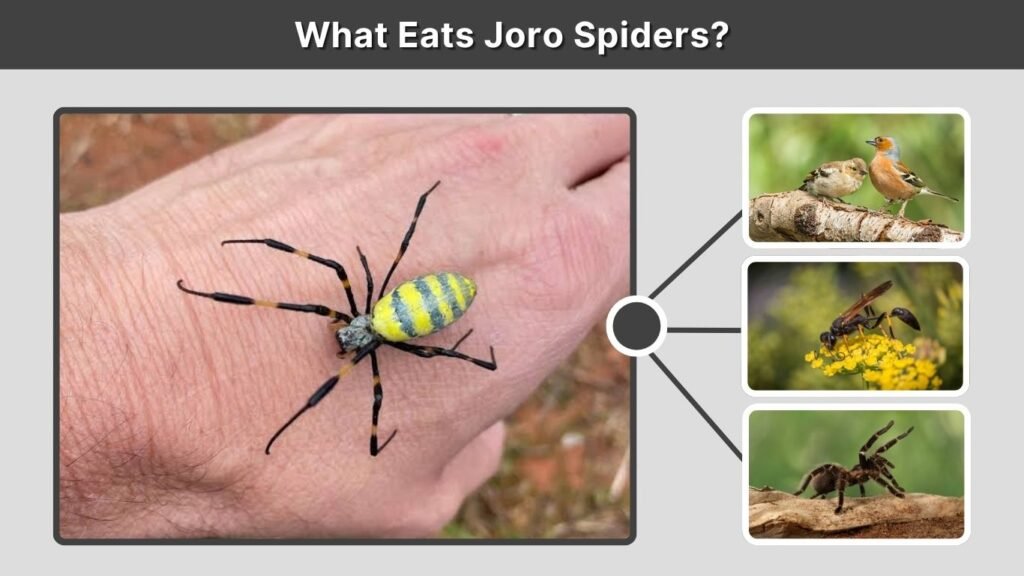
Joro spiders are predators, but they can become prey themselves. Scientists are still determining which North American predators regularly consume them because the spider is relatively new to the region. Birds and certain wasps have already been observed taking advantage of them.
Joro Spider Predators
Potential or documented predators include:
- Birds
- Mud dauber wasps
- Other spiders
- Spider-hunting parasitoid wasps
- Certain predatory insects
- Possibly other opportunistic vertebrates
UGA Extension specifically reports Joro spiders as prey for birds and mud dauber wasps.
Do Birds Eat Joro Spiders?
Yes, birds can eat Joro spiders.
Bird predation is one of the natural pressures Joros face in the United States, although researchers do not yet know how strongly birds limit their populations.
Birds may consume adult spiders or smaller individuals and can also take insects caught in Joro webs.
How Much Can Joro Spiders Affect Insect Populations?
Large Joro webs can capture impressive numbers of insects, but that does not automatically mean the species will dramatically reduce mosquitoes, stink bugs, or lanternflies. Researchers are still investigating its ecological effects in North America.
A Generalist, Not a Pest-Control Specialist
Joros consume both unwanted pests and beneficial insects.
That means a web can catch a stink bug one day and a bee the next. UGA’s current guidance emphasizes that the broader ecological effect is still being studied, and researchers advise against assuming the spider is either completely beneficial or severely harmful.
Their role is best understood as that of a broad, opportunistic predator.
FAQs
1. What do Joro spiders eat most?
Recent research indicates that Joro spiders eat a broad range of insects, with flies forming an important part of their diet. They also consume moths, beetles, stink bugs, bees, wasps, and other arthropods.
2. Do Joro spiders eat mosquitoes?
Yes. Mosquitoes can become trapped and eaten, although Joro spiders should not be relied upon as an effective method of controlling mosquito populations.
3. Do Joro spiders eat spotted lanternflies?
Yes. Joro spiders can eat spotted lanternflies, but scientists do not expect them to reduce lanternfly populations enough to function as meaningful biological control.
4. What animals eat Joro spiders?
Birds and mud dauber wasps have been documented as Joro spider predators. Other spiders and parasitoids may also attack them.
5. Do Joro spiders eat hummingbirds?
There is no evidence that hummingbirds are normal Joro spider prey. Their diet consists mainly of insects and other arthropods caught in their orb webs.
