
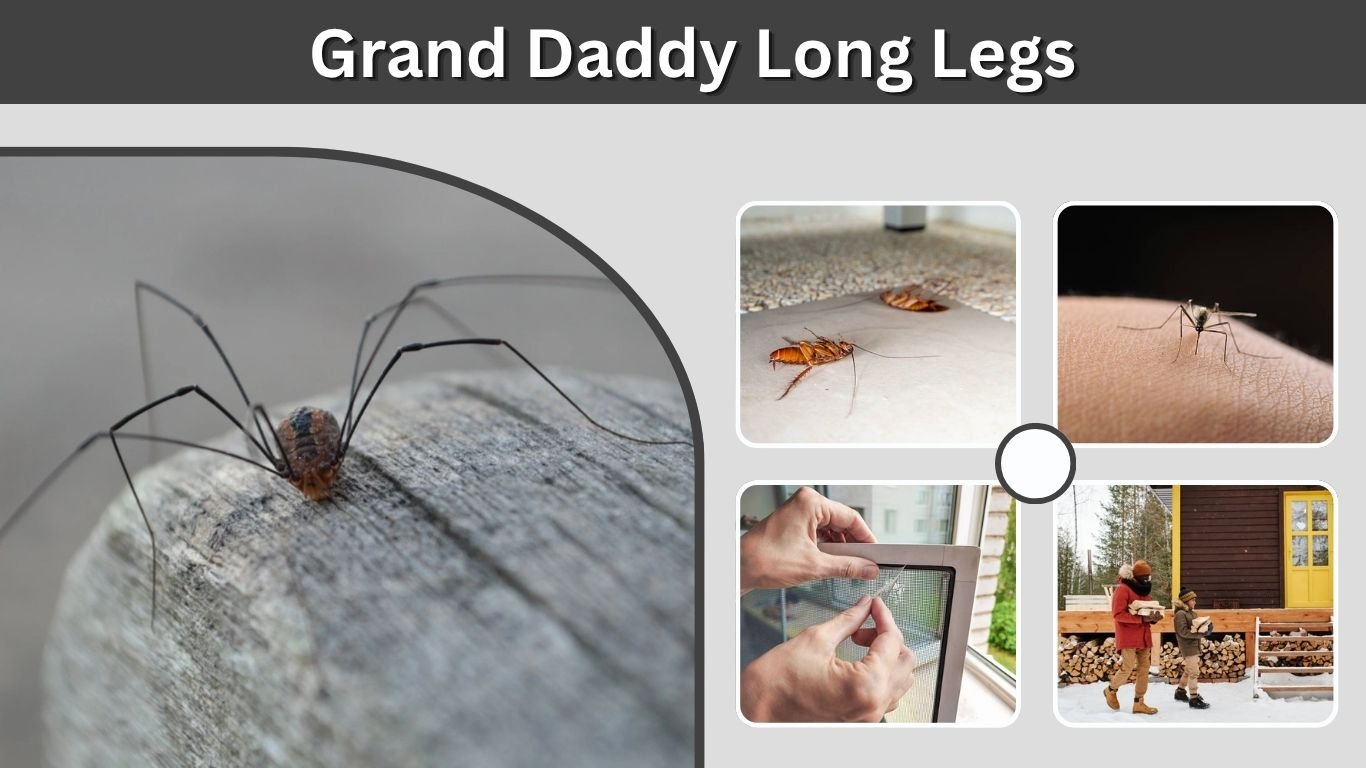
Grand daddy long legs are familiar arachnids recognized by their tiny bodies and extremely long, slender legs. The name most commonly refers to harvestmen in the order Opiliones, although people sometimes use it for cellar spiders as well. Despite a famous myth, harvestmen are neither highly venomous nor dangerous to humans. They lack venom glands and cannot spin webs. This guide explains whether grand daddy long legs are spiders, whether they bite, what they eat, where they live, and why they sometimes gather in large groups.
What Are Grand Daddy Long Legs?
The term “grand daddy long legs” or “granddaddy longlegs” is usually applied to harvestmen, arachnids belonging to the order Opiliones. They have eight legs like spiders, but their anatomy and behavior are different. The common name can cause confusion because long-legged cellar spiders are also called daddy longlegs in some regions.
Grand Daddy Long Legs Classification
The basic classification of a typical harvestman is:
- Kingdom: Animalia
- Phylum: Arthropoda
- Class: Arachnida
- Order: Opiliones
- Common names: Harvestman, daddy longlegs, granddaddy longlegs
- Number of legs: Eight
- Distribution: Found across much of the world except Antarctica
Thousands of harvestman species have been described worldwide, so appearance, size, and behavior can vary among species.
Are Grand Daddy Long Legs Spiders?
No. Grand daddy long legs are not spiders when the name refers to harvestmen. Both harvestmen and true spiders belong to the class Arachnida, but spiders belong to the order Araneae, while harvestmen belong to Opiliones.
A harvestman’s body appears broadly fused rather than having the clearly separated cephalothorax and abdomen typical of spiders. Harvestmen also lack silk glands and therefore cannot produce spider webs.
However, a cellar spider is a true spider and is sometimes called a grand daddy long legs spider. This naming overlap is responsible for many confusing claims about venom and webs.
Are Grand Daddy Long Legs Poisonous or Venomous?
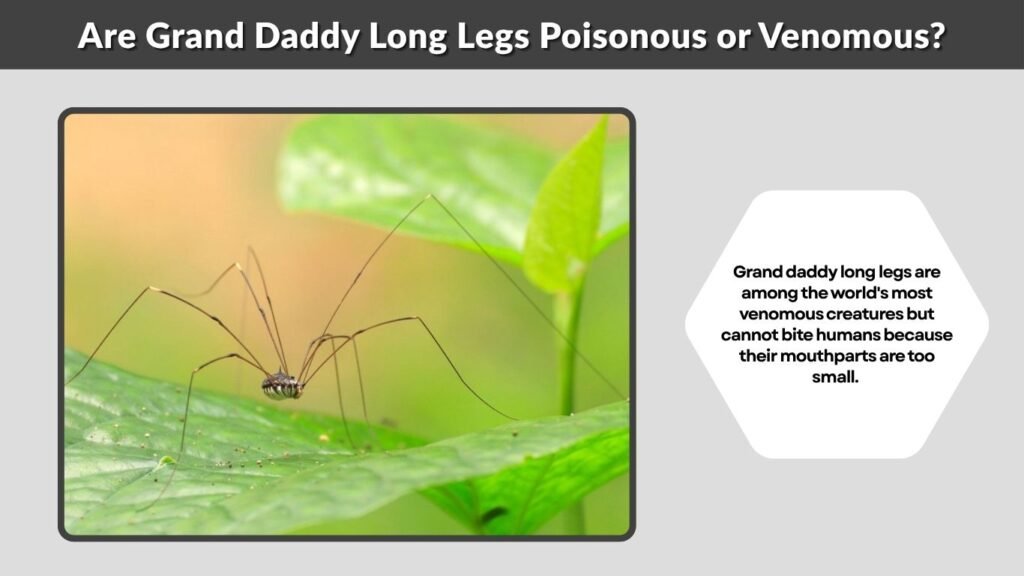
One of the most persistent stories claims that grand daddy long legs are among the world’s most venomous creatures but cannot bite humans because their mouthparts are too small. That claim is false for harvestmen. Harvestmen do not possess venom glands, so there is no extremely potent hidden venom waiting to be delivered through a bite.
The Grand Daddy Long Legs Venom Myth
Important facts behind the myth include:
- Harvestmen do not have venom glands.
- They are not venomous spiders.
- They do not inject medically important venom into people.
- They possess small mouthparts called chelicerae.
- They have defensive glands, but these are not venom-delivery systems.
- Harvestmen are considered harmless to humans.
The widespread “most poisonous spider” story therefore combines several incorrect ideas about their anatomy.
What About Cellar Spiders?
Cellar spiders are different. They belong to the spider family Pholcidae and do possess venom used to subdue prey. Nevertheless, common cellar spiders are not regarded as medically dangerous to humans.
So when someone asks whether a “grand daddy long legs spider” is venomous, identifying the animal first is important. A harvestman has no venom, while a cellar spider is a true spider with venom but is generally not considered dangerous to people.
Can Grand Daddy Long Legs Bite You?
Harvestmen have mouthparts used for feeding, but they are not considered a biting hazard to people. They do not hunt humans, defend themselves with venomous bites, or cause the type of medically significant bites associated with a few true spider species. University extension sources describe harvestmen as harmless to humans.
Grand Daddy Long Legs Bite Facts
Keep these points in mind:
- They do not have venomous fangs like true spiders.
- They normally avoid conflict with people.
- Handling one does not usually result in a bite.
- They are not known for medically significant human bites.
- A skin mark blamed on a harvestman may have another cause.
Because “daddy longlegs” can also mean a cellar spider, reports involving an actual spider should be considered separately.
Are Grand Daddy Long Legs Dangerous?
For ordinary household encounters, harvestmen pose very little risk to people. Their long legs and unusual movements can make them look intimidating, but their appearance does not reflect their danger level.
They are also not known for damaging buildings, clothing, furniture, or stored food in the way certain household pests can.
What Do Grand Daddy Long Legs Eat?
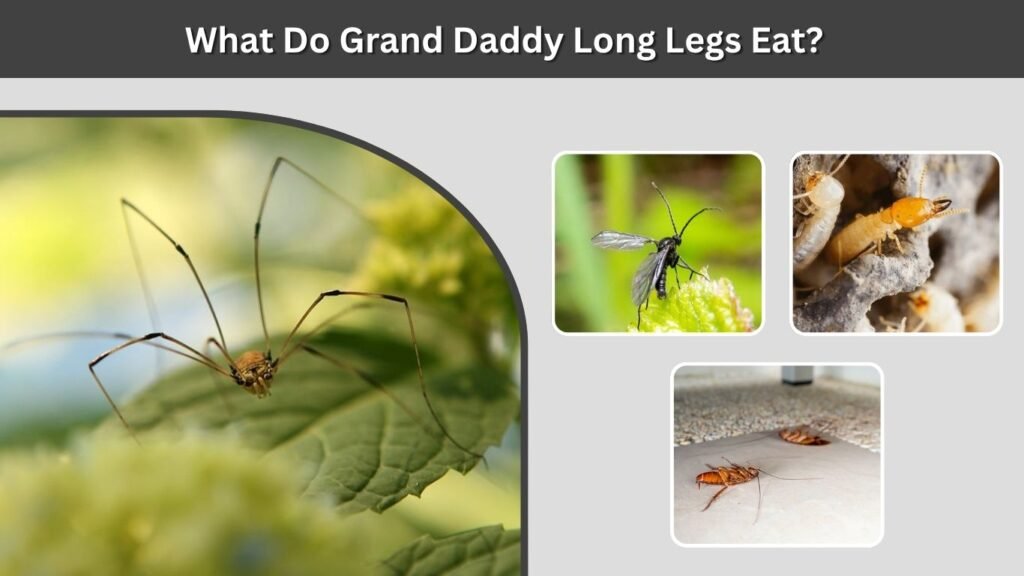
Harvestmen have a fairly broad diet. Depending on the species, they can act as predators, scavengers, or omnivores. Their feeding habits can actually make them useful outdoors because they consume small arthropods and organic material rather than attacking people, pets, or structures.
Grand Daddy Long Legs Diet
Their food may include:
- Small insects
- Other tiny arthropods
- Dead insects and arthropods
- Decaying organic material
- Plant juices
- Other small food particles they encounter while foraging
This varied diet allows harvestmen to occupy forests, grasslands, gardens, fields, and developed environments.
Do Grand Daddy Long Legs Make Webs?
No. Harvestmen cannot spin silk, so they do not make webs or traditional spider nests. If you see a very long-legged animal hanging in an irregular web in a basement, garage, or ceiling corner, it is more likely to be a cellar spider.
Harvestmen usually wander across the ground, vegetation, walls, rocks, and other surfaces while searching for food and sheltered resting places.
Why Do Grand Daddy Long Legs Gather in Clusters?
Seeing dozens or even hundreds of grand daddy long legs packed together can look alarming. However, aggregation is a known harvestman behavior. Groups may gather in sheltered locations where conditions help them conserve moisture and avoid unfavorable daytime conditions. They often become more active when environmental conditions are suitable for foraging.
Reasons They May Form a Ball or Cluster
Large groups can be associated with:
- Protection from dry environmental conditions
- Access to cool, humid shelter
- Suitable daytime resting sites
- Seasonal population increases
- Nearby food and favorable habitat
- Shared protected spaces beneath structures or vegetation
A cluster does not mean the animals are building a communal web or preparing to attack.
Where Do Grand Daddy Long Legs Live?
Harvestmen occupy many habitats, including forests, fields, wetlands, mountains, caves, gardens, and urban areas. Around homes, they may occur under logs, rocks, vegetation, porches, siding, or other protected locations.
Many species favor relatively humid environments because their bodies can lose moisture more readily than those of some other terrestrial arthropods.
Grand Daddy Long Legs Infestation and Control
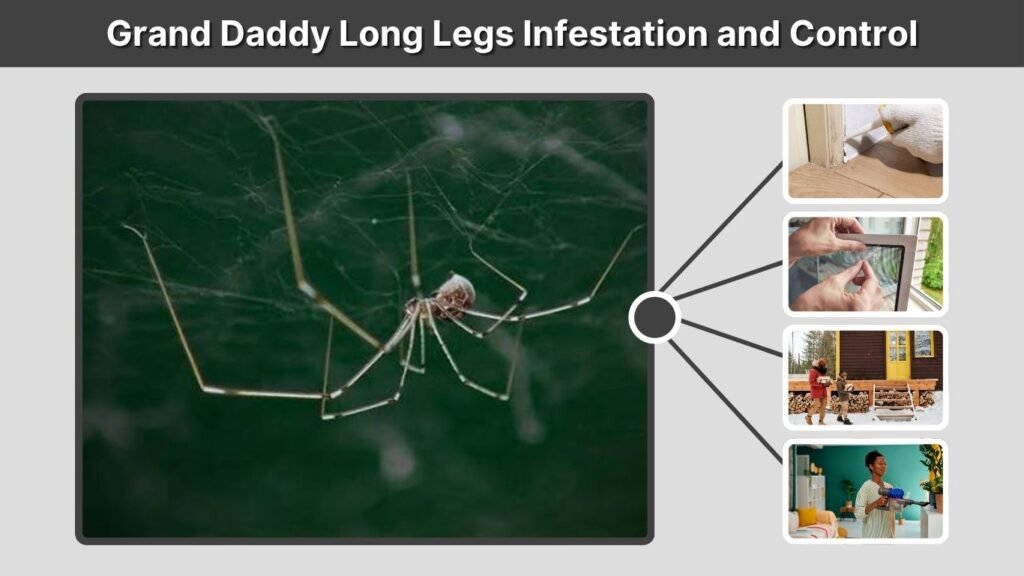
A few harvestmen around a property normally do not require control. They are harmless and may consume small arthropods or dead organic matter. Large numbers around doors, foundations, patios, or damp areas can nevertheless become a nuisance, especially when environmental conditions concentrate them close to buildings.
How to Get Rid of Grand Daddy Long Legs
Start with nonchemical prevention:
- Seal cracks around doors, windows, and foundations.
- Repair damaged screens.
- Reduce excessive moisture around the building.
- Remove unnecessary debris near exterior walls.
- Move firewood and dense vegetation away from the foundation.
- Sweep or vacuum individuals found indoors.
- Reduce outdoor conditions that provide excessive shelter.
Harvestmen are rarely common in the main living areas of homes, so correcting entry points and favorable outdoor hiding places is usually more useful than treating them like a serious indoor pest.
What Are Grand Daddy Long Legs Good For?
Harvestmen contribute to outdoor ecosystems by feeding on small arthropods and scavenging dead organisms and organic material. Because they are harmless to people and can consume other small creatures, there is usually little reason to remove them from gardens or natural areas.
Daddy Long Legs vs Grand Daddy Long Legs
There is generally no biological distinction between “daddy long legs” and “grand daddy long legs.” They are regional common names rather than separate scientific groups. The important distinction is which animal the speaker means: a harvestman or a cellar spider.
How to Tell Them Apart
A harvestman typically has a compact, apparently single oval body and wanders without a web. A cellar spider has a visibly divided spider body and is often found hanging in a loose, irregular web.
Knowing this difference resolves many questions about whether grand daddy long legs are spiders, whether they produce webs, and whether they possess venom.
FAQs
Grand daddy long legs generate many questions because several different long-legged creatures share similar common names. Most questions about poison, venom, bites, and spider classification can be answered by first determining whether the animal is a harvestman or a true cellar spider.
1. Are grand daddy long legs poisonous?
Harvestmen are not the dangerously poisonous creatures described in the popular myth. They lack venom glands and are regarded as harmless to humans.
2. Is a grand daddy long legs a spider?
A harvestman is not a true spider. It is an arachnid belonging to the order Opiliones. Cellar spiders, however, are sometimes given the same common name and are true spiders.
3. Can grand daddy long legs bite humans?
Harvestmen are not considered a human biting hazard and lack venom glands. They generally attempt to escape rather than interact defensively with people.
4. Why do I have so many grand daddy long legs?
Large numbers may occur when your property provides moisture, shelter, abundant food, and protected resting places. Seasonal conditions can also increase how many are visible at one time.
5. How long do grand daddy long legs live?
Lifespan varies considerably among harvestman species and climates. Their life cycle progresses through egg, juvenile stages, and adulthood, so there is no single lifespan that accurately applies to every animal called a grand daddy long legs.
