
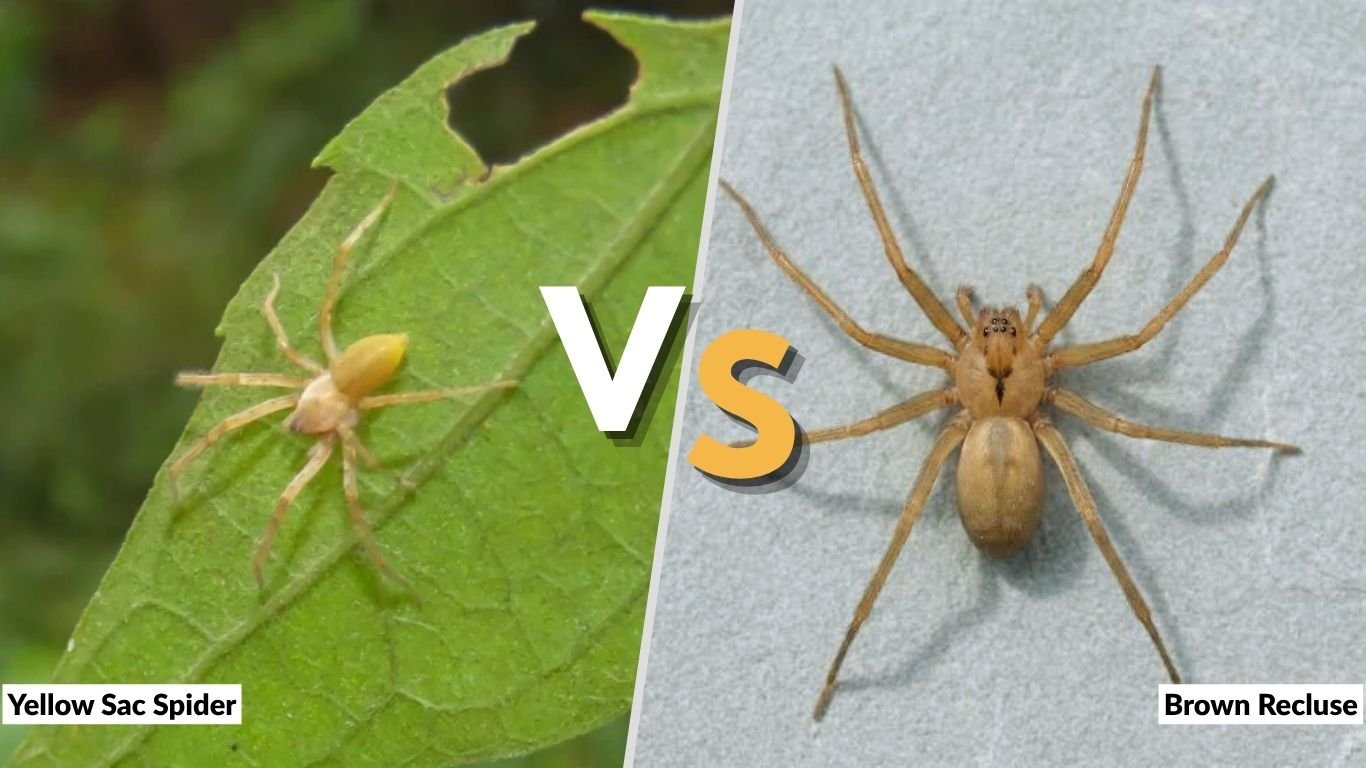
The yellow sac spider vs brown recluse comparison can be confusing because both spiders may appear tan, yellowish, or light brown and may occasionally enter homes. However, they are quite different when you examine their eyes, body markings, legs, behavior, and geographic range. Yellow sac spiders usually have eight eyes and a pale yellow-to-cream body, while brown recluses have six eyes arranged in three pairs and typically show uniform brown coloration. Their bites also differ in medical significance. This guide explains how to tell these spiders apart and what to do after a suspected bite.
Yellow Sac Spider vs Brown Recluse: Quick Comparison
Yellow sac spiders commonly found around homes include species in the genus Cheiracanthium, while the true brown recluse is Loxosceles reclusa.
Although both may be described simply as “small brown spiders,” careful identification reveals several important differences.
| Feature | Yellow Sac Spider | Brown Recluse |
| Typical color | Pale yellow, cream, tan | Light to medium brown |
| Eyes | 8 | 6 |
| Eye arrangement | Two rows | Three pairs |
| Abdomen | Often pale with subtle darker stripe | Uniformly colored |
| Legs | Pale, often darker at tips | Uniform brown, no stout spines |
| Violin mark | No | Often present |
| Web | Small silk retreat or sac | Irregular retreat web |
| Activity | Active hunter, often at night | Secretive, usually hidden |
| Medical concern | Usually localized symptoms | Can occasionally damage tissue |
What Does a Yellow Sac Spider Look Like?
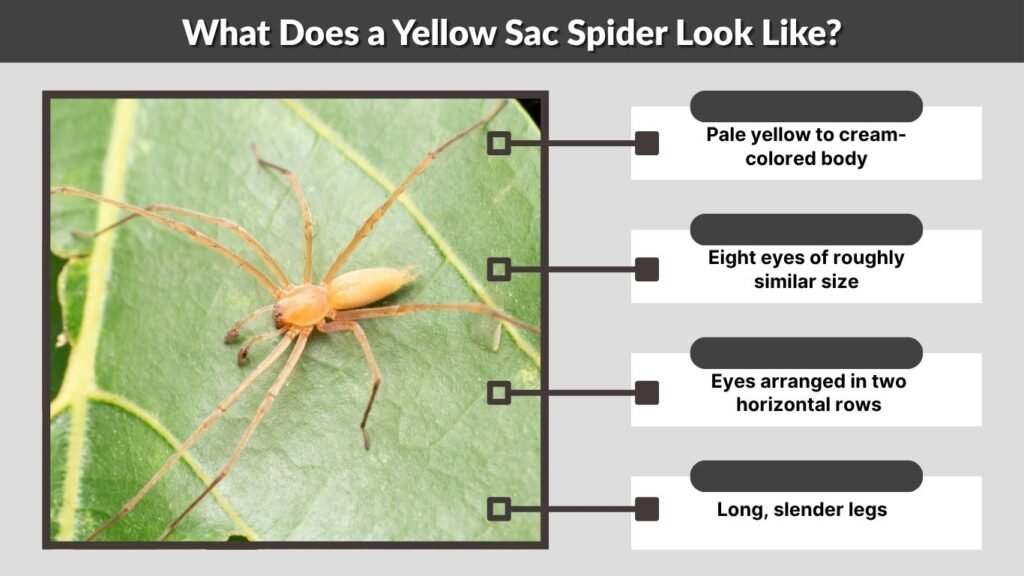
Yellow sac spiders are relatively small, lightly built spiders. The common house-dwelling species Cheiracanthium mildei is usually pale yellow, cream, greenish-yellow, or light tan.
Yellow Sac Spider Identification
- Pale yellow to cream-colored body
- Eight eyes of roughly similar size
- Eyes arranged in two horizontal rows
- Slightly darker stripe may appear on the abdomen
- Long, slender legs
- Front legs often particularly noticeable
- Leg tips may appear darker
- Small silken retreat rather than a prey-catching web
Yellow sac spiders commonly create small silk sacs in corners, behind pictures, beneath shelves, or among outdoor vegetation. They often leave these retreats at night to hunt.
What Does a Brown Recluse Look Like?
The brown recluse is a uniformly colored tan-to-brown spider with relatively long, smooth-looking legs.
Its famous “violin” marking appears on the upper portion of the cephalothorax, with the narrow end pointing toward the abdomen. However, the violin alone is not a reliable identification feature, because several harmless spiders have similar-looking markings.
Brown Recluse Identification
- Six eyes rather than eight
- Eyes arranged in three separated pairs
- Uniform tan to brown abdomen
- Uniformly colored legs
- No stout leg spines
- Fine hairs on the body
- Violin-shaped marking may be visible
- Body length generally no more than about 3/8 inch
The six-eye arrangement is one of the most useful characteristics for separating a recluse from most other household spiders.
Yellow Sac Spider vs Brown Recluse Eyes
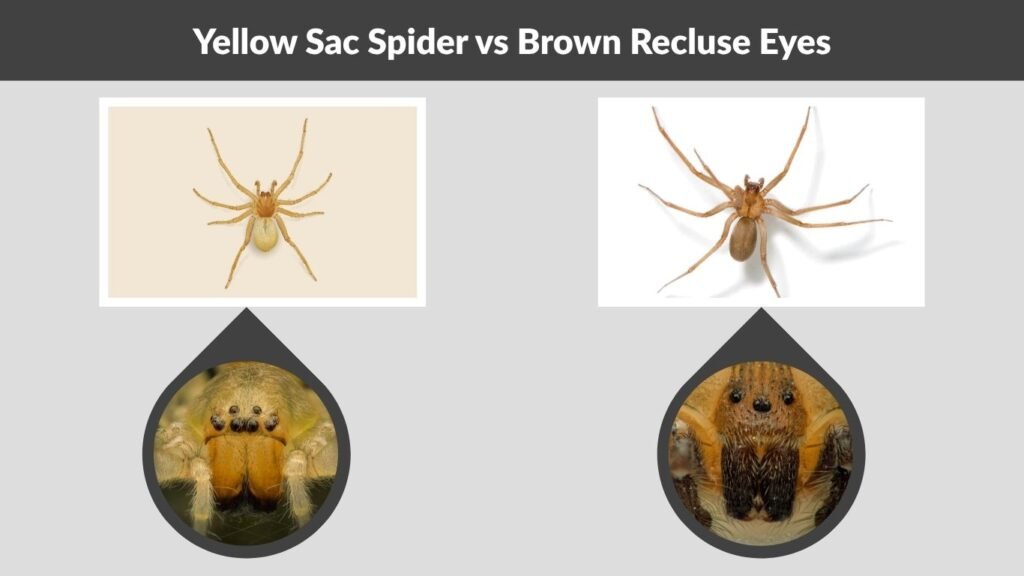
The eye pattern is one of the strongest identification differences.
Yellow sac spiders have eight eyes arranged in two rows. Brown recluses have only six eyes, grouped into three pairs.
This distinction is considerably more reliable than searching for a violin-shaped mark.
However, spider eyes are extremely small, so checking them may require a hand lens or close macro photograph. Avoid handling an unidentified spider simply to examine its eyes.
Yellow Sac Spider vs Brown Recluse Color
Color creates much of the confusion between these spiders.
Yellow sac spiders can range from pale yellow to light brown. A darker stripe may run down the upper part of the abdomen.
Brown recluses range from beige or light tan to darker brown, but their abdomen and legs generally lack obvious bands or contrasting patterns.
A spider with strongly patterned legs, bold abdominal markings, or conspicuous leg spines is unlikely to be a true brown recluse.
Brown Recluse vs Yellow Sac Spider Size
Both are relatively small spiders, so size alone is not enough for identification.
A brown recluse’s body is generally no more than about 3/8 inch long, although its legs make the entire spider appear larger. Yellow sac spiders are similarly small and slender.
Instead of relying on apparent size, examine the color pattern, eyes, leg structure, and geographic location.
Yellow Sac Spider vs Brown Recluse Habitat
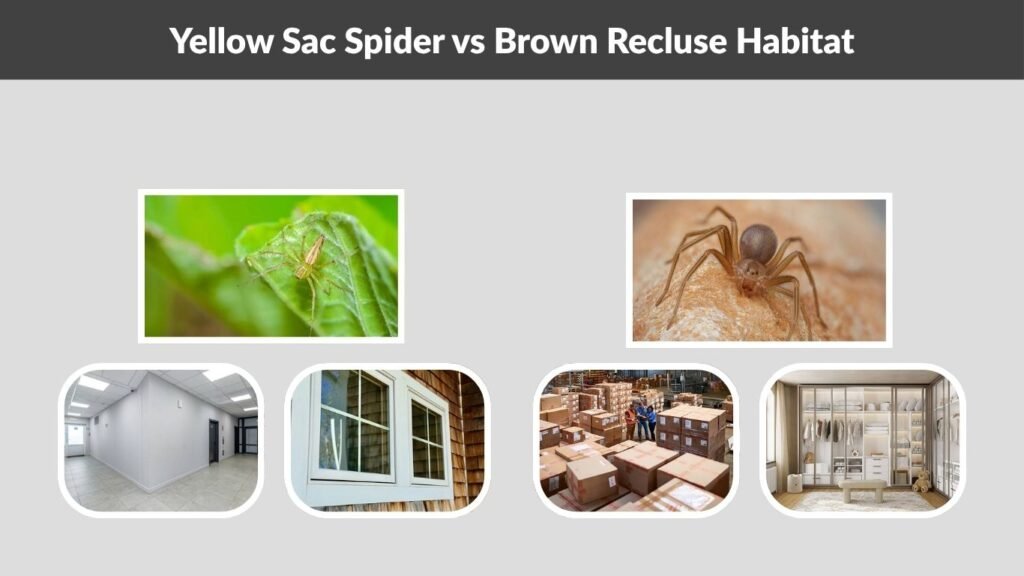
Yellow sac spiders are frequently encountered both indoors and outdoors.
Inside homes, they may hide:
- Behind pictures
- Near ceilings
- In wall corners
- Behind shelves
- Around windows
- In clothing or bedding
- Inside quiet storage areas
Outdoors, they commonly live among shrubs, leaves, and vegetation.
Brown recluses prefer quiet, undisturbed areas such as storage boxes, closets, wood piles, sheds, basements, and other sheltered spaces.
Where Do Brown Recluse Spiders Live?
Geography is extremely important when deciding whether a spider could realistically be a brown recluse.
The native U.S. range of Loxosceles reclusa is concentrated in the south-central and Midwestern states, extending roughly from southeastern Nebraska east to southwestern Ohio and south through Texas to northern Georgia.
What About California?
True brown recluse populations are not established in California. Individual spiders have occasionally been transported there, but verified specimens have been extremely rare.
California does have other native Loxosceles species, especially the desert recluse in southeastern desert regions. Yellow sac spiders, meanwhile, are common household spiders in California and are frequently mistaken for brown recluses.
Yellow Sac Spider Bite vs Brown Recluse Bite
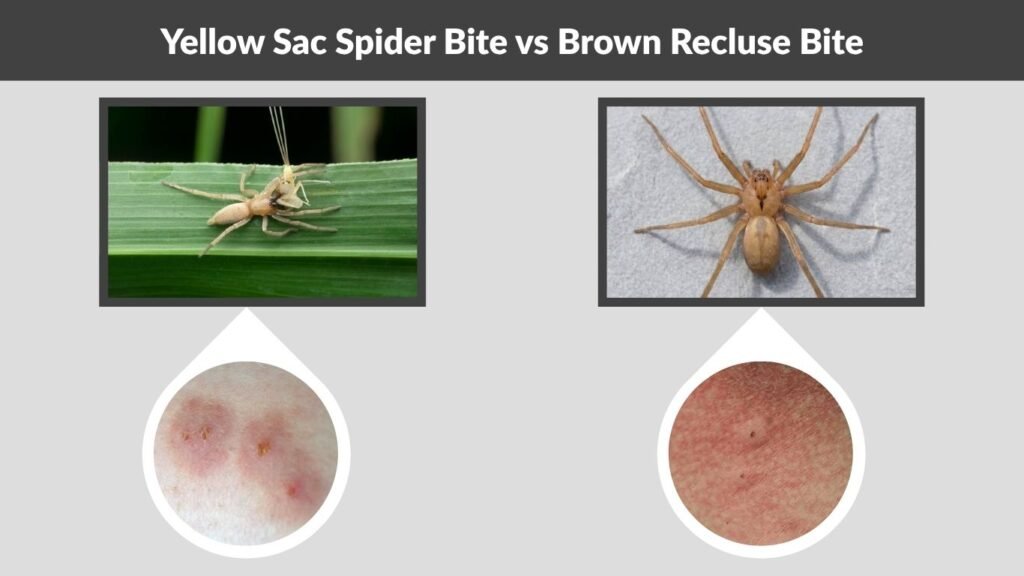
Both spiders possess venom, but their typical bite effects are not equivalent.
Yellow Sac Spider Bite
A yellow sac spider may bite when accidentally trapped against the skin, such as inside clothing or bedding.
Typical reported symptoms include:
- Immediate pain
- Redness
- Mild swelling
- Local irritation
UC IPM describes the initial pain as sometimes resembling a bee sting. Verified yellow sac spider bites have generally supported localized symptoms rather than the dramatic tissue destruction historically attributed to these spiders.
Brown Recluse Bite
Brown recluse bites can also initially be mild, and many heal without major complications.
However, recluse venom has the potential to cause tissue injury. UC IPM estimates that about 10% of brown recluse bites produce moderate or greater tissue damage and scarring, while most result primarily in inflammation and heal without serious medical intervention.
Rare systemic reactions can be more serious, particularly in children.
Can You Identify the Spider From the Bite?
No. A skin lesion alone generally cannot confirm whether a yellow sac spider, brown recluse, or any other spider was responsible.
Many conditions can resemble suspected spider bites, including bacterial infections, insect bites, allergic reactions, and other skin disorders.
Brown recluse bites are particularly overdiagnosed in regions where the spider does not naturally occur.
If the spider can be captured safely without touching it, keeping it in a secure container may assist professional identification.
Which Is More Dangerous?
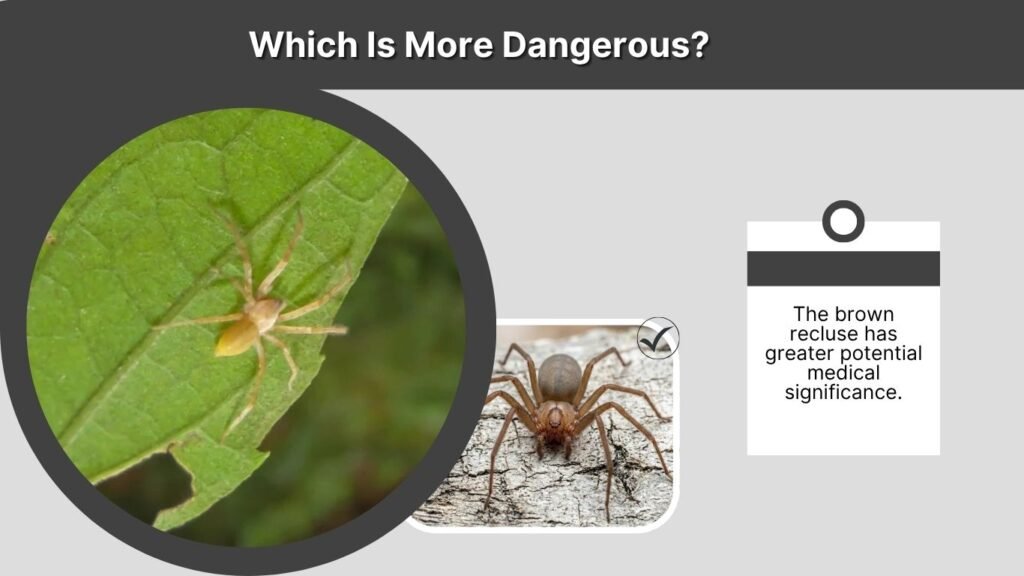
The brown recluse has greater potential medical significance.
Most recluse bites do not become severe, but some can cause substantial localized tissue damage. Yellow sac spider bites generally cause shorter-lived localized pain, redness, or swelling.
Neither species normally seeks people out to attack them. Bites usually occur because the spider becomes trapped against the skin or is unintentionally disturbed.
Northern Yellow Sac Spider vs Brown Recluse
The northern yellow sac spider, commonly associated with Cheiracanthium mildei and related species in household discussions, can be confused with a recluse because of its light tan coloration and long legs.
The easiest distinction remains the eyes: yellow sac spiders have eight, whereas brown recluses have six.
A yellow sac spider also tends to look more translucent or yellowish and may have darker tips on the legs. The brown recluse is generally more uniformly colored.
Behavior Differences
Yellow sac spiders are active hunters.
Instead of sitting in a large prey-catching web, they walk across walls, ceilings, vegetation, and other surfaces at night searching for insects. During daylight they retreat into a silken sac.
Brown recluses are appropriately named because they usually remain hidden. They favor dark, relatively undisturbed areas and are more likely to flee from disturbance than confront people.
How to Prevent Yellow Sac and Brown Recluse Spiders Indoors

Reducing hiding places and insect prey can make homes less attractive to both types.
Seal cracks around windows, doors, foundations, and utility openings. Shake out clothing and shoes that have been stored for long periods, reduce clutter, vacuum quiet corners, and keep boxes organized.
Move firewood away from the home’s exterior and avoid leaving clothing or bedding on floors in areas where spiders are common.
FAQs
Is a yellow sac spider a brown recluse?
No. Yellow sac spiders belong to Cheiracanthium, whereas the brown recluse is Loxosceles reclusa. They are unrelated spiders that can sometimes look superficially similar.
How can I quickly tell a brown recluse from a yellow sac spider?
Eye number is especially useful. Brown recluses have six eyes arranged in three pairs, while yellow sac spiders have eight eyes.
Are yellow sac spiders dangerous?
Their bites can be painful and cause localized redness or swelling, but serious reactions appear uncommon. Seek medical attention for severe or worsening symptoms.
Can a yellow sac spider bite cause necrosis?
Older reports sometimes associated yellow sac spiders with necrotic wounds, but evidence from verified bites does not support treating them as a common cause of significant tissue necrosis.
Which is worse, a yellow sac spider or brown recluse?
The brown recluse presents the greater potential medical concern because some bites can cause significant tissue injury. Most brown recluse bites, however, still do not progress to severe necrosis.
