
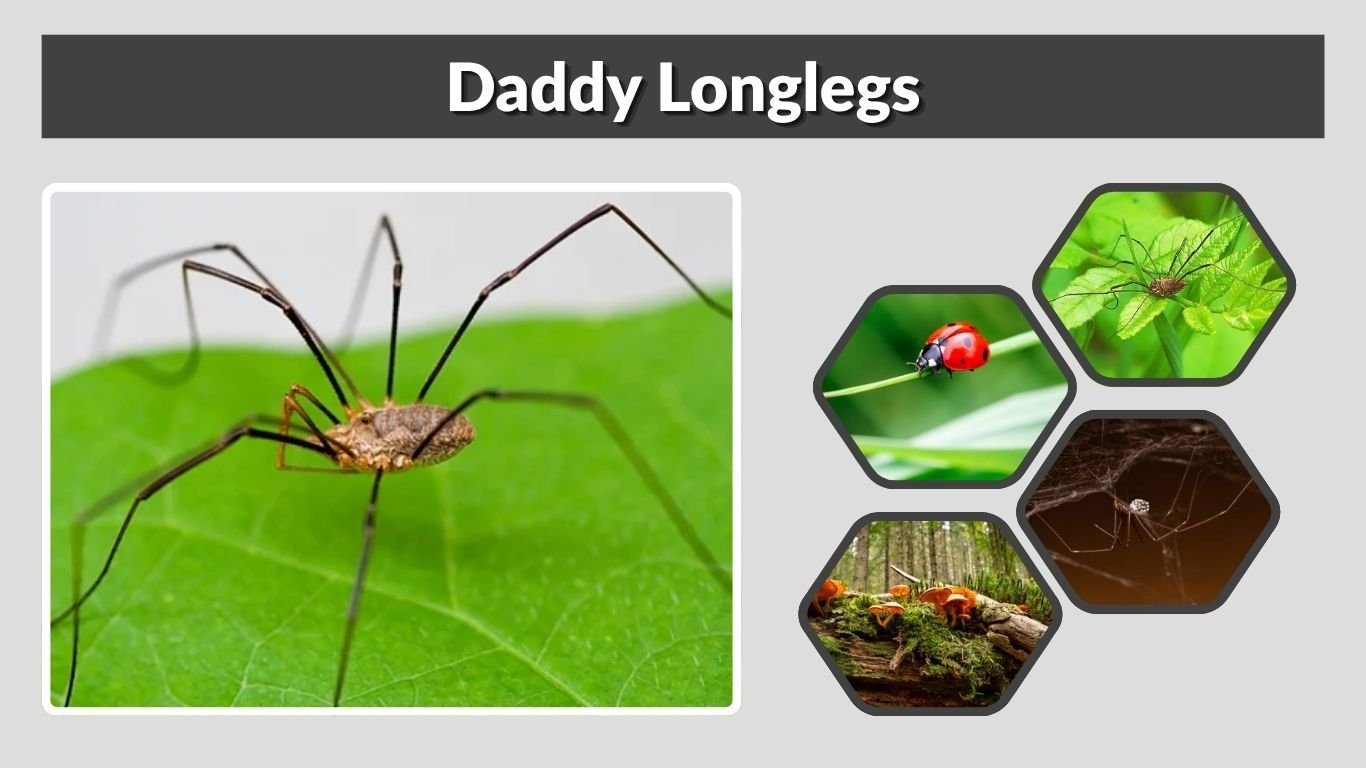
Daddy longlegs are familiar long-legged creatures found in gardens, forests, basements, sheds, and around homes. However, the name is confusing because it can describe several completely different animals. Most commonly, it refers to harvestmen, which are arachnids but not true spiders. Cellar spiders and even crane flies are also called daddy longlegs in some regions. Despite a widespread myth, harvestmen are neither dangerously venomous nor poisonous to humans. This guide explains their identification, diet, bites, webs, lifespan, behavior, and safety.
What Is a Daddy Longlegs?
“Daddy longlegs” is a common name rather than the scientific name of one particular animal. Depending on where you live, people may use it for a harvestman, a long-legged cellar spider, or a crane fly. These animals can look superficially similar because of their extremely long legs, but biologically they belong to different groups and have important differences.
Three Animals Called Daddy Longlegs
The name commonly refers to:
- Harvestmen: Arachnids belonging to the order Opiliones. They have eight legs but are not true spiders.
- Cellar spiders: True spiders in the family Pholcidae. They have long, delicate legs and build irregular webs indoors.
- Crane flies: Six-legged insects with wings that can resemble oversized mosquitoes.
When people in North America discuss a daddy longlegs crawling through a garden, they often mean a harvestman. In houses and basements, the term is also frequently applied to cellar spiders.
Are Daddy Longlegs Spiders?
Whether a daddy longlegs is a spider depends entirely on which animal is being described. Harvestmen are not spiders, although they belong to the arachnid class alongside spiders, scorpions, mites, and ticks. Cellar spiders, by contrast, are genuine spiders. This distinction explains much of the confusion surrounding daddy longlegs venom, bites, webs, and anatomy.
Harvestman vs. Spider
Harvestmen belong to the order Opiliones, while true spiders belong to the order Araneae. A harvestman’s body looks like one compact oval because its major body regions are broadly joined. True spiders have a much more obvious narrow connection between the cephalothorax and abdomen.
Harvestmen also lack silk-producing spinnerets and therefore cannot construct spider webs. They typically have a single pair of eyes, whereas many true spiders have several pairs. Most importantly for the famous daddy longlegs myth, harvestmen lack venom glands.
How to Identify Daddy Longlegs
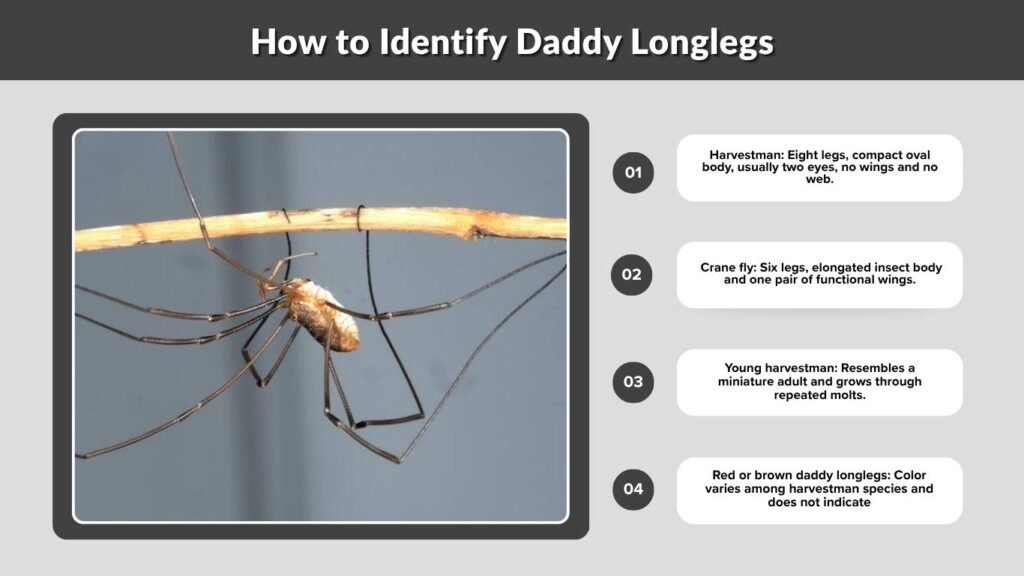
Long legs alone are not enough to determine which daddy longlegs you have found. Examining the body shape, number of legs, presence of wings, and whether the animal is sitting in a web makes identification much easier. Harvestmen are especially common outdoors, while long-bodied cellar spiders are frequently encountered in undisturbed corners of buildings.
Daddy Longlegs Identification
Look for these differences:
- Harvestman: Eight legs, compact oval body, usually two eyes, no wings and no web.
- Cellar spider: Eight legs, two clearly separated body regions, extremely thin legs and usually found hanging in a loose web.
- Crane fly: Six legs, elongated insect body and one pair of functional wings.
- Young harvestman: Resembles a miniature adult and grows through repeated molts.
- Red or brown daddy longlegs: Color varies among harvestman species and does not indicate that the animal is dangerous.
A daddy longlegs flying around a light is therefore not a harvestman or cellar spider—it is most likely a crane fly.
Are Daddy Longlegs Poisonous or Venomous?
One of the most persistent spider myths claims that daddy longlegs possess the world’s strongest venom but cannot harm humans because their fangs are too short. This story is false. The confusion becomes easier to understand once harvestmen and cellar spiders are separated: harvestmen have no venom glands, while cellar spiders have venom but are not considered dangerously venomous to humans.
The “Most Venomous Spider” Myth
Harvestmen do not possess fangs or venom glands, so they cannot inject venom. Some species produce foul-smelling defensive chemicals that discourage predators, but this is completely different from possessing dangerous injectable venom.
Cellar spiders are true spiders and do have venom used to subdue their small prey. However, University of California, Riverside researchers report no evidence supporting the claim that their venom is exceptionally toxic or medically dangerous to people.
Therefore, the claim that daddy longlegs are secretly the world’s deadliest spiders is a myth.
Do Daddy Longlegs Bite Humans?
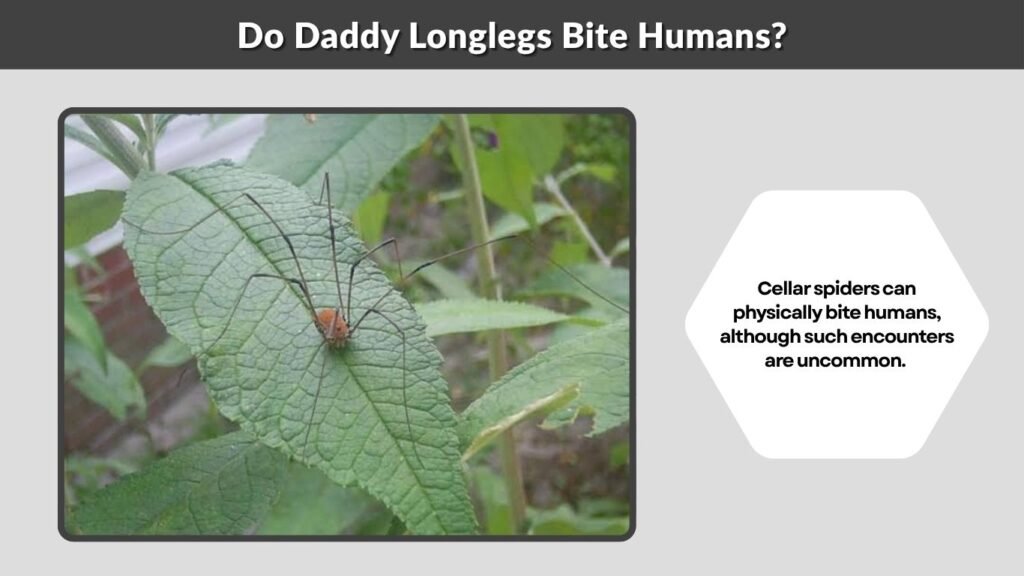
Questions about daddy longlegs bites are complicated by the shared common name. Harvestmen and cellar spiders have completely different feeding structures. Harvestmen are considered harmless to humans and have no venom. Cellar spiders possess fangs and venom, as true spiders do, but documented human effects are considered minor rather than medically significant.
Can Harvestmen Bite?
Harvestmen do not have the venom-injecting fangs found in spiders. They have small mouthparts called chelicerae that help them handle food, but they are considered harmless to people. University of Minnesota Extension specifically notes that harvestmen pose no danger to humans and possess no venom.
Can Cellar Spiders Bite?
Cellar spiders can physically bite humans, although such encounters are uncommon. Their venom is designed for small arthropod prey, and there is no good evidence that cellar spider venom causes serious toxic effects in people.
A suspected bite that produces severe pain, spreading swelling, breathing difficulty, or worsening skin damage should not simply be assumed to have come from a daddy longlegs; unusual or severe symptoms warrant appropriate medical evaluation.
What Do Daddy Longlegs Eat?
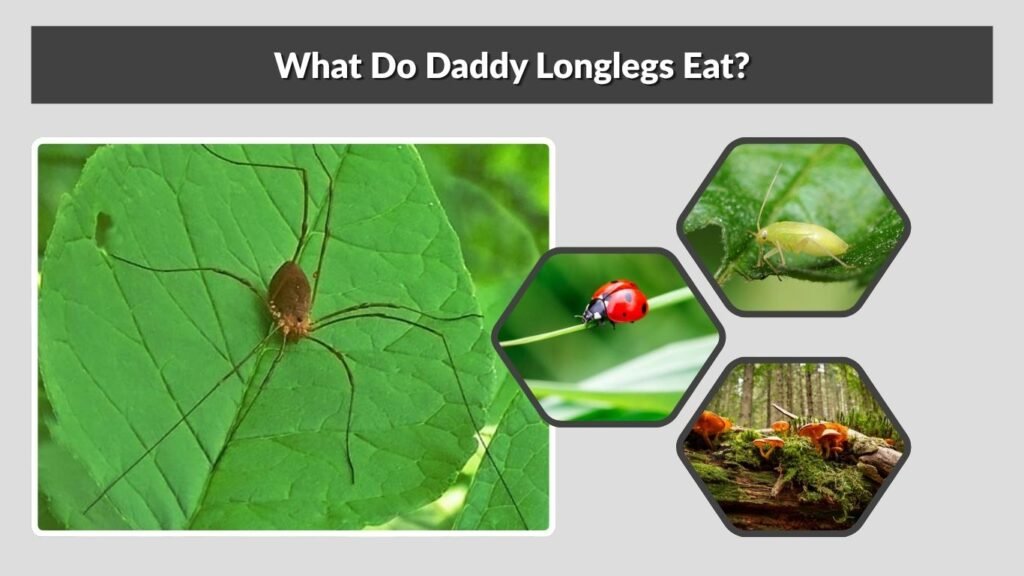
Harvestmen have a broader diet than many true spiders. They are opportunistic feeders that may prey on small invertebrates while also scavenging dead organisms and consuming plant material. This flexibility allows daddy longlegs to survive in gardens, woodland, buildings, and other environments where several different food sources may become available during the year.
Daddy Longlegs Diet
Harvestmen may consume:
- Small insects
- Aphids and other tiny arthropods
- Dead insects
- Other dead animal material
- Plant juices
- Fungi
- Decaying vegetation
- Other available organic material
This combination of predation and scavenging means harvestmen can contribute to breaking down organic material while also consuming small arthropods.
Cellar spiders have a different diet. They capture insects and other spiders in their loose silk webs, making them useful indoor predators.
Do Daddy Longlegs Make Webs?
The answer again depends on which animal is being called daddy longlegs. Harvestmen do not make webs, because they cannot produce silk. Cellar spiders do produce silk and are frequently encountered sitting upside down in loose, irregular webs. This behavioral difference is one of the fastest ways to distinguish the two long-legged arachnids around a home.
Daddy Longlegs Web vs. Cellar Spider Web
If you find a long-legged animal actively living in a messy web in the corner of a basement, ceiling, crawlspace, or garage, it is probably a cellar spider rather than a harvestman.
Cellar spiders build loose, irregular webs in quiet indoor locations. Harvestmen generally walk across vegetation, soil, tree trunks, walls, and other surfaces rather than waiting for prey in silk traps.
Why Do Daddy Longlegs Gather in Clusters?
Large daddy longlegs clusters can contain many individual harvestmen gathered close together. Aggregation behavior occurs in various harvestman species and can make them look like a single moving mass of legs. Their social gatherings should not be interpreted as nests, colonies like ants, or evidence that the animals are preparing to attack people.
Why Do Harvestmen Group Together?
Grouping may provide protection from predators and help harvestmen maintain favorable moisture conditions. When disturbed, individuals can quickly scatter, creating the dramatic appearance often seen in videos of daddy longlegs clusters.
Harvestmen also possess defensive scent glands. Their secretions can make them less appealing to potential predators, and grouping may potentially enhance some defensive benefits. Harvestmen remain harmless to people despite the intimidating appearance of a large aggregation.
Daddy Longlegs Eggs and Lifespan
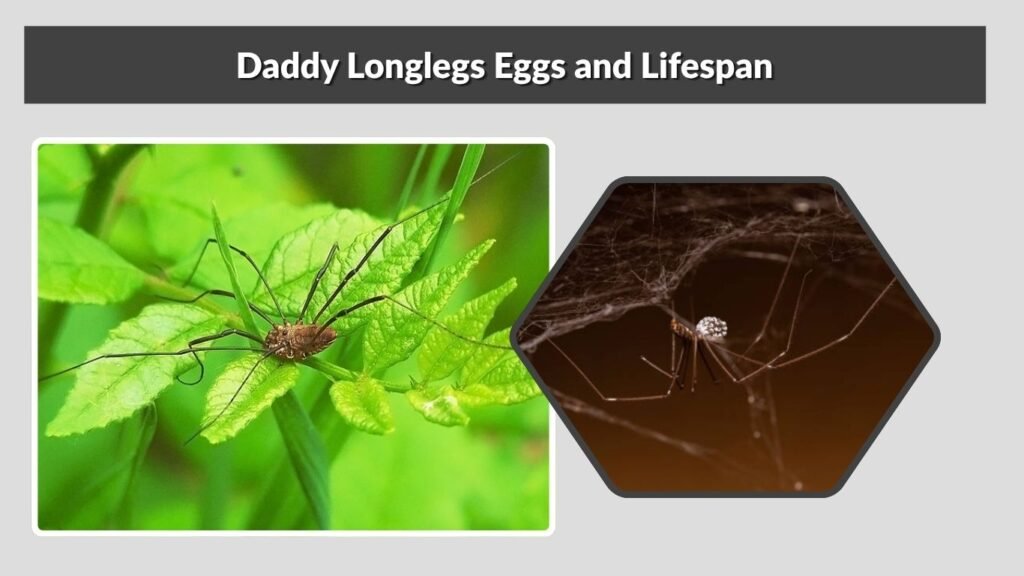
Harvestmen reproduce by laying eggs rather than producing live young. Development varies considerably among the many species worldwide, so there is no single daddy longlegs lifespan that applies everywhere. In temperate regions, many familiar species complete much of their life cycle within approximately a year, with eggs or immature stages surviving unfavorable seasons.
Daddy Longlegs Life Cycle
After mating, female harvestmen deposit eggs in protected locations such as moist soil or other sheltered areas. Young hatch looking broadly like tiny versions of adults rather than passing through a caterpillar-like larval stage.
They grow through repeated molts, developing larger bodies and longer legs until reaching maturity. Kentucky Extension notes that many local harvestmen there live for roughly a year, although lifespan varies among species and climates.
Are Daddy Longlegs Beneficial?
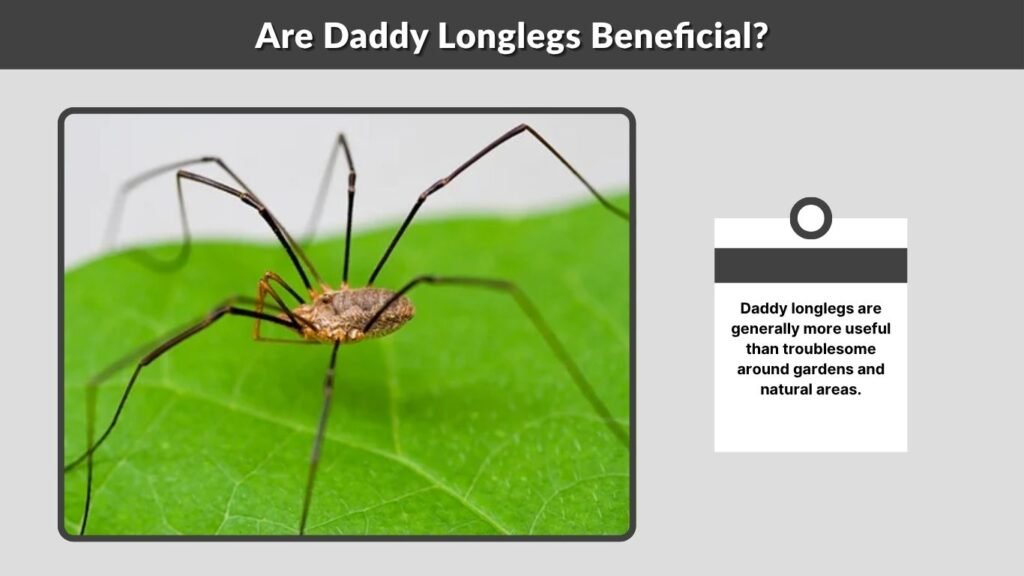
Daddy longlegs are generally more useful than troublesome around gardens and natural areas. Harvestmen consume small arthropods and dead organic material, while cellar spiders help capture insects inside buildings. Neither group normally requires control simply because a few individuals are present. Their frightening reputation comes largely from appearance and myths rather than actual danger.
Benefits of Daddy Longlegs
Their potential benefits include:
- Eating small insects and other arthropods
- Scavenging dead insects and animal material
- Helping break down organic matter
- Serving as food for other wildlife
- Cellar spiders capturing indoor insects
- Contributing to natural food webs
If a harvestman enters your home, it can simply be moved outside rather than killed. Cellar spiders can also be removed if their webs become unwanted, but they are generally harmless occupants.
FAQs
Daddy longlegs generate unusual amounts of confusion because one common name is applied to multiple animals. The most important distinction is that harvestmen are arachnids but not true spiders, while cellar spiders really are spiders. Neither supports the famous claim that daddy longlegs are extraordinarily venomous but unable to bite people. These quick answers summarize the most common questions.
Are Daddy Longlegs Spiders?
Harvestmen are not spiders; they belong to the arachnid order Opiliones. However, cellar spiders are also called daddy longlegs and are true spiders.
Are Daddy Longlegs Poisonous?
Harvestmen do not possess venom glands. Some produce defensive chemical secretions, but they are considered harmless to humans.
Can Daddy Longlegs Bite Humans?
Harvestmen lack spider-like venomous fangs and are harmless. Cellar spiders can technically bite, but there is no evidence that their venom produces serious toxic effects in humans.
How Many Legs Does a Daddy Longlegs Have?
Harvestmen and cellar spiders have eight legs because both are arachnids. Crane flies, which are also sometimes called daddy longlegs, are insects and therefore have six legs.
Do Daddy Longlegs Have Wings?
Harvestmen and cellar spiders do not have wings. If the daddy longlegs you see has wings and flies, it is most likely a crane fly rather than an arachnid.
