
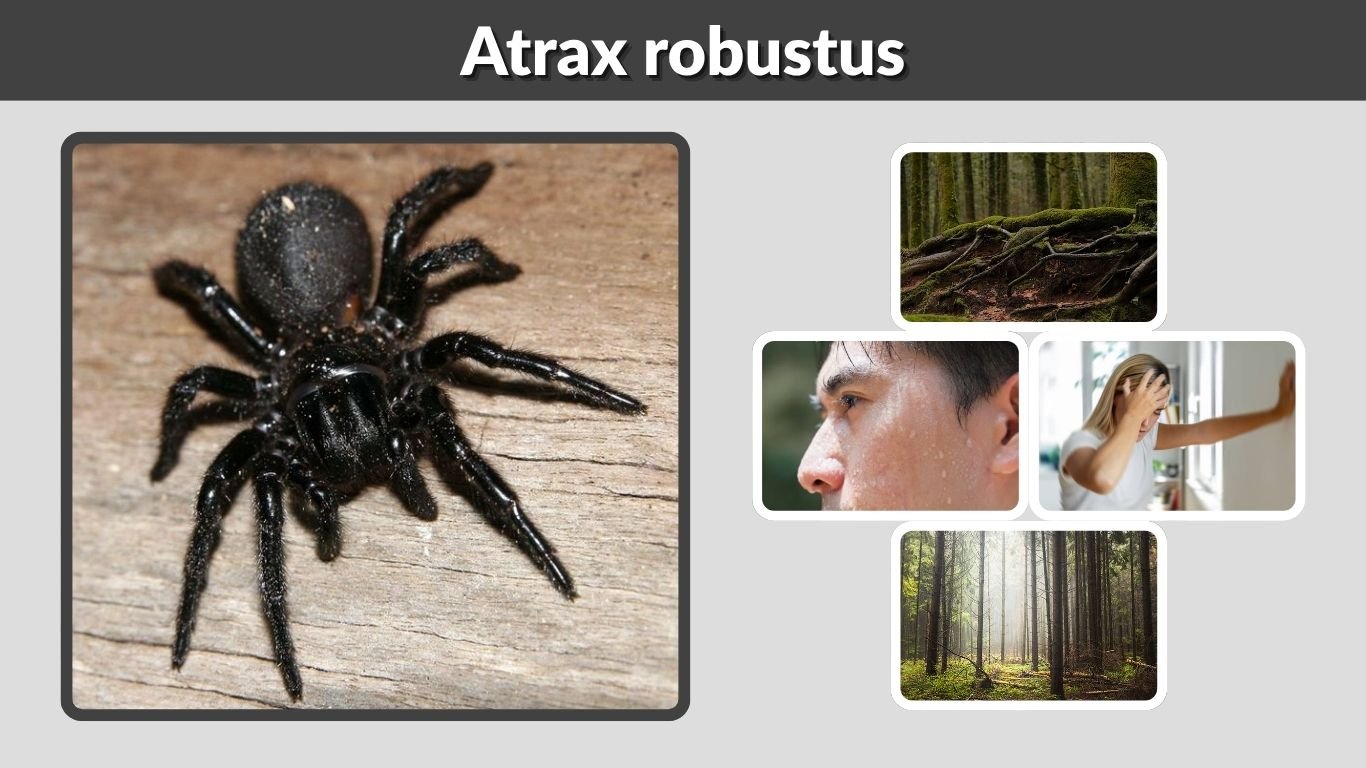
Atrax robustus, commonly known as the Sydney funnel-web spider, is one of Australia’s best-known medically significant spiders. This dark, heavily built spider lives mainly around the Sydney region of New South Wales, where it occupies cool, humid burrows beneath logs, rocks, and other sheltered places. Adults can reach about 2–4 cm in body length, and males are particularly important medically because of their potent venom. Despite its reputation, effective first aid and antivenom have dramatically improved outcomes from bites.
What Is Atrax robustus?
Atrax robustus is a mygalomorph spider in the family Atracidae and is commonly called the Sydney funnel-web spider. It should not be confused with harmless funnel-weaver spiders found in North America. Australian funnel-web spiders are a different group with large fangs and medically important venom. The Sydney species is primarily associated with suitable habitats around the Sydney region.
Atrax robustus Identification
Important features include:
- Color: Usually glossy black, dark brown, or nearly black
- Carapace: Smooth, shiny, and relatively hairless
- Body: Heavy and robust rather than slender
- Legs: Thick, powerful, and dark colored
- Fangs: Large and directed downward
- Abdomen: Usually dark and less glossy than the carapace
- Spinnerets: Noticeable finger-like spinnerets at the rear
- Web: A silk-lined burrow with silk trip lines extending from the entrance
Because several Australian mygalomorph spiders look similar, appearance alone should not be relied on when medical decisions are involved.
Atrax robustus Size
The Sydney funnel-web typically measures about 2–4 cm in body length, excluding the legs. A spider’s total span can appear considerably greater once the legs are included.
Females tend to be more heavily built, while adult males generally have longer legs relative to their bodies. Large individuals may look intimidating, but size alone cannot reliably distinguish A. robustus from other Australian funnel-web species.
Current Classification
An important taxonomic update occurred in 2025. Research showed that spiders previously grouped broadly under the Sydney funnel-web name represented three distinct species: Atrax robustus, Atrax montanus, and Atrax christenseni. The name A. robustus continues to apply to the Sydney funnel-web in its more restricted modern sense.
This distinction is useful when reading older books or websites, because historical records labeled A. robustus may include specimens now assigned to the other species.
Where Does Atrax robustus Live?
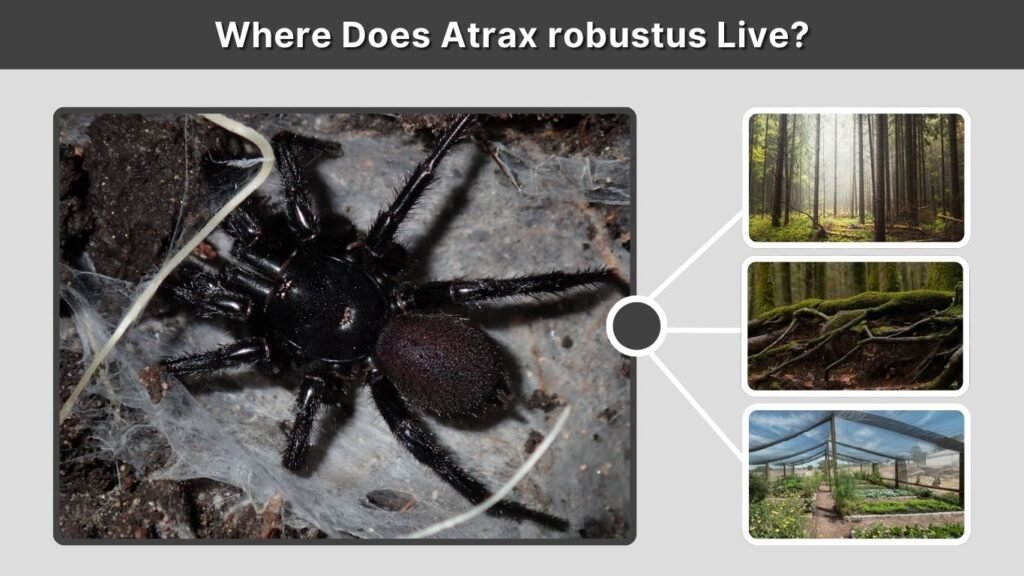
Atrax robustus is native to New South Wales, Australia, and has a comparatively restricted distribution. The Australian Museum describes the species as occurring from the Central Coast south toward the Georges River area. Within this range, it requires sheltered locations that remain moist enough to prevent the spider from drying out.
Atrax robustus Habitat
Typical locations include:
- Moist forested areas
- Beneath fallen logs
- Under rocks
- Protected banks and slopes
- Shaded gardens
- Beneath landscaping materials
- Cool areas near foundations
- Sheltered places with consistently humid soil
Sydney funnel-web spiders are vulnerable to dehydration, so they generally favor cool, damp conditions rather than exposed, hot environments. Their burrows provide both protection and a suitable microclimate.
Why They Sometimes Appear Around Homes
Homes surrounded by suitable vegetation can provide conditions similar to the spider’s natural habitat. Gardens, retaining walls, rockeries, swimming-pool surroundings, and shaded landscaping can offer protected places.
Adult males are much more likely to wander above ground while searching for females. During suitable warm and humid conditions, a male may accidentally enter a garage, shed, swimming pool, or house.
The spider is not searching for people and does not deliberately chase humans.
Can Atrax robustus Swim?
Sydney funnel-web spiders can sometimes survive for extended periods when trapped in swimming pools because air bubbles may remain around hairs on their body. This has contributed to stories about funnel-web spiders “swimming.”
They are not specialized swimming spiders, however. A funnel-web found in a pool should still be treated cautiously because a submerged spider may remain alive.
Atrax robustus Web and Burrow
Unlike an orb-weaver, Atrax robustus does not construct a large circular aerial web. Instead, it creates a silk-lined terrestrial retreat. The burrow provides protection against predators and dry conditions while functioning as the center of the spider’s hunting territory.
What Does an Atrax robustus Web Look Like?
Common characteristics include:
- A silk-lined tubular burrow
- An entrance concealed beneath rocks, logs, or vegetation
- Irregular silk around the burrow opening
- Silk trip lines extending outward
- A cool and protected location
- No traditional circular orb web
The spider waits inside the retreat and detects vibrations transmitted through its silk.
How Atrax robustus Hunts
When an insect or another small animal contacts the trip lines, vibrations alert the spider. It rushes from the burrow, captures the prey with its powerful fangs, and returns to shelter.
Its natural diet includes insects and other small animals it can overpower. The funnel-shaped retreat therefore functions as both a shelter and an effective ambush-hunting system.
Atrax robustus Venom
The venom of the Sydney funnel-web contains potent neurotoxic components capable of severely affecting the human nervous system. Severe funnel-web envenomation is a medical emergency. Historically, deaths occurred before effective antivenom became available, but the introduction of funnel-web antivenom in 1981 transformed treatment outcomes.
Why Male Atrax robustus Is Dangerous
Adult males are especially important medically. The venom of male Sydney funnel-web spiders is substantially more dangerous to humans than that of females and juveniles.
Males are also more likely to encounter people because they leave their burrows and wander while searching for females. This combination of potent venom and wandering behavior contributes greatly to the species’ dangerous reputation.
Females should still never be handled, since any suspected funnel-web bite must be taken seriously.
Atrax robustus Venom and Humans
The venom acts primarily on the nervous system and may produce rapidly developing systemic symptoms following significant envenomation. Severe cases can interfere with breathing and other essential body functions.
Thirteen deaths were historically attributed to the Sydney funnel-web before modern antivenom became available, and the Australian Museum reports no fatalities since antivenom was introduced.
Atrax robustus Bite
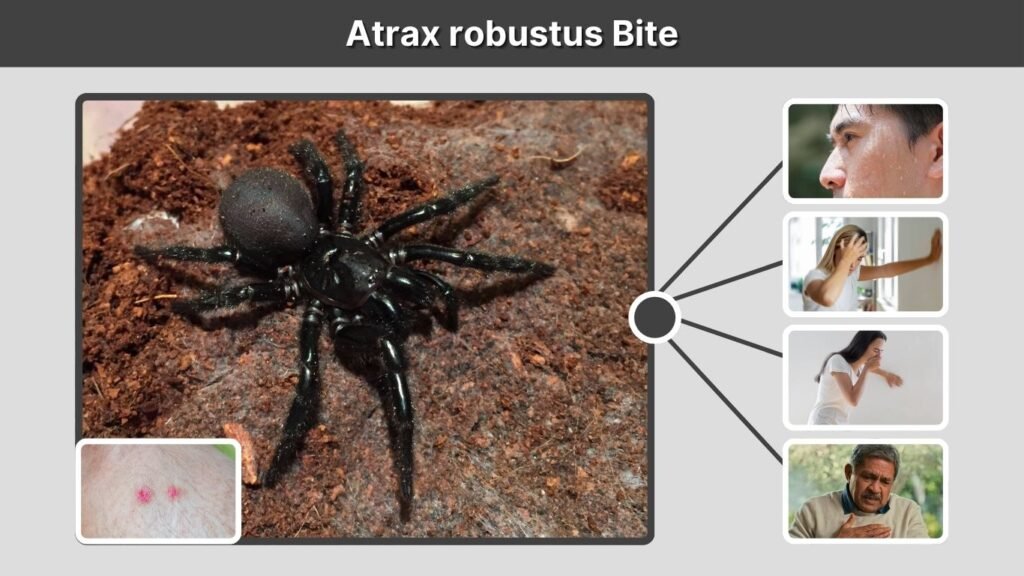
A bite from a confirmed or suspected Sydney funnel-web spider must be considered a medical emergency. NSW health authorities advise treating bites from large black spiders in eastern Australia as suspected funnel-web bites when identification is uncertain. Immediate first aid and emergency medical assessment are essential.
Atrax robustus Bite Symptoms
Possible symptoms of significant funnel-web envenomation include:
- Severe pain at the bite site
- Heavy sweating
- Nausea
- Vomiting
- Difficulty breathing
- Muscle twitching or spasms
- Excessive secretions or salivation
- Rapid development of neurological symptoms
Symptoms can progress quickly, so a person should not wait for symptoms to appear before seeking emergency help after a suspected funnel-web bite.
First Aid for a Sydney Funnel-Web Bite
In Australia, NSW authorities recommend:
- Call Triple Zero (000) immediately.
- Keep the bitten person lying down and as still as possible.
- Apply a firm pressure bandage directly over the bite.
- Continue bandaging the entire affected limb.
- Immobilize the limb with a splint where possible.
- Keep both the victim and bitten limb still.
- Do not allow the person to walk or run.
- Do not cut, suck, or otherwise interfere with the bite wound.
Pressure immobilization is specifically recommended for funnel-web bites because it can slow movement of venom through the lymphatic system.
Atrax robustus Antivenom
Funnel-web spider antivenom became available for clinical use in 1981. It is administered in hospital when clinical signs of funnel-web envenomation are present. Current NSW clinical guidance recommends funnel-web antivenom for symptomatic patients alongside appropriate supportive care.
The availability of antivenom and effective pressure-immobilization first aid has made modern outcomes dramatically better than those recorded historically.
Male vs Female Atrax robustus
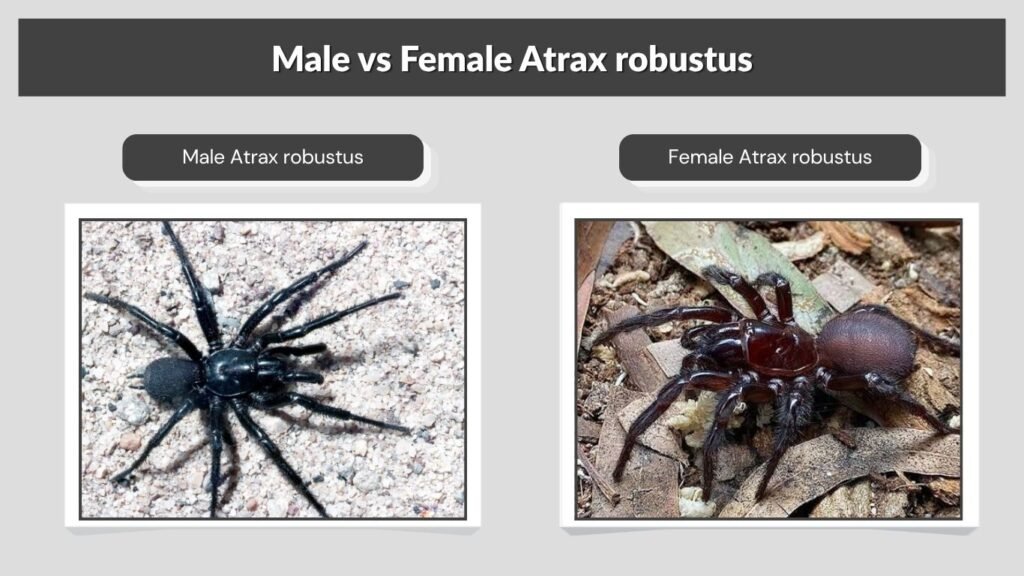
Male and female Sydney funnel-web spiders differ in appearance, lifestyle, and medical significance. Females spend much of their lives within established burrows. Mature males eventually leave their retreats and wander in search of receptive females, increasing the likelihood that people will encounter them.
Male Atrax robustus
Mature males have a slimmer body and proportionally longer legs than females. They are often encountered while wandering, especially when environmental conditions favor movement.
The male is particularly significant because its venom can cause severe human envenomation. Anyone encountering a suspected male funnel-web should avoid touching, trapping by hand, or provoking it.
Female Atrax robustus
Females are usually more robust and remain closely associated with their burrows. They may live there for extended periods and capture prey from the entrance.
Although females have historically been regarded as less dangerous than adult males, they still possess venom and large fangs. A suspected bite from either sex should therefore receive emergency medical attention.
Atrax robustus Facts
The Sydney funnel-web has become one of Australia’s most famous spiders because of its distinctive appearance, unusual biology, and medical importance. Modern research has also changed scientists’ understanding of exactly which populations belong to A. robustus.
Quick Facts
- Scientific name: Atrax robustus
- Common name: Sydney funnel-web spider
- Family: Atracidae
- Location: Sydney region of New South Wales, Australia
- Body size: Approximately 2–4 cm
- Color: Dark brown to glossy black
- Lifestyle: Terrestrial and burrowing
- Web: Silk-lined burrow with trip lines
- Diet: Predatory, mainly feeding on small animals
- Medical significance: Highly venomous
- Most concerning sex: Adult male
- Antivenom introduced: 1981
- Handling: Should never be handled casually
The species’ reputation is serious, but encounters do not mean that a bite is inevitable. Funnel-web spiders generally use their burrows for shelter and hunting rather than actively seeking contact with humans.
FAQs
Is Atrax robustus the Sydney funnel-web spider?
Yes. Atrax robustus is the scientific name for the Sydney funnel-web spider. However, a 2025 taxonomic revision separated some populations formerly included under that name into Atrax montanus and Atrax christenseni, giving A. robustus a more restricted modern definition.
How big is Atrax robustus?
Sydney funnel-web spiders generally have a body length of approximately 2–4 cm, excluding their legs. Females typically appear heavier and more robust, while adult males often have proportionally longer legs. Size alone should not be used to identify a suspected funnel-web spider.
Is Atrax robustus deadly?
Atrax robustus can cause life-threatening envenomation, particularly from an adult male. Historically, deaths were attributed to Sydney funnel-web bites. However, the Australian Museum reports no fatalities since funnel-web antivenom was introduced in 1981. Any suspected bite still requires immediate emergency treatment.
Where does Atrax robustus live?
The species occurs in the Sydney region of New South Wales, with the Australian Museum describing its current range from the Central Coast south toward the Georges River. It prefers cool, humid sheltered habitats and commonly builds burrows underneath rocks, logs, and similar cover.
What should you do after an Atrax robustus bite?
Treat a suspected bite as an emergency. In Australia, call 000, keep the victim completely still, apply a pressure-immobilization bandage over the bite and entire affected limb, immobilize the limb, and wait for emergency medical assistance. Do not wait for symptoms before seeking help.
