
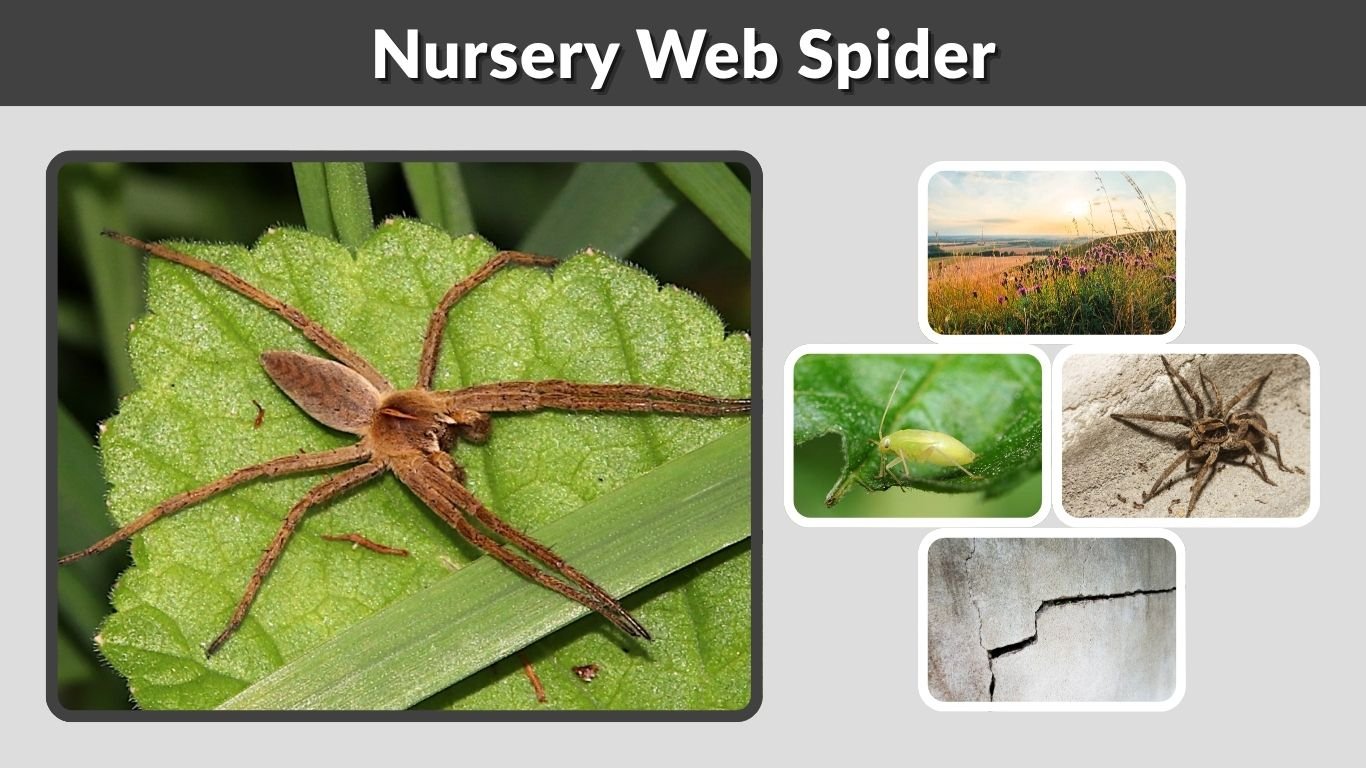
The nursery web spider is a long-legged hunting spider commonly found on grasses, shrubs, garden plants, and woodland vegetation. Its large size and brown coloring sometimes cause people to mistake it for a wolf spider or brown recluse. However, nursery web spiders are beneficial predators and are not considered harmful to people. Their name comes from the protective silk “nursery” that females build around their egg sacs and newly hatched spiderlings.
What Is a Nursery Web Spider?
Nursery web spiders belong to the family Pisauridae. The best-known North American species is the American nursery web spider, Pisaurina mira. In the UK and much of Europe, the name commonly refers to Pisaura mirabilis. Fishing spiders in the genus Dolomedes are close relatives within the same family.
Unlike orb weavers, nursery web spiders do not construct circular webs to trap flying insects. They hunt by waiting motionless on vegetation and quickly grabbing insects that come within reach. Silk is mainly used for safety lines, egg sacs, resting sites, and the nursery that protects their young.
| Feature | Description |
| Scientific name | Pisaurina mira in North America |
| Family | Pisauridae |
| Typical body length | About ½–¾ inch |
| Color | Brown, tan, gray, or orange-brown |
| Diet | Insects and other small arthropods |
| Hunting method | Ambush hunting |
| Human danger | Not considered harmful |
Nursery Web Spider Identification
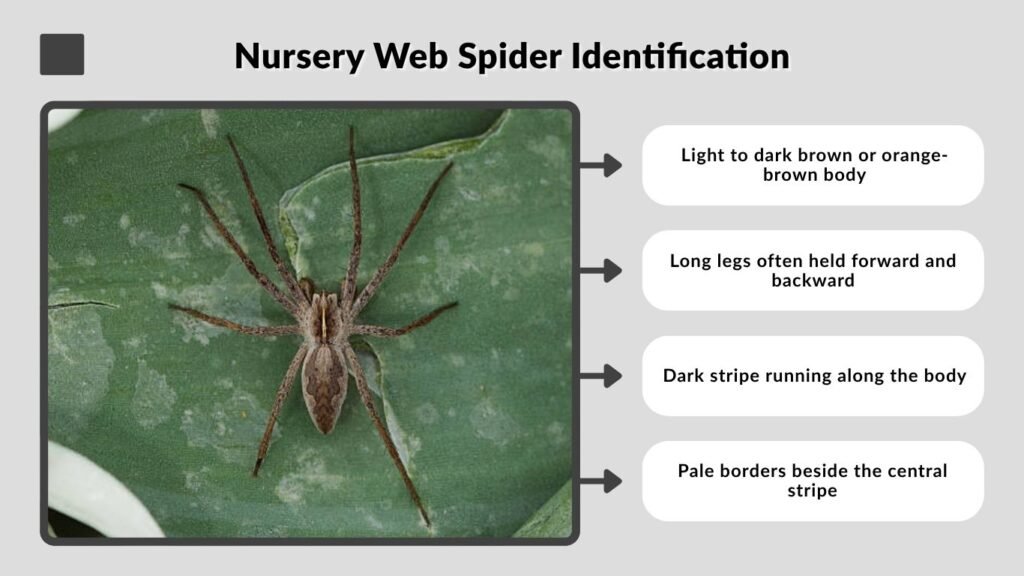
Nursery web spiders have elongated bodies and long, slender legs. Their muted colors help them disappear against dry grass, stems, bark, and leaves.
Key Identification Features
- Light to dark brown or orange-brown body
- Long legs often held forward and backward
- Dark stripe running along the body
- Pale borders beside the central stripe
- Elongated abdomen rather than a round one
- Eight eyes arranged in two curved rows
- Usually found resting on vegetation
- No permanent prey-catching web
The American nursery web spider commonly has a dark central stripe running across the front body and abdomen. The pattern can vary greatly: some individuals are pale beige, while others appear almost black. The legs of Pisaurina mira are generally less strongly banded than those of many fishing spiders.
Nursery Web Spider Eyes
Like most spiders, nursery web spiders have eight eyes. Their eye arrangement differs from that of wolf spiders, although seeing the pattern usually requires a close photograph or magnification.
Wolf spiders have four small eyes in a lower row, two large forward-facing eyes above them, and two additional eyes farther back. Nursery web spiders lack the wolf spider’s especially noticeable pair of large front-facing eyes.
How Big Is a Nursery Web Spider?
An adult American nursery web spider usually measures approximately ½–¾ inch in body length, excluding its legs. Females are normally larger and heavier than males. With the legs fully extended, a large individual may appear several inches across.
| Spider | General appearance |
| Adult female | Larger body and fuller abdomen |
| Adult male | Smaller, slimmer, and longer-legged |
| Spiderling | Tiny, pale, and often clustered in a nursery |
A large nursery web spider may look intimidating, but size does not indicate that it is medically dangerous.
Nursery Web Spider Habitat and Range
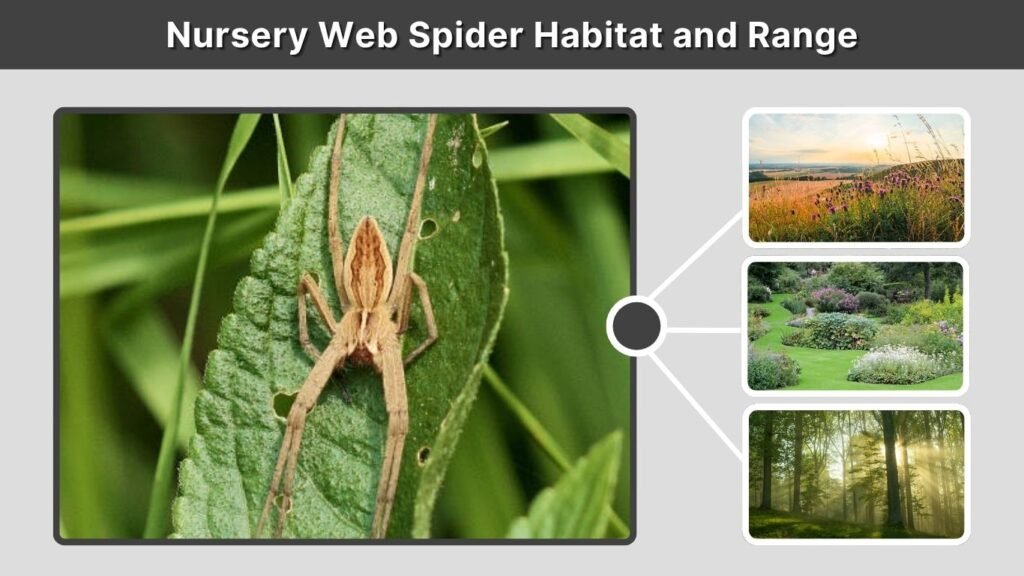
Nursery web spiders generally inhabit places with abundant vegetation and insect prey. They are frequently found above ground on leaves, tall grasses, weeds, shrubs, and low tree branches.
Common habitats include:
- Meadows and grasslands
- Woodland understories
- Gardens and parks
- Forest edges
- Wetlands and stream banks
- Shrubs around homes
- Agricultural fields
The American nursery web spider is widespread through much of the United States and southern Canada. Sightings are common in Michigan, Minnesota, Wisconsin, Ohio, Illinois, Pennsylvania, Maryland, Virginia, Maine, Massachusetts, Florida, and Ontario. Exact abundance varies with climate and habitat.
In the UK, Pisaura mirabilis is widespread and is often seen in rough grassland, open woodland, gardens, and sunny vegetation.
Nursery Web Spider Web and Egg Sac
The nursery web is not used to catch prey. It is a temporary protective structure built by a female shortly before her eggs hatch.
Why Is It Called a Nursery Web Spider?
After producing an egg sac, the female carries it beneath her body using her jaws and nearby mouthparts. When the spiderlings are ready to emerge, she attaches the sac to vegetation and surrounds it with a tent-like mass of silk.
The female remains close to the nursery and guards her young until they molt or begin dispersing. This maternal care is the behavior that gives the spider its common name.
A nursery web may look like a loose, three-dimensional sheet of silk wrapped around folded leaves or the tips of plants. Numerous tiny spiderlings may be visible inside it.
Male vs. Female Nursery Web Spider
Female nursery web spiders are typically larger, with broader abdomens that become especially noticeable when they are carrying eggs. Adult males are slimmer and have enlarged pedipalps near the mouth, which may resemble small boxing gloves.
European male nursery web spiders are famous for presenting females with a nuptial gift. The male catches an insect, wraps it in silk, and offers it to the female during courtship. She feeds on the gift while mating occurs.
What Do Nursery Web Spiders Eat?
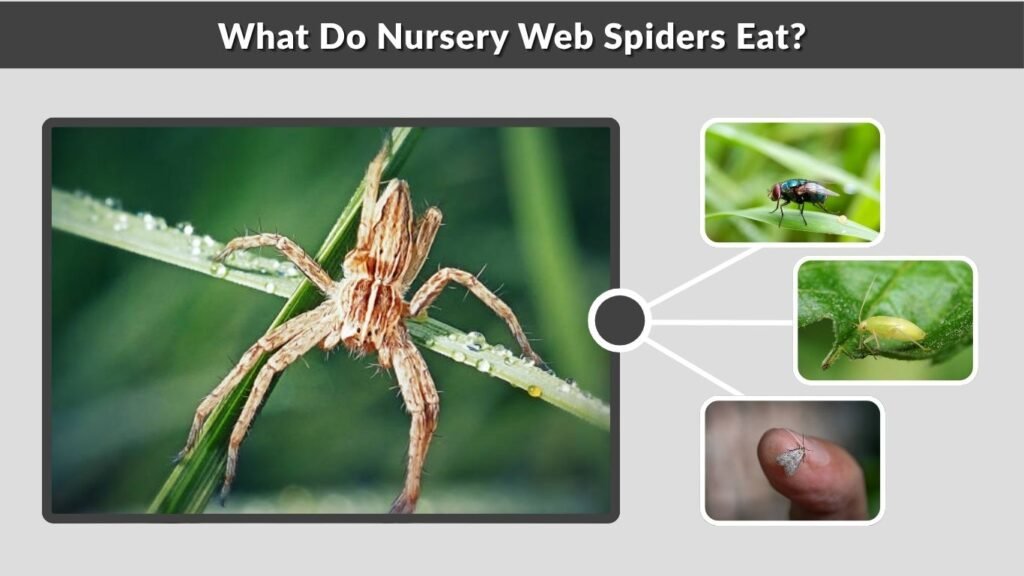
Nursery web spiders are active predators of insects and other small arthropods. They wait on vegetation, detect nearby movement, and seize prey using their front legs.
Their diet may include:
- Flies
- Mosquitoes
- Moths
- Crickets
- Grasshoppers
- Leafhoppers
- Small beetles
- Other spiders
They help reduce insect populations in gardens, fields, and natural habitats. University of Minnesota Extension classifies Pisaurina mira as a beneficial insect predator.
Is a Nursery Web Spider Poisonous?
A nursery web spider is not poisonous. Like most spiders, it is technically venomous because it injects venom into its prey through its fangs. However, its venom is not considered medically significant to humans.
These spiders rely on camouflage or escape when threatened. They do not chase or deliberately attack people, and American nursery web spiders are considered harmless to humans.
Nursery Web Spider Bite
A nursery web spider can potentially bite when trapped against the skin, squeezed, or handled roughly. Bites are uncommon because the spider normally runs away when disturbed.
A possible bite may cause:
- Brief stinging or pinching
- Local redness
- Mild swelling
- Itching or tenderness
- Temporary discomfort
Wash the area with soap and water and apply a cold pack wrapped in cloth for approximately 10 minutes. Avoid scratching the skin. Seek medical care if pain or swelling becomes severe, redness spreads, infection develops, or breathing difficulty, dizziness, facial swelling, or widespread hives occur.
Nursery Web Spider vs. Wolf Spider
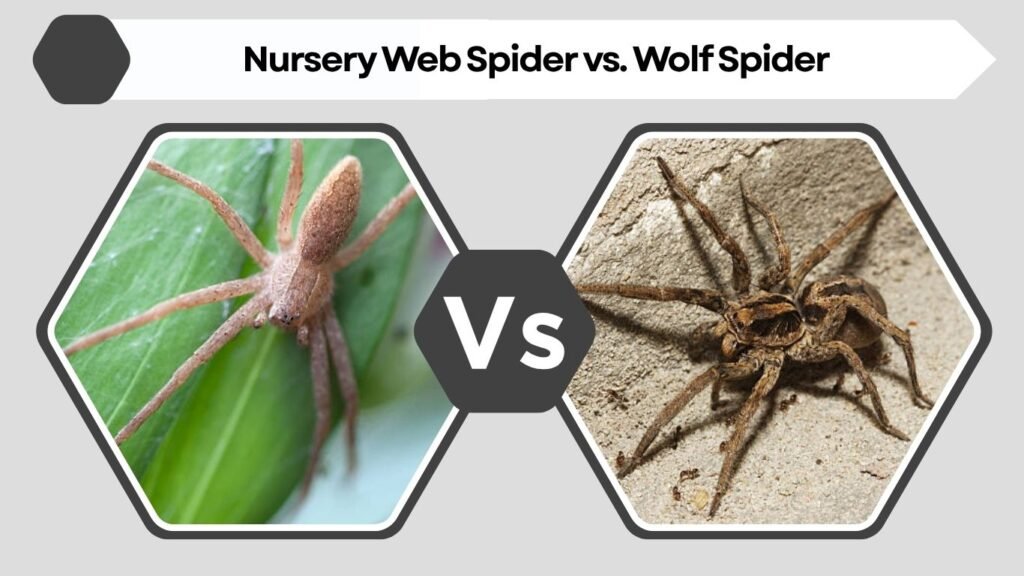
These spiders look similar because both are brown, long-legged hunters. However, their habitats and maternal behavior provide useful identification clues.
| Feature | Nursery web spider | Wolf spider |
| Family | Pisauridae | Lycosidae |
| Common location | Vegetation above ground | Ground, stones, and leaf litter |
| Egg sac position | Held beneath body in jaws | Attached behind abdomen |
| Young spiderlings | Guarded inside nursery web | Ride on mother’s back |
| Eyes | Two rows without huge central eyes | Two large central eyes are prominent |
| Hunting style | Ambushes prey on plants | Runs across the ground |
Female wolf spiders attach their egg sacs to the spinnerets at the rear of the abdomen. After hatching, the babies climb onto the mother’s back. Female nursery web spiders carry their sacs in their jaws and later place them inside a guarded silk nursery.
Nursery Web Spider vs. Brown Recluse
Nursery web spiders are frequently mistaken for brown recluses because they are brown and may have a dark marking on the front body. However, the stripe on a nursery web spider is not the brown recluse’s violin-shaped marking.
| Feature | Nursery web spider | Brown recluse |
| Eyes | Eight | Six |
| Body pattern | Long central stripe | Violin-like mark on front body |
| Legs | Often visibly hairy | Fine-haired, plain-colored legs |
| Habitat | Vegetation and gardens | Dry, undisturbed indoor areas |
| Medical importance | Low | Bite may be medically significant |
Wolf, nursery web, and funnel-weaver spiders are commonly misidentified as brown recluses when their ordinary stripes are mistaken for a violin marking.
Nursery Web Spider in the House
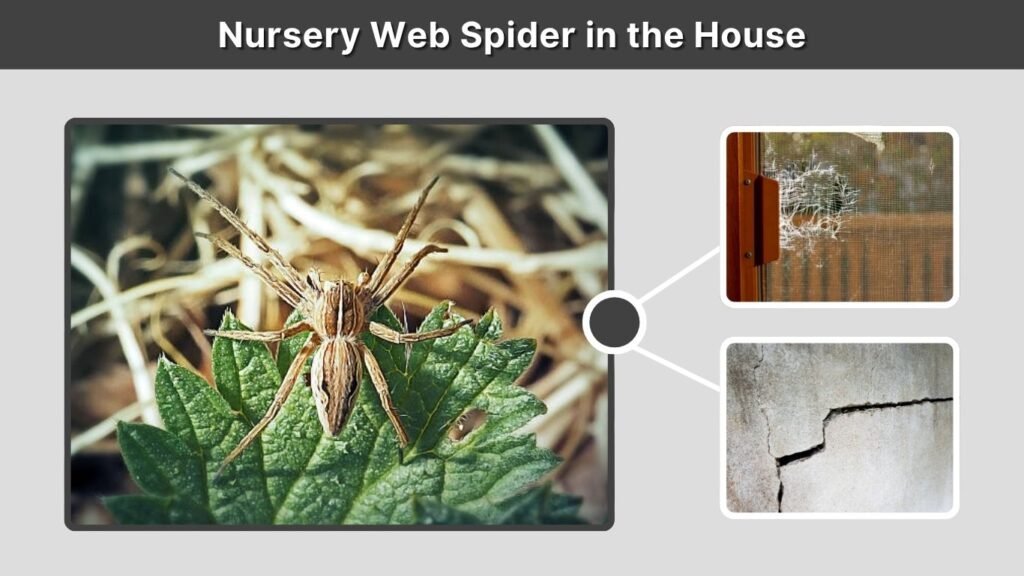
A nursery web spider may accidentally wander indoors through an open door, damaged screen, foundation gap, or plant brought inside. It may appear on a wall, near a window, in a garage, or inside a basement.
Finding one does not normally indicate an infestation. Place a container over the spider, slide stiff paper underneath, and release it onto vegetation outside. Seal entry gaps and reduce indoor insects if spiders appear repeatedly.
FAQs
Are nursery web spiders dangerous?
No. Nursery web spiders are beneficial insect predators and are not considered dangerous to humans. They normally remain still, hide, or run away when disturbed.
Do nursery web spiders build webs?
They do not build capture webs for catching prey. Females construct tent-like nursery webs around their egg sacs shortly before the spiderlings hatch.
Can a nursery web spider bite?
It may bite when squeezed or trapped against the skin, but bites are uncommon. Any reaction is generally expected to remain localized.
Why does a nursery web spider carry an egg sac?
The female carries the sac beneath her body to protect the developing eggs. She later places it inside a silk nursery and guards the emerging young.
Should I remove nursery web spiders from my garden?
Removal is usually unnecessary. Nursery web spiders consume insects and contribute to natural pest control without damaging plants.
