
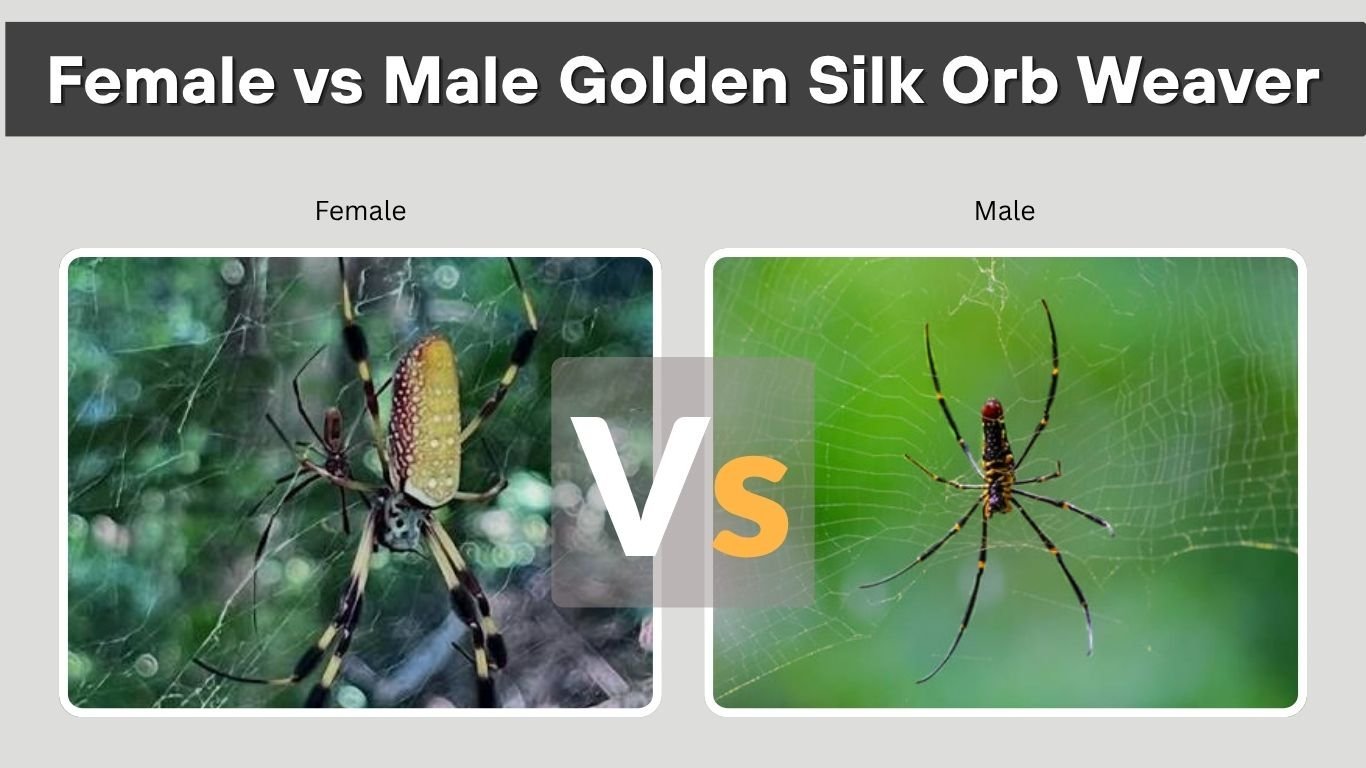
The difference between a female and male golden silk orb weaver is dramatic. Females are large, colorful, and responsible for building the species’ famous golden webs, while males are much smaller, darker, and often difficult to notice. This extreme size difference can make the two sexes appear to be unrelated spiders. Understanding their appearance, behavior, web roles, and mating habits makes identification easier and helps distinguish them from Joro spiders, yellow garden spiders, and other orb weavers.
Female vs Male Golden Silk Orb Weaver Overview
Golden silk orb weavers belong to the genus Trichonephila. In the southeastern United States, the species most commonly called the golden silk orb weaver is Trichonephila clavipes.
These spiders are also widely called golden orb weavers, golden silk spiders, or banana spiders. The word “golden” refers mainly to the yellow-gold silk used in their large webs rather than the spider’s body color.
Quick Comparison
| Feature | Female golden silk orb weaver | Male golden silk orb weaver |
| Body size | Large, often 24–40 mm | Small, often 5–8 mm |
| Leg span | May reach several inches | Usually less than an inch |
| Color | Yellow, orange, silver and brown | Dark brown or reddish brown |
| Abdomen | Long and cylindrical | Small and narrow |
| Web building | Builds and maintains the main web | Rarely builds a large capture web |
| Feeding | Captures many flying insects | Eats small prey or food from female’s web |
| Visibility | Easy to notice | Often overlooked |
| Main adult role | Feeding, web building and egg production | Finding and mating with females |
Size Difference Between Females and Males
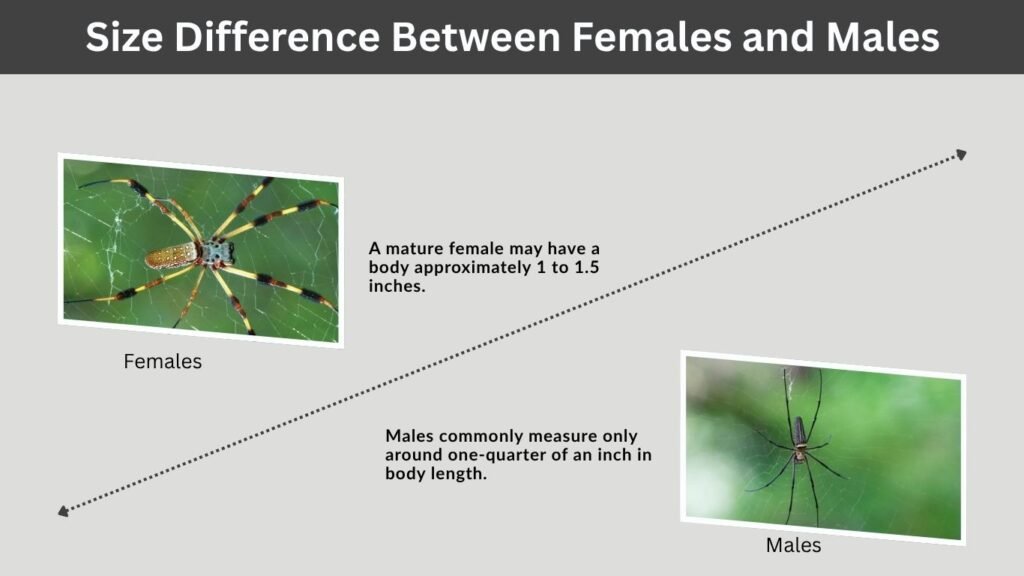
Size is the easiest way to distinguish a female from a male golden silk orb weaver. Females are several times larger than males in both body length and weight.
A mature female may have a body approximately 1 to 1.5 inches long. Her long legs can create a total span of 4 inches or more. Males commonly measure only around one-quarter of an inch in body length.
Why Are Females So Much Larger?
Large female sizes provide several reproductive advantages. A bigger body allows a female to:
- Produce more eggs
- Store more nutrients
- Capture larger prey
- Maintain an extensive web
- Survive the energy demands of reproduction
The male does not need a large abdomen because his primary adult function is locating a female and mating. A smaller body also allows him to move around the female’s web with less risk of being detected as prey.
This pronounced difference is called sexual size dimorphism.
Female Golden Silk Orb Weaver Identification
The female is the spider most people recognize. She is large, long-legged, and usually positioned near the center of an impressive golden web.
Her abdomen is elongated rather than round. Depending on the individual and lighting, it may appear yellow, golden, orange, silver, tan, or brown.
Female Identification Features
A mature female generally has:
- A long, cylindrical abdomen
- Yellow or orange markings
- Silvery or pale patches on the upper body
- Extremely long legs
- Dark hair-like brushes on portions of the legs
- Orange or yellow bands near the leg joints
- A large golden web
Her body can look intimidating, but she is normally calm and reluctant to bite.
Female Web Behavior
The female constructs the main orb web and remains close to it. The web may stretch several feet between trees, shrubs, utility lines, fences, or building supports.
She repairs damaged sections, consumes old silk, replaces sticky threads, and responds to insects trapped in the web. Some females maintain the same general web location for extended periods.
Male Golden Silk Orb Weaver Identification
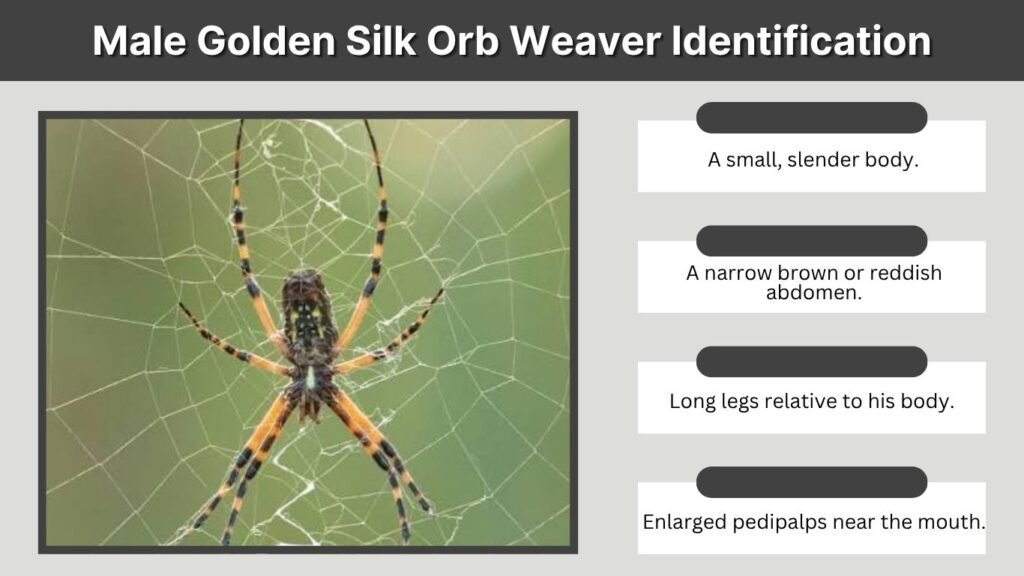
Male golden silk orb weavers are tiny compared with females. They are often seen near the upper edge of a female’s web or along its supporting threads.
Because of their size and darker color, males may initially look like young spiders or unrelated species.
Male Identification Features
A male typically has:
- A small, slender body
- A narrow brown or reddish abdomen
- Long legs relative to his body
- Enlarged pedipalps near the mouth
- Less noticeable coloring
- No large independent orb web
The enlarged pedipalps resemble small boxing gloves and contain the structures used to transfer sperm during mating.
Several males may sometimes live around the outer areas of one female’s web.
Web-Building Differences
Female and male golden silk orb weavers do not contribute equally to web construction. The female creates the large golden capture web associated with the species.
The male may produce silk for safety lines, resting areas, and courtship, but he does not normally construct a large prey-catching web once mature.
The Female’s Golden Web
Golden silk may appear yellow or bronze when sunlight passes through it. The web can be:
- Several feet wide
- Positioned high above the ground
- Strong enough to capture large insects
- Surrounded by irregular barrier threads
- Repaired after storms or prey struggles
The yellow color may help the web attract certain insects in sunlight while making it less visible in shaded conditions.
Feeding Differences
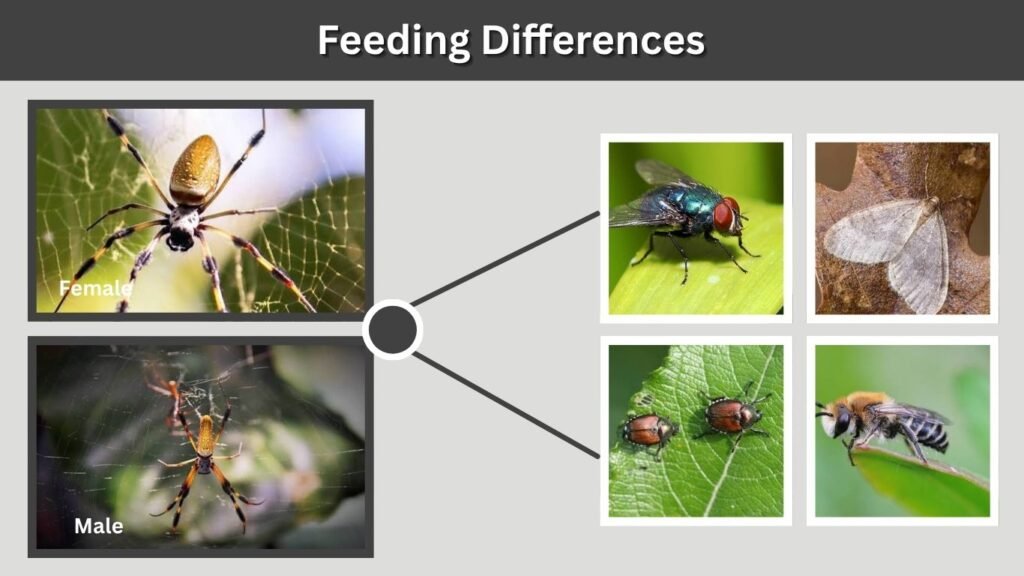
Females consume significantly more food because they are larger and must produce eggs. Their webs capture flies, moths, beetles, grasshoppers, bees, wasps, and other insects.
Males require less food. A male may catch very small prey near the edge of the web or consume leftovers that the female has ignored.
Occasionally, a male may attempt to feed from prey already captured by the female. He must move carefully because sudden vibrations can cause the female to investigate.
Courtship and Mating Behavior
Mating is risky for the much smaller male. The female could potentially mistake him for prey, especially if he approaches carelessly.
To reduce this danger, the male produces controlled vibrations on the web. These signals help announce that he is a potential mate rather than a trapped insect.
How Mating Occurs
The general process includes:
- The male locates an adult or nearly mature female.
- He remains near the edge of her web.
- He produces courtship vibrations through the silk.
- He approaches when the female is calm or distracted.
- He transfers sperm using his pedipalps.
- He retreats to reduce the risk of being attacked.
Males may mate more safely while the female is feeding or shortly after she has molted, when she is temporarily less active.
Although sexual cannibalism can occur among orb weavers, the female does not automatically eat every male after mating.
Female and Male Life Cycle
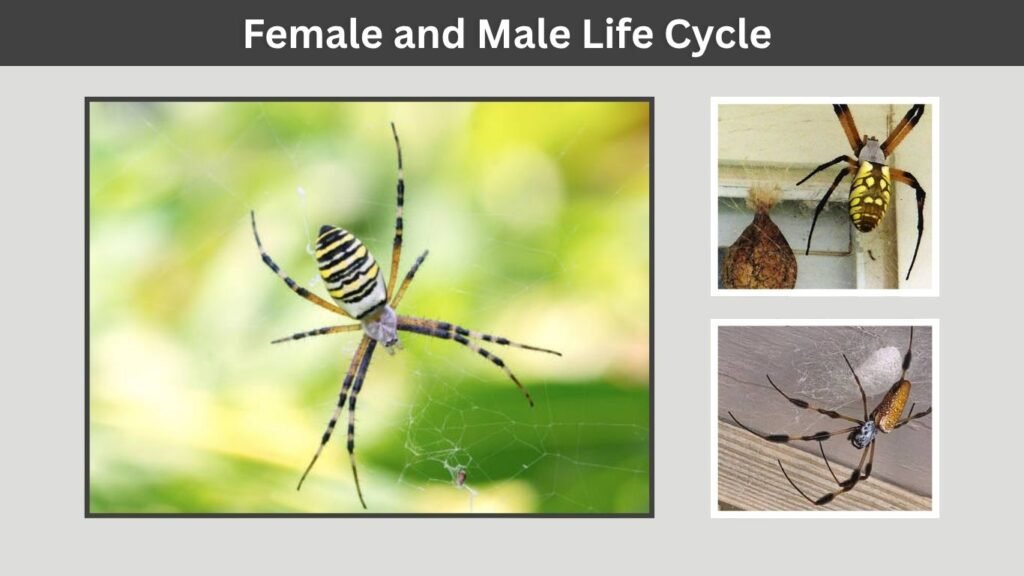
Golden silk orb weavers begin life as tiny spiderlings. At this stage, the size difference between the sexes is not yet obvious.
As they mature, females undergo greater growth and develop their characteristic long abdomen and powerful legs. Males mature at a smaller size and begin searching for females.
Reproduction and Egg Sacs
After mating, the female creates an egg sac in a protected location near her web. A single sac may contain hundreds of eggs.
The female invests substantial energy in producing and protecting the eggs. Males do not provide parental care.
In regions with cold winters, adults generally die when temperatures drop. The eggs survive in their protective sacs and hatch when warmer conditions return.
Are Female Golden Silk Orb Weavers Dangerous?
Female golden silk orb weavers appear more threatening because of their large size, but they are not considered medically dangerous to humans.
They possess venom for immobilizing insects, as nearly all web-building spiders do. However, their venom is not regarded as seriously harmful to healthy people.
A female may bite when:
- Squeezed against the skin
- Picked up
- Trapped inside clothing
- Handled while guarding eggs
- Prevented from escaping
Possible effects include temporary pain, redness, itching, or mild swelling. Males can theoretically bite, but their small fangs make a noticeable bite even less likely.
Golden Silk Orb Weaver vs Joro Spider
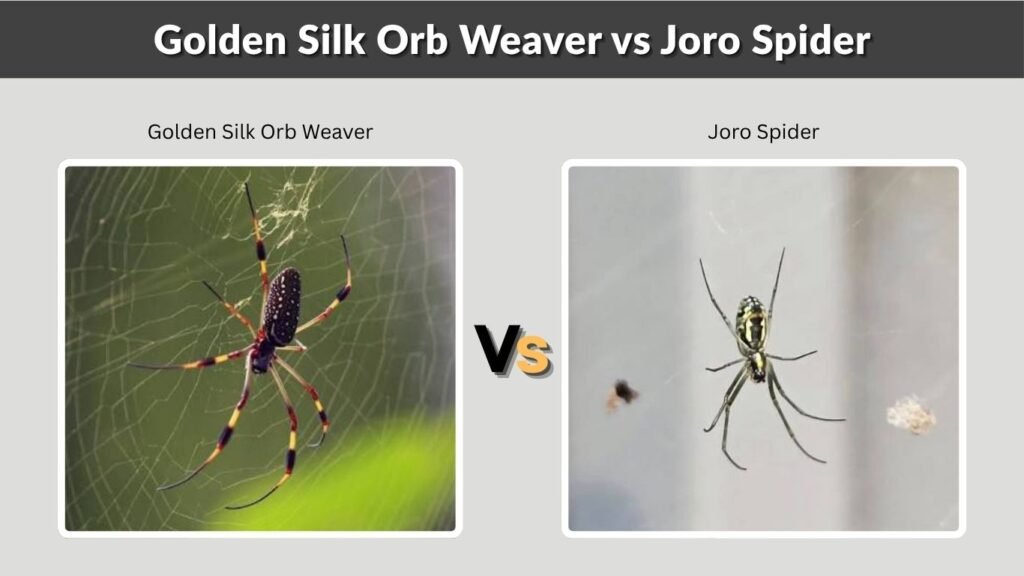
Golden silk orb weavers and Joro spiders belong to the same genus and share several features. Both produce large webs, have elongated bodies, and display yellow markings.
However, they are separate species.
| Feature | Golden silk orb weaver | Joro spider |
| Scientific name | Trichonephila clavipes | Trichonephila clavata |
| Female abdomen | Long, golden or silver-brown | Bright yellow with dark blue or black bands |
| Underside | Less vividly marked | Often has a red marking |
| Leg brushes | Noticeable dark hair tufts | Usually lacks equally prominent brushes |
| Native range | Americas | East Asia |
| U.S. distribution | Primarily southeastern states | Established mainly in parts of the Southeast |
Joro spiders usually have bolder black-and-yellow patterns, while golden silk orb weavers often have a more muted golden, orange, silver, and brown appearance.
Golden Silk Orb Weaver vs Banana Spider
The name “banana spider” creates confusion because it is applied to several unrelated spiders.
In much of the southeastern United States, people use banana spider as another name for the golden silk orb weaver. In this context, the two names describe the same spider.
However, “banana spider” may also refer to:
- Brazilian wandering spiders
- Hawaiian garden spiders
- Other large yellow orb weavers
Location and appearance should therefore be considered before assuming which species the name describes.
Golden Silk Orb Weaver vs Yellow Garden Spider
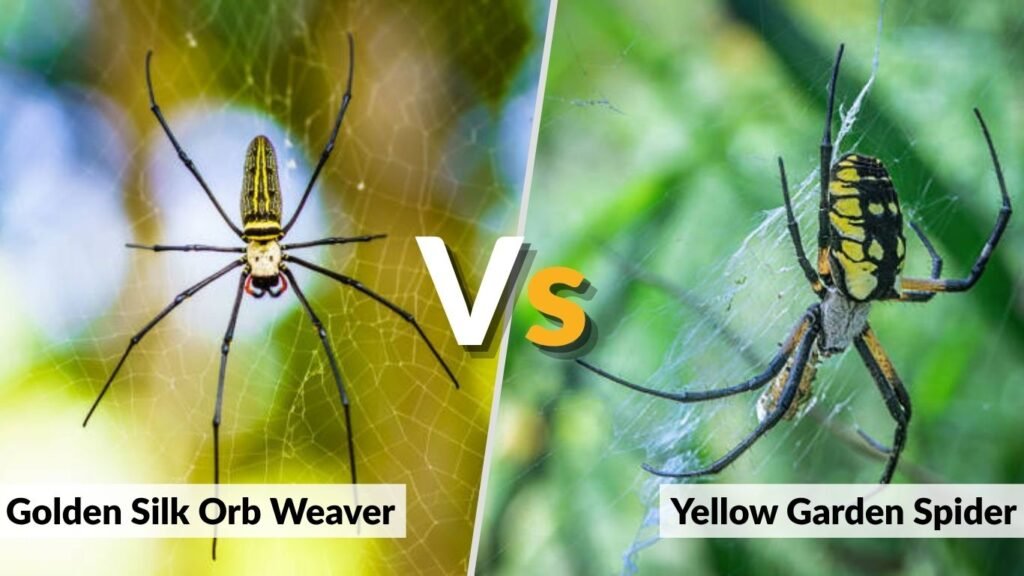
The yellow garden spider, Argiope aurantia, is another large North American orb weaver with black-and-yellow coloring.
| Feature | Golden silk orb weaver | Yellow garden spider |
| Abdomen shape | Long and cylindrical | Broad and oval |
| Leg appearance | Very long with dark hair brushes | Strong black-and-yellow or orange bands |
| Web silk | Often visibly golden | Usually white or clear |
| Web decoration | Usually lacks a bold central zigzag | Often has a thick zigzag stabilimentum |
| Typical posture | Legs spread unevenly | Legs often held in paired groups |
Both species are beneficial insect predators and are not considered dangerous to humans.
Golden Silk Orb Weaver vs Cross Orb Weaver Size
The cross orb weaver is generally smaller and more compact than a female golden silk orb weaver.
Cross orb weavers have rounded abdomens with pale spots forming a cross. Golden silk orb weavers have elongated abdomens and much longer legs.
A large female cross orb weaver may have a substantial body, but she usually lacks the impressive leg span and elongated appearance of a female golden silk orb weaver.
Habitat and Distribution
Golden silk orb weavers prefer warm climates with abundant insects and strong structures for attaching webs.
Common habitats include:
- Forest edges
- Gardens
- Swamps
- Coastal vegetation
- Wooded trails
- Shrublands
- Areas around buildings
- Roadsides with trees
In the United States, they are most frequently encountered in southeastern and Gulf Coast regions. Their webs may span gaps between trees and sometimes cross walking trails.
FAQs
How can you tell a male from a female golden silk orb weaver?
The female is much larger, more colorful, and has a long cylindrical abdomen. She builds the large golden web. The male is tiny, slender, and usually brown or reddish. He commonly remains near the edge of a female’s web rather than building his own large orb.
Why is the male golden silk orb weaver so small?
The male’s small size allows him to mature using less energy and move carefully around a female’s web. Females grow much larger because they need substantial energy reserves to build webs, capture prey, produce egg sacs, and support hundreds of developing eggs.
Do female golden silk orb weavers eat the males?
A female can attack or consume a male, but this does not happen after every mating. Males use courtship vibrations and cautious movements to reduce the risk. They may also approach while the female is feeding, molting, or otherwise less likely to react aggressively.
Is a Joro spider the same as a golden silk orb weaver?
No. They are related spiders in the same genus, but they are different species. Joro spiders usually have brighter black-and-yellow patterns and may display red underneath. Golden silk orb weavers generally have golden, orange, silver, and brown coloring with noticeable leg brushes.
Are golden silk orb weavers dangerous to humans?
Golden silk orb weavers are not considered dangerous. They are venomous because they inject venom into insect prey, but the venom is not medically significant to most people. Bites are uncommon and usually occur only when a spider is trapped, squeezed, or deliberately handled.
