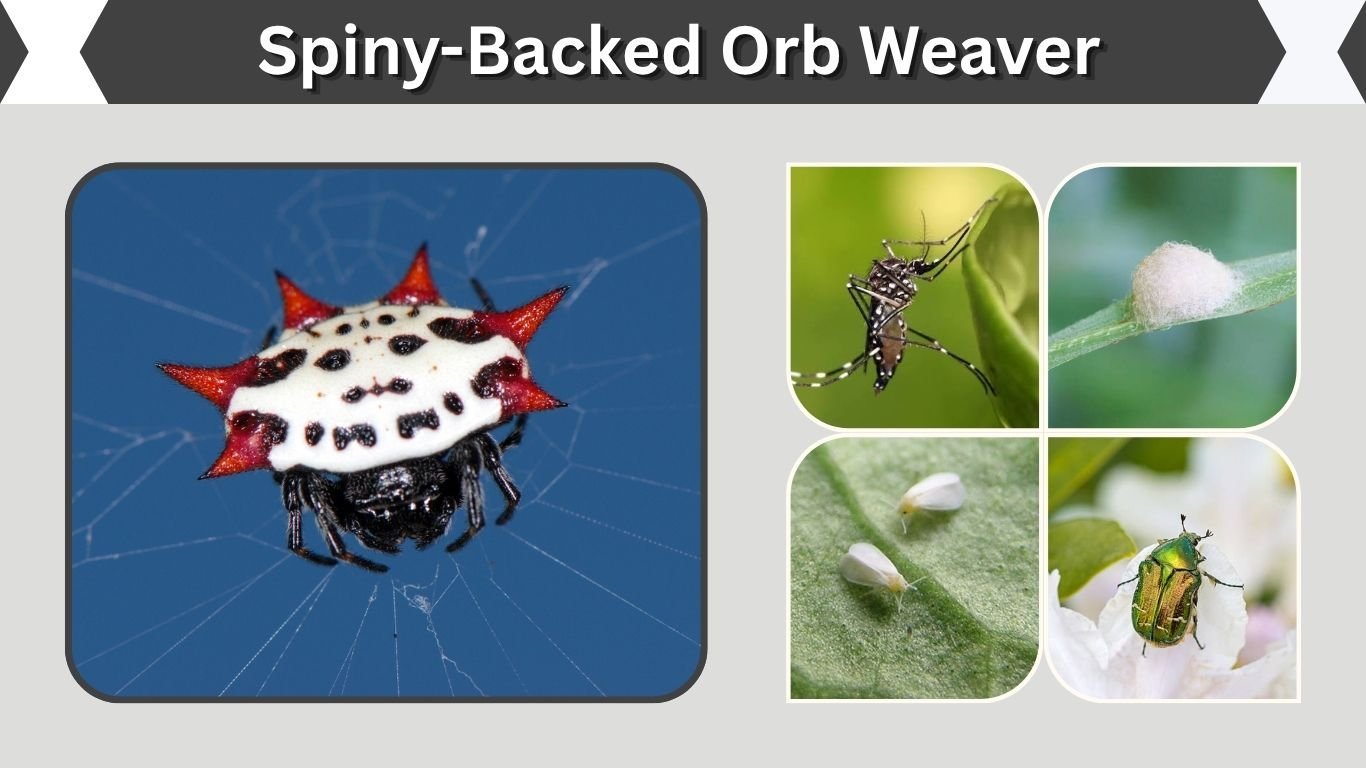
The spiny-backed orb weaver is a small, colorful spider recognized by its broad, crab-shaped abdomen and six pointed spines. Its scientific name is Gasteracantha cancriformis, and it belongs to the orb-weaver family Araneidae. Although its unusual appearance can seem intimidating, this garden spider is not considered dangerous to people. It builds circular webs among trees and shrubs, where it helps control mosquitoes, flies, moths, beetles, and other small insects.
Spiny-Backed Orb Weaver Quick Facts
This species is sometimes called the spiny orb weaver, crablike spiny orb weaver, or crab spider. However, it is not a true crab spider from the family Thomisidae. Its flattened, armored abdomen merely gives it a crablike appearance.
| Feature | Description |
| Scientific name | Gasteracantha cancriformis |
| Family | Araneidae |
| Female size | About 5–9 mm long and 10–13 mm wide |
| Male size | About 2–3 mm long |
| Main colors | White, yellow, orange, red, and black |
| Number of large spines | Six on adult females |
| Diet | Mosquitoes, flies, moths, beetles, and whiteflies |
| Habitat | Woodlands, gardens, orchards, shrubs, and trees |
| Risk to humans | Bite is not known to cause serious effects |
The measurements, feeding habits, and safety information above are based primarily on descriptions from the University of Florida’s entomology resources.
How to Identify a Spiny-Backed Orb Weaver
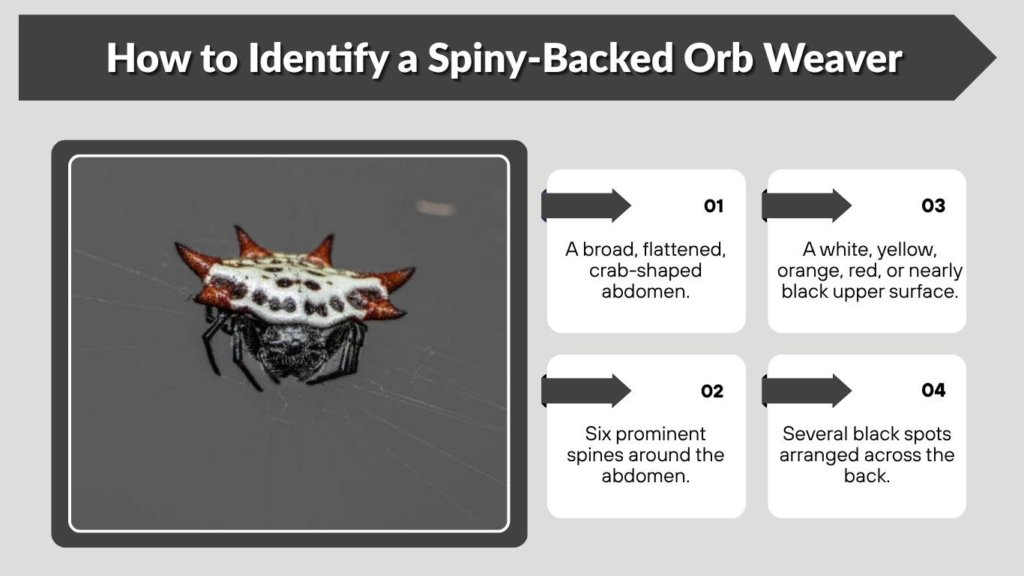
The female is far more noticeable than the male. Her wide abdomen resembles a small shell or shield with pointed projections around its edge. Color can vary considerably, so the body shape and web are often more reliable identification features than color alone.
Identification Features
- A broad, flattened, crab-shaped abdomen
- Six prominent spines around the abdomen
- A white, yellow, orange, red, or nearly black upper surface
- Several black spots arranged across the back
- Red, orange, or black abdominal spines
- Black legs and front body in many individuals
- A circular, wheel-shaped web between plants
Florida females are commonly white with black spots and red spines. In other regions, individuals may have yellow backs, black spines, or an almost completely black body.
Black and Yellow Color Patterns
A black spiny-backed orb weaver or yellow spiny-backed orb weaver is not necessarily a different species. Gasteracantha cancriformis has several natural color forms. Some females are yellow with dark spots, while others are white, orange, red, or mostly black.
Male vs. Female
Female spiny-backed orb weavers are approximately 5–9 mm long but may be up to 13 mm wide. Males are only about 2–3 mm long. They lack the female’s six large spines, although several small humps may appear near the rear of the abdomen.
Is the Spiny-Backed Orb Weaver Poisonous?
The spiny-backed orb weaver is venomous in the biological sense because it uses venom to subdue insect prey. However, it is not considered medically dangerous to humans, and the bite of this species is not known to cause serious effects.
Does It Bite?
A spiny-backed orb weaver may bite when trapped, squeezed, or handled roughly, but biting is uncommon. The spider normally remains in its web or attempts to escape rather than defend itself against a person.
A bite may cause minor localized discomfort similar to other small spider bites. Wash the area with soap and water, apply a cold compress, and avoid scratching it. Seek medical attention if severe pain, spreading swelling, breathing difficulty, or another serious reaction develops.
Are the Spines Dangerous?
The abdominal spines are defensive structures rather than stingers. Researchers believe they may make the spider difficult for birds and other predators to swallow or handle. The spines can feel sharp, so the spider should not be picked up.
Spiny-Backed Orb Weaver Web
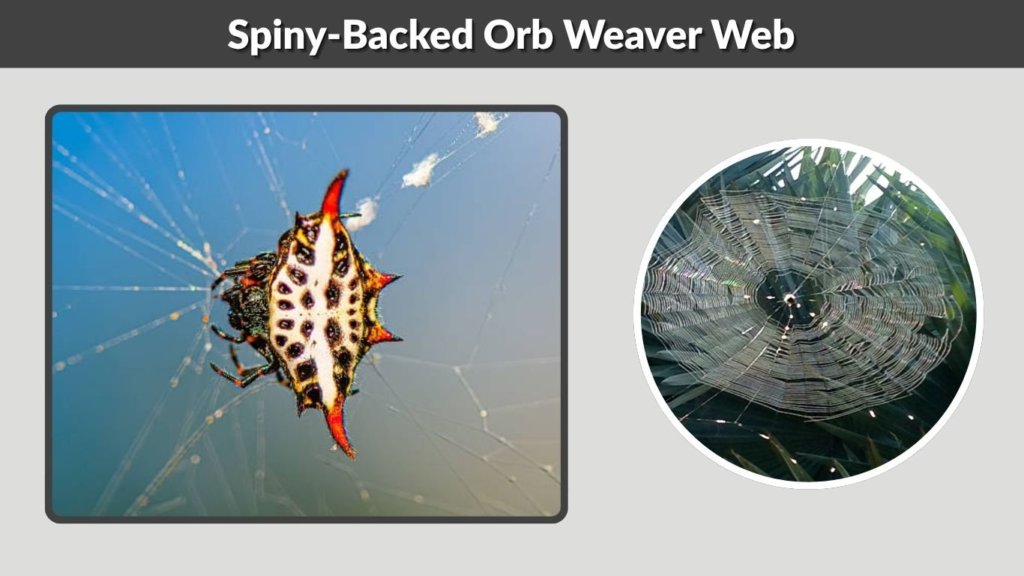
Spiny-backed orb weavers construct flat, circular webs that resemble wheels. The female usually rests in the center, facing downward while waiting for flying insects to strike the sticky spiral threads.
Web Size and Appearance
A mature web’s catching area may measure approximately 30–60 cm across and contain 10–30 radial support lines. The spider may place conspicuous white silk tufts along the foundation lines. One proposed purpose of these visible decorations is to help birds notice and avoid the web.
The webs can be positioned from less than one metre to more than six metres above the ground. They are commonly stretched between tree branches, shrubs, fences, porches, and garden plants.
Spiny-Backed Orb Weaver Habitat and Distribution
Spiny-backed orb weavers prefer areas with vegetation that provides strong attachment points for their webs. Woodland edges, shrubby gardens, citrus groves, nurseries, suburban yards, and landscaped properties are common habitats.
Are Spiny-Backed Orb Weavers Common in Florida?
They are especially common in Florida and other warm parts of the southeastern United States. Florida residents frequently notice them between trees, shrubs, patios, and garden plants, particularly when adult populations become more visible in autumn and winter.
Geographic Range
Gasteracantha cancriformis occurs from the southern United States through Central America, the Caribbean, and parts of South America. It is also established in Hawaii. Reports from places such as Australia or northern Europe may involve transported individuals or other spiny orb-weaver species with a similar appearance.
What Do Spiny-Backed Orb Weavers Eat?
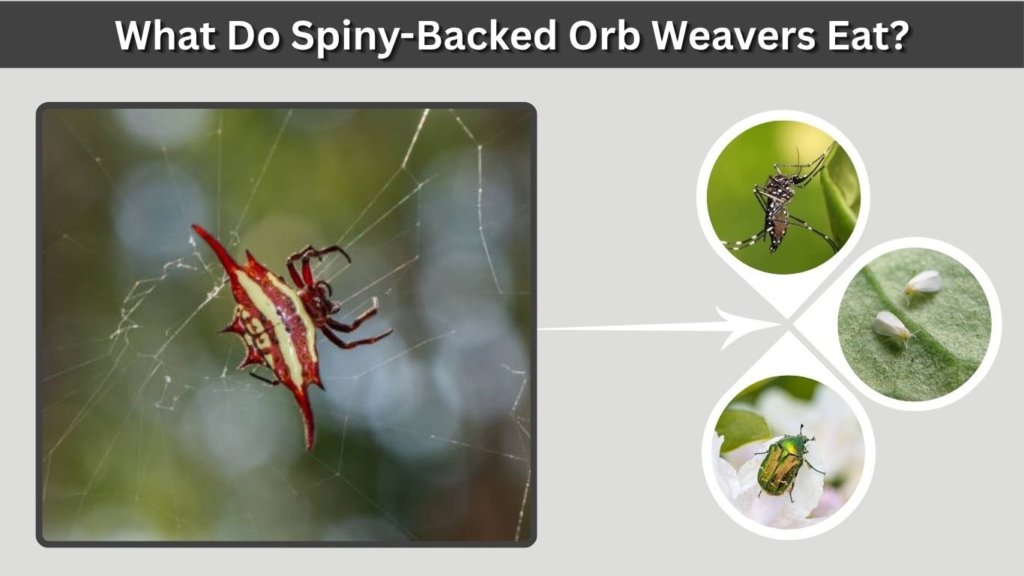
These spiders eat small insects and other arthropods captured in their webs. Their common prey includes:
- Mosquitoes
- Whiteflies
- Small moths
- Beetles
- Flies
- Other flying garden insects
When an insect becomes trapped, the spider detects vibrations through the silk, approaches the prey, bites it, and carries or consumes it near the web’s central area. This natural pest-control role makes the spider beneficial in gardens and orchards.
Egg Sacs and Life Cycle
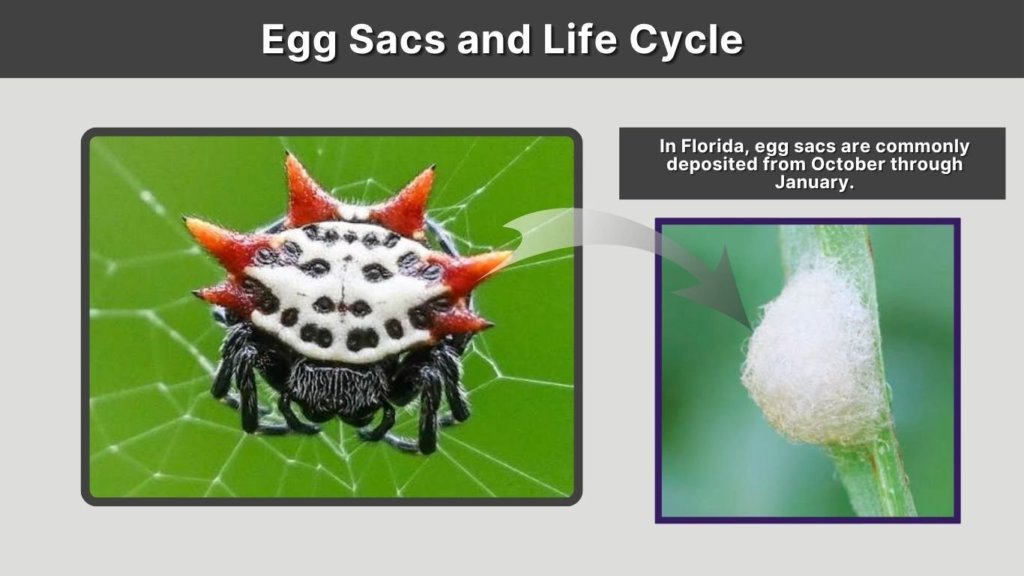
The female places her egg sac on the underside of a leaf near her web rather than maintaining a permanent nest. In Florida, egg sacs are commonly deposited from October through January.
What Does the Egg Sac Look Like?
The egg sac is oval and usually measures about 20–25 mm long. It contains a mass of eggs protected by layers of white, yellow, and greenish silk. A female may lay approximately 101–256 eggs, with one Florida study recording an average of 169 eggs per sac.
Eggs may hatch in about 11–13 days, although the young spiders can remain protected within the sac for several additional weeks. The spiderlings eventually disperse and begin constructing tiny orb webs or hanging from individual silk strands.
Should You Remove a Spiny-Backed Orb Weaver?
Removal is usually unnecessary because the spider is beneficial and poses little risk. Leaving it alone allows it to capture insects around the garden.
Move the spider only when its web repeatedly blocks a doorway, walkway, or frequently used area. Use a long stick or garden tool to gently break the outer support threads while the spider is not directly beneath your hand. It will usually relocate and construct another web nearby.
FAQs
Are spiny-backed orb weaver spiders poisonous?
They possess venom for immobilizing insect prey, but they are not regarded as medically dangerous to humans. Their bite is uncommon and is not known to produce serious effects in healthy people. Avoid handling them because any spider may bite when squeezed or trapped.
What does a spiny-backed orb weaver bite look like?
There is no unique appearance that reliably identifies its bite. A minor bite could produce temporary redness, tenderness, itching, or slight swelling. Many skin irritations are mistakenly blamed on spiders, so persistent or worsening symptoms should be evaluated by a medical professional.
Why does the spiny-backed orb weaver have spikes?
The six abdominal spines probably help discourage predators by making the spider appear larger, harder to grasp, or more difficult to swallow. The bright body colors may also provide a warning signal, although the exact defensive functions remain under study.
Is a spiny-backed orb weaver the same as a crab spider?
No. It is sometimes locally called a crab spider because its broad abdomen resembles a crab shell. True crab spiders belong to the family Thomisidae and normally hunt without building circular orb webs.
How long does a spiny-backed orb weaver live?
It generally follows a seasonal life cycle lasting less than or around one year. Adults reproduce, females produce protected egg sacs, and a new generation develops and disperses. Temperature and regional climate can affect when adults appear and how long each stage lasts.
