
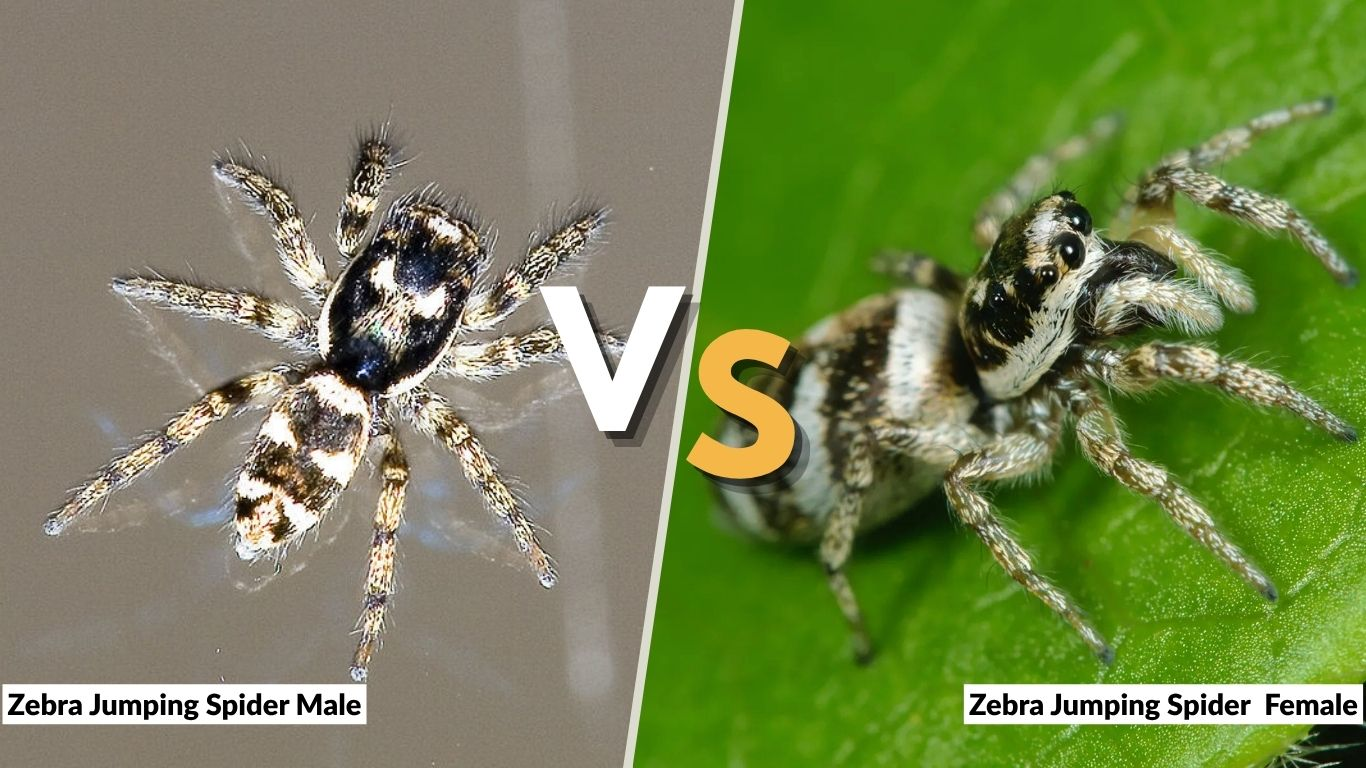
Telling a male zebra jumping spider from a female can be tricky because both are tiny, striped, and fast-moving. However, once you know what to look for, the differences become much easier to spot. Male zebra jumping spiders are usually smaller and often have longer, more noticeable mouthparts, while females tend to look rounder and slightly larger. This guide explains the main male vs female differences, including size, markings, behavior, mating, and beginner-friendly identification tips.
What Is a Zebra Jumping Spider?
The zebra jumping spider, scientifically known as Salticus scenicus, is a small black-and-white jumping spider commonly seen on walls, fences, windowsills, tree trunks, and sunny outdoor surfaces. It is also called the zebra spider, zebra jumper spider, or jumping zebra spider.
Like other jumping spiders, it does not rely on a sticky web to catch prey. Instead, it hunts during the day using excellent vision, careful stalking, and short, accurate jumps. Its large front-facing eyes give it a curious appearance, and its striped body makes it one of the easiest jumping spiders to recognize.
Before comparing males and females, it helps to remember that both sexes share the same basic traits: compact body, black-and-white striping, strong front vision, and quick stop-start movements. The differences are subtle, so you usually need a close look or a clear photo.
Zebra Jumping Spider Male vs Female at a Glance
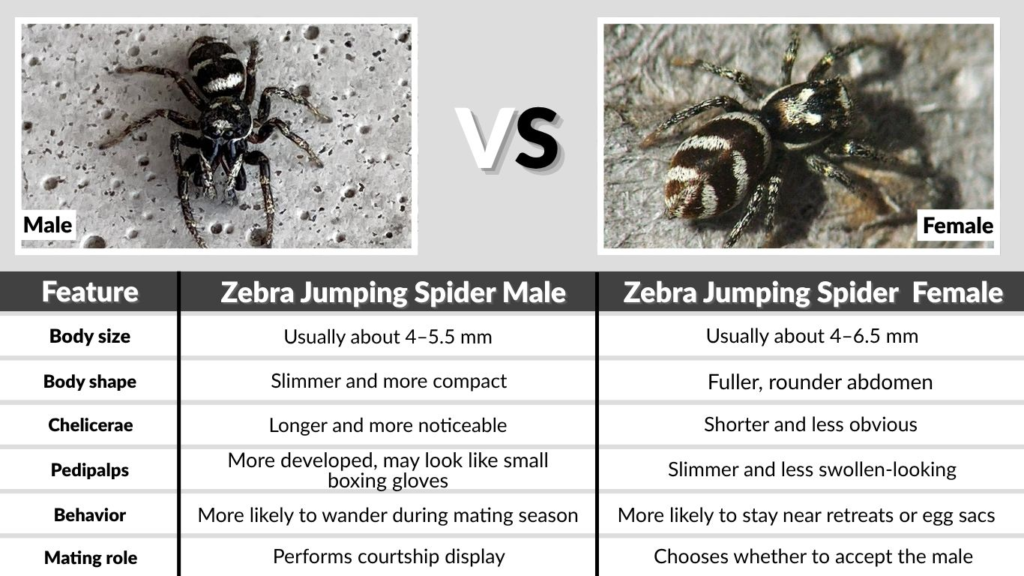
The easiest way to compare a male and female zebra jumping spider is to look at size, body shape, front mouthparts, and behavior. Males often look more angular and have longer chelicerae. Females often look fuller, especially around the abdomen.
| Feature | Male Zebra Jumping Spider | Female Zebra Jumping Spider |
| Body size | Usually about 4–5.5 mm | Usually about 4–6.5 mm |
| Body shape | Slimmer and more compact | Fuller, rounder abdomen |
| Chelicerae | Longer and more noticeable | Shorter and less obvious |
| Pedipalps | More developed, may look like small boxing gloves | Slimmer and less swollen-looking |
| Behavior | More likely to wander during mating season | More likely to stay near retreats or egg sacs |
| Mating role | Performs courtship display | Chooses whether to accept the male |
| Best ID clue | Long front chelicerae | Larger, rounder abdomen |
Male Zebra Jumping Spider Identification
A male zebra jumping spider can usually be identified by its smaller body and more noticeable front structures. The chelicerae, which are the mouthpart structures at the front of the spider, are often longer in males. From the front, these can look like dark jaws, fangs, or even a tiny moustache.
Males may also have more prominent pedipalps. Pedipalps are the small leg-like appendages near the mouth. In mature male spiders, these are used during mating and can appear larger or more bulb-like than those of females.
Key Signs of a Male Zebra Jumping Spider
Look for these features:
- Slightly smaller body
- Slimmer abdomen
- Long, dark chelicerae at the front
- More noticeable pedipalps
- Active wandering behavior
- Courtship movements around females
A male zebra jumping spider is often easier to recognize when viewed from the front. If you can clearly see long mouthparts projecting downward or forward, there is a good chance you are looking at a male.
Female Zebra Jumping Spider Identification
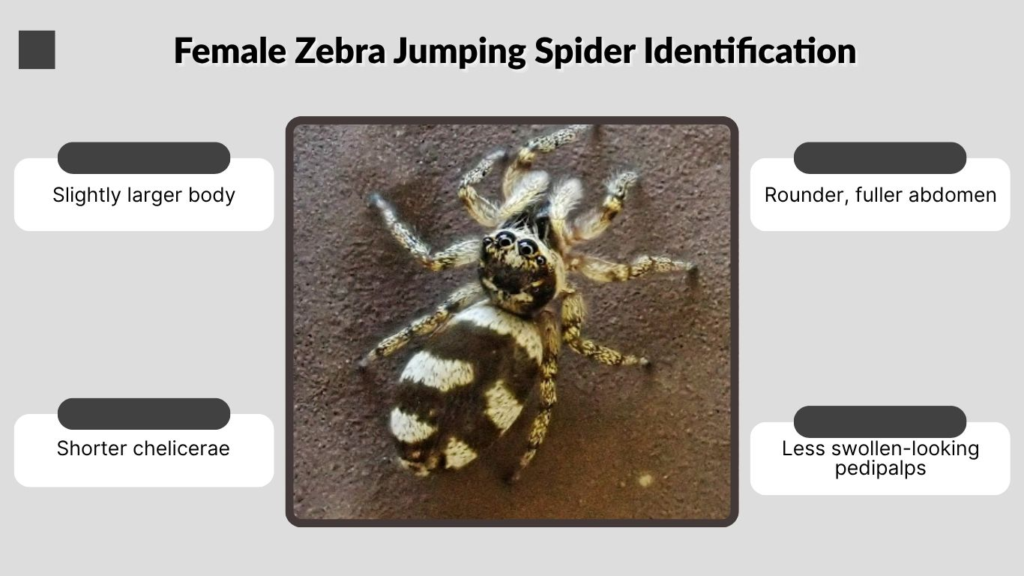
A female zebra jumping spider is often slightly larger and rounder than a male. Her abdomen may look fuller, especially if she is well-fed or carrying eggs. Her chelicerae are usually shorter and less dramatic than the male’s.
Females may also be seen near silk retreats, especially during egg-laying periods. After mating, a female may create a silk shelter where she lays and guards her eggs. This behavior can make females easier to find in protected cracks, corners, window frames, or sheltered wall spaces.
Key Signs of a Female Zebra Jumping Spider
Look for these features:
- Slightly larger body
- Rounder, fuller abdomen
- Shorter chelicerae
- Less swollen-looking pedipalps
- Possible guarding behavior near silk retreat
- Less wandering than males during mating season
A female zebra jumping spider may still move quickly and jump accurately, but she often looks more robust than a male when seen from above.
Size Difference Between Male and Female Zebra Jumping Spiders
Size is one of the most common clues, but it should not be used alone. Females are generally a little larger than males. Males are commonly around 4–5.5 mm in body length, while females are often around 4–6.5 mm.
This difference is small, so it can be hard to judge without comparison. A large male may overlap in size with a small female. Juveniles add even more confusion because they are not fully developed and may not show clear adult sex characteristics.
Why Size Can Be Misleading
Size may vary because of:
- Age
- Recent molting
- Feeding condition
- Whether the female is carrying eggs
- Camera angle
- Individual variation
A well-fed male may look larger than expected, while a young adult female may look small. For accurate sexing, combine size with body shape, chelicerae, and pedipalps.
Chelicerae: The Best Male vs Female Clue
The chelicerae are one of the most useful features for telling male and female zebra jumping spiders apart. In males, the chelicerae are noticeably longer. They may appear as dark, extended jaws below the face. In females, the chelicerae are shorter and less obvious.
This is why many people search for “zebra jumping spider male why big teeth.” The “big teeth” are usually the male’s enlarged chelicerae. They are not a sign that the spider is more dangerous. Instead, they are part of the male’s appearance and may be involved in display and species recognition.
How to Check the Chelicerae Safely
Do not pick up the spider to inspect it. Instead:
- Watch it through a clear container
- Take a close-up photo
- Zoom in on the front of the face
- Compare the mouthpart length
- Look for long, dark structures in males
A front-facing photo is often better than a top-down photo for seeing this difference.
Pedipalps: Another Useful Sexing Feature
Pedipalps are small appendages near the spider’s mouth. They look a bit like tiny extra legs. In mature males, pedipalps are modified for reproduction and can look enlarged or bulb-like. In females, the pedipalps are usually slimmer.
For beginners, pedipalps can be harder to judge than chelicerae because the spider is small and often moving. However, in clear macro photos, the difference may be visible.
Male Pedipalps
Male pedipalps may look:
- Rounder at the ends
- More swollen
- More noticeable near the face
- Like tiny “boxing gloves”
Female Pedipalps
Female pedipalps are usually:
- Slimmer
- Less bulb-like
- Less prominent
- Easier to overlook
Pedipalps are especially useful when identifying mature adults. Juveniles may not show clear adult features yet.
Body Shape and Abdomen Differences
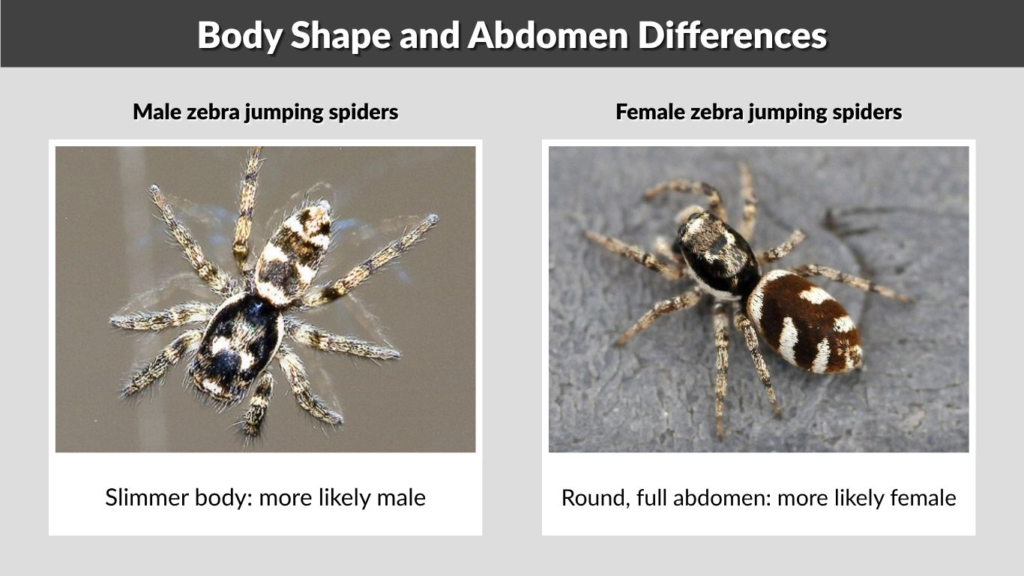
Body shape can also help. Female zebra jumping spiders often have a fuller abdomen. This may be especially noticeable from above. If the abdomen looks rounded and broad compared with the front body section, the spider may be female.
Males usually look slimmer. Their abdomen may appear narrower, and their front structures may draw more attention than the body shape.
Body Shape Clues
Use these visual clues:
- Round, full abdomen: more likely female
- Slimmer body: more likely male
- Large front mouthparts: more likely male
- Fuller rear body: more likely female
Still, body shape alone is not always reliable. A hungry female can look slim, and a well-fed male can look plump.
Color and Stripe Differences
Both male and female zebra jumping spiders have black-and-white or dark-and-pale striping. The stripes are the reason for the common name “zebra spider.” However, color is not always the best way to tell males and females apart.
Some individuals may look brighter, darker, or more faded depending on age, lighting, molt stage, and camera quality. A freshly molted spider may look cleaner or paler, while an older spider may appear duller.
Can You Sex Them by Color?
Usually, no. Color can help confirm that the spider is a zebra jumping spider, but it is not the most reliable male vs female feature. Chelicerae, pedipalps, body size, and abdomen shape are more useful.
Behavior Differences Between Male and Female Zebra Jumping Spiders
Behavior can provide clues, especially during spring and early summer when mating activity is more common. Males may wander more as they search for females. They may also perform courtship displays if they encounter a female.
A male may wave his front legs, move side to side, or show a dance-like display. This is not aggression toward humans. It is part of mating communication.
Females may be more selective. If a female accepts the male, she allows him to approach. If she does not, the male may retreat or risk being attacked.
Male Behavior
Male zebra jumping spiders may:
- Wander more often
- Search for females
- Perform courtship displays
- Wave legs or move side to side
- Approach cautiously
Female Behavior
Female zebra jumping spiders may:
- Stay near sheltered areas
- Guard egg sacs
- Watch males before accepting
- Reject or avoid unwanted males
- Spend more time near retreats
Behavior is helpful, but it is not enough by itself. A female can wander, and a male can rest in a retreat.
Zebra Jumping Spider Mating Dance
The zebra jumping spider mating dance is one of the most interesting differences between males and females. The male performs visual signals to show the female that he is a potential mate rather than prey or a threat.
He may wave his legs, move in short bursts, and display his body from different angles. His enlarged chelicerae can make the display more noticeable. The female watches and decides whether to accept him.
If the female accepts, she crouches and allows the male to approach. The male then climbs onto her and transfers sperm using his pedipalps. If she rejects him, he may move away to avoid danger.
Female Zebra Jumping Spider Eggs
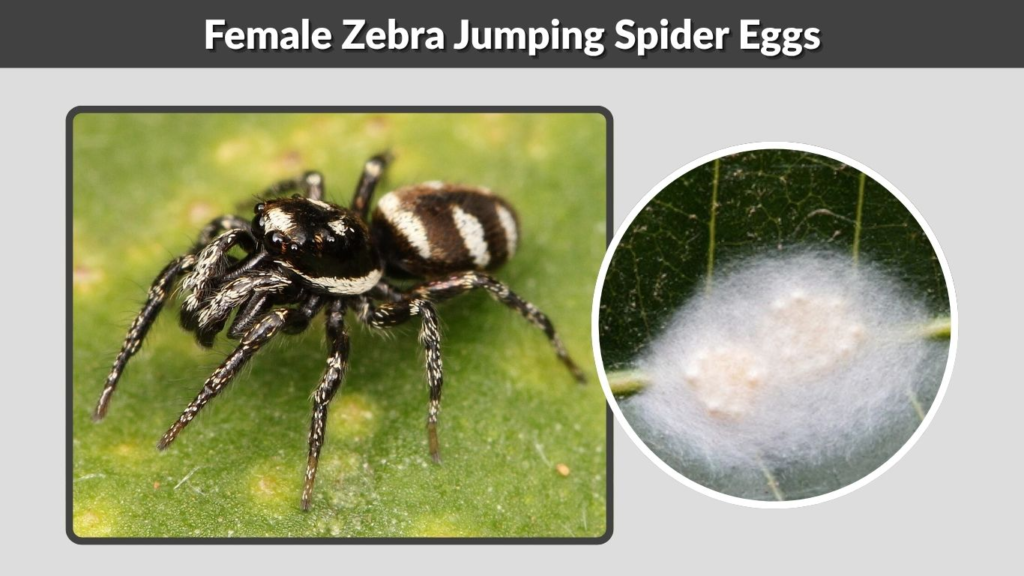
After mating, the female zebra jumping spider may lay eggs inside a silk retreat or cocoon. She guards the eggs until they hatch. This maternal behavior is another reason females may be found near protected spaces.
A female with eggs may appear rounder than usual. However, a full abdomen does not always mean she is carrying eggs. She may simply have eaten recently.
Signs of a Female With Eggs
Possible signs include:
- Very round abdomen
- Staying inside or near silk retreat
- Reduced wandering
- Defensive behavior near shelter
- Presence of a small silk egg sac
Do not disturb a female guarding eggs. If she is indoors and not causing a problem, it is often best to leave her alone or carefully relocate only if necessary.
How to Sex a Zebra Jumping Spider Step by Step
Sexing a zebra jumping spider is easiest with a clear view and patience. Since these spiders are tiny, a phone camera with zoom or a macro lens can help.
Step 1: Confirm It Is a Zebra Jumping Spider
Look for the compact jumping spider shape, large front eyes, and black-and-white striped pattern. Make sure you are not looking at another small jumping spider species.
Step 2: Look at the Size
If the spider is slightly larger and rounder, it may be female. If it is smaller and slimmer, it may be male. Do not decide from size alone.
Step 3: Check the Chelicerae
Look at the front of the face. Long, noticeable chelicerae suggest a male. Shorter, less obvious chelicerae suggest a female.
Step 4: Check the Pedipalps
Bulb-like pedipalps near the mouth suggest a mature male. Slimmer pedipalps suggest a female or immature spider.
Step 5: Watch the Behavior
A wandering spider performing display movements may be male. A spider guarding a silk retreat or egg sac may be female.
Step 6: Compare Multiple Clues
The best identification comes from combining features. Size, chelicerae, pedipalps, abdomen shape, and behavior together are more reliable than any single clue.
Common Mistakes When Identifying Male and Female Zebra Jumping Spiders
Many people misidentify zebra jumping spiders because they rely on only one feature. Since these spiders are small, lighting and camera angle can easily change how they appear.
Mistake 1: Using Size Only
Females are often larger, but size overlaps. A small female and large male can look similar.
Mistake 2: Using Color Only
Both sexes have zebra-like stripes. Color differences are not reliable enough for sexing.
Mistake 3: Confusing Juveniles With Females
Juveniles may lack the obvious male features seen in mature adults. A young male may not yet show clearly enlarged pedipalps.
Mistake 4: Assuming Big Chelicerae Mean Danger
Male chelicerae can look dramatic, but they do not mean the spider is aggressive or dangerous to people.
Is the Male Zebra Jumping Spider More Dangerous?
No, a male zebra jumping spider is not more dangerous than a female. The male’s long chelicerae may look intimidating, but zebra jumping spiders are not considered harmful to humans. They are small, shy, and more likely to escape than bite.
Both males and females have venom for hunting tiny prey. However, their venom is not considered medically significant for most people. Bites are rare and usually mild.
Can You Keep Male and Female Zebra Jumping Spiders Together?
It is not recommended to keep male and female zebra jumping spiders together long-term. Spiders are solitary animals. A male may approach a female for mating, but there is risk involved. The female may reject, attack, or even eat the male.
If someone keeps zebra jumping spiders as pets, they should usually house them separately. Breeding attempts should only be done with careful research and close supervision.
FAQs
How can you tell if a zebra jumping spider is male or female?
Look at the chelicerae, pedipalps, body size, and abdomen shape. Males are usually smaller and have longer chelicerae with more noticeable pedipalps. Females are often slightly larger, rounder, and have shorter chelicerae.
Are female zebra jumping spiders bigger than males?
Yes, females are usually slightly bigger than males. Females are often about 4–6.5 mm in body length, while males are commonly about 4–5.5 mm. However, size can overlap, so it should not be the only clue.
Why do male zebra jumping spiders have big teeth?
The “big teeth” are usually enlarged chelicerae, not a sign of danger. Male zebra jumping spiders have longer chelicerae than females, and these structures help with appearance, display, and species recognition.
Do male zebra jumping spiders dance?
Yes, males may perform courtship displays around females. This can include leg waving, side-to-side movement, and careful approach. The dance helps the female recognize him as a potential mate rather than prey or a threat.
Is a male or female zebra jumping spider better as a pet?
Both can be kept for observation, but females may live longer as adults and may be easier to observe near retreats. Males may wander more and be more active during mating season. Either sex needs a secure enclosure and tiny live prey.
