
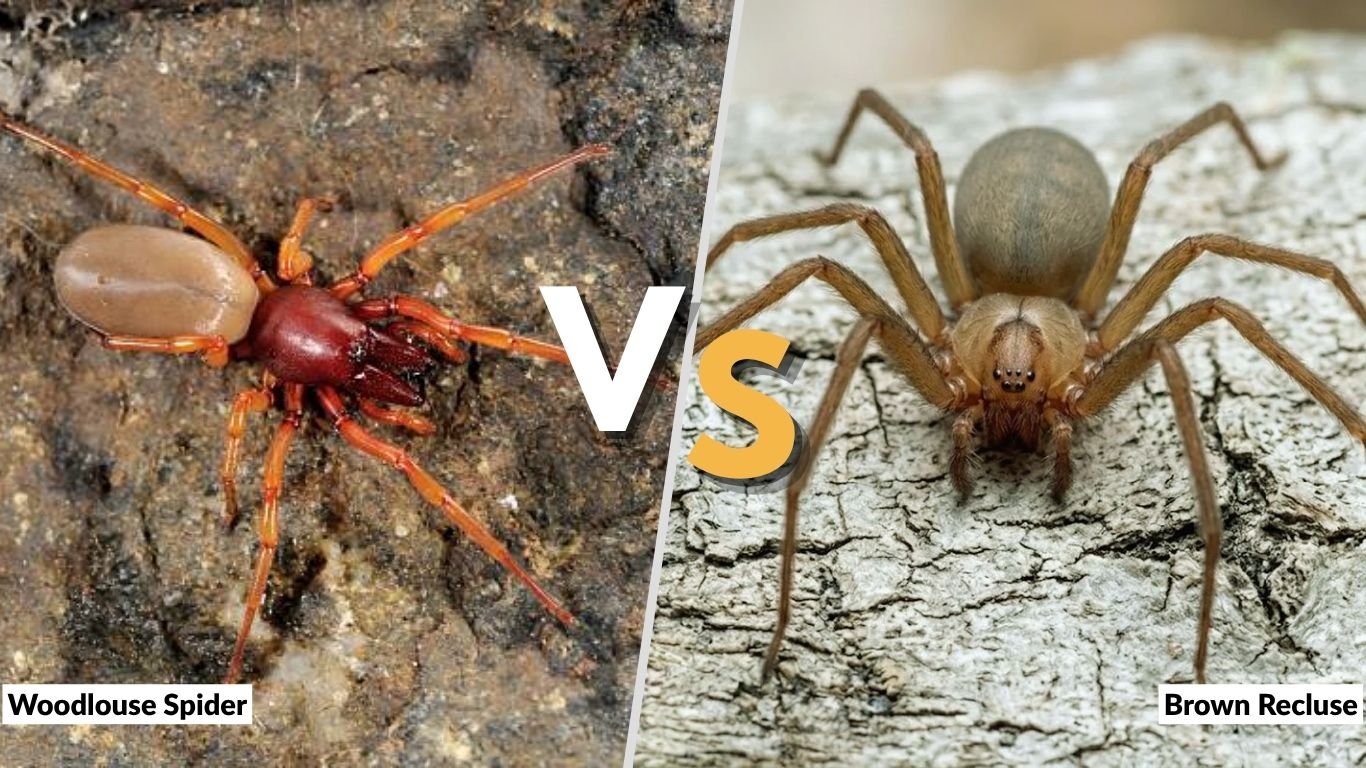
The woodlouse spider and brown recluse can both appear indoors and have six eyes, but they are relatively easy to separate when their colors, fangs, legs, and eye arrangements are examined. A woodlouse spider has a reddish-orange front body, a pale abdomen, and enormous forward-pointing jaws. A brown recluse is more uniformly tan or brown, with slender legs and a possible violin-shaped marking. More importantly, brown recluse venom can occasionally damage skin tissue, whereas woodlouse spider bites are not considered medically significant.
Woodlouse Spider vs Brown Recluse: Quick Comparison
Although these spiders may have similar body lengths, their shapes and color patterns are noticeably different. The woodlouse spider is Dysdera crocata, while the brown recluse is Loxosceles reclusa.
| Feature | Woodlouse spider | Brown recluse |
| Front-body color | Glossy red or orange-brown | Light to dark brown |
| Abdomen | Cream, gray, tan, or pinkish | Plain, uniformly brown |
| Eyes | Six eyes clustered closely together | Six eyes arranged in three separated pairs |
| Fangs | Large and visibly project forward | Smaller and less noticeable |
| Legs | Reddish and relatively sturdy | Long, thin, and uniformly brown |
| Main food | Woodlice and other small invertebrates | Insects and other spiders |
| Preferred conditions | Moist areas near woodlice | Dry, dark, undisturbed shelters |
| Bite effect | Usually brief localized discomfort | Occasionally causes significant skin injury |
| Medical importance | Low | Potentially medically significant |
Colorado State University identifies woodlouse hunters as one of the spiders most frequently mistaken for brown recluses. Both have six eyes, but their eye arrangements, coloration, and jaws are different.
How to Identify a Woodlouse Spider
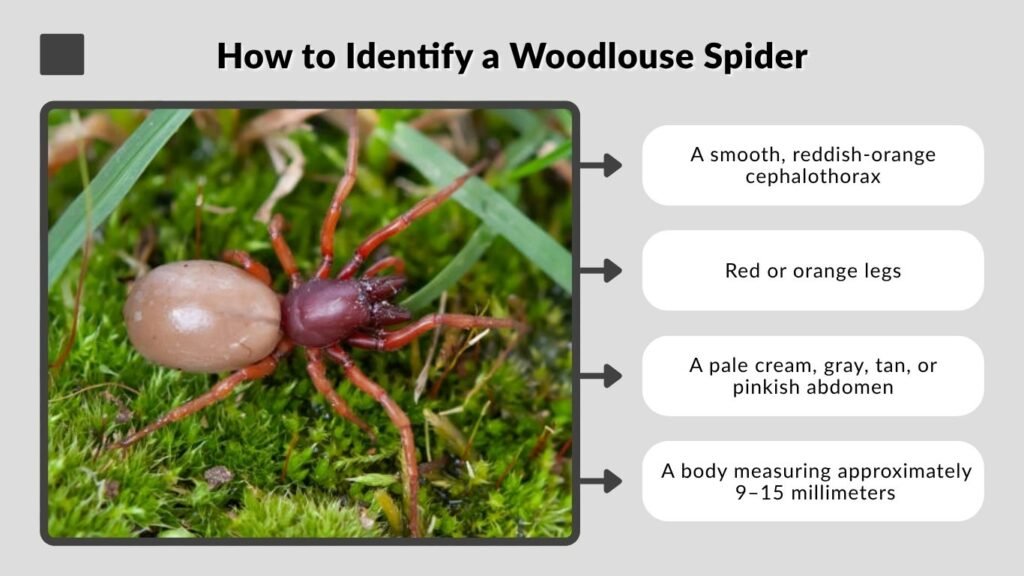
Woodlouse spiders are named for their habit of hunting woodlice, also called pill bugs, sowbugs, slaters, or roly-polies. Their large jaws are adapted to pierce the less-protected parts of these armored crustaceans.
Identification Features
- A smooth, reddish-orange cephalothorax
- Red or orange legs
- A pale cream, gray, tan, or pinkish abdomen
- Six small eyes grouped closely near the center of the head
- Large jaws and long fangs projecting forward
- A body measuring approximately 9–15 millimeters
- No visible prey-catching web
Female woodlouse spiders generally measure around 11–15 millimeters in body length, while males are approximately 9–10 millimeters. Their highly visible fangs create an intimidating appearance, but the species is not known to be a significant human health hazard.
Color and Body Shape
The woodlouse spider’s strongest identifying characteristic is the contrast between its two body sections. The cephalothorax and legs are usually reddish, while the oval abdomen is much lighter.
The spider appears solid and powerful compared with a brown recluse. Its cephalothorax is broad, and the jaws are easy to see without magnification. The abdomen normally has no bold stripes, spots, or chevrons.
How to Identify a Brown Recluse
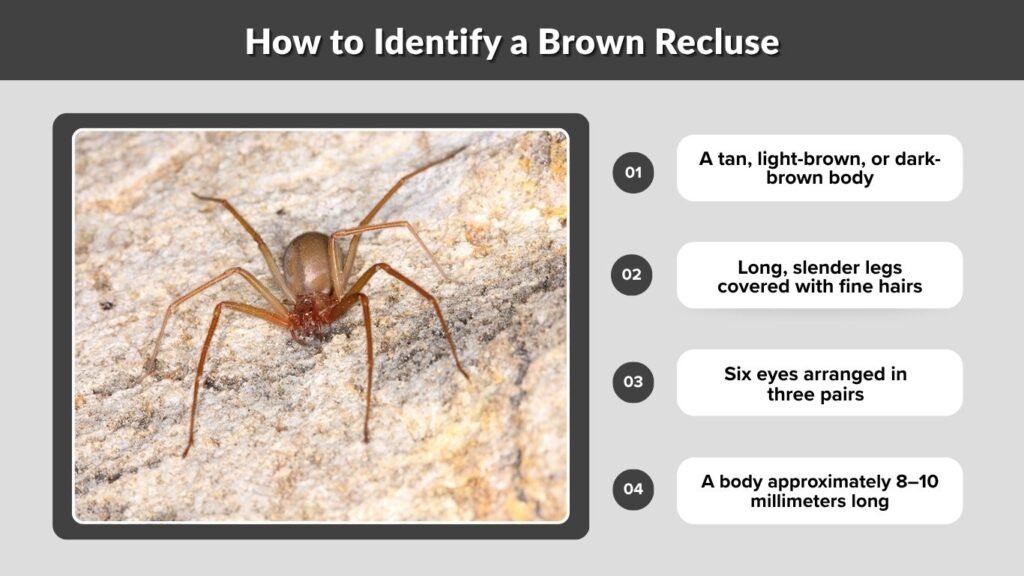
The brown recluse is a uniformly colored spider with a relatively plain appearance. It lacks the bright red-and-cream contrast of a woodlouse spider.
Identification Features
- A tan, light-brown, or dark-brown body
- A uniformly colored abdomen without stripes or spots
- Long, slender legs covered with fine hairs
- No obvious bands or strong spines on the legs
- Six eyes arranged in three pairs
- A possible dark violin-shaped marking on the cephalothorax
- A body approximately 8–10 millimeters long
The brown recluse’s three eye pairs form a curved arrangement, with one pair facing forward and one pair on each side. Its abdomen and legs should be uniformly colored. A violin-shaped marking may be present, but its visibility varies, so the marking alone is not a reliable identification method.
Is the Violin Mark Enough?
Many harmless spiders have dark marks that people interpret as violins. Lighting, shadows, and natural patterns can make almost any brown spider appear to have a similar marking.
A suspected recluse should satisfy several characteristics at once: six eyes in three separated pairs, an unpatterned abdomen, uniformly colored slender legs, and the correct geographic location. Identification may require magnification or examination by an arachnologist or local extension specialist.
Woodlouse Spider vs Brown Recluse Size
The two spiders overlap considerably in body size. Therefore, size alone is a poor way to tell them apart.
| Measurement | Woodlouse spider | Brown recluse |
| Male body length | About 9–10 mm | Approximately 7–12 mm |
| Female body length | About 11–15 mm | Approximately 7–12 mm |
| Overall build | Sturdy and compact | Slim and delicate |
| Fangs | Large and prominent | Comparatively inconspicuous |
| Legs | Moderately long and strong | Long and thin |
A large female woodlouse spider can have a longer body than a typical brown recluse. However, the recluse may appear larger because its slender legs extend farther from its body. Spider measurements normally refer to body length and exclude the legs.
Eye and Fang Differences
Both species have six eyes, which is unusual because most spiders possess eight. However, the eye pattern clearly separates them.
The woodlouse spider’s six eyes are densely clustered in a compact group near the middle of the head. A brown recluse has three visibly separated pairs arranged in a semicircle. Viewing this feature safely usually requires a magnifying lens or a close, sharply focused photograph.
Fangs provide another major clue. A woodlouse spider has enormous reddish jaws that extend directly in front of its head. A brown recluse’s fangs are much less obvious when viewed from above.
Habitat and Behavior
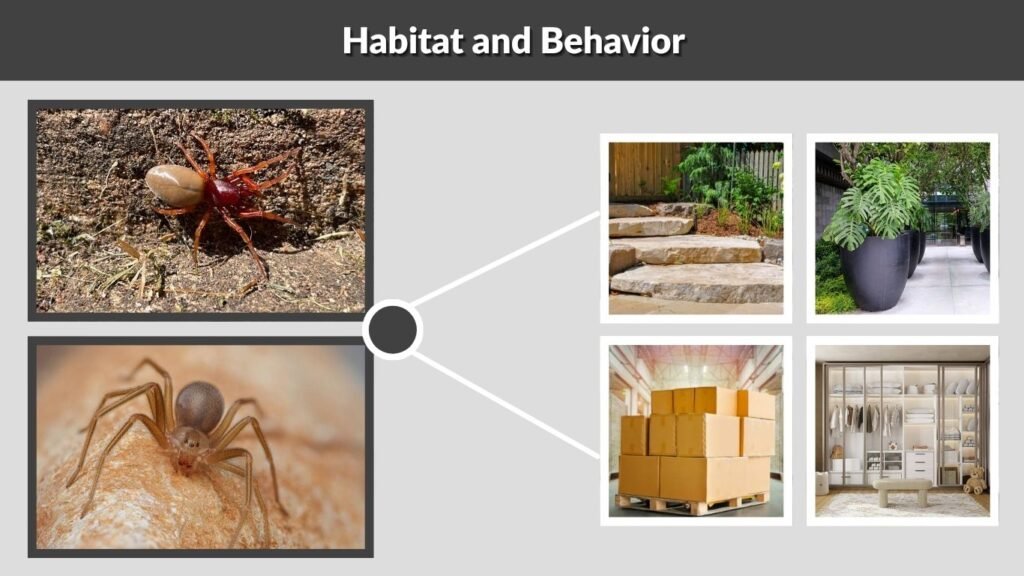
Both are nighttime hunters that hide during the day, but they prefer different conditions.
Where Woodlouse Spiders Live
Woodlouse spiders prefer moist environments where their prey is abundant. Outdoors, they hide beneath stones, bark, mulch, plant pots, garbage cans, boards, and wood piles.
Indoors, they may appear in basements, garages, bathrooms, crawl spaces, and ground-floor rooms. Finding one can indicate dampness or the presence of woodlice, although a single spider may simply have wandered inside.
Where Brown Recluses Live
Brown recluses prefer dry, secluded, undisturbed spaces. They may shelter in closets, attics, basements, storage boxes, shoes, furniture, wall voids, and piles of unused materials.
Their established range is primarily within the south-central and Midwestern United States. They may occasionally be transported elsewhere in furniture or boxes, but confirmed established populations outside their normal range are uncommon.
Woodlouse Spider Bite vs Brown Recluse Bite
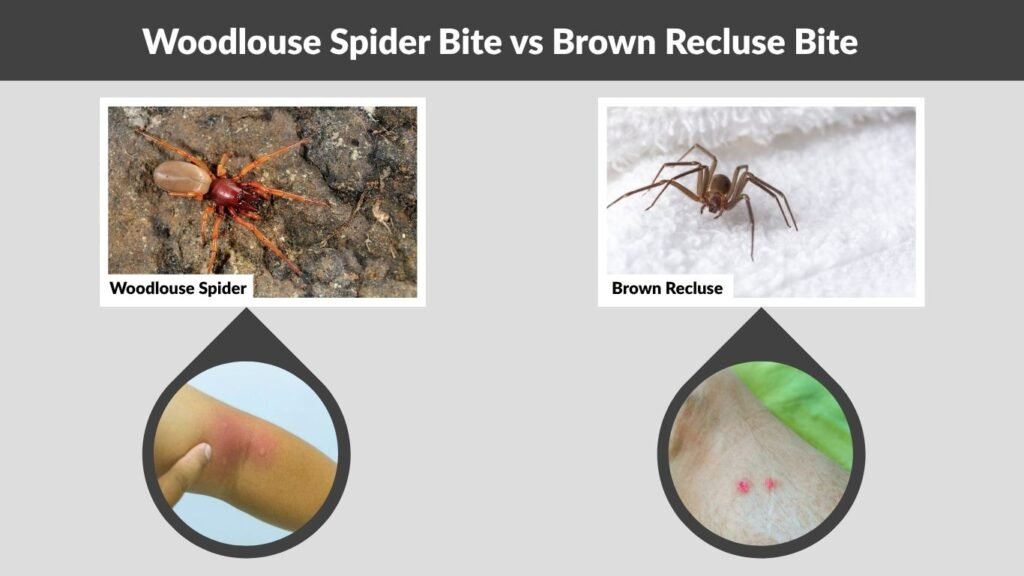
The medical risk is the most important difference between these spiders. Neither species normally seeks people, and bites usually occur when a spider becomes trapped against the skin.
| Bite feature | Woodlouse spider | Brown recluse |
| Initial sensation | Often an immediate sharp pinch | May be unnoticed or feel like a pinprick |
| Typical reaction | Mild pain, redness, or itching | Frequently mild, but symptoms can progress |
| Severe tissue damage | Not expected | Possible in a small proportion of cases |
| Symptom progression | Usually improves relatively quickly | May worsen over the following hours or days |
| Medical attention | Needed for unusual or worsening symptoms | Recommended for a suspected confirmed bite |
Woodlouse Spider Bite
A woodlouse spider can puncture human skin with its large fangs. The bite may cause immediate localized pain, itching, redness, or mild swelling.
Despite the fang size, this spider is not known to be a serious health hazard. Its bite is generally considered painful but medically insignificant for most people.
Brown Recluse Bite
Many brown recluse bites cause little or no lasting injury. The initial bite may not be noticed, and some bites inject no venom.
In a small percentage of cases, pain, itching, redness, and a blister develop within several hours. Rarely, the area can become blue or purple, sink in the center, and progress into an ulcer as damaged tissue breaks down. Such wounds may take weeks or months to heal.
A skin wound alone cannot prove that a brown recluse caused it. Bacterial infections, fungal infections, shingles, allergic reactions, and other medical conditions are frequently misdiagnosed as recluse bites.
What to Do After a Suspected Bite
Wash the area with soap and water, apply a cold compress wrapped in cloth, and elevate the affected limb when possible. Do not cut the skin, squeeze the wound, apply heat, or attempt to remove venom.
Seek medical attention if pain or swelling worsens, a blister or dark center appears, redness spreads, or symptoms such as fever, vomiting, weakness, or severe headache develop. Difficulty breathing, facial swelling, confusion, or fainting requires emergency care. Safely photograph or collect the spider for professional identification when possible, but do not risk another bite.
Other Spiders That Look Similar
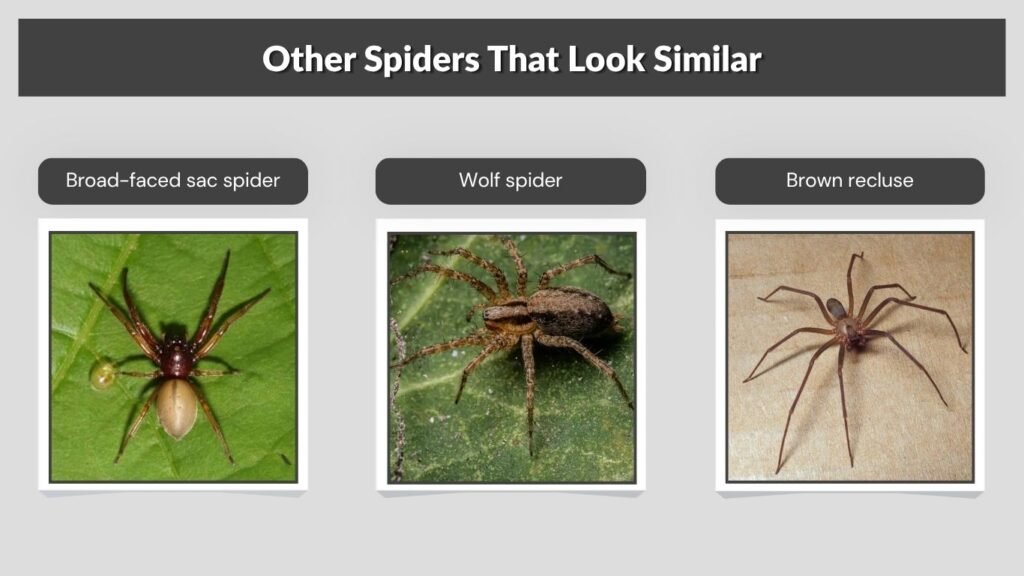
Several harmless or low-risk spiders are mistaken for both species.
| Spider | How it differs from a woodlouse spider |
| Broad-faced sac spider | Darker front legs, smaller jaws, and a pale abdomen with a faint stripe |
| Wolf spider | Hairy body, patterned abdomen, and eight eyes, including two large central eyes |
| Brown recluse | Uniformly brown body, thin legs, and three separated eye pairs |
| Other dysderid spiders | May look almost identical and require expert examination |
Broad-Faced Sac Spider vs Woodlouse Spider
The broad-faced sac spider also has a reddish-brown cephalothorax and pale abdomen. However, its front legs are darker and thicker than its other legs, and its abdomen may have a subtle dorsal stripe. Its jaws are thick but do not project as dramatically as those of the woodlouse hunter.
Wolf Spider vs Woodlouse Spider
Wolf spiders are usually brown or gray, visibly hairy, and marked with stripes or mottled patterns. They have eight eyes, including two conspicuously large eyes, rather than the woodlouse spider’s compact six-eye group. Wolf spiders also tend to have longer, hairier legs and lack the woodlouse hunter’s reddish-and-cream coloration.
FAQs
Which is more dangerous, a woodlouse spider or a brown recluse?
The brown recluse presents the greater medical risk. Most bites remain mild, but its venom can occasionally damage skin tissue. Woodlouse spider bites normally cause only brief localized pain or irritation.
Is a red spider with a white abdomen a brown recluse?
Probably not. A red or orange front body combined with a cream, gray, or pale abdomen strongly suggests a woodlouse spider. Brown recluses are more uniformly tan or brown.
Do woodlouse spiders have a violin marking?
Woodlouse spiders may show shadows or color variations that resemble a marking, but they do not have the characteristic recluse pattern. Their large jaws and contrasting pale abdomen provide better identification clues.
Can both spiders be found inside houses?
Yes. Woodlouse spiders enter damp basements, bathrooms, and garages while searching for woodlice. Brown recluses shelter in dry, dark, undisturbed storage areas, particularly within their established US range.
Should I identify a spider from its bite mark?
No. Bite marks from spiders, insects, infections, and skin conditions can appear similar. Identification is more reliable when the actual spider is safely photographed, collected, and examined by an expert.
