
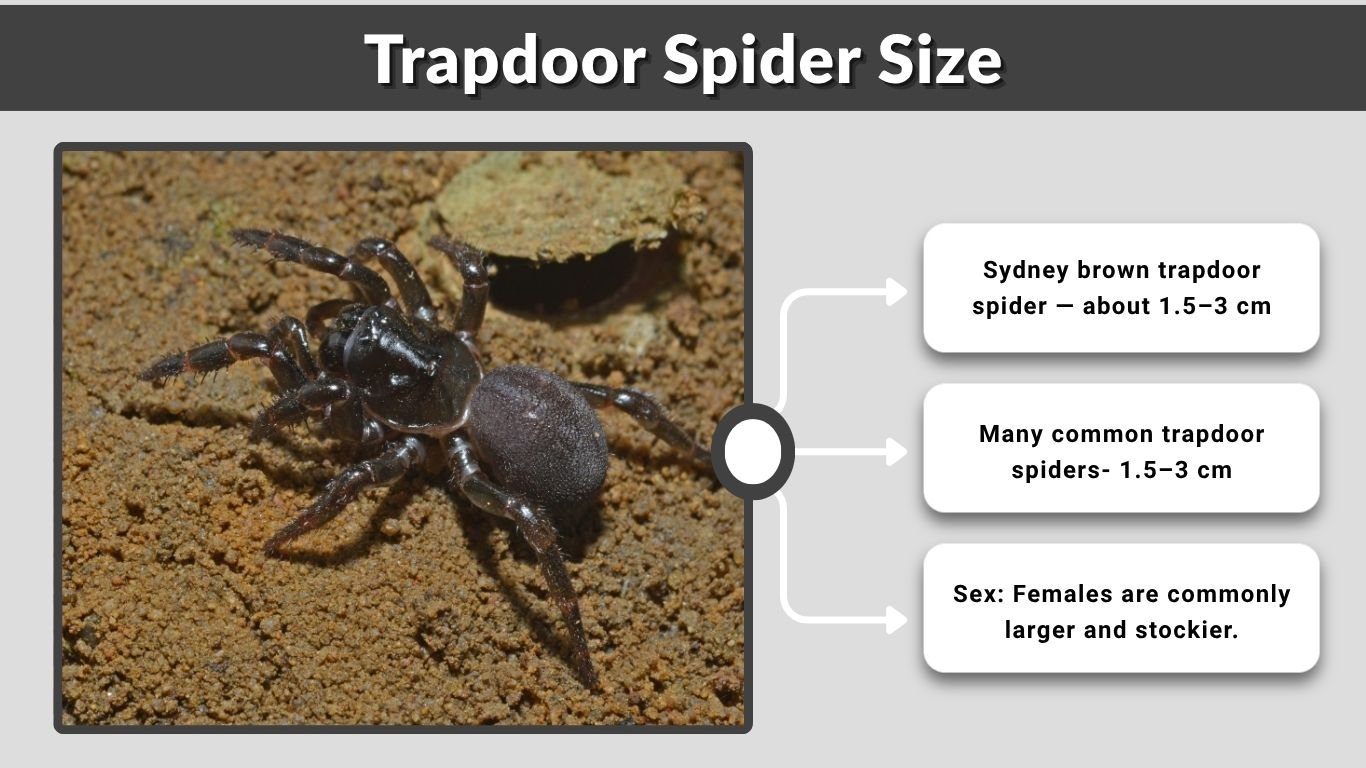
Trapdoor spider size varies considerably because the name refers to many species rather than a single spider. Most commonly encountered trapdoor spiders have a body roughly 0.5 to 1.2 inches (1.5–3 cm) long, although some exceptionally large species approach 2 inches (5 cm) in body length. Their thick legs and stocky bodies often make them look larger than their measurements suggest. Females are generally larger and heavier than males, while newly hatched spiderlings may measure only a few millimeters.
Average Trapdoor Spider Size
Trapdoor spiders belong to several groups of mygalomorph spiders and occur in different parts of the world. Because species vary, there is no universal adult size. The Sydney brown trapdoor spider, for example, has a documented body length of about 1.5–3 cm, which provides a useful indication of the size of many medium-sized trapdoor spiders.
Typical measurements include:
- Small species or juveniles: Less than 0.5 inch (1.3 cm)
- Many adult species: Around 0.5–1.2 inches (1.5–3 cm)
- Large species: Around 1.2–1.8 inches (3–4.5 cm)
- Exceptional giants: Close to 2 inches (5 cm) in body length
- Spiderlings: Often only several millimeters long
Body Length vs Leg Span
When discussing the size of a trapdoor spider, it is important to distinguish body length from total leg span.
Body length measures the spider from the front of its body to the end of its abdomen without including the legs. Leg span measures across the extended legs and therefore produces a considerably larger number.
Scientific descriptions usually emphasize body length, which makes comparisons between species more reliable.
Why Do Trapdoor Spiders Look So Big?
Trapdoor spiders often look larger than their actual body measurements because they have thick legs, large mouthparts, and robust bodies.
Their build resembles that of small tarantulas more closely than the slender appearance of many common house spiders. A spider measuring only an inch in body length can therefore appear surprisingly substantial when its legs are extended.
Female Trapdoor Spider Size vs Male
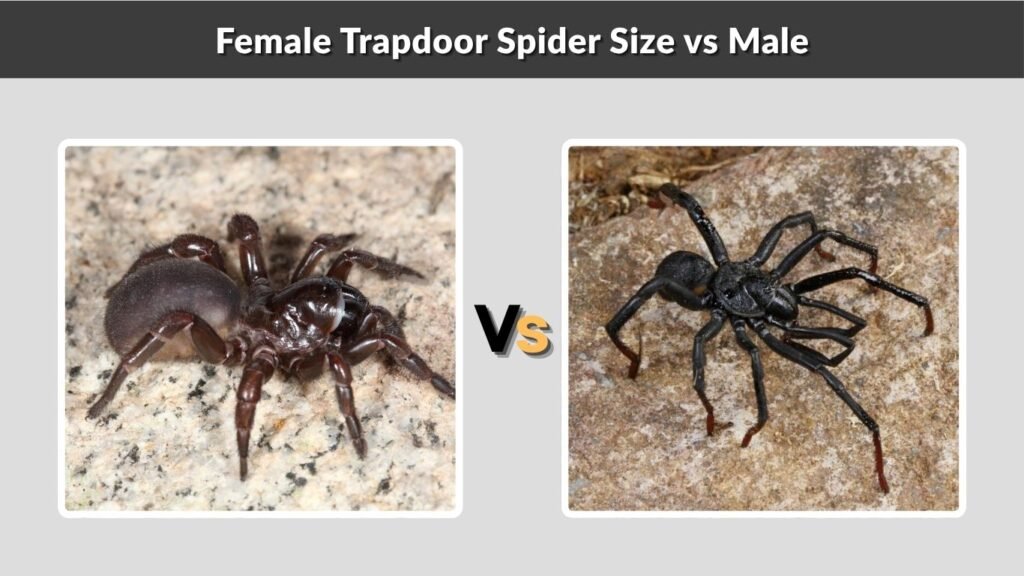
Sex is one of the most important factors affecting trapdoor spider size. In many species, adult females are larger, heavier, and more robust than males. Australian Museum information on Sydney brown trapdoor spiders likewise notes that females are larger than males.
Female Trapdoor Spider Size
Female trapdoor spiders generally have:
- A wider abdomen
- A heavier body
- Shorter-looking, thicker legs
- Greater overall body mass
- A more robust appearance
Females spend much of their lives inside their burrows, where a strong body helps them excavate soil, maintain the burrow, defend the entrance, and ambush prey.
Male Trapdoor Spider Size
Adult males often appear slimmer than females even when their legs make them look large.
Once mature, males commonly leave their burrows and wander in search of females. Their bodies are generally lighter and their legs can appear proportionally longer, giving them a different silhouette from the stockier females.
Giant Trapdoor Spider Size
Some trapdoor spiders are considerably larger than the familiar species found in gardens. One well-known example is Euoplos dignitas, a large golden trapdoor spider formally described from Queensland, Australia.
Females of this species can approach 5 cm, or nearly 2 inches, in body length, making them unusually large trapdoor spiders.
Super-Sized Trapdoor Spider in Australia
Euoplos dignitas attracted widespread attention after researchers formally described it in 2023.
The species occurs in Queensland’s Brigalow Belt. Researchers reported females approaching five centimeters in body length, while describing them as darker and more robust than males.
Its approximate measurements demonstrate just how much trapdoor spider size can vary between species.
Is a Giant Trapdoor Spider Tarantula-Sized?
Large trapdoor spiders can resemble smaller tarantulas because both belong to the mygalomorph group and share thick bodies, powerful fangs, and robust legs.
However, even very large trapdoor spiders generally have smaller bodies than the world’s largest tarantula species.
Their appearance can still be impressive because a nearly 2-inch body combined with extended legs creates a much larger overall footprint.
Australian Trapdoor Spider Size
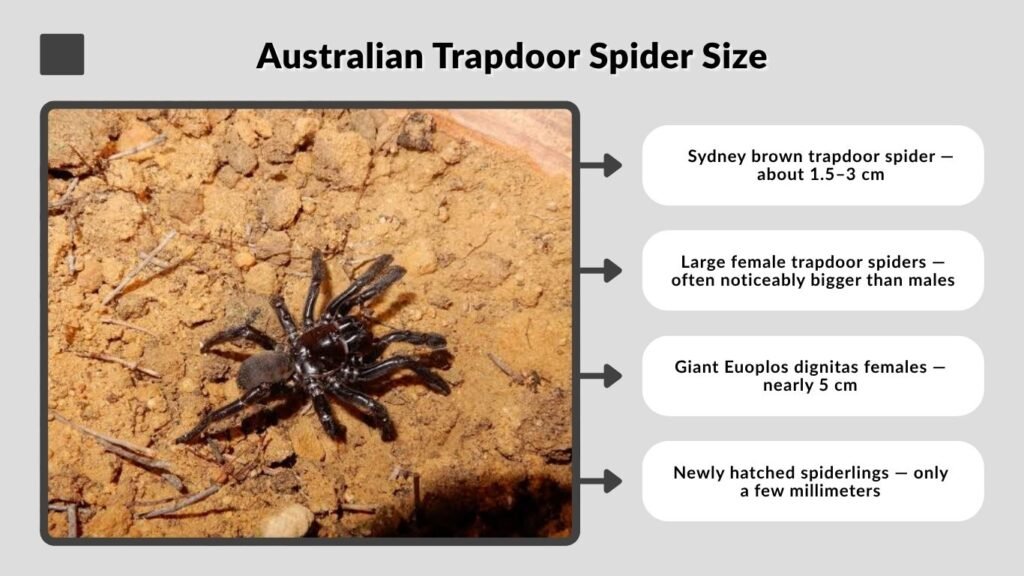
Australia contains numerous kinds of trapdoor spiders, so the term Australian trapdoor spider size describes a broad range rather than one measurement.
The Sydney brown trapdoor spider measures approximately 1.5–3 cm in body length, while some exceptional Australian species can approach 5 cm.
Common Australian Size Range
Depending on species and sex, Australian examples may include:
- Sydney brown trapdoor spider — about 1.5–3 cm
- Large female trapdoor spiders — often noticeably bigger than males
- Giant Euoplos dignitas females — nearly 5 cm
- Newly hatched spiderlings — only a few millimeters
This variation is why identifying the species is important before giving an exact measurement.
Golden Trapdoor Spider Size
Golden trapdoor spiders include species within Euoplos. Their sizes vary considerably.
The unusually large Euoplos dignitas is one of the most famous examples, with females approaching 5 cm in body length. Researchers specifically highlighted its impressive size when describing the species.
African Trapdoor Spider Size
Africa also supports numerous trapdoor spider species, including members of genera such as Idiops. Their size depends strongly on species, sex, and age.
For example, the Pretoria trapdoor spider, Idiops pretoriae, has been reported at approximately 31.5 mm, or just over 3 cm, in total length.
African Red Trapdoor Spider Size
The name “African red trapdoor spider” may be used for different reddish trapdoor spiders rather than consistently identifying one species.
Consequently, it is safer to identify the exact species before assigning a precise size. Many medium-to-large African trapdoor spiders can fall around several centimeters in body length.
California and American Trapdoor Spider Size
North America has several trapdoor spider groups, including species of Ummidia. Individual measurements documented for Ummidia show bodies around 1.3–3 cm in some adults, although species and individuals differ considerably.
California Trapdoor Spider Size
“California trapdoor spider” can refer to multiple species, so there is no single California trapdoor spider size.
In general, a mature spider may have a body around an inch or less to somewhat larger, depending on species and sex. Females frequently appear particularly stocky because of their large abdomens.
Texas Trapdoor Spider Size
Texas also has trapdoor spiders from multiple groups. Like California species, measurements vary.
When one appears outdoors, its extended legs can make it seem considerably larger than its actual body length. Accurate measurement should therefore be based on the body rather than the overall leg span.
Ravine, Southern and Other Trapdoor Spider Sizes
Names such as ravine trapdoor spider, southern trapdoor spider, brush-footed trapdoor spider, cork-lid trapdoor spider, and folding trapdoor spider represent different species or groups. Their adult dimensions can therefore differ substantially.
Approximate Size Comparison
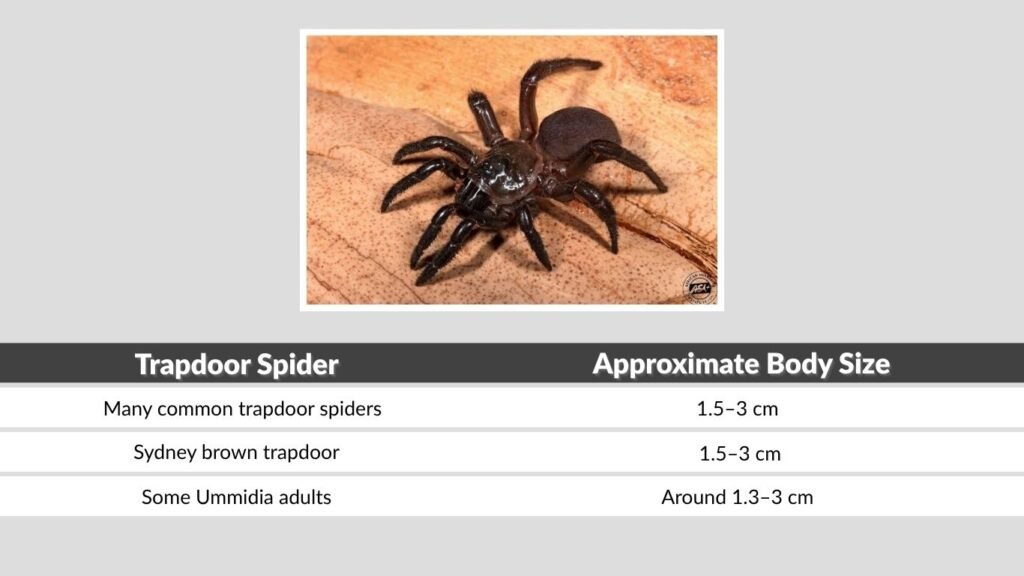
| Trapdoor Spider | Approximate Body Size |
| Many common trapdoor spiders | 1.5–3 cm |
| Sydney brown trapdoor | 1.5–3 cm |
| Some Ummidia adults | Around 1.3–3 cm |
| Pretoria trapdoor spider | About 3.15 cm |
| Large Heligmomerus maximus female | Up to about 3.2 cm |
| Giant Euoplos dignitas female | Nearly 5 cm |
A scientific description of Heligmomerus maximus from India reported adult females reaching about 32 mm, illustrating another relatively large trapdoor spider.
Prehistoric Trapdoor Spider Size
Fossil evidence shows that trapdoor spider relatives have existed for millions of years. Fossilized examples are uncommon because these spiders spend much of their lives underground, where conditions are not always suitable for fossil formation.
Giant Trapdoor Spider Fossils
A fossil brush-footed trapdoor spider described from Australia attracted attention because it was considered unusually large for the fossil record of its group.
However, “prehistoric” does not automatically mean enormous. Fossil trapdoor spiders were not necessarily monster-sized spiders; many remained within the general size range expected for mygalomorph spiders.
What Determines Trapdoor Spider Size?
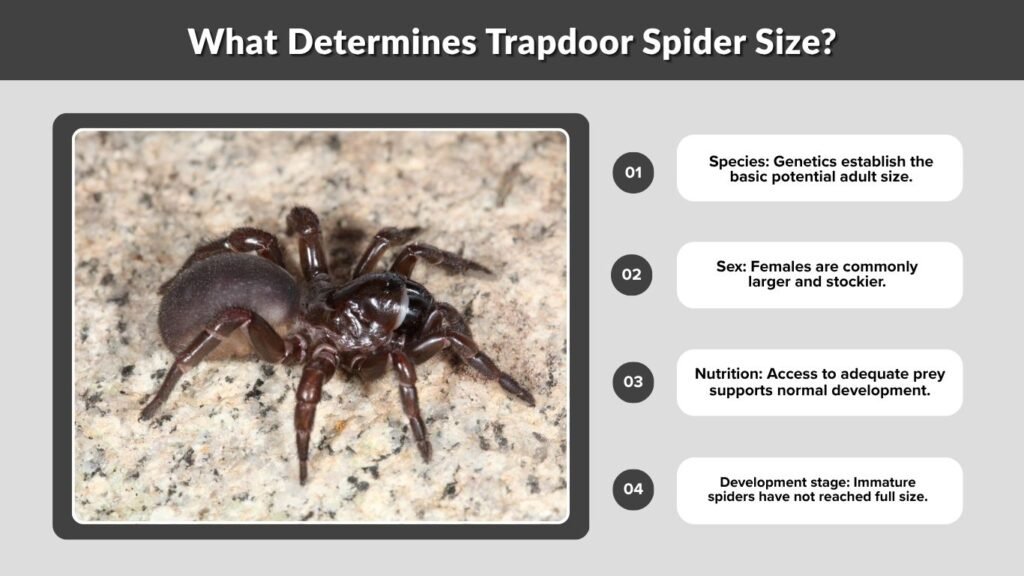
Several biological factors explain why two trapdoor spiders can have noticeably different dimensions.
- Species: Genetics establish the basic potential adult size.
- Sex: Females are commonly larger and stockier.
- Age: Spiderlings begin extremely small and grow through repeated molts.
- Nutrition: Access to adequate prey supports normal development.
- Development stage: Immature spiders have not reached full size.
- Body condition: A well-fed or egg-carrying female may have a larger abdomen.
How Big Are Baby Trapdoor Spiders?
Trapdoor spiderlings are tiny compared with adults.
Observations of Ummidia spiderlings have recorded individuals around 4–5 mm long. They grow gradually through successive molts before developing the heavy body and powerful legs associated with mature trapdoor spiders.
FAQs
How big do trapdoor spiders get?
Many trapdoor spiders have bodies around 1.5–3 cm long, although larger species can exceed this range. Exceptional species such as Euoplos dignitas can approach 5 cm in body length.
What is the largest trapdoor spider size?
Some of the largest well-known trapdoor spiders approach approximately 5 cm, or 2 inches, in body length, excluding the legs.
Are female trapdoor spiders bigger than males?
In many species, yes. Females tend to have larger, heavier bodies, while mature males are often slimmer and more adapted for wandering in search of mates.
How big is an Australian trapdoor spider?
Size depends on species. Sydney brown trapdoor spiders are around 1.5–3 cm in body length, while giant Australian species can approach 5 cm.
Does trapdoor spider size include the legs?
Usually not when scientific body measurements are given. Body length normally excludes the legs, while leg span measures the total width when the spider’s legs are extended.
