
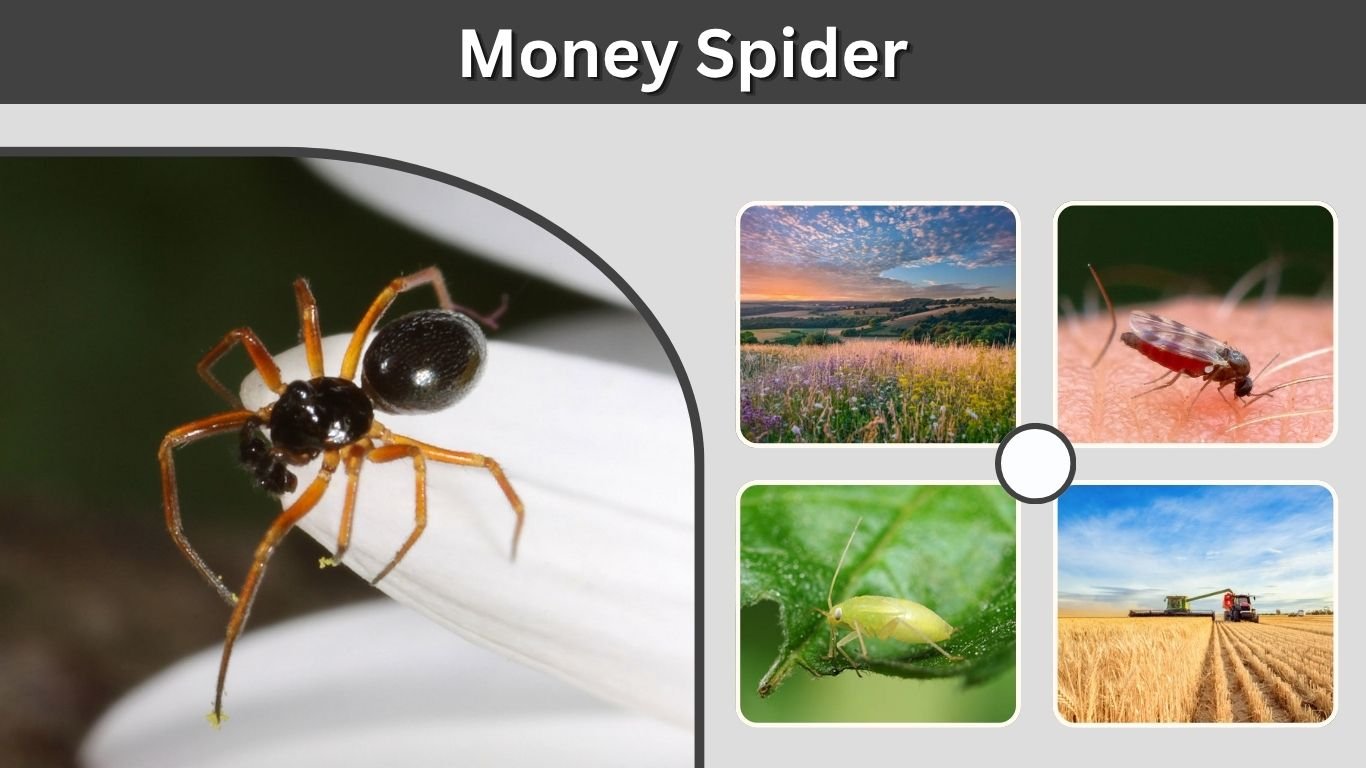
The money spider is a tiny spider best known in Britain and Ireland, where the name commonly refers to members of the family Linyphiidae. These small spiders are often black, brown, reddish, or patterned and build delicate sheet-shaped webs close to the ground or among vegetation. Money spiders are harmless to people and play a useful role by catching small insects. They are also famous for a long-standing superstition suggesting that finding one crawling on you may bring money or good luck.
What Is a Money Spider?
“Money spider” does not refer to one individual species. It is a common name applied mainly to numerous small spiders in the family Linyphiidae. Britain alone has more than 270 species in this family, representing a large proportion of its spider diversity. Most are so small that identifying the exact species usually requires close examination or even a microscope.
Money Spider Identification
Typical characteristics include:
- Family: Linyphiidae
- Size: Usually only a few millimeters long
- Body: Small with a rounded or egg-shaped abdomen
- Color: Black, brown, reddish, gray, or patterned
- Legs: Thin and relatively long
- Eyes: Eight
- Web: Fine horizontal sheet or hammock-like structure
- Movement: Usually quick when disturbed
- Habitat: Grass, shrubs, gardens, soil, and woodland
Many of the classic tiny black money spiders belong to the genus Erigone.
Black, Red and Green Money Spiders
Money spiders vary considerably in appearance because the name covers many species.
The traditional black money spider is usually tiny, dark, and difficult to identify without magnification. Some linyphiids have reddish legs or bodies, while larger species can have silver, brown, cream, or greenish-looking patterns.
A very bright red “tiny spider” may sometimes actually be a mite rather than a true money spider, so color alone is not enough for reliable identification.
Money Spider Size and Appearance
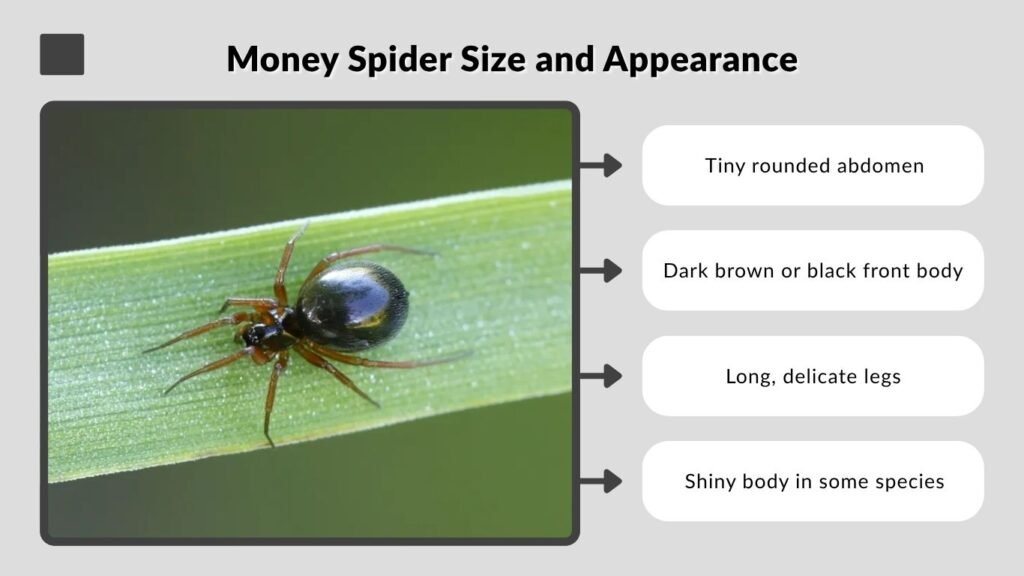
Most money spiders are extremely small, which is one reason people may notice their silk before seeing the spider itself. The British Arachnological Society describes typical money spiders as only a few millimeters long, though some larger members of the family reach approximately 5–8 mm. Their small size also makes distinguishing closely related species particularly difficult.
What Does a Money Spider Look Like?
Common appearance features include:
- Tiny rounded abdomen
- Dark brown or black front body
- Long, delicate legs
- Shiny body in some species
- Pale or patterned abdomen in larger species
- Fine hairs on the legs
- Small body compared with leg length
Some males have unusual humps, pits, or raised structures on the front portion of their bodies that are associated with courtship.
Male vs Female Money Spider
There is no single visual rule for separating every male and female money spider because the family contains hundreds of species.
Mature males generally have enlarged pedipalps near the mouth, which function in reproduction. Females may have fuller abdomens, particularly when carrying developing eggs.
In many species, accurate sex and species identification requires examination under magnification.
Money Spider Habitat and Web
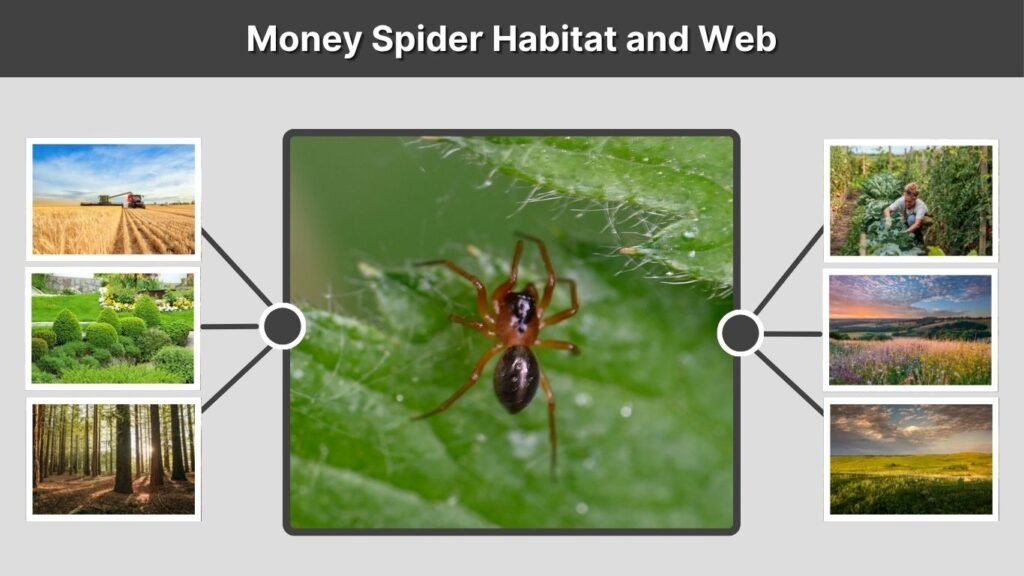
Money spiders occupy an impressive variety of environments. They can live close to the soil, among grasses, inside shrubs, along woodland edges, and even in agricultural fields. Their small size allows them to occupy tiny spaces overlooked by larger spiders. Many species construct distinctive sheet webs that become particularly easy to notice when covered with dew on cool mornings.
Where Do Money Spiders Live?
Money spiders may occur in:
- Gardens
- Lawns
- Meadows
- Grasslands
- Hedgerows
- Shrubs
- Woodland
- Agricultural fields
- Leaf litter
- Soil cracks
- Marshy areas
- Low vegetation
They are especially well known in the UK and Ireland, although members of Linyphiidae occur widely around the world, including Australia.
Money Spider Web
The typical money spider web looks like a small horizontal sheet or hammock.
Fine supporting strands extend above the sheet. When a tiny flying insect strikes these threads, it may fall onto the web below.
The spider commonly waits underneath the sheet and attacks prey through the silk.
These webs can become particularly visible in autumn when morning dew covers fields and vegetation with thousands of tiny shining strands.
What Do Money Spiders Eat?
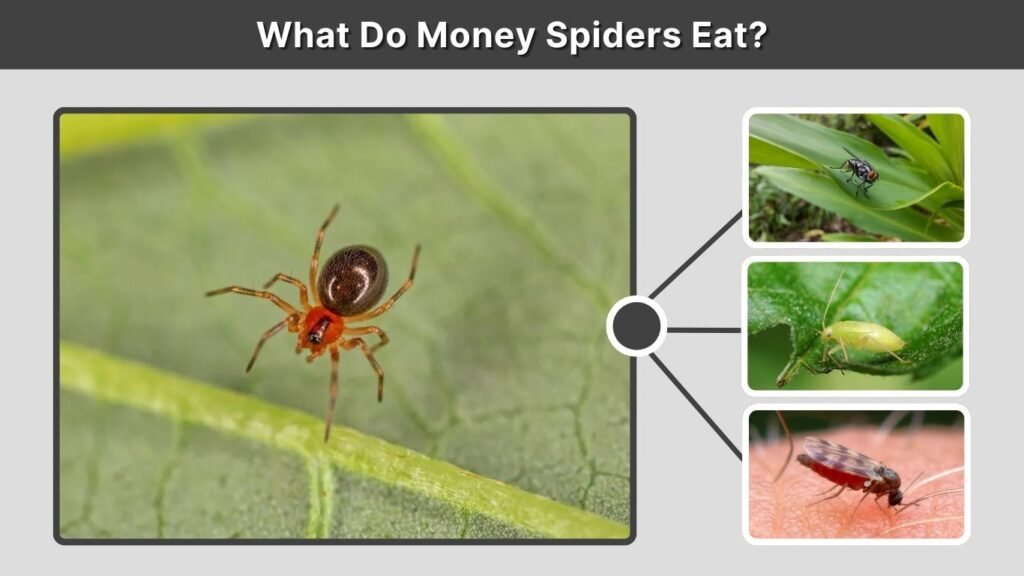
Money spiders are predators despite their tiny size. Their webs are especially effective at capturing small flying and crawling insects that are abundant around grass and vegetation. They therefore contribute to natural insect control in gardens, farmland, and other habitats. The spider waits near or beneath its sheet web until vibrations reveal that suitable prey has become trapped.
Money Spider Diet
Their prey may include:
- Small flies
- Gnats
- Aphids
- Springtails
- Tiny mosquitoes
- Midges
- Small insect larvae
- Other tiny arthropods
After capturing prey, the spider bites it and uses venom to subdue it before feeding.
Money Spider Hunting Behavior
Unlike active hunters such as jumping spiders, most money spiders depend heavily on silk.
Their sheet web acts as both a trap and a platform for detecting vibrations. Once an insect falls onto the silk, the spider usually approaches from underneath and bites through the web.
This feeding strategy allows a very small spider to catch fast-moving insects efficiently.
Money Spider Life Cycle and Ballooning
Money spiders begin life as eggs and pass through several immature stages before becoming adults. Their exact life cycle varies between species. Some mature during warmer months, while others become adults in autumn and can remain active through winter. One particularly famous behavior is ballooning, which allows tiny spiders to travel far beyond the place where they hatched.
Money Spider Life Cycle
The basic stages are:
- Egg
- Spiderling
- Several molts
- Juvenile
- Adult
- Mating and egg production
The precise lifespan differs among species, so there is no single lifespan that applies to every money spider.
Why Do Money Spiders Fly Through the Air?
Money spiders cannot actually fly, but many use a dispersal method called ballooning.
A spider climbs to an exposed point, raises its abdomen, and releases fine strands of silk. Air currents catch the silk and lift the spider.
Most journeys are short, but favorable atmospheric conditions can carry tiny spiders substantial distances. This behavior explains why money spiders sometimes suddenly appear on clothing, fences, cars, or people.
Money Spider Bite, Venom and Infestations
Like most spiders, money spiders possess venom for subduing prey. However, their extremely small size means they pose essentially no meaningful danger to people. They do not seek humans as prey and normally escape when disturbed. Finding several around a house or garden is also usually connected to seasonal dispersal or suitable insect habitat rather than a dangerous infestation.
Can a Money Spider Bite?
Money spiders are not considered medically significant to humans.
Their tiny fangs are adapted for catching very small arthropods. Bites are rarely reported, and many species would have difficulty penetrating human skin effectively.
If an unexplained skin reaction becomes severe or persistent, it is better to obtain appropriate medical advice rather than assuming a spider caused it.
Money Spider Infestation
Seeing many tiny spiders does not necessarily indicate an infestation.
Large numbers may temporarily appear because of:
- Ballooning events
- Warm weather
- Abundant insects
- Nearby vegetation
- Seasonal breeding
- Newly hatched spiderlings
Money spiders outdoors are beneficial predators and generally do not require control.
Why Is It Called a Money Spider?
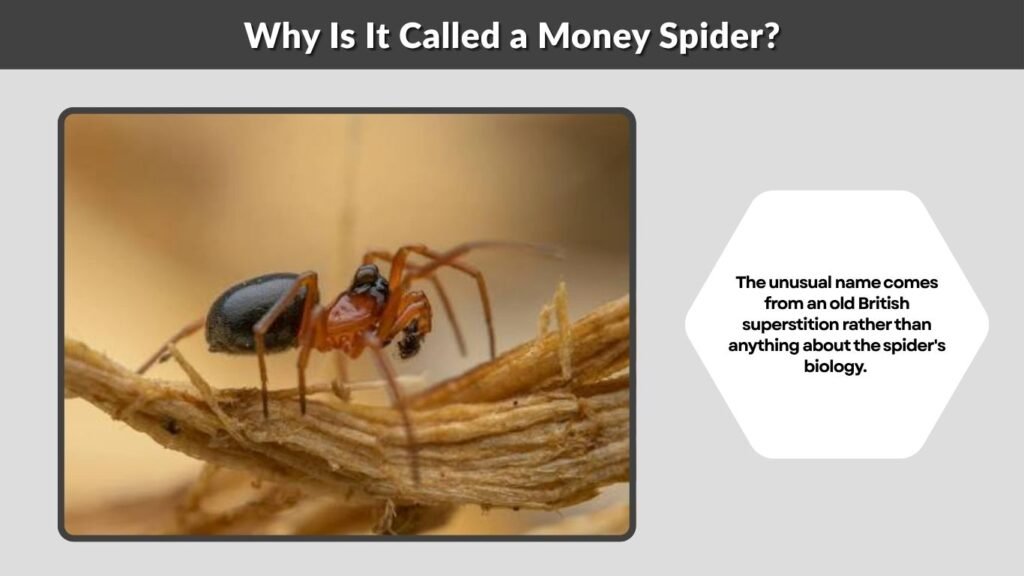
The unusual name comes from an old British superstition rather than anything about the spider’s biology. Tiny ballooning spiders sometimes land on people’s bodies or clothing. Tradition suggested that if one crawled on you, it was “spinning new clothes” and that money or financial good fortune would soon follow.
Money Spider Good Luck Superstition
According to traditional folklore, finding a money spider on yourself could represent approaching wealth.
Some versions of the superstition advised allowing the spider to remain rather than brushing it away.
Other traditions connected money spiders with new clothes, suggesting that a spider spinning silk on you meant you would soon have enough money to purchase something new.
These ideas are folklore rather than scientific facts.
Money Spider Spiritual Meaning
Modern symbolic interpretations sometimes associate money spiders with prosperity, patience, opportunity, creativity, and gradual financial growth.
There is no scientifically established spiritual meaning attached to the spider.
Its association with wealth developed primarily from cultural storytelling and the traditional British belief that having one land on you was a sign of coming money.
FAQs
Money spiders often generate questions because the term covers many different tiny species rather than a single spider. Their extremely small size, unusual ballooning behavior, delicate sheet webs, and association with good-luck folklore make them easy to notice but difficult to identify precisely. These five answers cover some of the most common questions about their appearance, safety, habitat, and traditional meaning.
Are Money Spiders Poisonous?
No. Money spiders are venomous rather than poisonous, but their venom is designed for tiny prey and they are not considered dangerous to humans.
How Big Is a Money Spider?
Many are only about 2–5 mm long, although some larger linyphiid species may reach approximately 8 mm.
Why Are Money Spiders Considered Lucky?
British folklore traditionally suggests that a money spider landing or crawling on you means financial good fortune may be coming.
Do Money Spiders Live in the UK?
Yes. Money spiders are extremely widespread in Britain, where the family Linyphiidae contains hundreds of species.
Should I Kill Money Spiders in My House?
Usually there is no need. They are tiny, harmless predators that feed on small insects. A spider indoors can simply be moved outside if it is unwanted.
