
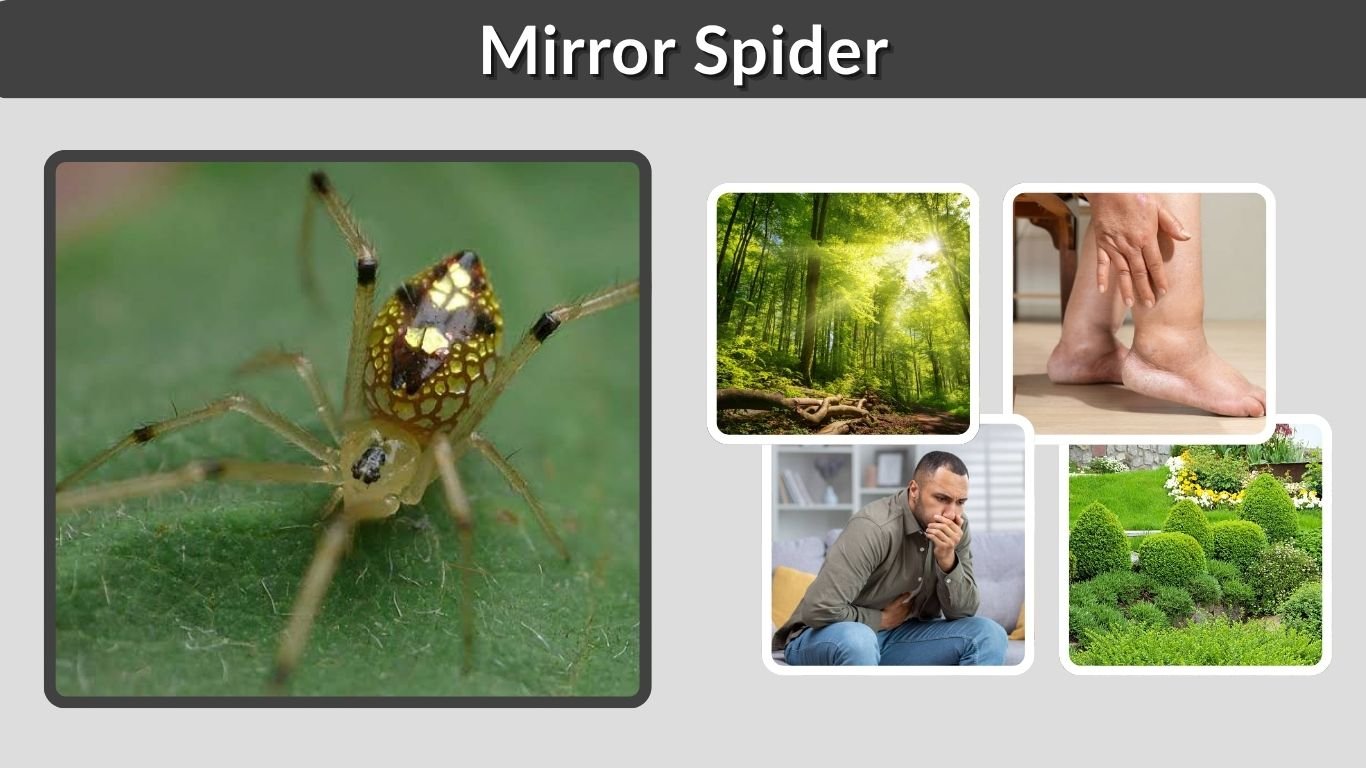
The mirror spider is a tiny but spectacular arachnid famous for the shiny, metallic patches covering its abdomen. Most spiders called mirror spiders belong to the genus Thwaitesia, part of the cobweb-spider family Theridiidae. Their silver, gold, and sometimes rainbow-colored markings can make the abdomen resemble pieces of broken mirror or stained glass. Despite their dazzling appearance, these spiders are small, secretive, and harmless to people in normal circumstances. They are especially associated with leafy, humid habitats in Australia and tropical parts of Asia.
What Is a Mirror Spider?
“Mirror spider” is a common name applied to several Thwaitesia spiders rather than one universal species. One of the best-known Australian species is Thwaitesia argentiopunctata, also called the sequined spider. Another is Thwaitesia nigronodosa. Both are remarkable for reflective abdominal markings created by deposits associated with their digestive system.
Mirror Spider Identification
Look for these characteristics:
- Very small body
- Pale or translucent legs
- Rounded or pointed abdomen
- Silver or gold reflective patches
- Red, yellow, green, or black markings
- Mosaic or stained-glass appearance
- Small eyes arranged near the front of the body
- Usually found resting beneath or among leaves
The reflective abdomen is the most recognizable characteristic, although patterns vary between species and individuals.
Why Does It Look Like a Mirror?
The shiny areas contain guanine, a substance associated with waste products from digestion. Deposits of guanine create the highly reflective silver appearance visible through parts of the abdomen.
Instead of functioning simply as decoration, the mirrored surface probably helps camouflage the spider by scattering and reflecting surrounding light.
Mirror Spider Size
Mirror spiders are surprisingly tiny considering their elaborate appearance. They can easily be overlooked without close observation or macro photography.
For T. argentiopunctata, females are around 4 mm in body length, while males are approximately 3 mm. T. nigronodosa has been recorded at about 5 mm for females and 4 mm for males.
Female Mirror Spider
Females are generally larger and have fuller abdomens. Their reflective abdominal patterns can cover much of the body when the silver areas are highly visible.
Because females may spend considerable time near vegetation and their webs, they can be difficult to notice despite their brilliant coloring.
Male Mirror Spider
Males tend to be smaller and more slender. Color patterns can also differ from those of females depending on the species.
The tiny size of adult males means they are particularly difficult to observe without magnification.
Mirror Spider’s Amazing Reflective Ability
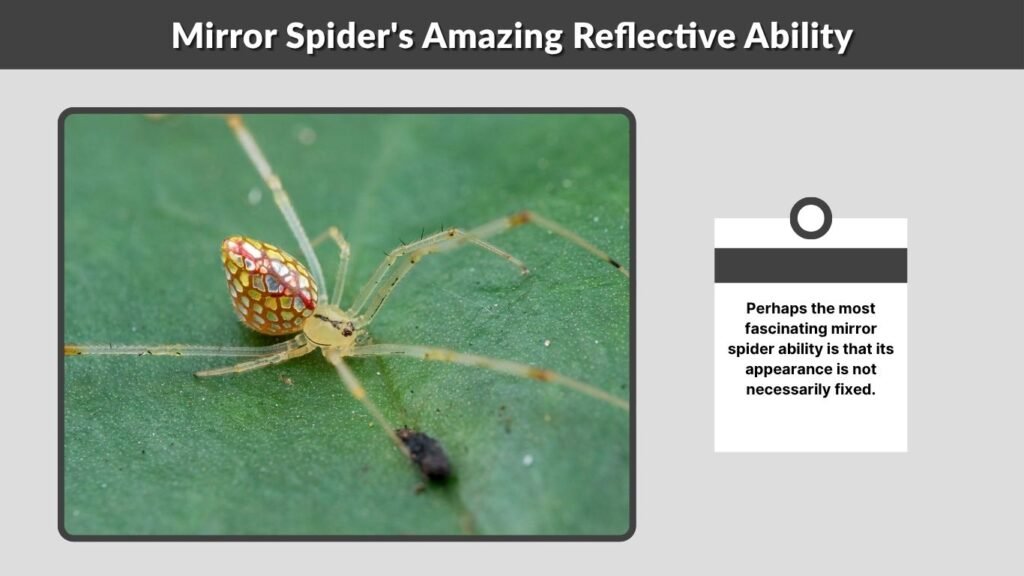
Perhaps the most fascinating mirror spider ability is that its appearance is not necessarily fixed. In some Thwaitesia, the amount of visible reflective silver can change, making the spider appear more or less mirrored at different times.
Can Mirror Spiders Change Color?
Certain mirror spiders can rapidly reduce the visible area of their silvery patches. Structures containing guanine are involved in producing this changing effect, allowing darker areas to become more prominent as the reflective portions appear to shrink.
This produces dramatic differences in appearance even in the same individual.
Why Do the Reflective Patches Change?
Camouflage is considered an important explanation. In wet tropical vegetation, droplets of water and changing sunlight create many small reflections.
A spider whose abdomen produces scattered flashes of light may blend surprisingly well into this environment rather than standing out.
Mirror Spider Habitat and Location
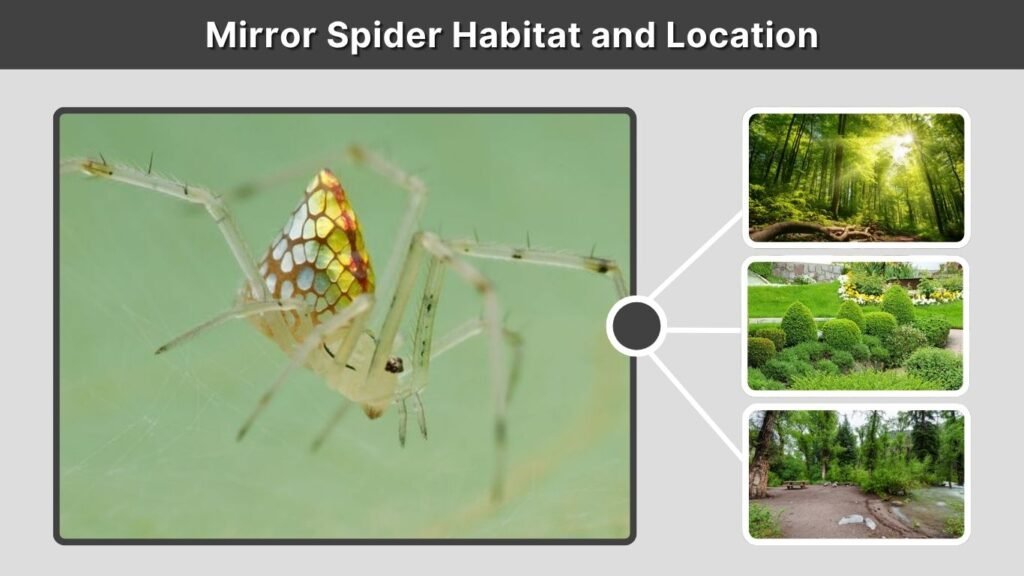
Different Thwaitesia species occur in tropical and subtropical environments. Australia is particularly famous for its mirror spiders, while members of the genus also occur in parts of Asia and other warm regions.
They typically live on vegetation where their reflective camouflage is most useful.
Australian Mirror Spider
Australia has well-known species including Thwaitesia argentiopunctata and T. nigronodosa. The latter is associated with Queensland rainforest and rainforest margins and is often encountered around creek-line vegetation.
Common habitats include:
- Rainforest margins
- Creek-side vegetation
- Shrubs
- Leafy woodland
- Gardens near suitable natural habitat
- Undersides of leaves
Their small bodies allow them to remain almost invisible among vegetation.
Asian Mirror Spider
Mirror spiders also occur in tropical Asia. Some Thwaitesia found there live on foliage in primary and secondary forests.
One Asian form described in spider references measures roughly 4–6 mm for females and about 3 mm for males.
Mirror Spider Web and Hunting
Mirror spiders belong to Theridiidae, the family commonly known as cobweb or comb-footed spiders. Rather than constructing the large symmetrical circular web associated with orb-weavers, they use relatively small webs among vegetation.
Their webs help detect and capture tiny insects moving nearby.
What Does a Mirror Spider Web Look Like?
At least some Thwaitesia construct simple silk structures between leaves. Asian specimens have been observed creating simplified web arrangements connecting foliage. Australian species may hide beneath leaves within small tangled webs during the daytime.
The web is much less conspicuous than the elaborate circular webs created by many garden spiders.
What Do Mirror Spiders Eat?
Mirror spiders are predators and are expected to consume appropriately sized insects and other tiny arthropods caught around their web.
Because the spider itself may only measure a few millimeters, its prey is correspondingly small. Its venom and silk help control prey before feeding.
Is the Mirror Spider Poisonous or Venomous?
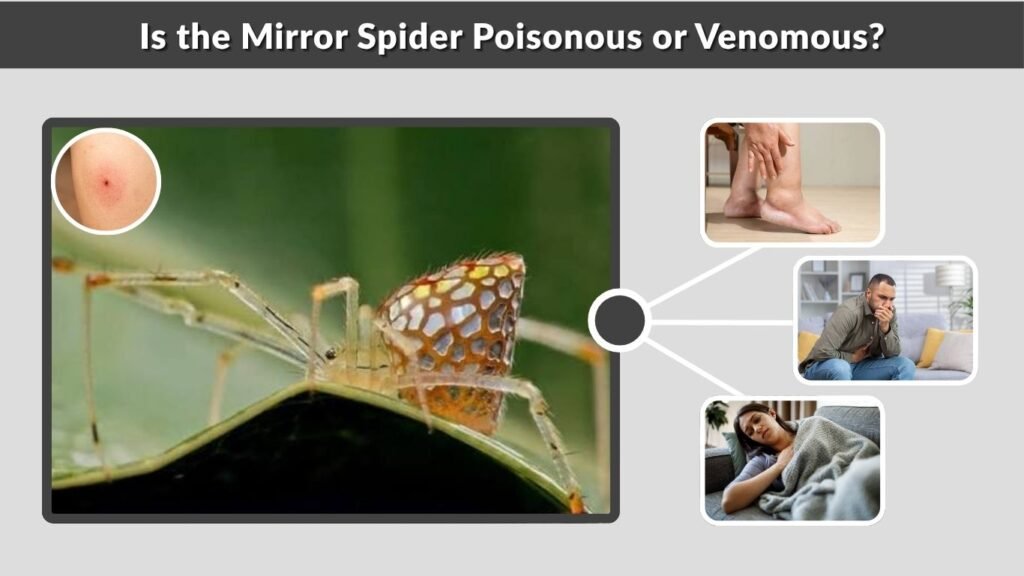
Mirror spiders are venomous rather than poisonous, as spiders use venom to subdue prey. However, there is no evidence that Thwaitesia belongs among spiders of major medical concern.
Most spider species worldwide do not produce medically significant bites in humans.
Is a Mirror Spider Dangerous?
Mirror spiders are not regarded as dangerous spiders. Their extremely small size and secretive lifestyle also make meaningful interactions with people unlikely.
They should still be observed without deliberately squeezing or handling them, both to avoid stressing the animal and because unnecessary handling can injure such a tiny spider.
Mirror Spider Bite
Reliable reports of confirmed Thwaitesia bites are very limited. Therefore, specific bite symptoms should not be confidently attributed to this genus without evidence.
In general, most spiders outside a relatively small number of medically important groups cause no serious effects or only minor, temporary local reactions when verified bites occur.
If an unidentified spider bite causes severe pain, rapidly worsening swelling, breathing problems, vomiting, weakness, or other significant symptoms, medical assessment is appropriate.
Mirror Spider vs Jumping Spider
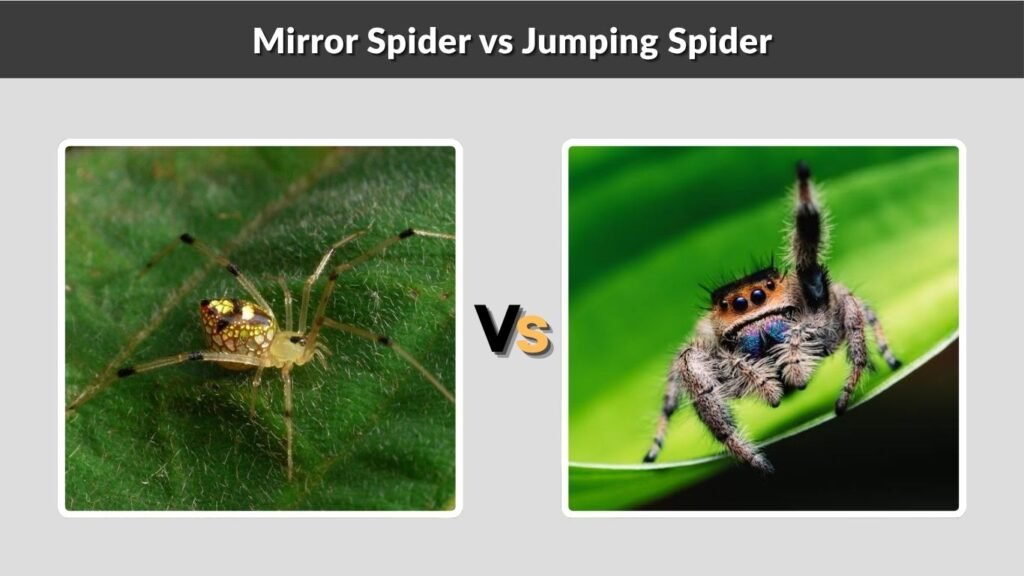
Mirror spiders and jumping spiders are sometimes confused in searches because both can display colorful or metallic appearances. However, they belong to very different spider families and behave differently.
How They Differ
- Mirror spider: Belongs to Theridiidae.
- Jumping spider: Belongs to Salticidae.
- Mirror spider: Famous for reflective abdominal patches.
- Jumping spider: Famous for large forward-facing eyes.
- Mirror spider: Relies substantially on silk and web-based hunting.
- Jumping spider: Actively stalks and jumps on prey.
- Mirror spider: Often rests beneath vegetation.
- Jumping spider: Frequently explores exposed surfaces.
A jumping spider reacting to its reflection in a mirror is therefore unrelated to the animal actually known as the mirror spider.
Interesting Mirror Spider Facts
Mirror spiders have become especially popular with macro photographers because details invisible at normal viewing distance become spectacular when enlarged.
Some of their most interesting features include:
- They belong to the genus Thwaitesia.
- Their reflective areas contain guanine.
- Their abdomen can resemble silver, gold, or stained glass.
- Some can alter how much reflective silver is visible.
- Females of some species are only around 4–5 mm long.
- They commonly live among foliage.
- Australia has several well-known mirror spider species.
- Their reflective appearance may provide camouflage.
- They belong to the cobweb-spider family Theridiidae.
- They are not considered a major danger to humans.
FAQs
What is a mirror spider?
A mirror spider is a small spider belonging primarily to the genus Thwaitesia. It is named for the highly reflective silver or metallic patches covering portions of its abdomen.
Where do mirror spiders live?
They occur mainly in warm regions and are often associated with forest vegetation, rainforest margins, creek lines, shrubs, and leaves. Several striking species occur in Australia.
How big is a mirror spider?
Many are only a few millimeters long. Female T. argentiopunctata, for example, is approximately 4 mm long, while the male is around 3 mm.
Are mirror spiders poisonous?
Mirror spiders have venom for capturing prey but are not considered medically dangerous to humans. It is more accurate to describe spiders as venomous rather than poisonous.
Why is the mirror spider shiny?
Its mirror-like appearance comes from reflective guanine deposits associated with the abdomen. These metallic-looking areas scatter light and may help camouflage the spider among wet, sunlit vegetation.
