
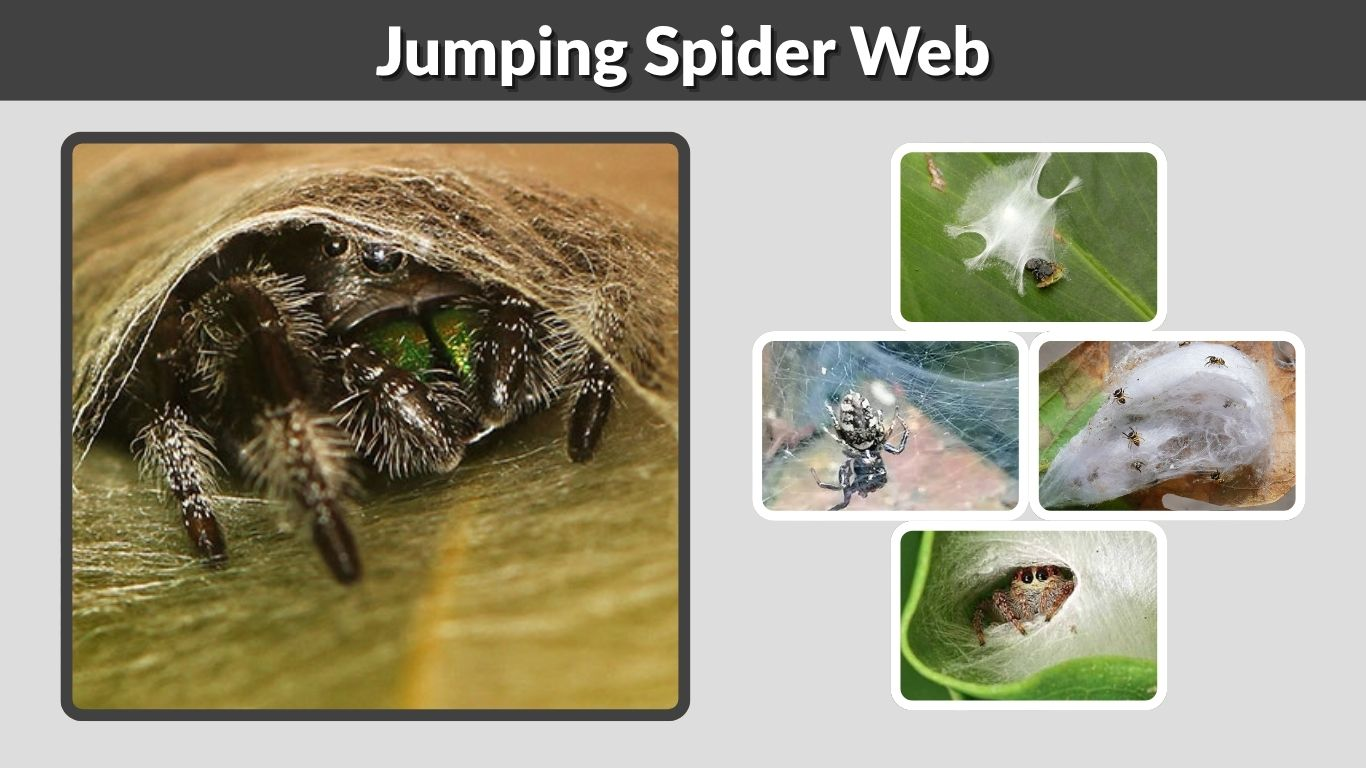
A jumping spider web looks different from the round, sticky webs many people expect. Jumping spiders do make silk, but they usually do not build large prey-catching webs. Instead, they use webbing for safety lines, sleeping shelters, molting, egg sacs, and hiding spots. If your jumping spider is staying in its web, it may be resting, stressed, preparing to molt, or guarding eggs.
Do Jumping Spiders Make Webs?
Jumping spiders do make webs, but not in the same way as orb-weaving spiders or house spiders. They are active hunters. Instead of waiting for insects to fly into a sticky web, they stalk prey with their excellent eyesight and jump when close enough.
Their silk is still very important. A jumping spider uses webbing as a tool for protection, movement, and survival. This is why you may see a jumping spider hanging from web, hiding in webbing, or making a small web nest in a corner.
Jumping Spider Webs Are Not Hunting Webs
Most jumping spider webs are not designed to trap insects. They do not usually create big spiral webs across windows, corners, or garden plants. Their webs are more like hammocks, retreats, or safety ropes.
A jumping spider may leave silk lines as it moves. These lines help it recover if it misses a jump or falls from a surface. This is sometimes called a dragline.
Why People Get Confused
People often expect every spider to make a visible web. When they see a jumping spider making webbing, they may wonder if something is wrong. In most cases, webbing is normal behavior.
Jumping spiders are still spiders, so silk production is part of their biology. They simply use silk differently from many web-building species.
What Does a Jumping Spider Web Look Like?
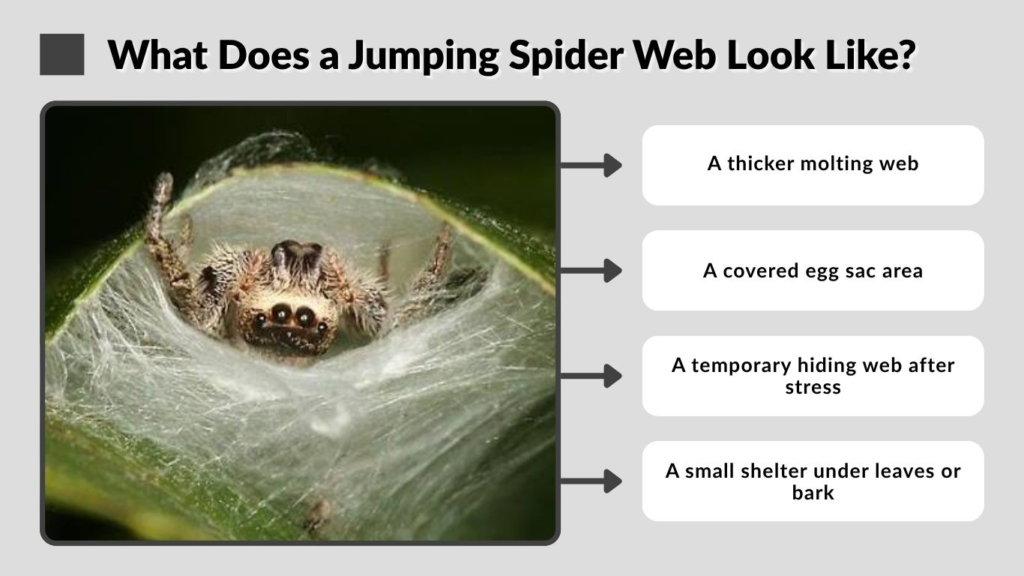
A jumping spider web usually looks like a small patch, tube, tent, hammock, or cocoon-like shelter. It may appear in a corner, under a leaf, inside bark, near the top of an enclosure, or behind a small object.
The web may look messy or thick compared with a delicate orb web. It can also look like a soft white blanket or a small silk sleeping bag.
Common Jumping Spider Web Types
Jumping spider webbing can appear in several forms:
- A thin silk line behind the spider as it walks
- A small hammock near the top of an enclosure
- A white silk retreat in a corner
- A thicker molting web
- A covered egg sac area
- A temporary hiding web after stress
- A small shelter under leaves or bark
These webs may be easy to miss at first. Over time, a jumping spider may add more silk and make the shelter thicker.
Jumping Spider Web Pictures and Visual Clues
If you are looking at jumping spider web pictures, notice that most examples show compact silk shelters rather than large open webs. The web often sits close to a solid surface. It may be tucked into a corner, under a lid, behind a plant stem, or inside a curled leaf.
Why Is My Jumping Spider Making a Web?
A jumping spider making a web is usually doing something normal. It may be creating a safe place to sleep, preparing to molt, protecting eggs, or building a retreat because it feels exposed.
In captivity, jumping spiders often build hammocks near the top of their enclosure. In the wild, they may choose hidden spaces like leaf folds, cracks, bark, or corners.
It Is Building a Sleeping Hammock
A jumping spider web hammock is one of the most common types of webbing. The spider uses it as a resting place. Many jumping spiders sleep inside these silk shelters at night or during inactive periods.
The hammock may start as a thin patch and become thicker over time. Some spiders return to the same hammock repeatedly, while others build new ones in different areas.
It Is Creating a Safe Retreat
A jumping spider may make a web around itself when it wants protection. This can happen after being moved into a new enclosure, after being handled, during cold weather, or when it feels threatened.
A retreat gives the spider a sense of security. It also helps protect it from predators, dryness, and disturbance.
It Is Preparing to Molt
A jumping spider molting web is usually thicker and more enclosed than a normal resting hammock. Before molting, a spider may stop eating, hide more often, and stay inside its web for days or even longer.
This is a delicate stage. The spider is preparing to shed its old exoskeleton. During this time, it should not be touched, shaken, or offered large prey.
Why Is My Jumping Spider Staying in Its Web?
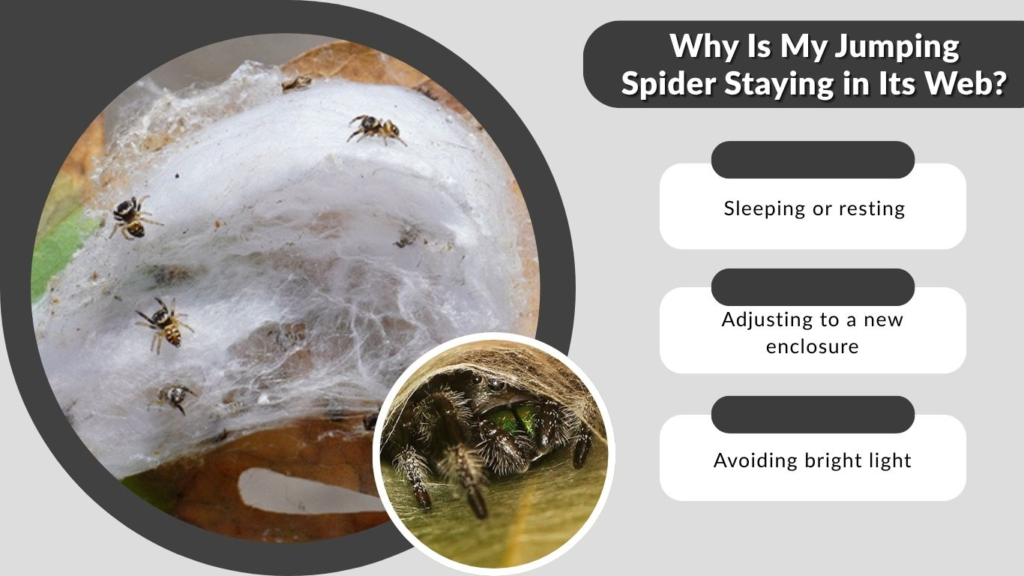
A jumping spider staying in its web can worry new keepers, but it is not always a bad sign. Jumping spiders naturally rest, hide, molt, and guard eggs inside silk retreats.
The meaning depends on the spider’s age, sex, recent behavior, and environment.
Normal Reasons
Your jumping spider may stay in its web because it is:
- Sleeping or resting
- Adjusting to a new enclosure
- Avoiding bright light
- Preparing to molt
- Recovering after a molt
- Guarding an egg sac
- Hiding after stress
- Too cold or inactive
- Not hungry
If the spider looks healthy and the enclosure conditions are good, staying in a web for a while may be completely normal.
When to Be Concerned
You should pay closer attention if the spider is weak, curled up, falling repeatedly, unable to climb, or sitting in a very dry enclosure. Also check whether uneaten prey is bothering it.
A spider that is molting should not have live crickets or other strong prey left inside the enclosure. Prey can injure a vulnerable spider during or after a molt.
Jumping Spider Molting Web vs Egg Sac
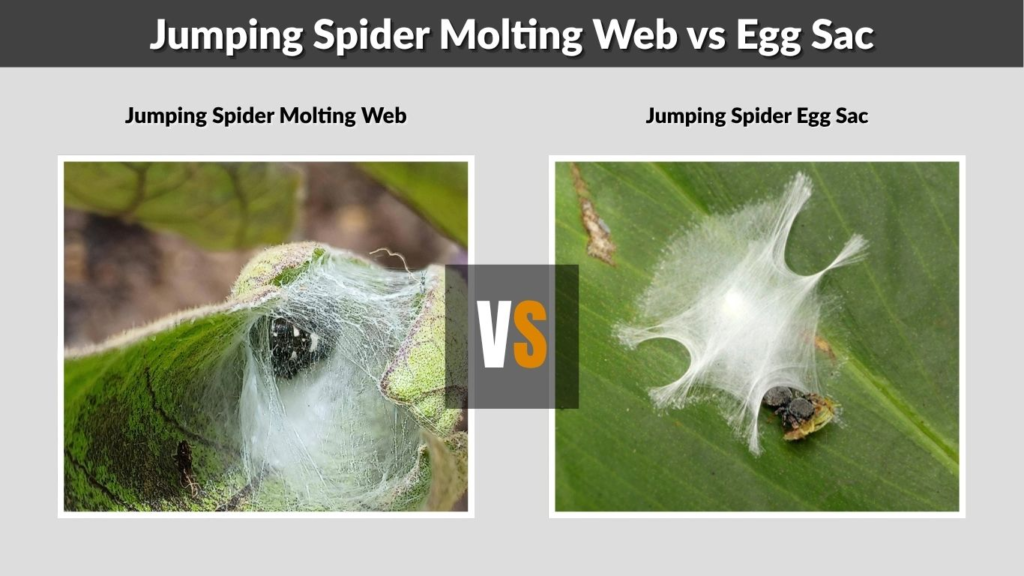
Many owners search for “jumping spider molting web vs egg sac” because both can look like thick white webbing. The difference is important, especially for female jumping spiders.
A molting web is usually a private shelter where the spider hides before shedding. An egg sac is usually thicker, rounder, and more protected. A female may stay near it for long periods.
Signs of a Molting Web
A molting web may appear when the spider:
- Stops eating
- Hides more than usual
- Builds thicker webbing
- Becomes less active
- Looks dull in color
- Avoids prey
- Stays sealed inside the hammock
Do not open the web to check. Disturbing a molting spider can cause injury or death.
Signs of an Egg Sac
An egg sac may be present if a mature female builds a dense white web and remains inside or near it. The sac may look like a thick silk ball or enclosed chamber.
Some female jumping spiders can lay infertile eggs even without recent mating. If the eggs are fertile, tiny spiderlings may eventually emerge. If they are infertile, the female may abandon or eat them later.
Jumping Spider Not Making a Web
A jumping spider not making a web is not always a problem. Some spiders build webbing quickly, while others take more time. A new spider may explore before choosing a hammock spot.
However, if a pet jumping spider never makes a web, the enclosure setup may not feel suitable.
Possible Reasons
A jumping spider may avoid making a web because:
- The enclosure is too bare
- There are no good anchor points
- It feels too exposed
- Humidity is unsuitable
- The enclosure is too large
- It is stressed from recent handling
- It has not settled in yet
- It prefers a hidden spot you have not noticed
Adding safe climbing surfaces, cork bark, fake leaves, small hides, or textured areas can help the spider choose a web site.
How to Help
Place anchor points near the upper part of the enclosure. Many jumping spiders prefer building hammocks high up. Avoid smooth, empty enclosures with no surfaces for silk attachment.
Do not force the spider into a web or move it repeatedly. Let it explore and settle.
Jumping Spider Hiding in Web: Is It Sick?
A jumping spider hiding in webbing is not automatically sick. It may simply be resting or feeling secure. Jumping spiders are active hunters, but they are not active every moment of the day.
They also become less active during premolt, after eating a large meal, during cooler temperatures, or when stressed.
Check the Environment
If your spider hides constantly, review the enclosure:
- Is the temperature comfortable?
- Is there enough ventilation?
- Is the enclosure too dry?
- Is there too much light?
- Is prey too large or aggressive?
- Are there enough hiding places?
- Has the spider recently been moved?
A spider that feels exposed may create more webbing and spend more time hidden.
Avoid Overhandling
Too much handling can stress a jumping spider. Even though many are curious, they are still small animals. Frequent handling may make the spider retreat into its web more often.
Give it quiet time, especially after moving, feeding, or enclosure cleaning.
Bold, Regal, and Zebra Jumping Spider Webs
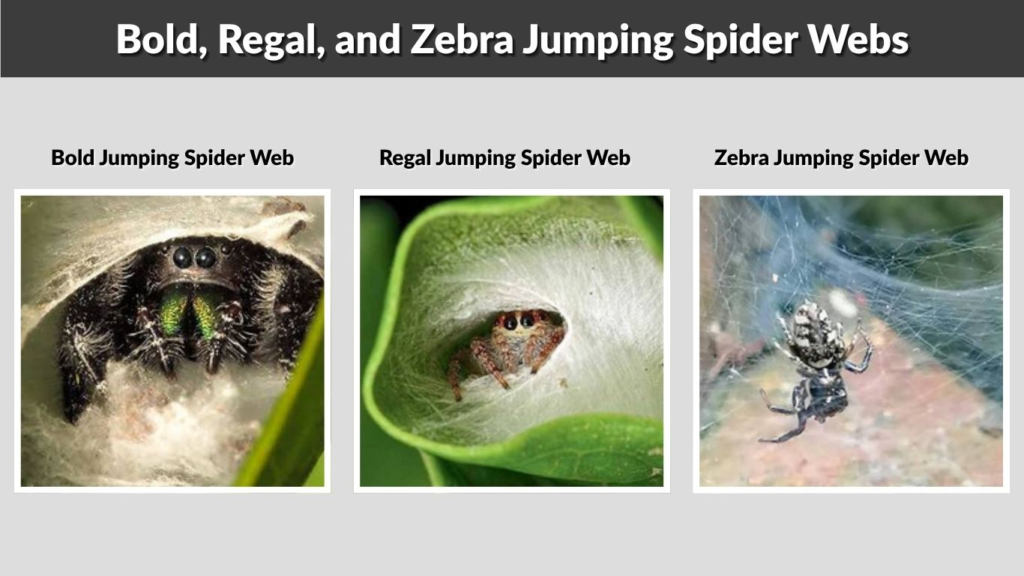
Searches for bold jumping spider web, regal jumping spider web, and zebra jumping spider web are common because these species are popular or often seen around homes. Their web behavior is generally similar.
They use silk for retreats, egg sacs, draglines, and molting spaces. They do not usually build large prey-catching webs.
Bold Jumping Spider Web
A bold jumping spider may build a silk retreat in a hidden corner, under bark, near a windowsill, or inside an enclosure. These spiders are often dark with pale markings and are commonly noticed indoors or around structures.
Their webbing may look like a compact white shelter rather than a wide web.
Regal Jumping Spider Web
A regal jumping spider, especially in captivity, often builds a hammock near the top of its enclosure. It may sleep there, molt there, or use it as a safe retreat.
Female regal jumping spiders may also build thick silk areas for egg sacs.
Zebra Jumping Spider Web
A zebra jumping spider may build small retreats in cracks, crevices, or sheltered surfaces. These spiders are often seen on walls, fences, and sunny outdoor areas. Their webbing is usually small and easy to overlook.
Jumping Spider Hanging From Web
A jumping spider hanging from webbing is usually using a safety line. When a jumping spider leaps, climbs, or drops, it may leave silk attached behind it. This silk can stop a fall and allow the spider to climb back up.
This is normal behavior and not a sign that the spider is trapped.
Why They Use Safety Lines
Jumping is risky. A dragline helps the spider recover if it misses a landing. It also helps when the spider explores vertical surfaces, enclosure lids, branches, or walls.
In a home, you may see a jumping spider suddenly drop from a ceiling or shelf and hang from a thin thread. It is not attacking. It is using silk for safety.
Is a Jumping Spider in a Web Trapped?
A jumping spider in webbing is usually not trapped if it made the web itself. It may sit inside a retreat, hide from light, molt, rest, or guard eggs.
However, if a jumping spider is caught in another spider’s sticky web, that is different. Jumping spiders can sometimes get trapped in webs made by other spiders.
Jumping Spider in Another Spider’s Web
If you find a jumping spider stuck in a sticky web, it may be at risk. Some jumping spiders hunt near other spiders, but a sticky web can still be dangerous.
If it is a pet spider, carefully remove dangerous webbing from the enclosure. If it is a wild spider, you can gently free it with a soft tool if it is safe to do so.
Jumping Spider Web in the House
Indoor jumping spider webs are usually small and hidden. You may find them in wall corners, around windows, behind furniture, on houseplants, or near ceiling edges.
A jumping spider web in the house does not usually mean you have a web infestation. It may be one spider using a small silk retreat.
Should You Remove the Web?
If the spider is wild and you do not want it indoors, relocate the spider first and then remove the web. If the spider is a pet, do not remove its hammock unless absolutely necessary.
A pet jumping spider depends on its hammock for rest and security. Destroying the web too often can stress the spider.
FAQs
Do jumping spiders make webs?
Yes, jumping spiders make webs, but they usually do not make large sticky webs to catch prey. They use silk for safety lines, sleeping hammocks, molting shelters, egg sacs, and retreats. Their webs are often small, thick, and hidden in corners or sheltered spaces.
Why did my jumping spider make a web around itself?
A jumping spider may make a web around itself to rest, hide, molt, or protect eggs. If it is eating less and staying sealed inside, it may be preparing to molt. Do not disturb the web unless there is an urgent safety issue.
What does a jumping spider web look like?
A jumping spider web often looks like a small white hammock, tent, tube, or cocoon-like shelter. It is usually built in a corner, under a leaf, near the top of an enclosure, or inside a hidden space. It is not usually a big round web.
Why is my jumping spider not coming out of its web?
Your jumping spider may be resting, stressed, cold, full, preparing to molt, or guarding eggs. Check the enclosure conditions and remove dangerous uneaten prey. If the spider is in premolt, leave it alone and avoid opening or damaging the web.
Can jumping spiders get caught in webs?
Yes, a jumping spider can get caught in another spider’s sticky web. However, it is usually not trapped in its own silk shelter. Its own web is used for safety and resting. If a pet spider is stuck in foreign sticky webbing, remove the hazard carefully.
