

Sand wasps are fascinating solitary insects known for digging nests in loose soil and hunting other insects for their young. Depending on the species, they may prey on flies, cicadas, stink bugs, or other small insects. Most are not aggressive toward humans and can be beneficial predators in gardens, farms, and natural habitats. This guide covers 15 types of sand wasps, including their identification features, habitats, behaviors, diets, lifespans, and lifecycles.
1. American Sand Wasp

The American Sand Wasp (Bembix americana) is a solitary ground-nesting wasp recognized for its sturdy body, pale abdominal markings, and strong digging behavior. It belongs to the sand wasp group and occurs across the Americas. Unlike social yellowjackets, females build and care for their own nests, usually in sandy soil where they can quickly excavate burrows.
Identification
- Scientific name: Bembix americana
- Body: Robust rather than extremely slender
- Color: Mostly black with pale white, cream, or yellowish abdominal markings
- Wings: Clear to lightly smoky
- Legs: Strong and well suited for digging
- Antennae: Relatively short compared with many thread-waisted wasps
- Size: Often around 12–20 mm, depending on sex and subspecies
- Distinctive feature: Bold abdominal bands combined with fast activity around sandy burrows
Habitat and Distribution
American Sand Wasps favor open areas with loose, well-drained sandy soil. They may occur in dunes, beaches, sandy fields, roadsides, grasslands, and other sparsely vegetated places. Bembix americana has a broad distribution across the Americas, with several recognized regional forms. Individuals have also been documented excavating nests in shoreline dunes.
Behavior and Diet
Adults commonly visit flowers for nectar, but females are active hunters. They capture flies and other suitable insects to feed their larvae. After securing prey, a female carries it back to her underground nest. Sand wasps are usually solitary, although many females may establish separate burrows close together where suitable sandy nesting ground is limited.
Lifespan and Lifecycle
A female digs a burrow containing a protected nesting chamber and lays an egg inside. She supplies the developing larva with captured prey, sometimes returning repeatedly with additional food as it grows. The larva eventually pupates within the underground chamber. After metamorphosis is completed, the adult emerges from the soil and begins feeding, mating, and nesting during the warm season.
2. Western Sand Wasp
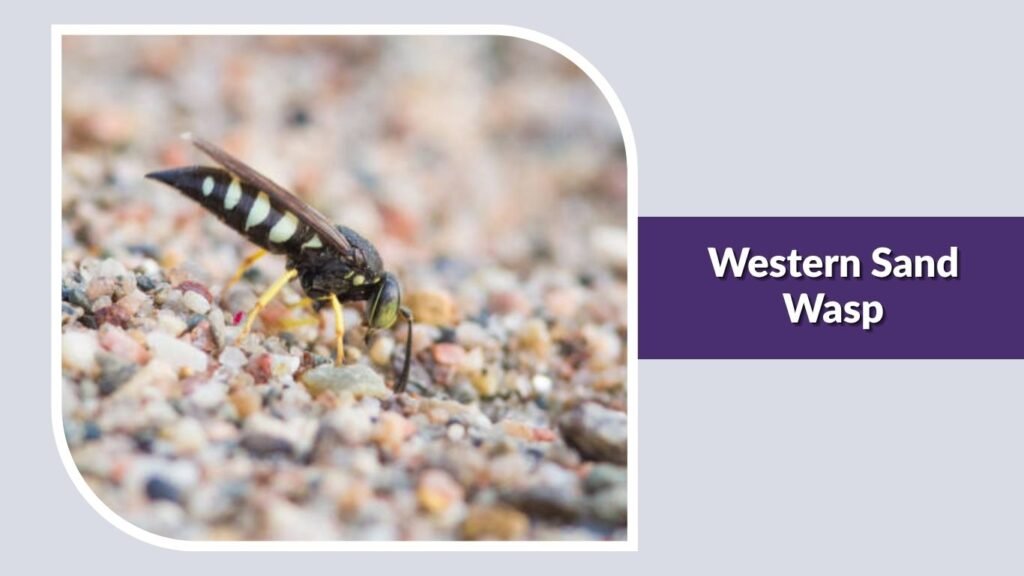
The Western Sand Wasp is a solitary ground-nesting wasp commonly associated with dry, sandy landscapes. It has a compact body, bold abdominal markings, and strong legs that help it excavate burrows quickly. Females hunt insects to feed their developing larvae, while adults often visit flowers for nectar. Despite nesting in groups in favorable areas, each female maintains her own burrow.
Identification
- Body: Compact and moderately robust
- Color: Usually black with pale yellow or whitish markings
- Abdomen: Distinct bands or spots across several segments
- Wings: Clear to slightly smoky
- Legs: Strong and adapted for digging
- Antennae: Short to medium in length
- Nesting clue: Frequently seen entering holes in sandy ground
Habitat and Distribution
Western Sand Wasps are most often found in dry, open habitats with loose soil. Sandy fields, desert margins, dunes, dry riverbanks, roadsides, and sparsely vegetated grasslands can provide suitable nesting conditions. They are particularly active during warm, sunny weather when prey insects and flowering plants are abundant.
Behavior and Diet
Adults mainly obtain energy from nectar, but females spend considerable time hunting flies and other small insects. Captured prey is carried back to the nest and provided to the larva. Although several females may nest close together in suitable soil, they do not form cooperative colonies like social wasps.
Lifespan and Lifecycle
A female excavates a tunnel ending in a nesting chamber where an egg is laid. She supplies the chamber with captured prey and may continue bringing food as the larva develops. After feeding sufficiently, the larva forms a pupa underground. The adult later emerges and begins the cycle of feeding, mating, and nesting.
3. San Clemente Sand Wasp

The San Clemente Sand Wasp is a ground-nesting solitary wasp associated with sandy and coastal environments. Its body is typically patterned with contrasting dark and pale markings that help distinguish it from many other insects. Females are efficient diggers and hunters, creating underground nests where their larvae develop on insect prey collected by the mother.
Identification
- Body: Medium-sized and sturdy
- Color: Dark brown or black with pale markings
- Abdomen: Banded or spotted appearance
- Wings: Transparent or lightly tinted
- Legs: Strong with digging adaptations
- Head: Relatively broad
- Behavior: Fast-moving around sandy nesting areas
Habitat and Distribution
This sand wasp is associated with the sandy habitats of the San Clemente Island region and similar coastal environments. It favors open ground with limited vegetation where females can dig easily. Coastal dunes, sandy flats, and dry patches with abundant sunlight provide particularly suitable conditions for nesting.
Behavior and Diet
Adults visit flowers for nectar and spend much of the warmer part of the day flying near nesting and feeding sites. Females hunt flies and other insects that serve as larval food. Each captured prey item is transported to the burrow, where it is placed close to the developing offspring.
Lifespan and Lifecycle
The female begins by excavating an underground chamber and depositing an egg. Once the larva hatches, she provides insect prey to support its growth. The larva consumes the stored or freshly delivered food and eventually pupates within the burrow. After completing metamorphosis, the adult emerges from the sandy soil.
4. San Nicolas Sand Wasp

The San Nicolas Sand Wasp is a solitary wasp adapted to exposed sandy landscapes. Like other sand wasps, it spends much of its life close to the ground, where females dig burrows for nesting. Its contrasting markings and active flight make it noticeable during warm weather. The species also contributes to natural insect control by hunting prey for its larvae.
Identification
- Body: Compact and robust
- Color: Mostly dark with pale yellow or cream markings
- Abdomen: Patterned with noticeable light bands
- Wings: Clear to lightly smoky
- Legs: Powerful and suited for digging
- Antennae: Relatively short
- Nest: Small circular entrance in loose sandy soil
Habitat and Distribution
San Nicolas Sand Wasps are associated with sandy habitats around San Nicolas Island and nearby coastal environments. They prefer exposed ground where vegetation is sparse and soil can be moved easily. Dunes, coastal flats, dry grasslands, and other sandy areas provide suitable locations for nesting and hunting.
Behavior and Diet
Adult wasps feed primarily on nectar, while females hunt small flying insects for their offspring. The female captures prey and returns to her burrow, often making numerous trips during larval development. These wasps are generally solitary, although multiple nests may occur close together where nesting conditions are especially favorable.
Lifespan and Lifecycle
A female constructs a burrow and prepares a chamber beneath the surface. An egg is laid within the nest, and suitable insect prey is provided as food. The larva feeds and grows until it is ready to pupate. It remains protected underground through metamorphosis before emerging as an adult during favorable weather.
5. Blue Sand Wasp

The Blue Sand Wasp is notable for its attractive dark body, which may show blue or metallic reflections under sunlight. It is a solitary hunter that typically nests in loose soil rather than building exposed paper nests. Females use their digging ability to create protected underground chambers and hunt insects that become food for their developing young.
Identification
- Body: Medium-sized and fairly robust
- Color: Dark blue, blue-black, or metallic
- Wings: Clear, smoky, or slightly iridescent
- Legs: Strong and adapted for digging
- Waist: Moderately narrowed
- Antennae: Dark and prominent
- Distinctive feature: Bluish sheen visible in bright light
Habitat and Distribution
Blue Sand Wasps occur in warm, open habitats where loose soil is available for nesting. Sandy grasslands, dunes, field margins, dry gardens, roadsides, and open woodland can all provide suitable conditions. Adults are especially noticeable during summer when they visit flowering plants and search for prey.
Behavior and Diet
Adults mainly feed on nectar, but females actively hunt insects to provision their nests. Depending on the species, prey may include flies, true bugs, or other small insects. Captured prey is subdued and carried to an underground chamber where it provides protein-rich food for the developing larva.
Lifespan and Lifecycle
The female excavates a burrow and prepares a nesting chamber beneath the soil. After placing prey inside, she lays an egg and continues provisioning the nest as needed. The larva feeds until mature and then forms a pupa underground. Once development is complete, the new adult emerges and begins feeding and reproducing.
6. Algodones Elegant Sand Wasp

The Algodones Elegant Sand Wasp is a solitary ground-nesting wasp associated with hot, sandy environments. Its streamlined body, contrasting markings, and rapid flight give it a distinctive appearance. Females spend much of their time digging nests and hunting insects for their offspring, while adults frequently visit flowers for nectar during warm, sunny periods.
Identification
- Body: Slender to moderately robust
- Color: Dark with pale yellow or cream markings
- Abdomen: Patterned with contrasting bands or spots
- Wings: Clear to slightly smoky
- Legs: Strong and suited for digging in loose sand
- Antennae: Dark and moderately long
- Behavioral clue: Often flies rapidly close to sandy ground
Habitat and Distribution
The Algodones Elegant Sand Wasp is associated with desert and sandy habitats, particularly areas containing loose, exposed soil. It may occur around dunes, desert flats, sandy roadsides, and sparsely vegetated open land. Warm temperatures and abundant sunlight provide favorable conditions for both nesting and hunting.
Behavior and Diet
Adults primarily drink nectar from flowering plants. Females hunt small insects that provide protein for their developing larvae. Once prey is captured and subdued, it is transported to an underground nest. Although several individuals may occupy the same favorable sandy area, each female independently maintains her own nesting burrow.
Lifespan and Lifecycle
A female digs a tunnel and prepares a chamber beneath the sandy surface. An egg is deposited inside, together with suitable insect prey. The larva feeds on the provisioned food and increases in size before entering the pupal stage. Development continues underground until a mature adult emerges and begins a new reproductive cycle.
7. Horse Guard Wasp

The Horse Guard Wasp is a large, conspicuous sand wasp known for hunting flies, particularly species that may bother horses and other livestock. Its bold markings and fast flight can make it resemble a yellowjacket, but it is solitary and generally much less aggressive. Females dig nests in sandy soil and provide captured flies to their larvae.
Identification
- Body: Large and sturdy
- Color: Black with bold yellow or pale markings
- Abdomen: Broad with noticeable bands
- Wings: Clear to lightly smoky
- Legs: Strong and adapted for digging
- Eyes: Large and prominent
- Flight: Fast and agile when pursuing flies
Habitat and Distribution
Horse Guard Wasps are commonly associated with open, sunny places where loose soil and abundant flies are present. They may be found near pastures, farms, sandy fields, roadsides, and areas containing livestock. Suitable nesting locations generally contain dry, well-drained soil that females can excavate easily.
Behavior and Diet
Adults drink nectar, but females are especially notable for hunting flies. They may patrol around horses, cattle, or other large animals because biting and nuisance flies frequently gather there. Captured flies are carried back to the burrow and used as food for developing larvae, making these wasps beneficial natural fly predators.
Lifespan and Lifecycle
The female excavates an underground burrow and creates a protected nesting chamber. After laying an egg, she repeatedly brings captured flies to the growing larva. Once the larva has consumed enough food, it pupates within the nest. The adult later emerges during warm weather and begins feeding, mating, and nesting.
8. Four-banded Stink Bug Wasp

The Four-banded Stink Bug Wasp is a solitary sand wasp known for capturing stink bugs and related true bugs for its offspring. Its dark body is marked with several pale bands across the abdomen, giving it a recognizable striped appearance. Females build underground nests and help control populations of plant-feeding bugs in gardens and natural habitats.
Identification
- Body: Robust and compact
- Color: Black with four noticeable pale abdominal bands
- Abdomen: Broad and distinctly patterned
- Wings: Clear or slightly smoky
- Legs: Strong and dark
- Antennae: Short to moderate in length
- Distinctive feature: Four contrasting bands across the abdomen
Habitat and Distribution
Four-banded Stink Bug Wasps inhabit sunny areas with loose or sandy soil suitable for nesting. They may be encountered in gardens, agricultural fields, meadows, roadsides, and open woodland edges. Areas with abundant stink bugs and flowering plants are especially favorable because they provide both larval prey and adult nectar.
Behavior and Diet
Adults feed primarily on nectar from flowers. Females actively search vegetation for stink bugs and other true bugs. Captured prey is stung, immobilized, and carried back to an underground chamber. Because many stink bugs feed on crops and garden plants, this hunting behavior can make the wasp a useful natural predator.
Lifespan and Lifecycle
A female excavates a burrow and provisions individual nest cells with paralyzed bugs. She lays an egg in each prepared chamber and closes the nest after sufficient food has been supplied. The larva consumes the stored prey, grows, and eventually pupates. A fully developed adult later emerges from the soil.
9. Sand Bee

The Sand Bee is a common name sometimes applied to solitary ground-nesting insects that resemble bees but may be confused with sand wasps. Sand-nesting wasps are typically stronger hunters and collect animal prey rather than pollen for their larvae. They often occur in open sandy places where multiple individual nests may appear close together.
Identification
- Body: Compact to moderately slender
- Color: Often black with yellow, white, or cream markings
- Wings: Transparent or lightly tinted
- Legs: Strong and suited for digging
- Abdomen: Frequently marked with pale bands
- Body covering: Generally less hairy than true bees
- Activity: Often seen flying low over exposed soil
Habitat and Distribution
Sand-nesting wasps occur in a wide variety of open habitats, including dunes, sandy lawns, riverbanks, dry fields, roadsides, and coastal areas. They prefer ground that receives plenty of sunlight and contains loose soil. Large nesting aggregations may form where conditions are especially favorable, although each female usually maintains her own nest.
Behavior and Diet
Adults commonly feed on nectar. Females hunt insects rather than collecting pollen for their larvae, which helps distinguish many sand wasps from true sand bees. Depending on the species, prey may include flies, bugs, caterpillars, or other small insects. The prey is carried underground and provided to developing offspring.
Lifespan and Lifecycle
Females excavate individual burrows containing one or more nesting chambers. An egg is placed in a chamber along with captured prey. The larva feeds on the supplied insects, grows, and later enters the pupal stage. Development is completed underground before the adult emerges to mate and begin another generation.
10. European Sand Wasp

The European Sand Wasp is a solitary ground-nesting wasp found in sandy habitats across parts of Europe. It is recognized by its patterned abdomen, strong digging legs, and rapid movement over exposed ground. Females are skilled hunters that provide insect prey for their larvae, while adults depend mainly on flower nectar for energy.
Identification
- Body: Medium-sized and robust
- Color: Mostly black with yellow or whitish abdominal markings
- Abdomen: Clearly banded
- Wings: Transparent to slightly smoky
- Legs: Powerful and adapted for digging
- Head: Broad with prominent eyes
- Activity: Frequently flies close to sandy nesting areas
Habitat and Distribution
European Sand Wasps favor dry, sunny locations with loose soil. Typical habitats include coastal dunes, inland sand deposits, heathlands, dry grasslands, riverbanks, and sandy paths. They are distributed across suitable parts of Europe where nesting substrate, flowering vegetation, and sufficient insect prey occur together.
Behavior and Diet
Adults visit flowers to drink nectar and may contribute to pollination. Females hunt flies and other insects, depending on the species. Captured prey is transported back to a burrow and supplied to the larva. Females may make repeated hunting trips while their offspring grow inside the underground nest chamber.
Lifespan and Lifecycle
The female excavates a burrow in loose sand and prepares a chamber for an egg. After hatching, the larva is supplied with captured prey and feeds until fully developed. It then forms a pupa within the nest. The new adult remains protected underground until conditions are suitable for emergence and reproduction.
11. Eastern Cicada Killer

The Eastern Cicada Killer is one of the largest solitary wasps found in North America. Despite its intimidating size, it is usually not aggressive toward people. Females dig extensive underground burrows and hunt cicadas as food for their larvae. Males may behave territorially around nesting areas, but they lack functional stingers and cannot sting.
Identification
- Scientific name: Sphecius speciosus
- Body: Large, heavy, and robust
- Color: Reddish-brown to black
- Abdomen: Marked with irregular yellow bands
- Wings: Amber to reddish-brown
- Legs: Strong and adapted for digging
- Size: Commonly about 25–40 mm long
- Distinctive feature: Very large size combined with bold yellow abdominal markings
Habitat and Distribution
Eastern Cicada Killers are widely distributed across eastern and central North America. They prefer sunny areas with loose, well-drained soil, including lawns, gardens, sandy banks, roadsides, parks, and woodland edges. Females often select bare or sparsely vegetated ground where they can excavate deep nesting tunnels.
Behavior and Diet
Adults primarily feed on flower nectar and other sugary plant liquids. Females hunt cicadas by locating them in trees, stinging them to cause paralysis, and transporting them back to their burrows. The cicadas are stored as food for larvae. Males patrol nesting areas and may approach people without being able to sting.
Lifespan and Lifecycle
A female digs a main burrow with several side chambers. She places one or more paralyzed cicadas in each chamber and lays an egg nearby. The larva hatches and consumes the cicada before forming a cocoon. It remains underground through development and eventually emerges as an adult during the following warm season.
12. Pacific Cicada Killer

The Pacific Cicada Killer is a large solitary hunting wasp associated with dry and sandy habitats of western regions. Like other cicada killers, females specialize in capturing cicadas to provide food for their offspring. Their impressive size and loud flight can attract attention, but they generally avoid unnecessary conflict with humans.
Identification
- Body: Large and strongly built
- Color: Dark brown, reddish, or black
- Abdomen: Marked with pale yellow bands or spots
- Wings: Amber or smoky brown
- Legs: Thick and powerful for digging
- Head: Broad with prominent eyes
- Behavioral clue: Often seen flying low around sandy burrows
Habitat and Distribution
Pacific Cicada Killers favor warm, open environments with sandy or loose soil. They may occur in dry grasslands, desert margins, sandy slopes, open woodland, and disturbed ground. Suitable habitats also need healthy cicada populations because females rely on these insects to provision their nests.
Behavior and Diet
Adults obtain energy from nectar and other sugary liquids. Females actively search trees and shrubs for cicadas, which they immobilize with a precise sting. The heavy prey is then flown or dragged toward the nesting burrow. Each captured cicada becomes a food source for a developing larva.
Lifespan and Lifecycle
Females excavate underground tunnels containing separate brood chambers. After placing paralyzed cicadas inside a chamber, the female lays an egg and seals the cell. The larva feeds on the stored prey and later forms a cocoon. Development continues underground until the adult emerges during the appropriate season.
13. Caribbean Cicada Killer

The Caribbean Cicada Killer is a large solitary wasp adapted to warm tropical and subtropical environments. Females are powerful predators of cicadas and use sandy soil for constructing underground nests. Although their size can be impressive, they are not social nest defenders and normally focus on hunting, feeding, mating, and reproduction.
Identification
- Body: Large and robust
- Color: Mainly dark brown or black
- Abdomen: Yellowish or pale patterned markings
- Wings: Brownish, amber, or lightly smoky
- Legs: Strong and adapted for excavation
- Antennae: Thick and noticeable
- Appearance: Similar to other cicada killer wasps but adapted to Caribbean regions
Habitat and Distribution
Caribbean Cicada Killers are associated with warm islands and nearby tropical areas where cicadas are common. They may inhabit sandy coastal zones, gardens, open woodland, grassy areas, and disturbed ground. Females prefer relatively dry, loose soil that allows them to construct and maintain nesting tunnels efficiently.
Behavior and Diet
Adult wasps primarily feed on nectar. Females hunt cicadas in nearby vegetation, using their sting to paralyze them without immediately killing them. The cicada is transported back to an underground burrow and placed inside a brood chamber. These wasps are solitary, although several females may nest near one another.
Lifespan and Lifecycle
The female prepares an underground nesting chamber and stocks it with paralyzed cicadas. An egg is laid on or near the prey. After hatching, the larva feeds on the cicada until fully grown. It then pupates or forms a protective cocoon underground before eventually emerging as a mature adult.
14. Steniolia Sand Wasp

Steniolia Sand Wasps are small to medium-sized solitary wasps that spend much of their time around sandy soils and flowering plants. They are active hunters and strong diggers, with females creating underground nests for their offspring. Their patterned bodies and quick movements make them typical representatives of sand-nesting hunting wasps.
Identification
- Body: Compact to moderately slender
- Color: Usually black with pale yellow or whitish markings
- Abdomen: Often patterned with bands or spots
- Wings: Clear or lightly smoky
- Legs: Strong and suitable for digging
- Eyes: Relatively large
- Activity: Frequently flies close to exposed sandy ground
Habitat and Distribution
Steniolia Sand Wasps are particularly associated with dry and sandy areas of North America. They may occur in deserts, dunes, sandy grasslands, roadsides, riverbanks, and open scrub habitats. Warm sunny conditions are preferred, especially where flowers and suitable prey insects are abundant.
Behavior and Diet
Adults mainly consume nectar from flowering plants. Females hunt flies and other small insects that can be transported back to their nests. After capturing prey, the wasp carries it into an underground chamber to feed its developing offspring. Each female maintains her own nest rather than participating in a social colony.
Lifespan and Lifecycle
Females dig burrows containing protected brood chambers in loose soil. After an egg is laid, insect prey is supplied for the emerging larva. The larva feeds until it reaches maturity, then pupates within the nest. Once metamorphosis is complete and environmental conditions are favorable, the adult emerges from the soil.
15. Bicyrtes Sand Wasp

Bicyrtes Sand Wasps are solitary ground-nesting wasps best known for hunting true bugs, including stink bugs and leaf-footed bugs. Their robust bodies and bold pale markings can resemble those of social wasps, but they live independently. Their predatory habits make them beneficial insects in gardens, farms, and natural ecosystems.
Identification
- Body: Medium-sized and robust
- Color: Mostly black with yellow or whitish markings
- Abdomen: Marked with distinct pale bands or spots
- Wings: Clear to lightly smoky
- Legs: Strong and adapted for digging
- Head: Broad with noticeable eyes
- Distinctive feature: Bold patterned abdomen and ground-nesting behavior
Habitat and Distribution
Bicyrtes Sand Wasps occur in open sunny habitats with loose or sandy soil. They can be found in gardens, prairies, agricultural fields, roadsides, sandy riverbanks, and woodland openings. Suitable locations provide both exposed ground for nesting and populations of true bugs that females can capture.
Behavior and Diet
Adults feed mainly on flower nectar, while females hunt stink bugs, leaf-footed bugs, and related insects. Prey is captured and immobilized before being transported to the underground nest. Because some of their prey species can damage crops and garden plants, Bicyrtes wasps may contribute to natural pest control.
Lifespan and Lifecycle
A female excavates a burrow with one or more brood chambers. Each chamber is supplied with several paralyzed true bugs before an egg is deposited. The larva hatches and consumes the stored prey, then enters the pupal stage underground. After completing development, the adult emerges to feed, mate, and reproduce.
FAQs
1. Are sand wasps dangerous to humans?
Sand wasps are generally not dangerous to people. Most species are solitary and do not aggressively defend large colonies. Females can sting if handled or threatened, but they usually avoid humans and focus on digging nests, feeding on nectar, and hunting insects for their larvae.
2. What do sand wasps eat?
Adult sand wasps mainly feed on flower nectar and other sugary plant liquids. Females hunt insects to feed their larvae. Depending on the species, prey may include flies, cicadas, stink bugs, leaf-footed bugs, and other small insects that are carried back to underground nests.
3. Where do sand wasps build their nests?
Most sand wasps build nests in loose, dry, or sandy soil. Common nesting locations include dunes, sandy fields, lawns, roadsides, riverbanks, beaches, and open grasslands. Females excavate individual burrows containing brood chambers where eggs are laid and prey is stored for developing larvae.
4. Do sand wasps live in colonies?
Sand wasps are primarily solitary, meaning each female constructs and manages her own nest. However, many females may build separate burrows close together in areas with ideal sandy soil. These nesting aggregations can look like colonies, but the wasps do not cooperate in the same way as social wasps.
5. Are sand wasps beneficial?
Yes. Sand wasps are beneficial predators that help control populations of flies, cicadas, stink bugs, and other insects. Some species may reduce agricultural or garden pests naturally. Adults also visit flowers for nectar and can contribute to pollination as they move between flowering plants.