
Crazy ants are a diverse group of fast-moving ants known for their long legs, erratic running patterns, and ability to thrive in many environments. Some species are harmless native ants, while others have become invasive pests capable of forming huge colonies and displacing local insects. They occur in forests, gardens, tropical habitats, urban areas, and even inside buildings. This guide covers 17 types of crazy ants, including their identification, habitat, behavior, diet, and life cycle.
1. Longhorn Crazy Ant

The Longhorn Crazy Ant (Paratrechina longicornis) is one of the world’s most widespread invasive ants. Its common name comes from its exceptionally long antennae and legs combined with its fast, erratic running behavior. These small dark ants readily live around buildings, gardens, greenhouses, and disturbed tropical habitats and can rapidly relocate when conditions change.
Identification
- Workers are approximately 2.3–3 mm long.
- Body color ranges from grayish-black to dark brown.
- Legs are exceptionally long and slender.
- Antennae are much longer than the head.
- Workers have numerous coarse body hairs.
- Workers run rapidly in irregular directions.
Habitat and Distribution
Longhorn Crazy Ants occur throughout tropical and subtropical regions and have been transported around the world through human commerce. Outdoors, colonies may nest beneath stones, logs, lumber, mulch, and plant debris. They also commonly occupy potted plants and can survive indoors in cooler climates.
Behavior and Diet
Workers are highly active foragers that consume sugary liquids, honeydew, insects, carrion, and many household foods. They frequently tend sap-feeding insects to obtain honeydew. Their colonies can move quickly when a nesting site becomes too dry, wet, hot, or otherwise unsuitable.
Lifespan and Life Cycle
Colonies may contain multiple queens and large numbers of workers. Eggs develop into larvae, pupae, and adults. Colony expansion can occur by budding, with queens and groups of workers moving away from an established nest to create additional nesting sites.
2. Tawny Crazy Ant
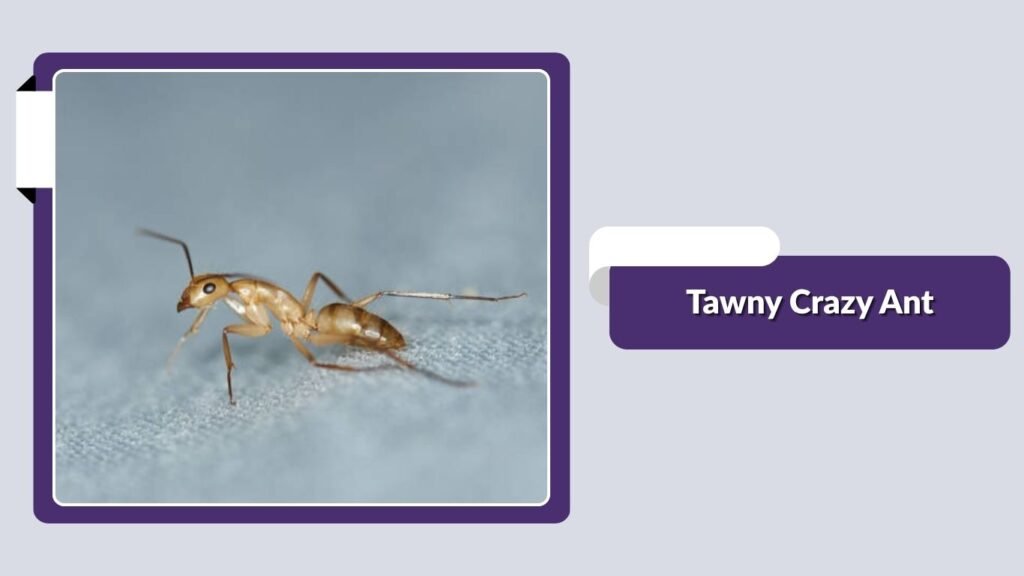
The Tawny Crazy Ant (Nylanderia fulva) is an invasive reddish-brown ant best known for forming enormous populations in parts of the southern United States. It was once confused with the closely related Caribbean Crazy Ant, but genetic and taxonomic research confirmed that the invasive populations spreading through Texas and neighboring states are N. fulva.
Identification
- Workers are approximately 2–2.5 mm long.
- Color is golden-brown to reddish-brown.
- All workers are roughly similar in size.
- The body is covered with fine hairs.
- Antennae and legs are relatively long.
- Movement is extremely fast and irregular.
Habitat and Distribution
Tawny Crazy Ants are native to South America but have become established in several southern U.S. states. Colonies occur beneath logs, rocks, landscape materials, debris, and other protected objects. They thrive particularly well in warm, humid environments.
Behavior and Diet
These ants are generalist feeders. Workers consume honeydew, nectar, insects, carrion, and household foods. Dense populations can displace native ants and other arthropods. They may also enter electrical equipment and buildings when colonies become abundant.
Lifespan and Life Cycle
Colonies contain multiple queens and can spread through budding. Queens continuously produce eggs during favorable conditions. Larvae are cared for by workers before pupating and becoming adults. Neighboring colonies may cooperate rather than defend strict territorial boundaries.
3. Yellow Crazy Ant

The Yellow Crazy Ant (Anoplolepis gracilipes) is a long-legged invasive ant found across many tropical regions. Workers are yellowish to brownish with unusually long legs and antennae. The species can form enormous interconnected colonies and is considered a serious invasive threat in several island and tropical ecosystems.
Identification
- Workers are approximately 4–5 mm long.
- Body is yellow to yellow-brown.
- Abdomen may appear darker than the rest of the body.
- Legs are extremely long.
- Antennae are long and slender.
- Workers move rapidly and erratically when disturbed.
Habitat and Distribution
Yellow Crazy Ants are now established across many tropical areas of Asia, Africa, Australia, and Pacific and Indian Ocean islands. They occupy rainforest edges, plantations, agricultural areas, urban environments, rocky ground, leaf litter, and other disturbed habitats.
Behavior and Diet
Workers consume insects, small animals, nectar, carrion, and honeydew. They frequently protect scale insects and other sap-feeding insects in exchange for sugary secretions. When threatened, workers can spray formic acid rather than sting.
Lifespan and Life Cycle
Colonies frequently contain multiple queens and may join into very large supercolonies. Eggs develop through larval and pupal stages before producing adults. Colonies can reproduce and spread through budding, allowing newly invaded areas to become occupied rapidly.
4. Hairy Crazy Ant

Hairy Crazy Ant is a common name associated with Nylanderia pubens, a small reddish-brown crazy ant of the Caribbean and nearby regions. The name has historically also been applied incorrectly to N. fulva, contributing to confusion between these closely related ants. Here, Hairy Crazy Ant refers to N. pubens.
Identification
- Workers are roughly 2.5–3 mm long.
- The body is reddish-brown.
- Fine hairs cover much of the body.
- Legs and antennae are elongated.
- Workers are similar in size.
- Movement is rapid and unpredictable.
Habitat and Distribution
Hairy Crazy Ants occur in the Caribbean and have been introduced into areas such as Florida. Colonies can occupy soil, vegetation, landscape debris, trees, structures, and other sheltered environments in warm climates.
Behavior and Diet
Workers forage extensively for sugary foods, honeydew, insects, and carrion. Their erratic running behavior is typical of Nylanderia. Colonies may reach high densities and can become nuisance pests when workers repeatedly invade buildings or food-storage areas.
Lifespan and Life Cycle
Colonies can contain several reproductive queens. Eggs hatch into larvae that are fed and protected by workers before developing into pupae. New colonies may develop through budding, allowing populations to spread without depending entirely on long-distance mating flights.
5. Robust Crazy Ant

The Robust Crazy Ant is the suggested common name for Nylanderia bourbonica. It is larger and darker than many other Nylanderia crazy ants and is believed to have originated in Southeast Asia. Human transportation has helped it colonize numerous tropical and subtropical islands and regions around the world.
Identification
- Workers measure approximately 2.1–3.2 mm.
- Body is dark brown to nearly black.
- Surface appears smooth and glossy.
- Numerous erect hairs occur across the body.
- Fine grayish hairs cover portions of the body.
- Workers are comparatively large for Nylanderia.
Habitat and Distribution
Robust Crazy Ants occur widely across tropical regions and have established introduced populations in places such as Florida. They favor naturally disturbed moist habitats, including marsh edges, mangroves, beaches, vegetation clumps, and areas containing driftwood or debris.
Behavior and Diet
Workers forage on the ground and around vegetation for sugary liquids, insects, carrion, and other available foods. Their flexible diet and willingness to nest in disturbed areas contribute to their ability to establish populations outside their original range.
Lifespan and Life Cycle
Colonies produce eggs, larvae, pupae, workers, queens, and males. Winged reproductive ants can be produced throughout much of the year in warm environments. Mating appears to occur during flights, after which fertilized females search for humid sites suitable for colony establishment.
6. Caribbean Crazy Ant

The Caribbean Crazy Ant is most appropriately associated with Nylanderia pubens. Therefore, it is not a separate species from the Hairy Crazy Ant described above, but an alternative common name. It was originally described from Saint Vincent in the Lesser Antilles and has become established in parts of Florida and elsewhere.
Identification
- Workers are approximately 2.6–3 mm long.
- Color is usually reddish-brown.
- Antennae consist of 12 segments.
- Antennae do not have a distinct terminal club.
- Long hairs occur across the body.
- Workers run quickly in seemingly random directions.
Habitat and Distribution
The species is strongly associated with the Caribbean and has also been recorded in Florida. It can inhabit gardens, landscaped areas, forests, urban environments, and other warm locations where moisture and food are readily available.
Behavior and Diet
Caribbean Crazy Ants forage for nectar, honeydew, insects, carrion, and household foods. They can form large populations and commonly move along vegetation, tree trunks, sidewalks, and structural surfaces in search of resources.
Lifespan and Life Cycle
Colonies may contain multiple reproductive queens, allowing populations to increase rapidly. Eggs pass through larval and pupal stages before adults emerge. Colony budding is an important means of local expansion and can create networks of nearby nests.
7. Guatemalan Crazy Ant
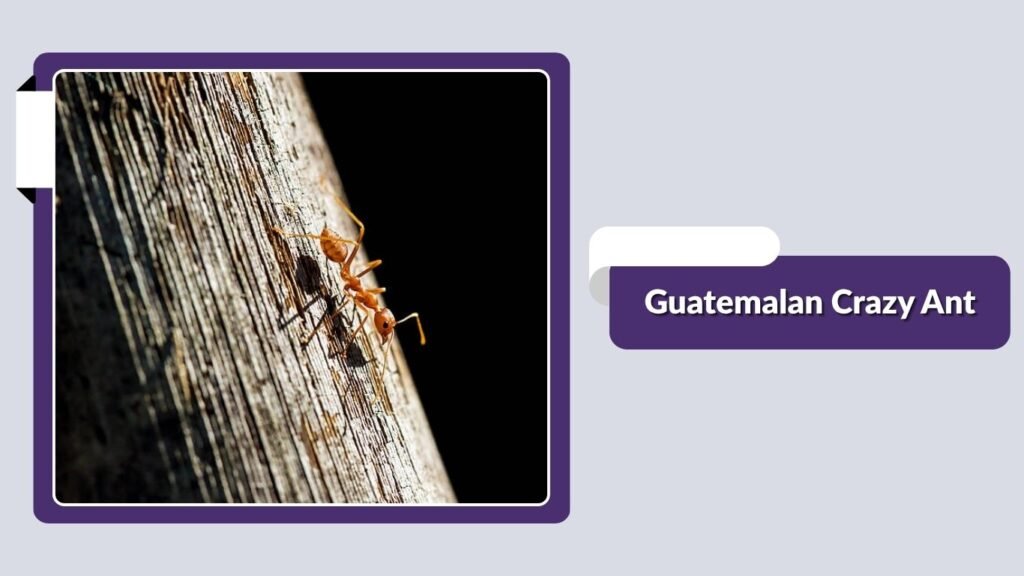
The Guatemalan Crazy Ant (Nylanderia guatemalensis) is a small tropical crazy ant native to Central America but now recorded beyond its original range. It is commonly found in lowland forests and disturbed environments, where workers forage both on the forest floor and in low vegetation.
Identification
- Workers are generally yellowish-brown to brown.
- Antennae and legs are relatively long.
- Dark erect hairs occur across the body.
- Workers have one clearly visible waist segment.
- The body is smaller and more delicate than many common ants.
- Workers display the characteristic erratic running behavior.
Habitat and Distribution
The species occurs naturally through parts of Central America, including Guatemala and Costa Rica, and has been introduced elsewhere. It inhabits lowland wet forest, dry forest, disturbed woodland, leaf litter, and low vegetation. Workers can also occur in human-modified tropical environments.
Behavior and Diet
Guatemalan Crazy Ants are generalist foragers. They visit food baits and extrafloral nectaries and search leaf litter for small food items. Their diet probably combines carbohydrate-rich plant secretions with animal material such as dead or captured arthropods.
Lifespan and Life Cycle
Queens produce eggs that develop into larvae, pupae, and adults. Workers undertake foraging, nest care, brood maintenance, and defense. Warm tropical conditions can allow extended periods of colony activity and reproduction.
8. Vivid Crazy Ant
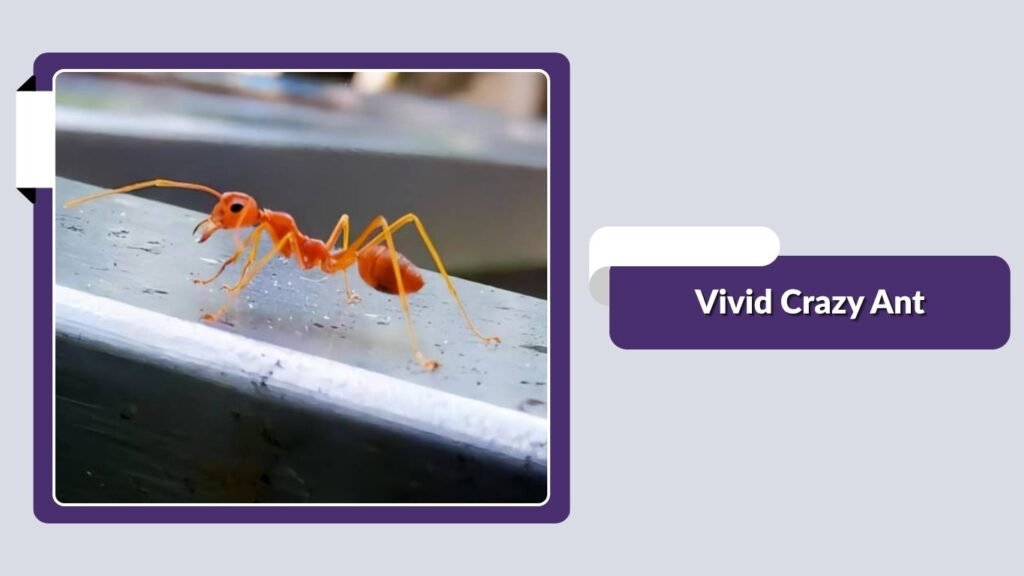
“Vivid Crazy Ant” is not the most established common name for Nylanderia vividula. The species is better known as Nylander’s Crazy Ant or sometimes the Field Crazy Ant. It is a small brown crazy ant found naturally in North America and introduced into several other regions through human activity.
Identification
- Workers are approximately 1.9–2.8 mm long.
- Color ranges from light brown to reddish-brown.
- Head and abdomen may be darker than the middle body.
- Head is relatively square when viewed from above.
- Eyes are comparatively large.
- Fine and erect hairs occur across the body.
Habitat and Distribution
Nylanderia vividula occurs naturally in the United States and Mexico and has also been transported elsewhere. In the southern United States, colonies frequently occur in disturbed forests, lawns, gardens, urban environments, and soil beneath rocks or other objects.
Behavior and Diet
Workers move rapidly while searching for sugary liquids, dead insects, small arthropods, and other foods. They readily exploit disturbed environments and may become nuisance ants around homes, landscaping, and other human-modified habitats.
Lifespan and Life Cycle
Colonies can contain multiple queens and grow considerably when food and nesting conditions are favorable. Reproductive ants may appear during warm periods. After mating, queens establish or join nests, producing eggs that develop into larvae, pupae, and new adult workers.
9. Ground Crazy Ant

Ground Crazy Ant is a descriptive name that can be applied to Nylanderia terricola, a widespread North American crazy ant. The species is particularly associated with prairies and open grassy environments, although it can tolerate many other habitats. Its small size, long legs, and quick movements are characteristic of the genus Nylanderia.
Identification
- Workers have a small, slender body.
- The head and abdomen are darker than the middle body.
- Legs are usually lighter brown.
- The head appears oval when viewed from above.
- Antennae are relatively long.
- Workers move rapidly when disturbed.
Habitat and Distribution
Nylanderia terricola has one of the broadest ranges among Nearctic Nylanderia, occurring across much of the United States and into northern and central Mexico. It is especially common in prairies but also occurs in grasslands, mesquite scrub, disturbed areas, woodland edges, and some forests. Colonies commonly nest beneath stones, logs, or directly in soil.
Behavior and Diet
Workers are active ground foragers that search for small insects, dead arthropods, nectar, and sugary secretions. Like other crazy ants, they can rapidly discover food and recruit additional workers. Their quick, irregular running pattern becomes particularly obvious when a nest or food source is disturbed.
Lifespan and Life Cycle
Colonies contain a reproductive queen, workers, developing brood, and seasonal winged reproductives. Eggs hatch into larvae before becoming pupae and adults. Reproductive males and females typically fly during spring and early summer, allowing new colonies to become established.
10. Steinheil’s Crazy Ant

Steinheil’s Crazy Ant (Nylanderia steinheili) is more commonly known as the West Indian Crazy Ant. This small dark species originated in the New World tropics and occurs throughout parts of the Caribbean, Central America, and South America. It has also introduced populations in places such as Florida and the Galápagos Islands.
Identification
- Workers measure approximately 1.7–2.3 mm.
- Body coloration is dark brown to almost black.
- Pale leg bases contrast with the darker body.
- Antennae and legs are relatively long.
- The body is slender.
- Workers run rapidly and unpredictably.
Habitat and Distribution
West Indian Crazy Ants occur in tropical and subtropical areas of the Americas. They have been recorded from the Caribbean, Central America, South America, Florida, and the Galápagos. Colonies can occupy soil, leaf litter, disturbed vegetation, gardens, and other sheltered locations.
Behavior and Diet
Workers are generalist foragers that search for sugary plant secretions and animal-based foods. They may consume nectar, honeydew, dead insects, and small arthropods. Their ability to exploit varied food sources helps them survive in disturbed and human-modified environments.
Lifespan and Life Cycle
Colonies can contain multiple queens. Eggs laid by queens develop into larvae, pupae, and adults. Workers care for the brood, forage for food, and maintain nesting sites. Winged reproductive ants eventually disperse and mate, helping the species colonize new locations.
11. Yellow-Footed Crazy Ant

The Yellow-Footed Crazy Ant refers here to Nylanderia flavipes, whose established common name is Yellow-footed Ant. It is an East Asian Nylanderia species that has been transported beyond its native range. Its pale legs contrast with its darker body, helping distinguish it from several similar crazy ants.
Identification
- Workers are small and slender.
- Body coloration is usually brown.
- Legs are noticeably yellowish or pale.
- Antennae are relatively long.
- Only one waist node is clearly visible.
- Workers move quickly when exposed.
Habitat and Distribution
The species is native to eastern Asia and has been introduced into other regions. In North America, established populations have been documented particularly in parts of the northeastern United States. Colonies may inhabit woodland litter, soil, gardens, landscaped environments, and protected areas close to human structures.
Behavior and Diet
Yellow-Footed Ants forage for small arthropods, dead insects, nectar, and honeydew. They may establish trails to reliable carbohydrate sources and often forage around vegetation. Their generalist feeding behavior gives colonies considerable flexibility when living in introduced environments.
Lifespan and Life Cycle
Queens produce eggs that pass through larval and pupal stages before becoming workers or reproductive adults. Workers maintain the colony and gather food. Mature nests periodically produce winged males and females that disperse during favorable seasonal conditions.
12. Small Crazy Ant

Small Crazy Ant is better called the Tiny Crazy Ant, a common name used for Nylanderia parvula. This species lives across much of the eastern United States and is among the smallest members of the regional crazy-ant fauna. It often occurs around forest edges and sandy soils where small crater-shaped nest entrances can reveal its presence.
Identification
- Workers measure about 1.6–2.2 mm.
- Body is uniformly dark brown to black.
- Workers are exceptionally small.
- Antennal scapes lack the large erect hairs seen in many relatives.
- Legs are slender.
- Movement is rapid and somewhat erratic.
Habitat and Distribution
Tiny Crazy Ants occur widely across the eastern United States and extend northward into southern Canada. They inhabit pine barrens, mixed forests, woodland edges, and open sandy ground. Nests are commonly built beneath stones or close to the surface of sandy soil, although chambers may extend deeper underground.
Behavior and Diet
Workers forage across soil and leaf litter for a variety of resources. They consume small animal material and sugary foods and have also been documented interacting with aphids. The species can move and disperse seeds, giving it an additional ecological role within woodland and grassland communities.
Lifespan and Life Cycle
Colonies are generally centered around a queen. Reproductives develop during summer and can remain inside nests through winter before flying the following spring. As with other ants, development progresses through egg, larva, pupa, and adult stages.
13. Phantom Crazy Ant

Phantom Crazy Ant is more accurately called the Ghostly Crazy Ant, referring to Nylanderia phantasma. This native southeastern U.S. species is unusual because it specializes in dry, sandy scrub habitats. Its nocturnal habits and pale appearance contributed to its ghost-like scientific and common names.
Identification
- Workers are small and relatively pale.
- Body coloration is generally light compared with many crazy ants.
- Antennae and legs are long.
- Workers have the slender Nylanderia body shape.
- Colonies may have numerous crater-like entrances.
- Activity is strongest during nighttime.
Habitat and Distribution
Ghostly Crazy Ants are found in the southeastern United States. They were originally believed to be restricted to Florida’s Lake Wales Ridge but have also been recorded in Georgia, Alabama, and Mississippi. They strongly favor xeric scrub and sandy dune environments.
Behavior and Diet
This species is mainly nocturnal. Workers leave their sandy nests after dark to forage for small arthropods and other available food. Sugary plant secretions are also likely important resources, as they are for many Nylanderia species.
Lifespan and Life Cycle
Workers can remain active throughout the year in suitable warm habitats. Reproductive ants are produced during fall, remain in the colony through cooler periods, and generally undertake mating flights during late winter or early spring.
14. Sand Crazy Ant

Sand Crazy Ant is a descriptive name for Nylanderia arenivaga, a North American species strongly specialized for sandy habitats. Although “Sand Crazy Ant” is not a universally standardized common name, it accurately reflects the species’ ecology. Most colonies are found in deep sand deposits, where workers maintain extensive underground nests with multiple entrances.
Identification
- Workers are small and slender.
- Coloration is typically light brown to brown.
- Antennae and legs are elongated.
- The body has a single visible waist node.
- Workers move quickly across exposed sand.
- Nest openings form small, flat craters.
Habitat and Distribution
Nylanderia arenivaga occurs primarily in the eastern United States from Massachusetts south through Florida, with additional populations along Gulf Coast states. It is strongly associated with open yellow sand, dunes, sandy woodland, and other deep sand deposits.
Behavior and Diet
Sand Crazy Ants are primarily nocturnal, reducing their exposure to hot and dry daytime conditions. Workers forage across sandy ground for small arthropods, dead insects, and sugary resources. Colonies can have numerous entrances concentrated within a relatively small area.
Lifespan and Life Cycle
Nests can extend more than 20–30 cm beneath the surface and may have up to around 20 entrances. Reproductive flights occur primarily from winter through spring, although timing differs by latitude. Workers in southern populations may forage throughout winter.
15. Magnolia Crazy Ant

“Magnolia Crazy Ant” is not an established common name. The closest species name from the original list is Nylanderia magnella, a native crazy ant from the southwestern United States. Importantly, its name does not indicate a special association with magnolia trees. It occurs mainly in dry southwestern habitats and can also survive around urban development.
Identification
- Workers measure approximately 2.3–2.6 mm.
- Overall coloration is orange-brown.
- The head is distinctly square-shaped.
- Antennal scapes have dense fine hairs.
- Workers are relatively large for a Nearctic Nylanderia.
- The abdomen may appear slightly darker.
Habitat and Distribution
Nylanderia magnella is known from southwestern California, southern Nevada, and central Arizona. Collections have come from coastal sage scrub, grassland, chaparral, and urban settings, including sidewalk cracks and areas close to homes.
Behavior and Diet
Workers forage across the ground and probably use the broad generalist diet typical of the genus, including small arthropods and carbohydrate-rich liquids. Their ability to occupy natural grassland as well as urban areas shows considerable flexibility in nesting and foraging.
Lifespan and Life Cycle
Available observations suggest nests can be polydomous, meaning one colony may occupy several connected nesting sites, and potentially polygynous, with multiple queens. Eggs develop through larval and pupal stages before adults emerge.
16. Woodland Crazy Ant

The Woodland Crazy Ant (Nylanderia faisonensis) is one of the most abundant native crazy ants in forests of the eastern United States. Unlike invasive crazy ants that commonly dominate disturbed urban areas, this species is strongly associated with woodland environments, where colonies occupy leaf litter, decaying wood, and shallow soil.
Identification
- Workers measure approximately 1.9–2.6 mm.
- Body is generally uniform brown.
- The abdomen may be slightly darker.
- Pale leg bases contrast with the body.
- Antennae and legs are long and slender.
- Workers have a delicate appearance.
Habitat and Distribution
Woodland Crazy Ants occur throughout much of the eastern United States. They are especially associated with moist deciduous forests and pine woodland. Colonies often occupy shallow nests beneath leaf litter, inside rotten wood, or directly within surface soil.
Behavior and Diet
The species is a generalist feeder and searches the forest floor for insects, carrion, and sugary resources. Workers tend to discover food quickly but are comparatively submissive when confronted by more aggressive ant species.
Lifespan and Life Cycle
Colonies are relatively small compared with massive invasive crazy-ant populations and are generally associated with a reproductive queen. Eggs become larvae, pupae, and adults. Workers perform foraging and brood care while reproductive males and females provide seasonal dispersal.
17. Tropical Crazy Ant

Tropical Crazy Ant is a descriptive name that can be applied to Nylanderia vaga, a widespread tropical and subtropical species. It should not be confused with the Longhorn Crazy Ant or Yellow Crazy Ant. N. vaga is particularly widespread across Australasia and Pacific islands and has been moved beyond portions of its original range through human activity.
Identification
- Workers are small and slender.
- Body coloration is generally brown.
- Legs and antennae are relatively long.
- Workers have one obvious waist node.
- Fine body hairs may be visible under magnification.
- Movement is rapid and irregular.
Habitat and Distribution
N. vaga occurs broadly through Australia, New Guinea, New Caledonia, New Zealand, and numerous Pacific islands, including Fiji, Samoa, Tonga, Vanuatu, and French Polynesia. It has also been recorded from the Galápagos Islands.
Behavior and Diet
Like many Nylanderia, Tropical Crazy Ants are rapid generalist foragers. Colonies exploit insects, carrion, nectar, honeydew, and other sugary materials. Workers can recruit quickly when they discover food, helping colonies take advantage of temporary resources in tropical habitats.
Lifespan and Life Cycle
Queens produce eggs that hatch into larvae and then develop into pupae and adults. Warm tropical conditions may permit colony activity for much of the year. Mature populations produce males and reproductive females, while local expansion can occur as colonies establish additional nesting sites.
FAQs
1. Why are they called crazy ants?
Crazy ants get their name from their rapid, irregular running behavior. Instead of following neat, predictable paths, workers often appear to dart in different directions when disturbed or searching for food.
2. Are crazy ants dangerous to humans?
Most crazy ants are not considered dangerous to people. They generally do not have medically significant stings, although some species may bite or spray defensive chemicals such as formic acid when threatened.
3. What do crazy ants eat?
Crazy ants are generalist feeders. They commonly eat honeydew, nectar, dead insects, small arthropods, sugary foods, and household scraps. Some species also protect aphids, scale insects, and other sap-feeding insects to obtain honeydew.
4. Where do crazy ants usually live?
Crazy ants can live in soil, leaf litter, gardens, forests, mulch, potted plants, wall voids, electrical equipment, and beneath stones or logs. Many species prefer warm, humid tropical or subtropical environments.
5. Which crazy ant species are invasive?
Several crazy ants are major invasive species, including the Yellow Crazy Ant, Tawny Crazy Ant, and Longhorn Crazy Ant. They can form extremely large colonies, displace native insects, invade buildings, and disrupt local ecosystems.