
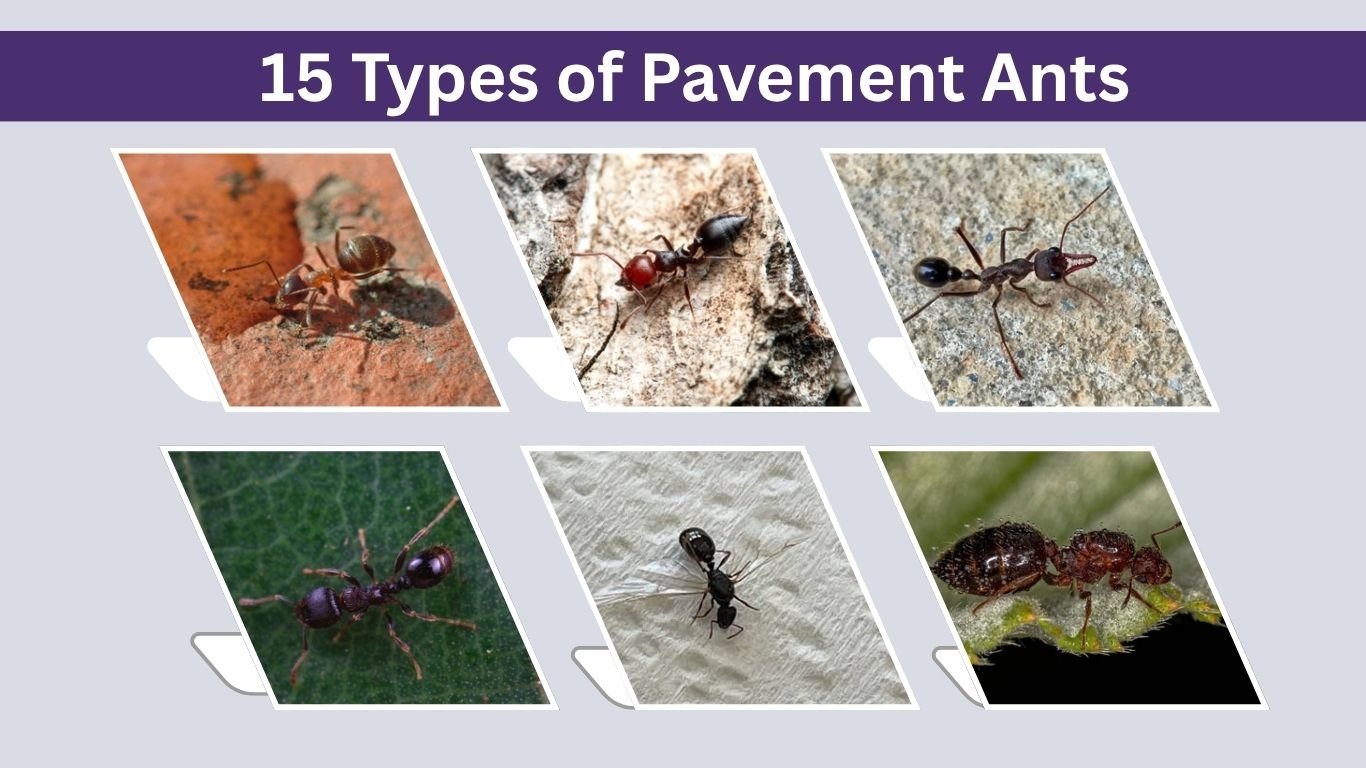
Pavement ants are small, adaptable ants commonly found beneath sidewalks, stones, driveways, foundations, and other disturbed areas. While the familiar pavement ant is widespread in cities and suburbs, several related Tetramorium species occur across Europe, Asia, Africa, Australia, and the Americas. Their diets typically include insects, seeds, sugary foods, and household scraps. This guide covers 15 types of pavement ants, including their identification, habitat, behavior, diet, and life cycle.
1. Pavement Ant

The Pavement Ant usually refers to Tetramorium immigrans in North America. This small, dark ant is especially successful in cities and suburbs, where colonies frequently establish themselves beneath sidewalks, driveways, patios, foundations, and stones. Its adaptability and broad diet allow it to live extremely close to people and sometimes enter buildings while searching for food.
Identification
- Workers are usually dark brown to nearly black.
- Adults are only a few millimeters long.
- The head and thorax have fine grooves or ridges.
- Two small spines occur toward the rear of the thorax.
- The waist consists of two distinct nodes.
- Antennae end in a three-segmented club.
Habitat and Distribution
Pavement Ants are widespread across temperate North America, especially in urban and suburban environments. They commonly nest beneath concrete slabs, sidewalks, stones, driveways, building foundations, and cracks in pavement. Colonies can also occur in grasslands, gardens, roadsides, and other disturbed habitats.
Behavior and Diet
These ants are highly flexible feeders. Workers consume insects, seeds, nectar, fruits, grease, meat, bread, pet food, and household scraps. They commonly forage considerable distances from their nests. Rival colonies sometimes engage in conspicuous battles along sidewalks and other territorial boundaries.
Lifespan and Life Cycle
Colonies contain queens, workers, developing brood, and seasonal reproductive ants. Eggs hatch into larvae, which workers feed until they pupate. Winged males and females are usually produced during warmer periods. After mating, fertilized queens establish new underground colonies.
2. Immigrant Pavement Ant
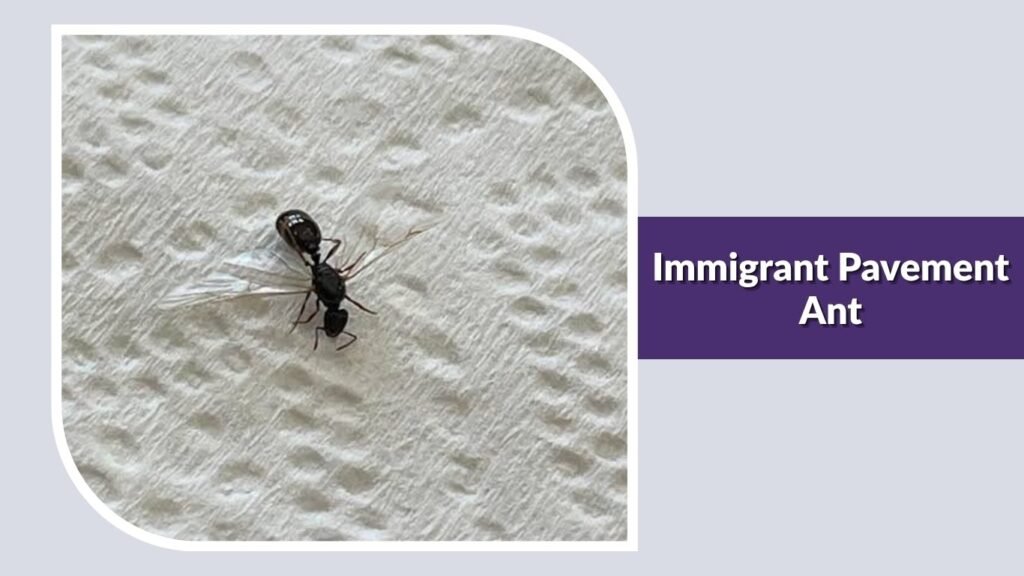
The Immigrant Pavement Ant is another common name for Tetramorium immigrans, the same species commonly called the Pavement Ant in North America. The name emphasizes its Old World origin and introduction into North America, where it has become one of the most familiar ants living around paved surfaces and buildings.
Identification
- Workers are dark brown to blackish.
- The body is roughly 2.5–4 mm long.
- Parallel grooves occur across the head and thorax.
- Workers have two small propodeal spines.
- The waist contains two segments.
- Legs and antennae may appear lighter than the body.
Habitat and Distribution
Immigrant Pavement Ants are native to Eurasia but are now extremely widespread in North America. They prosper around sidewalks, parking lots, patios, walls, gardens, parks, and buildings. Their nests are usually underground and may be hidden beneath concrete or stones.
Behavior and Diet
Workers forage both outdoors and indoors. They readily consume sugary foods, fats, seeds, insects, dead animals, and human food waste. This broad diet is one reason the species adapts so successfully to urban environments.
Lifespan and Life Cycle
A queen produces eggs that develop into larvae, pupae, and adult workers. Established colonies may contain hundreds or thousands of individuals. Mature colonies produce winged reproductive ants that leave to mate, after which newly fertilized queens search for suitable nesting locations.
3. European Pavement Ant

The European Pavement Ant (Tetramorium caespitum) is a widespread Palearctic ant and one of the species historically associated with the common name “pavement ant.” It resembles T. immigrans closely, which caused considerable confusion in older North American records. True T. caespitum is primarily associated with Europe and neighboring regions.
Identification
- Workers are generally brown to dark brown.
- The body is small and compact.
- Head and thorax have longitudinal sculpturing.
- The waist has two nodes.
- Small spines occur toward the rear of the thorax.
- Antennae terminate in a club.
Habitat and Distribution
European Pavement Ants occur across much of Europe and extend into portions of western Asia. They tolerate both natural and human-modified habitats, including grasslands, roadsides, gardens, fields, urban areas, and cracks around paved surfaces.
Behavior and Diet
The species is an opportunistic omnivore. Workers gather insects, carrion, seeds, nectar, and sweet substances. Colonies can defend food and nesting territories aggressively against neighboring ants, although workers generally present little concern to people.
Lifespan and Life Cycle
Queens lay eggs during favorable periods, and workers care for the developing larvae. The larvae pupate before becoming adult ants. Mature colonies produce winged males and females, allowing the species to disperse and establish new nests.
4. Japanese Pavement Ant

The Japanese Pavement Ant (Tetramorium tsushimae) is a common East Asian species frequently encountered in southern and central Japan. It has also become established in parts of the United States. Like other pavement ants, it readily occupies open ground and nests underneath stones or in disturbed soil.
Identification
- Workers are approximately 2.5–3 mm long.
- Color ranges from dark brown to nearly black.
- The head and thorax have fine surface ridges.
- The waist consists of two nodes.
- Workers are relatively uniform in size.
- Antennae are elbowed with a terminal club.
Habitat and Distribution
Japanese Pavement Ants are native to East Asia and are especially common in Japan. Introduced populations have become established in parts of Missouri, Illinois, and Kansas in the United States. They favor open land, disturbed soil, lawns, roadsides, and sites beneath stones.
Behavior and Diet
These ants use chemical trails to recruit nestmates rapidly to food. They consume insects, carrion, seeds, and sugary substances. Research has identified a specialized trail pheromone that helps workers coordinate mass recruitment during foraging.
Lifespan and Life Cycle
Queens produce eggs that become larvae, pupae, and workers. The workforce expands as colonies mature and develops organized foraging systems. Seasonal reproductive males and females eventually leave established colonies to mate and found new populations.
5. Guinea Ant

The Guinea Ant (Tetramorium bicarinatum) is a widespread tropical tramp ant that has been transported around the world through commerce. It has an attractive two-tone appearance, with a lighter reddish or yellow-brown head and thorax contrasting sharply with a dark abdomen. The species can live successfully around gardens, buildings, cultivated plants, and other disturbed environments.
Identification
- Workers are approximately 3–4 mm long.
- Head and thorax are yellow-brown to reddish-brown.
- The abdomen is dark brown or black.
- Workers within a colony are similar in size.
- The waist consists of two nodes.
- Workers possess a functional sting.
Habitat and Distribution
Guinea Ants occur throughout many tropical and subtropical regions and have been spread widely beyond their original range. Colonies may nest in soil, beneath stones, under bark, within rotten wood, in plant stems, and around potted plants.
Behavior and Diet
These ants are generalist scavengers and predators. Workers eat dead insects, small arthropods, sugary materials, and other available foods. Their ability to nest in transported plants and soil has contributed to their worldwide spread.
Lifespan and Life Cycle
Queens lay eggs that develop through larval and pupal stages. Workers feed the brood, gather food, maintain the nest, and defend the colony. In warm climates, colonies can remain active throughout much of the year and may spread readily through transported material.
6. Bicoloured Pennant Ant

The Bicoloured Pennant Ant is another established common name for Tetramorium bicarinatum, meaning it is the same species as the Guinea Ant described above. The name is particularly common in Australia and the Pacific region and refers to the obvious contrast between its reddish-brown front body and much darker abdomen.
Identification
- Workers are usually around 4 mm long.
- Head and thorax are light yellow-brown to reddish-brown.
- Abdomen is dark brown to black.
- All workers are approximately the same size.
- Two waist segments are clearly visible.
- A sting is present at the end of the abdomen.
Habitat and Distribution
Bicoloured Pennant Ants occur across many warm parts of the world. In Australia and Pacific regions, they can be found in gardens, disturbed ground, urban environments, and agricultural areas. Nests occur in exposed soil, beneath stones and pavers, under bark, and within decaying wood.
Behavior and Diet
Workers are active scavengers that search for dead insects and other animal material. They also consume sugary resources and may forage around homes or cultivated plants. Colonies can defend themselves with a painful sting if workers are disturbed or trapped against the skin.
Lifespan and Life Cycle
Colonies develop through the normal ant stages of egg, larva, pupa, and adult. Queens maintain egg production while workers perform food collection and brood care. Reproductive males and females allow established populations to expand into suitable new habitats.
7. Woolly Ant

The Woolly Ant, also called the Woolly Pavement Ant, is Tetramorium lanuginosum. Its name comes from the dense covering of soft, often branched hairs across its body, which gives the workers a fuzzy appearance under magnification. It is a widespread tropical tramp species originally associated with tropical and subtropical Asia.
Identification
- Workers measure approximately 2.5–3 mm.
- Body is reddish-brown to dark brown.
- The abdomen is generally darker.
- Dense soft hairs cover much of the body.
- Some hairs branch into two or three tips.
- Long, sharp spines occur toward the rear of the thorax.
Habitat and Distribution
Woolly Ants have been transported to tropical regions worldwide. Colonies occur in forests, gardens, urban areas, islands, and other warm environments. They commonly nest beneath stones, inside decaying wood, or in other sheltered places close to the ground.
Behavior and Diet
Workers are generalist scavengers and hunters. They feed on small insects, dead arthropods, carbohydrates, and other available organic material. Compared with many rapidly moving invasive ants, the Woolly Ant has a relatively slow and steady gait.
Lifespan and Life Cycle
Colonies contain workers of essentially one size rather than strongly differentiated major and minor castes. Eggs develop into larvae and pupae before becoming adults. Reproductive ants eventually allow colonies to spread, while international movement of soil and plant material has helped distribute the species widely.
8. Groove-Headed Fierce Ant

The Groove-Headed Fierce Ant (Tetramorium simillimum) is a small tropical ant that has become widely distributed through human commerce. Its common name refers to the strongly sculptured head and its ability to defend itself. Despite the dramatic name, it is primarily a small ground-foraging ant rather than an unusually dangerous species to humans.
Identification
- Workers are small and compact.
- Body is generally yellowish-brown to brown.
- The head has conspicuous grooves or sculpturing.
- The waist contains two distinct nodes.
- Antennae are elbowed.
- Small spines occur on the rear portion of the thorax.
Habitat and Distribution
Groove-Headed Fierce Ants are widespread throughout many tropical and subtropical regions. They occur in disturbed environments, gardens, plantations, agricultural land, urban habitats, and other warm areas. Colonies often nest beneath stones, in soil, or within protected crevices.
Behavior and Diet
Workers forage for insects, carrion, sugary liquids, and other available food. Their generalist feeding habits allow colonies to survive in many human-modified environments. Workers may defend nesting sites and food sources when disturbed.
Lifespan and Life Cycle
Queens produce eggs that hatch into larvae and later develop into pupae. Workers maintain the brood, collect food, and protect the colony. Mature nests produce reproductive males and females, enabling populations to disperse naturally as well as through human transportation.
9. Yellow Seed Ant

“Yellow Seed Ant” is not a widely standardized common name for a single Tetramorium species. The name can be used descriptively for small yellowish pavement ants that collect seeds, particularly species related to the Yellow Pavement Ant. These ants combine scavenging with seed collection and commonly live beneath stones or in warm, open soil.
Identification
- Workers are small and slender.
- Body color may be yellow to yellowish-brown.
- The waist consists of two distinct nodes.
- Antennae end in a noticeable club.
- Small spines occur toward the rear of the thorax.
- Workers may form trails between food sources and the nest.
Habitat and Distribution
Yellowish Tetramorium species are especially associated with warm parts of Europe and the Mediterranean. Colonies may occur beneath stones, paving slabs, walls, dry soil, and low-growing vegetation. Sunny gardens and other disturbed areas can provide particularly favorable nesting conditions.
Behavior and Diet
Workers are opportunistic omnivores. Seeds can form part of the diet, but colonies also consume insects, carrion, nectar, honeydew, and other sugary foods. Workers rapidly recruit nestmates when they discover a profitable food source.
Lifespan and Life Cycle
Queens produce eggs that develop into larvae, pupae, and adult workers. Young colonies grow gradually until enough workers are available for extensive foraging. Mature colonies eventually produce winged males and females that leave the nest to mate.
10. Dwarf Seed Ant

Dwarf Seed Ant is another descriptive rather than formally standardized pavement-ant name. It refers to very small seed-gathering Tetramorium-type ants whose workers forage close to the ground. Their tiny size allows them to use narrow soil cracks and sheltered spaces beneath stones where larger ants may have difficulty nesting.
Identification
- Workers are exceptionally small.
- Color may range from yellow-brown to dark brown.
- Two waist nodes are visible.
- Antennae have a terminal club.
- The head may have fine grooves under magnification.
- Workers have relatively strong jaws for their size.
Habitat and Distribution
Small Tetramorium ants occur across many tropical, subtropical, and temperate regions. They can occupy gardens, grassland, field margins, pavement edges, rocky ground, and disturbed urban areas. Colonies generally remain underground or beneath objects that protect them from extreme weather.
Behavior and Diet
Workers gather tiny seeds, insect remains, and sugary foods. Their small size enables them to exploit crumbs and other food particles that larger ants may overlook. When a food source is discovered, chemical trails allow additional workers to reach it efficiently.
Lifespan and Life Cycle
The colony develops around one or more reproductive queens depending on the species. Eggs hatch into larvae that are fed by workers before pupating. Adult workers then assume duties such as foraging, brood care, nest cleaning, and defense.
11. Hairy Pavement Ant

Hairy Pavement Ant is an informal descriptive name that fits pavement ants with conspicuous body hairs. Typical pavement ants in the Tetramorium caespitum complex have stiff hairs across the body in addition to the distinctive grooves on the head and thorax. They are small, hardy ants commonly associated with soil and paved environments.
Identification
- Workers are usually dark brown to nearly black.
- Stiff hairs occur over much of the body.
- Fine parallel grooves cover the head and thorax.
- Two small spines occur behind the thorax.
- The waist has two distinct nodes.
- Workers are generally around 2.5–4 mm long.
Habitat and Distribution
These pavement ants commonly establish nests beneath stones, sidewalks, driveways, boards, and concrete slabs. They are particularly successful in towns and cities, although they can also occupy gardens, grasslands, and other disturbed open habitats.
Behavior and Diet
Workers readily consume sweets, seeds, insects, grease, pet food, meat, and other organic material. Colonies often create trails leading from underground nests to dependable food sources. Neighboring colonies may fight intensely when their territories meet.
Lifespan and Life Cycle
Queens lay eggs that hatch into larvae and later become pupae. Workers maintain the developing brood and expand the nest. Mature colonies produce winged reproductive ants, often during warmer months, allowing new colonies to become established.
12. Yellow Pavement Ant

The Yellow Pavement Ant is commonly used in the ant-keeping community for Tetramorium semilaeve. This small yellowish-brown species is associated with Mediterranean environments and readily nests beneath stones, paving slabs, and other warm surfaces. Colonies can become large and recruit many workers very quickly when food is discovered.
Identification
- Workers are yellow to yellowish-brown.
- The body is small and relatively slender.
- Two nodes occur between the thorax and abdomen.
- Antennae terminate in a club.
- Workers are generally similar in size.
- Colonies may contain many thousands of workers.
Habitat and Distribution
Yellow Pavement Ants are associated particularly with warm Mediterranean areas. They occur beneath stones, paving slabs, low vegetation, garden structures, and cracks in sunny walls. Both urban and relatively natural open habitats may provide suitable nesting conditions.
Behavior and Diet
Workers respond rapidly to sugary foods and can recruit large numbers of nestmates. They also consume insects, other protein-rich foods, and various organic materials. Colonies can aggressively defend valuable food sources against competing ants.
Lifespan and Life Cycle
A newly established queen produces the first workers, which later take over feeding and brood care. As the workforce grows, colony expansion accelerates. Mature nests eventually produce winged reproductive ants that leave during favorable weather.
13. Dark Pavement Ant

Dark Pavement Ant is a descriptive name that fits the familiar Immigrant Pavement Ant, Tetramorium immigrans. Workers are generally reddish-brown to nearly black and are among the most common ants around sidewalks and buildings in many North American cities. The species originated in Europe and the Mediterranean before becoming established in North America.
Identification
- Workers are reddish-brown to black.
- Body length is roughly 2.5–4 mm.
- Head and thorax have fine parallel grooves.
- Two small thoracic spines are present.
- The waist consists of two nodes.
- Legs and antennae may be slightly paler.
Habitat and Distribution
Dark pavement ants commonly nest under sidewalks, driveways, patios, stones, logs, and concrete foundations. Their strong association with disturbed ground makes them particularly successful in cities and suburban landscapes.
Behavior and Diet
Workers are broad omnivores that consume meat, insects, bread, nuts, pet food, grease, and sweets. They readily enter buildings through cracks in foundations while searching for food.
Lifespan and Life Cycle
Colonies can contain thousands of workers. Queens continually produce eggs during suitable periods, and workers maintain the brood. Winged males and females commonly appear from late spring into summer before leaving to mate and establish new nests.
14. Mediterranean Pavement Ant
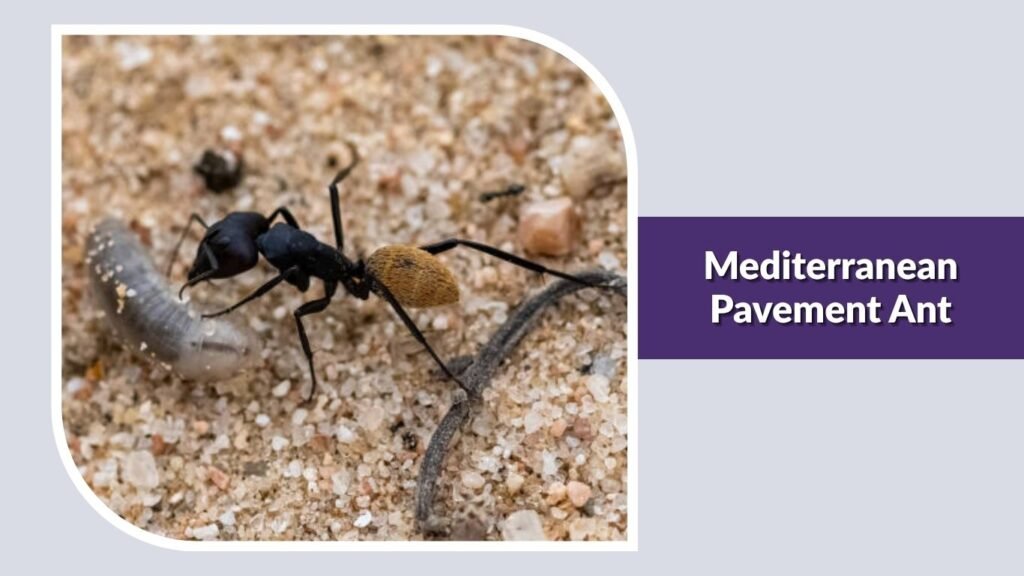
Mediterranean Pavement Ant is best treated as a regional descriptive name rather than a unique species. Tetramorium immigrans is a suitable example because evidence indicates that it is native to Europe and the Mediterranean, even though it is now extremely familiar as an introduced pavement ant in North America.
Identification
- Workers are usually dark brown.
- Body length is only a few millimeters.
- Fine grooves cover the head and thorax.
- Two waist nodes are clearly present.
- Small spines occur at the rear of the thorax.
- Workers have elbowed, clubbed antennae.
Habitat and Distribution
Mediterranean pavement ants thrive in open, disturbed environments with warm soil. They may nest beneath rocks, pavement, walls, roads, gardens, and building foundations. T. immigrans has subsequently become established far beyond its original European and Mediterranean range.
Behavior and Diet
Workers forage for insects, seeds, honeydew, sweets, grease, and food scraps. Urban colonies can benefit from human food and often establish trails along pavement edges or cracks leading toward buildings.
Lifespan and Life Cycle
Queens establish underground nests and produce eggs that develop into larvae and pupae. Once adult workers appear, they take over food gathering and brood care. Mature colonies later produce winged reproductive ants.
15. Asian Pavement Ant
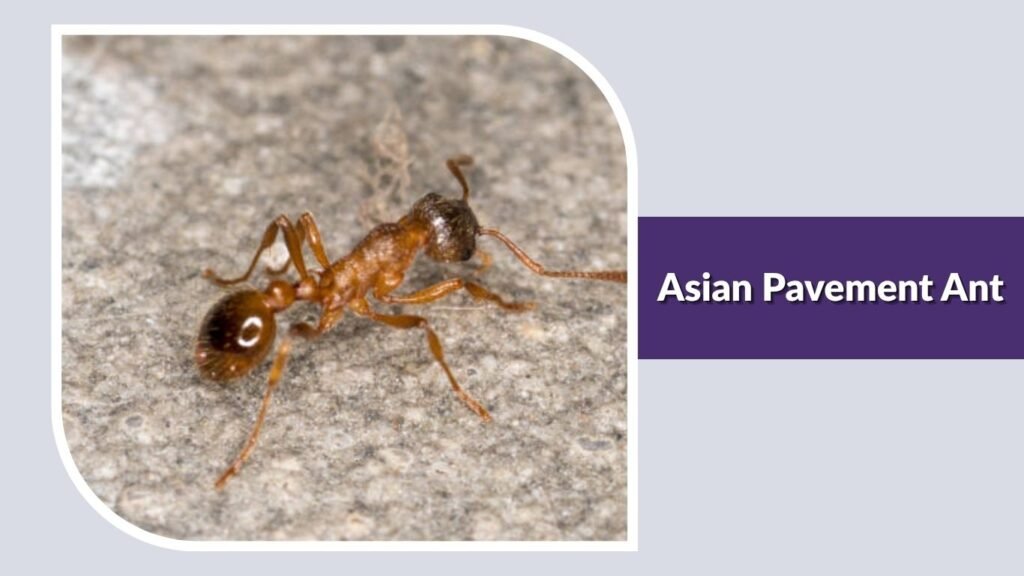
Asian Pavement Ant is a useful regional description for Tetramorium tsushimae, the Japanese Pavement Ant introduced earlier in this list. It is native to East Asia but has also become established in parts of the United States. Like other pavement ants, it thrives in disturbed ground and readily nests beneath stones or along paved areas.
Identification
- Workers are small and compact.
- Head and thorax may be reddish-brown.
- The abdomen is often darker.
- The waist contains two nodes.
- Antennae terminate in a club.
- Workers move in quick, dense trails when foraging.
Habitat and Distribution
Tetramorium tsushimae is native to East Asia, particularly Japan and neighboring areas. Introduced populations occur in parts of the central United States. Colonies occupy lawns, roadsides, pavement margins, disturbed soil, and open areas beneath stones.
Behavior and Diet
Workers are omnivorous and consume insects, seeds, sugary liquids, and animal-based foods. Efficient chemical recruitment helps colonies rapidly gather large numbers of workers around productive feeding sites.
Lifespan and Life Cycle
Mature colonies produce winged reproductive ants during warm months. After mating, queens establish nests and begin producing eggs. Development proceeds through larval and pupal stages until the first adult workers emerge and assume colony duties.
FAQs
1. Why are they called pavement ants?
They are named for their habit of nesting underneath and alongside sidewalks, driveways, patios, concrete slabs, and building foundations. Workers often push excavated soil through cracks, producing small piles of dirt that reveal the nest below.
2. What do pavement ants eat?
Pavement ants are opportunistic omnivores. They eat insects, seeds, meat, grease, bread, nuts, sweets, pet food, and many other organic materials. This flexible diet is one reason they survive so successfully around people.
3. Do pavement ants bite or sting?
Pavement ants can defend themselves, and some species possess functional stingers, but ordinary pavement ants rarely cause significant problems for people. They are primarily considered nuisance pests when they enter buildings or contaminate food.
4. Why do pavement ants fight on sidewalks?
Different colonies are territorial. When neighboring colonies meet, hundreds or even thousands of workers may gather and fight along pavement cracks or territorial boundaries. These large gatherings are sometimes informally called pavement-ant wars.
5. How can you identify a pavement ant?
Typical pavement ants are small and brown to black, with two waist nodes, small spines near the rear of the thorax, and fine parallel grooves across the head and thorax. These details are easiest to see with magnification.