
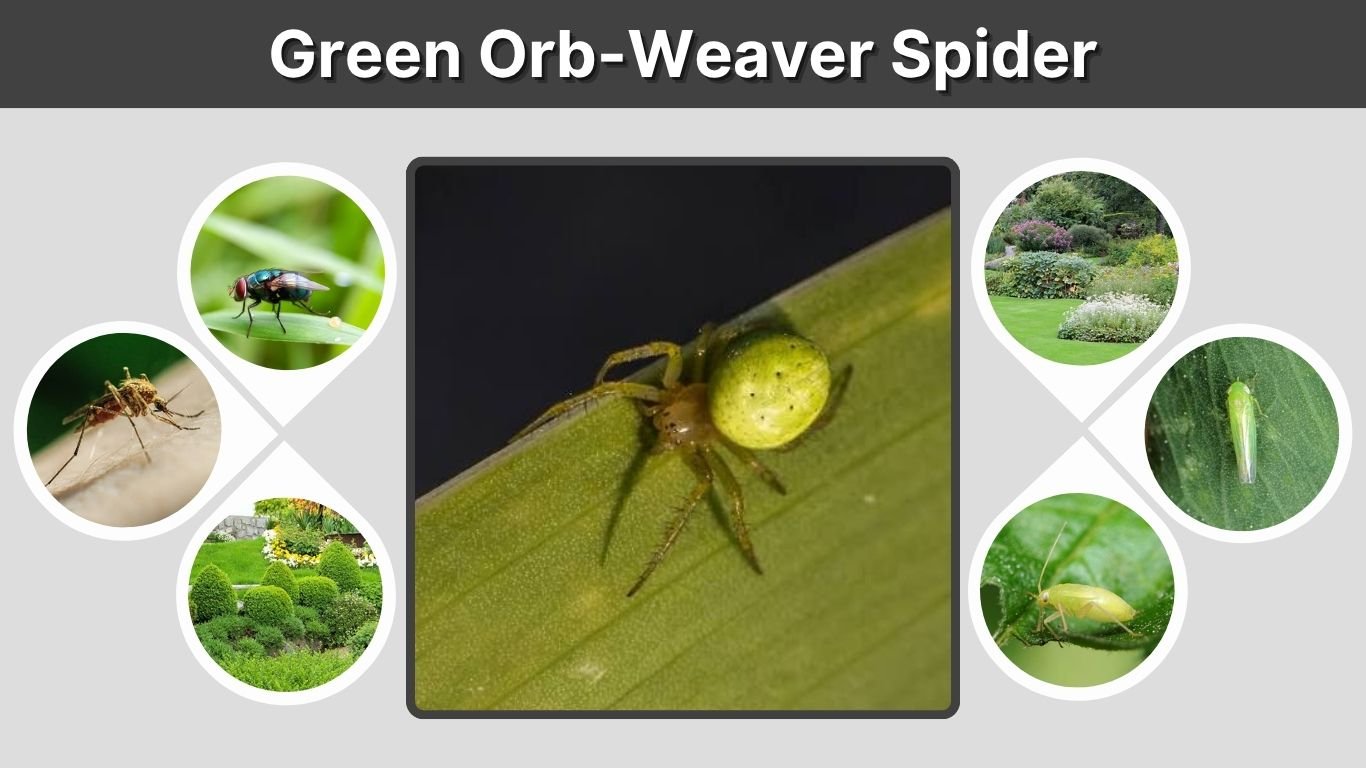
The green orb-weaver spider is a small, brightly colored spider commonly found among leaves, shrubs, hedges, and garden plants. Its lime-green abdomen provides excellent camouflage, making it difficult to notice until its circular web catches the light. The name may describe several species, but European sightings often involve cucumber spiders from the genus Araniella. Although these spiders possess venom for subduing insects, they are not considered dangerous to people. Understanding their color, size, web, habitat, and behavior can help you identify them correctly.
What Is a Green Orb-Weaver Spider?
Green orb-weavers belong to the orb-weaving spider family, Araneidae. Members of this family are known for creating circular webs with radiating support threads and sticky spiral silk. These webs may resemble small bicycle wheels suspended between leaves or stems.
Is It One Particular Species?
The name “green orb-weaver spider” does not always identify a single species. In the UK and much of Europe, it frequently refers to the cucumber green spider, Araniella cucurbitina, or the closely related Araniella opisthographa.
These two spiders look extremely similar and may live in the same habitat. Even specialists can require microscopic examination of mature spiders to separate them confidently. Therefore, a photographed spider may be more accurately identified simply as an Araniella species.
Green Orb-Weaver Spider Identification
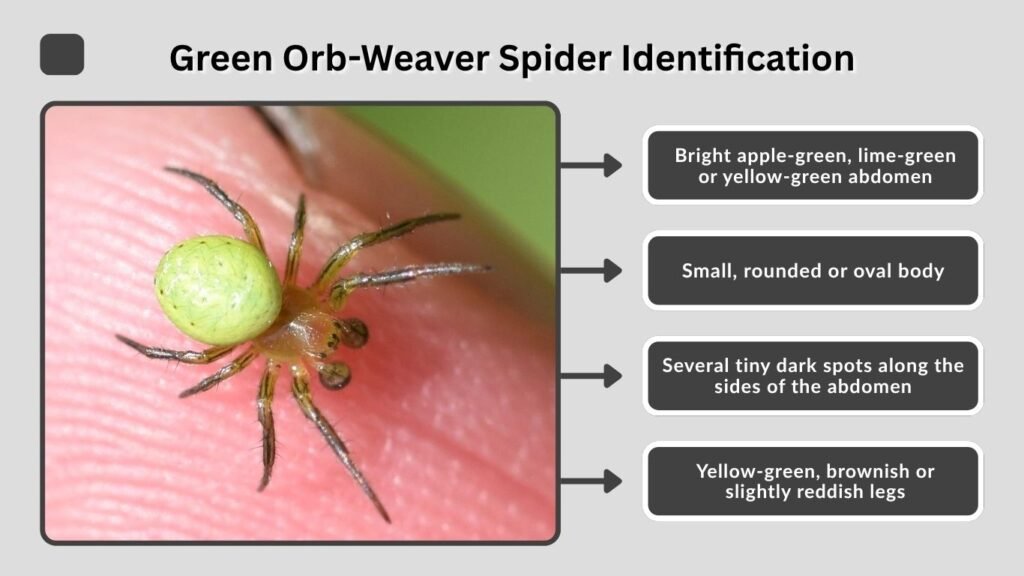
The green abdomen is the spider’s most obvious feature, but body color alone is not enough for reliable identification. Examine its size, markings, legs, web, and the location where it was discovered.
Main Identification Features
- Bright apple-green, lime-green or yellow-green abdomen
- Small, rounded or oval body
- Several tiny dark spots along the sides of the abdomen
- Yellow-green, brownish or slightly reddish legs
- Brown, yellowish or reddish-brown front body
- Small circular web constructed among leaves
- Red marking near the spinnerets in some cucumber spiders
- Female body length reaching approximately 6–8 mm
- Males generally smaller and more slender than females
The spider’s color helps it blend with fresh foliage. Adult females usually have rounder abdomens, while males have narrower bodies and proportionally longer legs. Females may reach approximately 8 mm, whereas males are commonly around 5 mm or smaller.
Light Green and Lime-Green Individuals
The abdomen may appear pale green, yellowish-green, vivid lime, or occasionally almost translucent. Lighting, age, surrounding vegetation, and the spider’s physical condition can affect how its color appears.
Tiny dark depressions may create rows of black dots along the abdomen. Some individuals also have a small reddish area underneath or near the rear of the abdomen.
Male Green Orb-Weaver Spider
Male green orb-weavers are usually smaller and slimmer than females. Mature males also have enlarged structures at the tips of their pedipalps, the short appendages located near the mouth.
During the breeding season, males may leave their webs and wander through vegetation while searching for females. A wandering male can therefore be found on a wall, fence, window, or garden furniture without a visible web nearby.
Baby Green Orb-Weaver Spider
Baby orb-weavers, called spiderlings, are extremely small and may not immediately display the strong green color seen in adults. Their color and markings become easier to recognize as they grow and molt.
After leaving the egg sac, spiderlings disperse into nearby vegetation. Each eventually begins building a tiny web suited to catching very small insects.
Habitat and Distribution
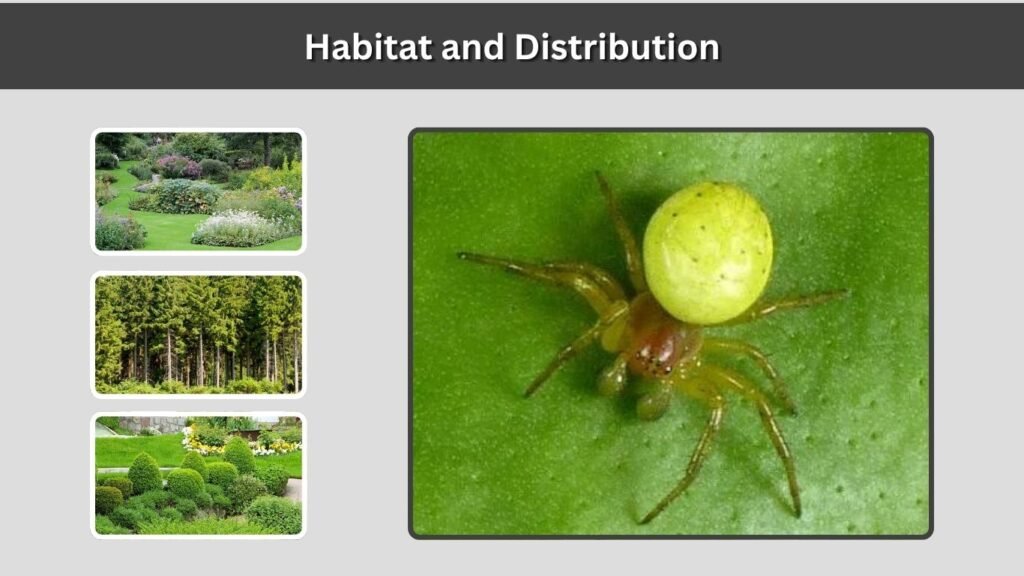
Green orb-weavers are strongly associated with leafy vegetation. Their coloring allows them to remain hidden from predators and prey while resting beneath leaves or beside their webs.
Where Do They Live?
Typical habitats include:
- Gardens and parks
- Woodland edges
- Hedgerows
- Shrubs and bushes
- Tall herbs
- Young trees
- Leafy plants near paths
- Meadows with scattered vegetation
Cucumber spiders often make miniature webs across individual leaves or between closely positioned stems. Their webs can be much smaller and less regular than the large webs produced by familiar garden orb-weavers.
Green Orb-Weaver Spider in the UK and Ireland
In the UK, Araniella cucurbitina and Araniella opisthographa are the most likely spiders associated with this name. Adults are most often noticed from spring through early autumn, particularly when searching trees, bushes, and hedges.
The same general identification approach applies to green orb-weavers found in Ireland. However, photographs should be accompanied by a location because the local range of individual species can differ.
Green Orb-Weaver Spider in South Africa
A South African green orb-weaver may not be the same species found in Europe. SANBI records list Araneus apricus as a green orb-web or green hairy field spider. Other African orb-weavers may also show green coloring, so location is essential before assigning a scientific name.
Web and Hunting Behavior
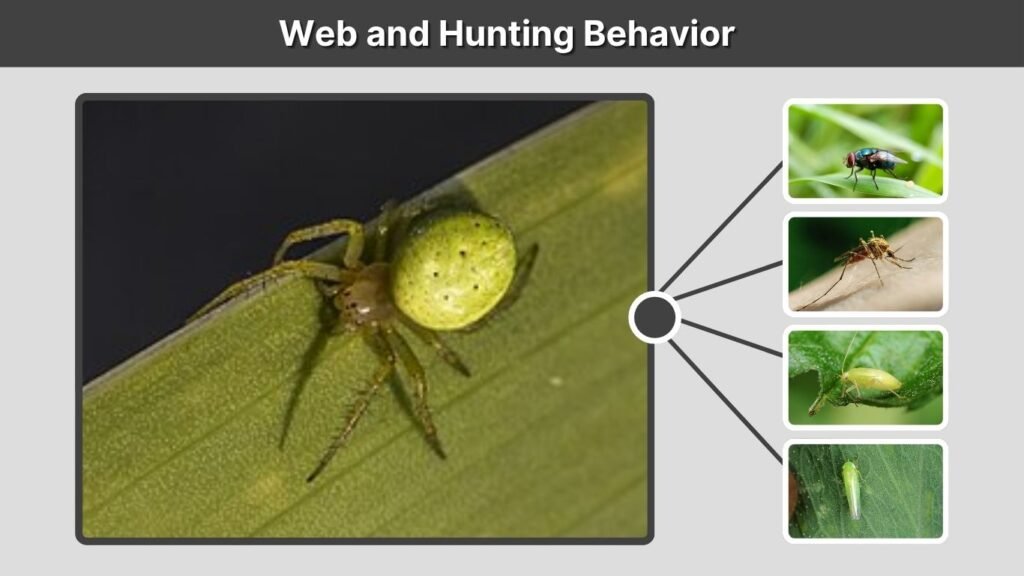
Green orb-weavers usually build webs between leaves, twigs, flowers, or plant stems. The web contains non-sticky radial lines that support a spiral of adhesive silk.
When a flying insect touches the web, vibrations alert the spider. It moves toward the prey, restrains it with silk, and delivers venom through its fangs.
What Does a Green Orb-Weaver Spider Eat?
Its diet commonly includes small insects such as:
- Flies
- Gnats
- Mosquitoes
- Aphids
- Leafhoppers
- Small moths
- Winged ants
- Other tiny garden insects
These spiders can benefit gardens by capturing insects that feed on plants or gather around outdoor areas. They do not eat leaves, flowers, vegetables, or other plant material.
Is the Green Orb-Weaver Spider Poisonous?
Green orb-weavers are venomous rather than poisonous. Venom is injected through fangs, while poison causes harm when touched or eaten.
Their venom is intended for small insect prey and is not regarded as medically important to humans. Orb-weavers are shy spiders that usually remain still, retreat into foliage, or drop from their webs when threatened.
Is the Green Orb-Weaver Spider Dangerous?
The green orb-weaver spider is not considered dangerous to people or pets. It has no interest in approaching humans and is unlikely to bite unless it is squeezed, trapped against the skin, or handled roughly.
Most spiders rarely bite people, and the majority of species are harmless. Individual allergic reactions are possible, but they are uncommon.
What Does a Green Orb-Weaver Spider Bite Feel Like?
Confirmed bites are unusual because these spiders are small and reluctant to defend themselves. A bite could potentially cause:
- Brief localized pain
- Minor redness
- Mild itching
- Temporary swelling
Wash the area with soap and water and avoid scratching it. Seek medical care if pain or swelling continues to worsen, the wound changes significantly, or symptoms such as breathing difficulty, dizziness, vomiting, or widespread hives develop.
Green Orb-Weaver Spider Life Cycle
Females place their eggs inside protective silk sacs attached to leaves, stems, bark, or other sheltered surfaces. The egg sac protects the developing spiderlings from weather and some predators.
Young spiders pass through several molts as they grow. Each molt allows the body and legs to increase in size. Adults eventually reproduce, and the seasonal cycle begins again.
Should You Remove a Green Orb-Weaver?
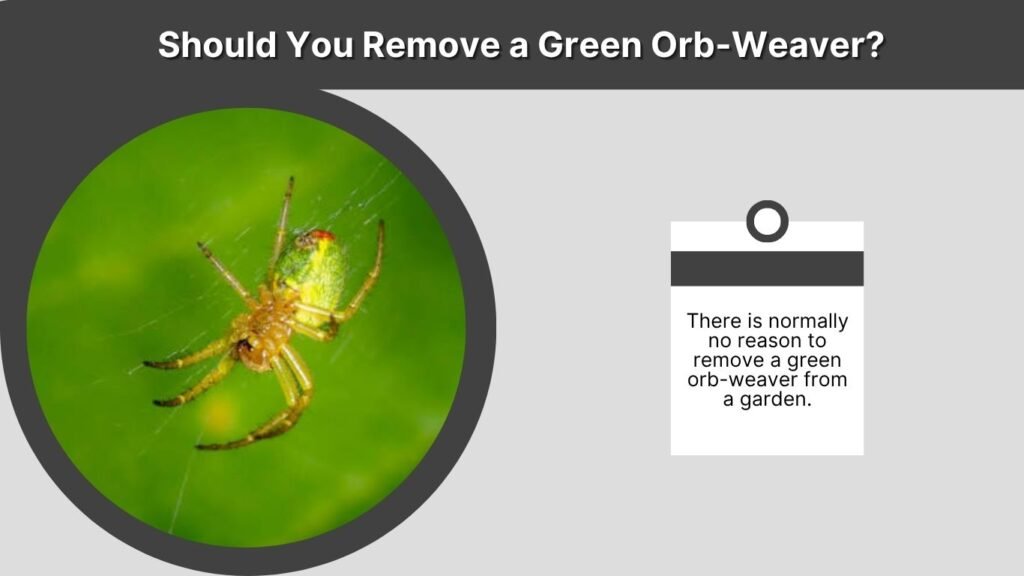
There is normally no reason to remove a green orb-weaver from a garden. It does not damage plants, infest buildings, or threaten people. Its web also captures numerous small insects.
When one enters the house, place a cup over it, slide a piece of paper underneath, and release it onto a leafy shrub. Avoid picking it up with bare hands because its delicate legs and abdomen can be injured.
FAQs
Are Green Orb-Weaver Spiders Rare?
Green orb-weavers can be relatively common in suitable habitats but are frequently overlooked because their bodies blend with leaves. Their small size and miniature webs also make them more difficult to notice than larger garden orb-weavers.
Can a Green Orb-Weaver Spider Bite a Human?
It is physically possible, but bites are extremely uncommon. The spider normally escapes rather than defending itself. A bite is most likely to happen when the spider is accidentally pressed against the skin or deliberately handled.
How Big Is a Green Orb-Weaver Spider?
European cucumber spiders are small. Females may reach approximately 6–8 mm in body length, while males are generally around 5 mm or smaller. Their extended legs make them appear slightly larger.
Why Is the Green Orb-Weaver Spider Green?
Its bright green color provides camouflage among fresh leaves and stems. This helps conceal the spider from birds and other predators while also allowing it to remain less noticeable to insects approaching its web.
Is a Green Orb-Weaver Safe Around Children and Pets?
Yes. These spiders are not considered a significant threat to children, cats, or dogs. However, children should be taught not to handle unfamiliar wildlife, and pets should be prevented from disturbing webs whenever possible.
