
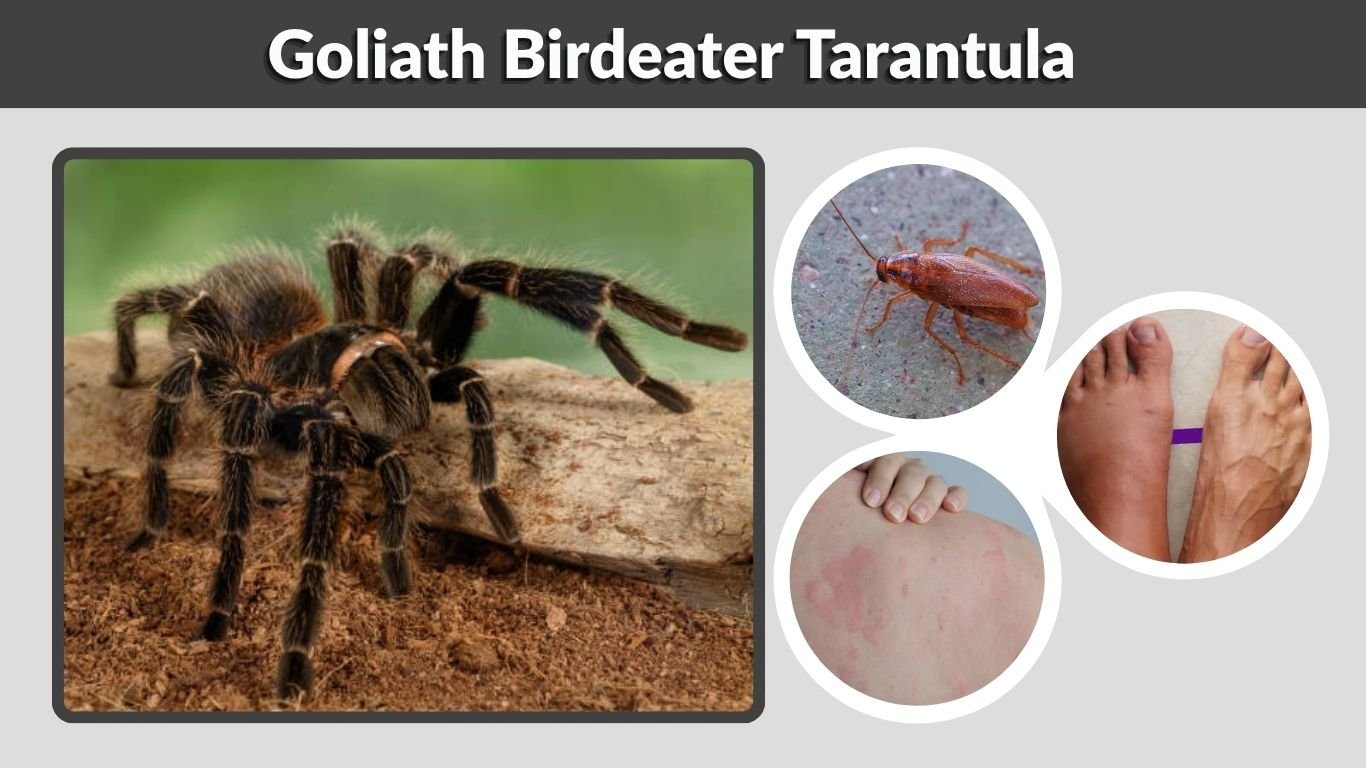
The Goliath birdeater tarantula (Theraphosa blondi) is one of the largest and heaviest spiders in the world. This massive, reddish-brown tarantula lives in the humid rainforests of northern South America, where it hides in deep burrows and hunts mainly at night. Despite its dramatic name, it rarely eats birds. Its usual prey consists of insects, frogs, small rodents, and other animals it can overpower on the forest floor.
Goliath Birdeater Quick Facts
The Goliath birdeater belongs to the tarantula family Theraphosidae. Its accepted scientific name is Theraphosa blondi, and its confirmed native distribution includes Venezuela, Brazil, and Guyana, with broader zoo accounts also including French Guiana and Suriname.
| Feature | Description |
| Scientific name | Theraphosa blondi |
| Family | Theraphosidae |
| Body length | Up to about 4.75 inches |
| Leg span | Up to about 11 inches |
| Weight | Large females may exceed 3.5 ounces |
| Color | Russet brown to nearly black |
| Habitat | Humid South American rainforest |
| Diet | Insects and small vertebrates |
| Activity | Mainly nocturnal |
| Female lifespan | Up to about 20 years |
| Male lifespan | Approximately 3–6 years |
What Does a Goliath Birdeater Look Like?
The Goliath birdeater has a heavy body, thick legs, and dense reddish-brown or dark-brown hairs. Unlike brightly patterned ornamental tarantulas, it generally has an earthy color that blends into wet soil, tree roots, and rainforest leaf litter.
Identification Features
- Thick, muscular, hair-covered legs
- Russet-brown, chocolate-brown, or nearly black body
- Large abdomen and broad carapace
- Leg span approaching 11 inches
- Downward-pointing fangs
- Defensive hairs on the abdomen
- Distinct spines on the third and fourth pairs of legs
- Four pairs of walking legs
- Two shorter pedipalps near the mouth
The spider’s chelicerae contain its fangs and venom, while its pedipalps help it sense and manipulate food. Males also use modified pedipalps during reproduction.
How Big Is a Goliath Birdeater Tarantula?
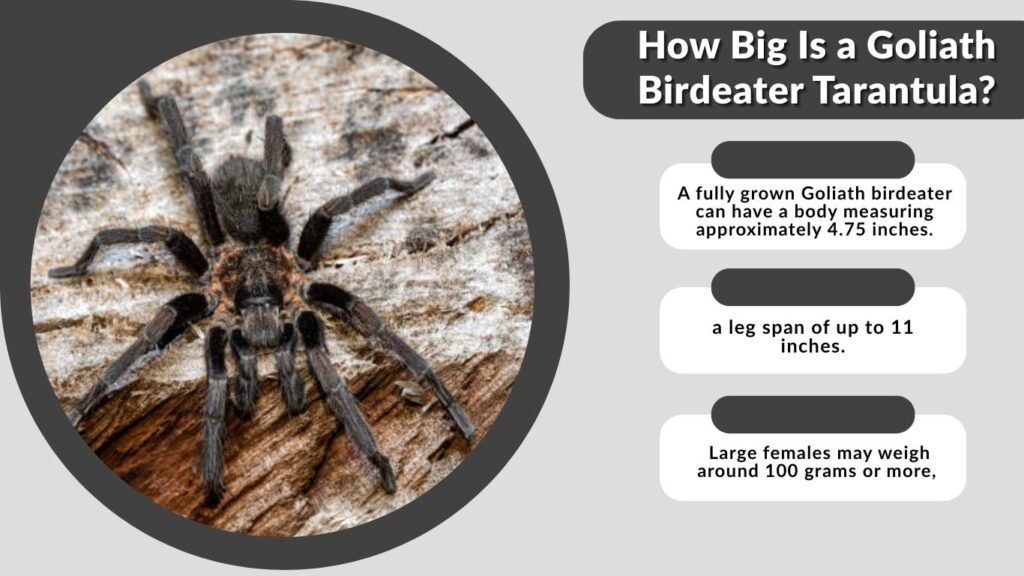
A fully grown Goliath birdeater can have a body measuring approximately 4.75 inches and a leg span of up to 11 inches. Large females may weigh around 100 grams or more, making this species the world’s heaviest spider.
The giant huntsman spider may occasionally exceed it in leg span, but the Goliath birdeater has a heavier, bulkier body. Female Goliath birdeaters are generally larger and more robust than males because females must produce and carry eggs.
Where Do Goliath Birdeaters Live?
Goliath birdeaters inhabit the humid rainforests of northern South America. They are associated with Venezuela, northern Brazil, Guyana, French Guiana, and Suriname. These spiders live at ground level rather than building aerial webs in trees.
Habitat and Burrows
A Goliath birdeater usually shelters inside a silk-lined burrow beneath rocks, roots, fallen logs, or dense vegetation. It may enlarge an existing animal burrow instead of excavating an entirely new one.
The burrow protects the tarantula from predators, temperature changes, and moisture loss. The spider generally remains hidden during daylight and emerges after dark to wait for passing prey.
What Does a Goliath Birdeater Eat?
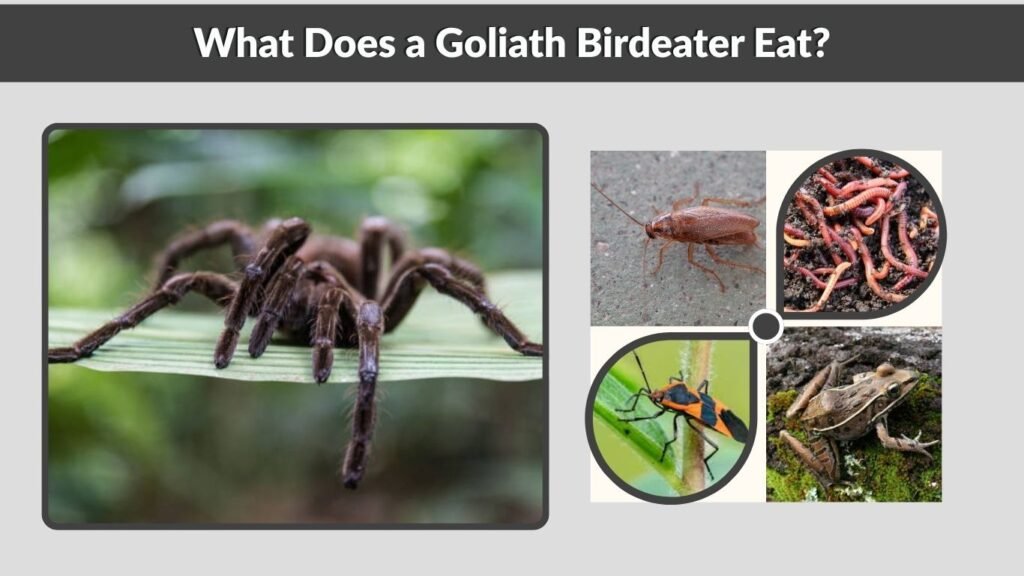
Although it can capture a small bird, birds are not a regular part of its diet. The name originated from historical illustrations and observations that emphasized the spider’s ability to overpower vertebrates.
Common Foods
The Goliath birdeater may eat:
- Cockroaches
- Crickets
- Beetles and other large insects
- Worms
- Frogs
- Small lizards
- Small snakes
- Mice and other tiny rodents
- Other spiders
- Occasional small birds
Insects probably form most of its normal diet, although a large individual can capture almost any appropriately sized animal that comes close to its burrow. Smithsonian tarantulas are commonly fed cockroaches in managed care.
How It Hunts
The Goliath birdeater does not build a large web to trap prey. It is an ambush predator that detects movement through sensitive hairs on its legs and body.
When prey approaches, the spider rushes forward, grabs it, and drives its downward-facing fangs into the animal. Venom and digestive fluids immobilize the prey and begin breaking down its internal tissues. Because spiders cannot consume solid pieces of food, the tarantula drinks the liquefied material.
Is the Goliath Birdeater Venomous?
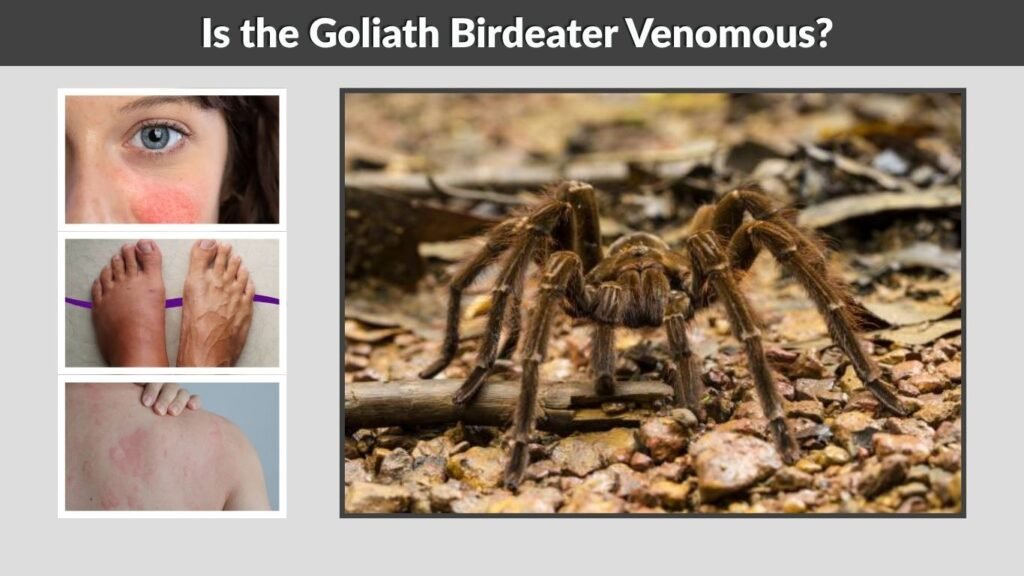
The Goliath birdeater is venomous, not poisonous. It delivers venom through its fangs when capturing prey. However, its venom is not generally considered dangerous to a healthy human.
A bite could still be extremely painful because the spider has large fangs capable of creating deep puncture wounds. Pain, redness, swelling, or infection may follow, and an allergic reaction is possible. The spider normally prefers to retreat or use warning displays rather than bite.
Urticating Hairs
The defensive hairs are often a greater concern than the venom. When threatened, the tarantula can rub its abdomen and release clouds of tiny barbed hairs.
These hairs may cause intense itching, redness, and irritation when they contact skin. Exposure around the eyes or respiratory system can be more serious. Handling should therefore be avoided, even when an individual appears calm.
How Does It Defend Itself?
A threatened Goliath birdeater may begin by retreating toward its burrow. When escape is impossible, it has several defensive options.
It can rear up and display its large fangs, kick urticating hairs from its abdomen, or produce a loud hissing sound called stridulation. The spider creates this sound by rubbing specialized bristles on its legs together. Smithsonian reports that the sound may be audible from as far as 15 feet away.
Goliath Birdeater Lifespan
Females live much longer than males. A female may survive for up to approximately 20 years, while males generally live around three to six years.
Males mature earlier and often die within months after mating. Females continue growing through molts and may reproduce more than once during their much longer adult lives.
Reproduction and Life Cycle
After mating, a female creates a silk egg sac containing approximately 50–200 eggs. The egg sac may be nearly as large as a tennis ball, although the number of successfully developing spiderlings varies.
Unlike many tarantulas, the female may carry and guard the egg sac. She can also incorporate irritating hairs into its silk as protection. Young spiders grow by repeatedly shedding their exoskeletons and may take approximately two to three years to reach maturity.
Can You Keep a Goliath Birdeater as a Pet?
The Goliath birdeater can be kept in managed care, but it is not a good beginner tarantula. Its enormous size, defensive hairs, strong feeding response, moisture requirements, and powerful fangs make it more suitable for an experienced keeper.
Basic Care Requirements
An enclosure should emphasize floor space rather than climbing height because this is a heavy terrestrial species. A deep layer of suitable substrate should allow burrowing, while a secure hide provides shelter.
Its rainforest origin means the enclosure must retain moisture without becoming stagnant or waterlogged. Good ventilation is essential, and a shallow water dish should always be available. The enclosure must also close securely.
Live insects such as appropriately sized cockroaches or crickets can form the captive diet. Vertebrate prey is unnecessary and can injure the tarantula or create sanitation problems.
Handling and Safety
Routine handling is strongly discouraged. A fall from even a modest height can rupture a tarantula’s abdomen, while handling also exposes the keeper to fangs and defensive hairs.
Use long tools when removing uneaten prey or maintaining the enclosure. Keep the spider away from children, pets, and anyone with respiratory or eye sensitivity.
Goliath Birdeater vs. Other Tarantulas
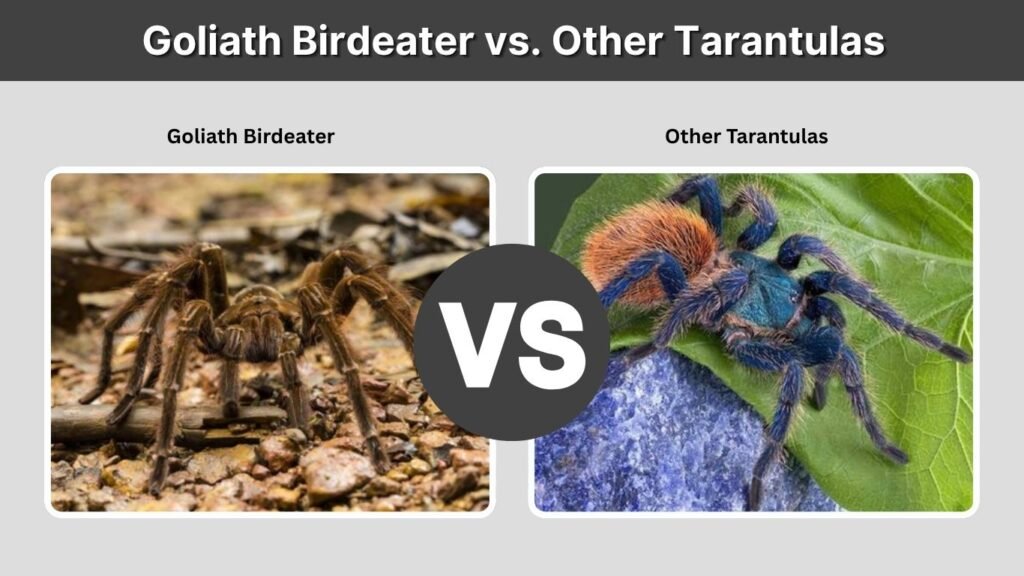
“Goliath birdeater” should properly refer to Theraphosa blondi, although related species are sometimes sold under similar common names. The genus Theraphosa currently includes T. blondi, T. apophysis, T. stirmi, and T. spinipes.
| Feature | Goliath birdeater | Typical pet tarantula |
| Maximum size | Exceptionally large | Small to moderately large |
| Temperament | Often defensive | Varies by species |
| Defensive hairs | Strongly irritating | Varies |
| Moisture needs | Relatively high | Depends on origin |
| Handling suitability | Poor | Some are calmer |
| Keeper level | Experienced | Beginner to advanced |
Buying a Goliath Birdeater
Availability and price vary according to size, sex, country, and whether the spider is captive-bred. Females generally cost more because they live longer and retain breeding value.
Before purchasing, confirm that local law allows private ownership and that the seller can identify the species accurately. Choose a legally sourced, captive-bred animal rather than supporting unnecessary collection from the wild. Some tarantula populations have been harmed by overcollection for the pet trade.
FAQs
Can a Goliath birdeater kill a human?
Its venom is not considered deadly to healthy people, but a bite can be painful and create deep punctures. Defensive hairs may also cause significant irritation, particularly if they enter the eyes or airways.
Does the Goliath birdeater really eat birds?
It can capture small birds, but it does not eat them regularly. Insects form most of its natural diet, supplemented by frogs, small reptiles, rodents, and other appropriately sized animals.
How large can a Goliath birdeater get?
Its body may reach approximately 4.75 inches, while its leg span can approach 11 inches. Large females may weigh around 100 grams or more.
Does the Goliath birdeater make a sound?
Yes. When threatened, it can rub specialized leg bristles together to produce a noticeable hissing sound called stridulation.
Is a Goliath birdeater suitable for beginners?
No. Its large size, defensive behavior, irritating hairs, strong feeding response, and specialized enclosure needs make it more appropriate for experienced tarantula keepers.
