
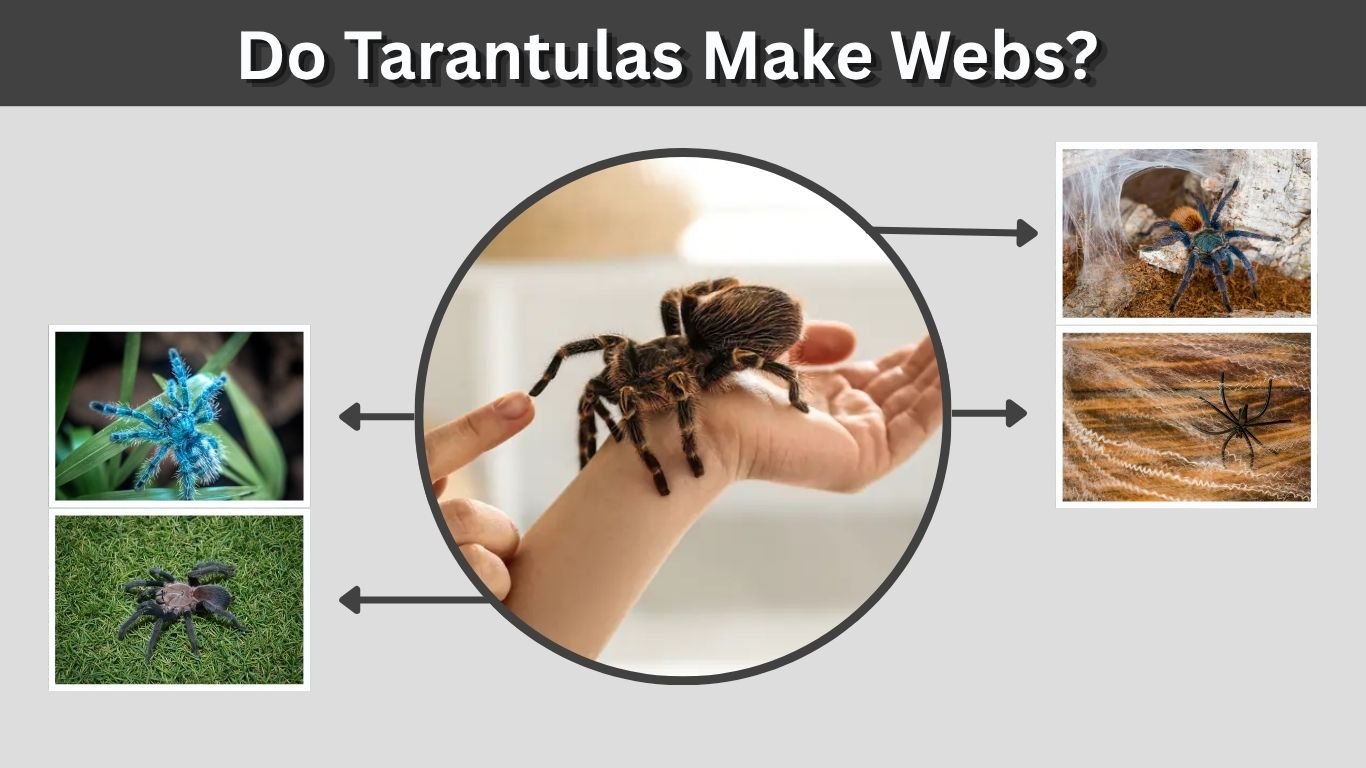
Yes, tarantulas make webs, but their webs are different from the large, sticky structures created by orb-weaver and house spiders. Tarantulas rarely depend on webs to trap flying insects. Instead, they use silk to line burrows, create shelters, detect nearby prey, protect eggs, and prepare safe places for molting. The amount and appearance of webbing depend on the tarantula’s species, age, environment, and individual behavior.
Do Tarantulas Spin Webs?
All tarantulas can produce silk. They release it through specialized structures called spinnerets, which are located at the rear of the abdomen. A tarantula can control the placement of its silk as it walks around its enclosure or natural habitat.
Unlike many familiar spiders, tarantulas normally hunt by ambushing prey rather than waiting for an insect to become trapped in a sticky web. Their silk is primarily used for construction, protection, communication, and detecting movement.
Some tarantulas place only a thin layer of silk around their shelter. Others cover much of their habitat with thick sheets, tunnels, and curtains of webbing.
| Webbing behavior | Main purpose |
|---|---|
| Lining a burrow | Strengthens the walls and creates a secure retreat |
| Building a silk tunnel | Provides protection and concealed movement |
| Creating trip lines | Detects approaching prey or predators |
| Making a molting mat | Produces a clean surface for shedding |
| Constructing an egg sac | Protects developing eggs |
| Building a sperm web | Allows a mature male to prepare for mating |
| Covering an entrance | Provides privacy or regulates the burrow |
Why Don’t Tarantulas Build Traditional Spiderwebs?
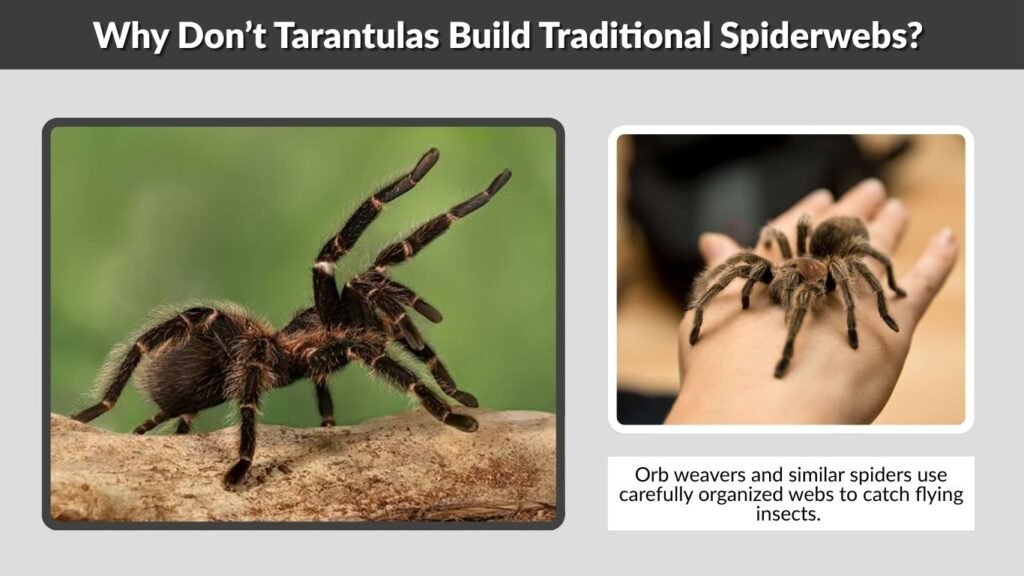
Orb weavers and similar spiders use carefully organized webs to catch flying insects. These webs contain specialized silk strands that trap prey until the spider can reach it.
Most tarantulas are large, heavy-bodied hunters that live on or beneath the ground. Others occupy trees and hide behind bark. Their bodies and lifestyles are not designed for sitting in delicate aerial webs.
Instead, a tarantula waits near a burrow, beneath a log, or inside a webbed retreat. When an insect comes within range, the tarantula detects its vibrations, rushes forward, and grabs it with its front legs and pedipalps.
The tarantula then uses its fangs to deliver venom that immobilizes the prey. Digestive fluids liquefy the prey’s internal tissues, allowing the spider to consume the resulting liquid.
How Tarantulas Use Their Webs
Tarantula silk performs several important functions. Some uses are visible throughout the spider’s life, while others appear only during molting or reproduction.
Lining and Strengthening Burrows
Terrestrial and fossorial tarantulas frequently line the inside of their burrows with silk. This silk helps stabilize loose soil and reduces the chance of the walls collapsing.
The webbed surface may also help the tarantula detect movement outside the burrow. Vibrations caused by an approaching insect can travel through the silk to the waiting spider.
A tarantula may extend webbing around the burrow entrance, producing a flat mat across the nearby ground. These strands function as an early-warning system for both prey and potential predators.
Creating Secure Shelters
Arboreal tarantulas live above the ground in trees, bark crevices, and hollow branches. Many create silk-lined tubes behind cork bark or between leaves.
These web tunnels offer a protected place in which the spider can rest, eat, and molt. Some arboreal species use soil, moss, leaves, and pieces of bark to reinforce their webbed shelter.
In captivity, an arboreal tarantula may build its retreat high in the enclosure. It can create dense silk curtains between the enclosure wall and a vertical piece of cork bark.
Detecting Prey
Tarantulas have limited eyesight and depend heavily on vibrations. Their legs contain sensitive hairs and sensory organs that help them detect movements in the ground, air, and silk around them.
Silk placed near a burrow entrance effectively extends the tarantula’s sensory range. When a cricket, cockroach, or other insect walks across the webbing, the vibrations alert the hidden spider.
The web itself usually does not hold the prey. Instead, it tells the tarantula where the potential meal is located, allowing it to launch a rapid ambush.
Making a Molting Mat
Before molting, many tarantulas create a thick silk mat. The mat provides a clean, relatively stable surface on which the spider can shed its old exoskeleton.
A terrestrial tarantula may place the mat directly on the substrate. An arboreal species may molt inside a suspended silk retreat.
The spider commonly lies on its back or side during the molt. This position is normal and should not be mistaken for death. The tarantula must not be touched, moved, or fed while it is shedding.
Some tarantulas incorporate their irritating urticating hairs into the molting mat. These hairs may help protect the vulnerable spider against predators and other disturbances.
Protecting Eggs
A female tarantula uses silk to construct an egg sac. She deposits her eggs on a sheet of silk, fertilizes them, and carefully wraps them inside several protective layers.
Depending on the species and the female’s condition, one egg sac may contain dozens or hundreds of eggs. The mother may guard the sac inside her burrow and periodically turn or reposition it.
The silk helps protect the developing eggs from physical damage and changing environmental conditions. However, the female may abandon or consume the egg sac if she experiences severe stress or unsuitable conditions.
Preparing for Mating
A mature male tarantula creates a special structure known as a sperm web. This web is usually a small sheet or tent-shaped construction rather than a permanent shelter.
The male deposits sperm onto the web and then transfers it into specialized structures on the ends of his pedipalps. He later uses these structures to transfer sperm to a receptive female.
After loading his pedipalps, the male may leave his shelter and begin searching for a mate. In captivity, increased wandering and climbing often indicate that a male has reached sexual maturity.
Different Types of Tarantula Webbing
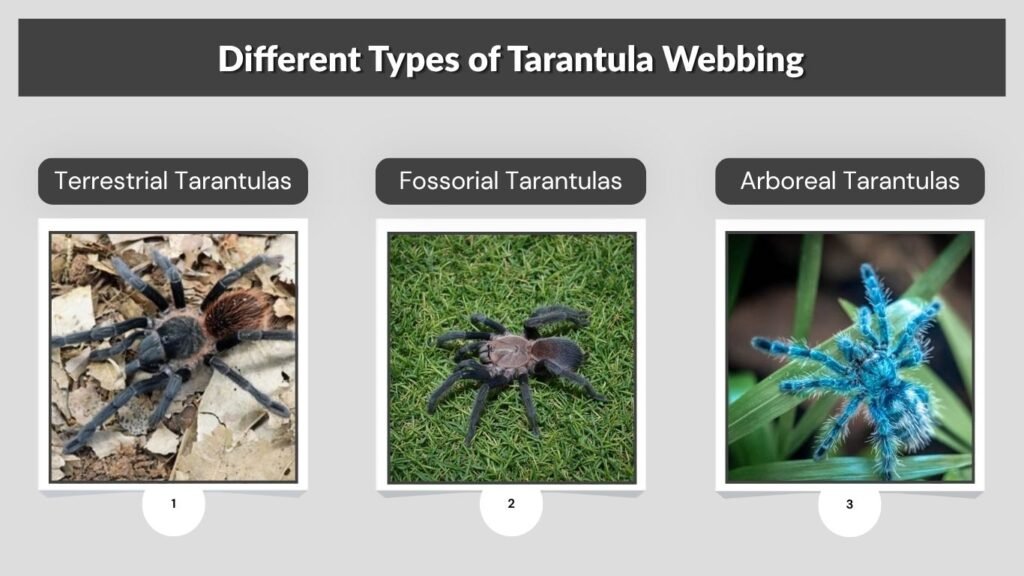
Not every tarantula produces the same amount of silk. Webbing behavior is strongly connected to its natural lifestyle.
Terrestrial Tarantulas
Terrestrial tarantulas spend most of their time on the ground. They usually create a burrow beneath a rock, piece of wood, or other shelter.
Many terrestrial species place a light layer of silk over the substrate and around their hides. Mexican red-knee, Brazilian black, and Arizona blonde tarantulas may produce noticeable webbing, but they usually do not cover their entire enclosure.
Individual behavior varies. One spider may heavily web its habitat, while another member of the same species may use very little silk.
Fossorial Tarantulas
Fossorial tarantulas are specialized burrowers that spend most of their lives underground. They often produce extensive silk inside their tunnels.
The silk stabilizes the soil and creates a sensitive surface that communicates vibrations. Some fossorial species cover the entrance with webbing, soil, leaves, or other available materials.
Owners may rarely see the entire spider. It may remain hidden and rush to the burrow entrance only when it detects prey.
Arboreal Tarantulas
Arboreal tarantulas live above ground and frequently create webbed tubes behind tree bark or between branches. Their silk retreats can be more visible and complex than those made by terrestrial species.
Pink-toe tarantulas commonly construct elevated web tunnels. Ornamental tarantulas in the Poecilotheria genus also use silk inside vertical retreats, although they may rely heavily on narrow bark crevices for security.
Arboreal enclosures should contain cork bark, branches, artificial leaves, and other anchor points that allow the spider to create a suitable shelter.
Heavy-Webbing Tarantulas
Certain tarantulas are famous for transforming their enclosures with thick sheets and tunnels of silk. Examples include the Greenbottle blue tarantula and several species in the Chilobrachys, Harpactira, and Monocentropus genera.
A heavy-webbing tarantula may cover the substrate, water dish, decorations, and enclosure walls. This is natural behavior and generally should not be removed unless the webbing has become contaminated.
Why Is My Tarantula Not Making a Web?
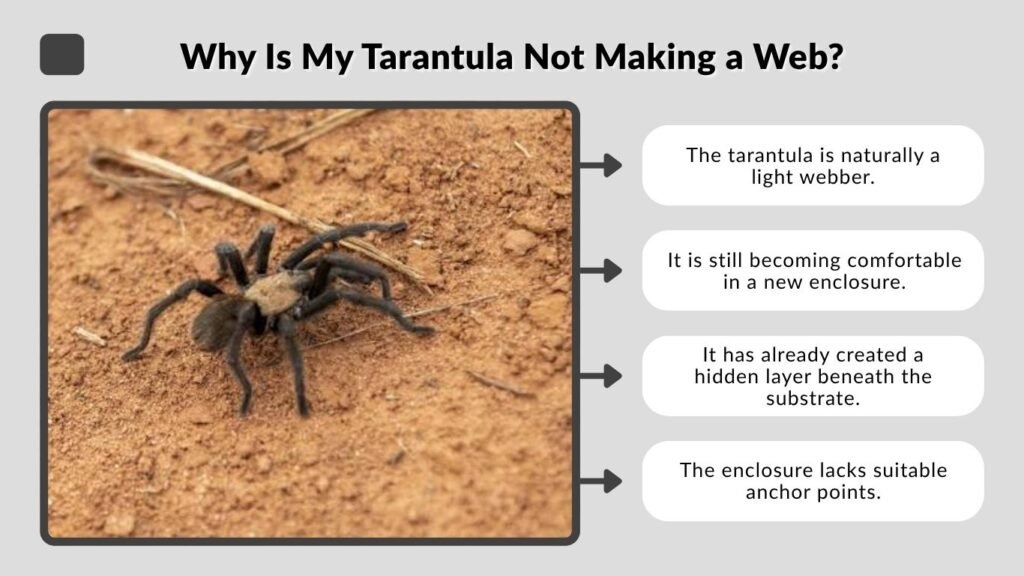
A lack of visible webbing does not necessarily indicate a health problem. Some species naturally use much less silk than others.
Possible explanations include:
- The tarantula is naturally a light webber.
- It is still becoming comfortable in a new enclosure.
- It has already created a hidden layer beneath the substrate.
- The enclosure lacks suitable anchor points.
- It prefers to dig rather than build exposed webbing.
- Recent cleaning removed established silk.
- The spider is preparing for a period of inactivity.
A tarantula may take several days or weeks to settle after being rehoused. Avoid repeatedly changing decorations or disturbing its shelter.
Providing the correct enclosure structure is more important than attempting to force webbing behavior. Terrestrial species need deep substrate and a ground-level hide, while arboreal species need vertical bark and elevated hiding places.
Why Is My Tarantula Webbing More Than Usual?
A sudden increase in webbing can have several explanations. The spider may simply have become comfortable and started arranging its surroundings.
Heavy webbing can also indicate that the tarantula is:
- Preparing to molt
- Constructing or strengthening a burrow
- Creating a feeding area
- Closing its shelter entrance
- Preparing an egg sac
- Producing a sperm web
- Responding to changes in its environment
A tarantula may seal its burrow with silk and soil before molting. Do not dig it out or reopen the entrance. It may remain hidden for weeks or months, especially if it is a slow-growing adult.
Continue providing clean water and avoid placing live prey inside a sealed burrow.
Should You Remove Tarantula Webbing?
Healthy, clean webbing should usually be left in place. It represents a significant amount of work and forms an important part of the tarantula’s shelter and sensory environment.
Removing it unnecessarily can cause stress and leave the spider exposed. Routine enclosure maintenance should focus on cleaning the water dish and removing uneaten prey, waste, and spoiled food remains.
Webbing may need to be disturbed when:
- Mold is spreading through the enclosure.
- The substrate is badly contaminated.
- A large prey carcass is trapped inside it.
- Mites or other pests are present.
- The enclosure must be replaced for safety.
- The tarantula requires emergency relocation.
When maintenance is necessary, use long tools and carefully monitor the tarantula’s position. Never pull webbing directly from beneath the spider.
Webbing After Feeding
A tarantula may place silk around its prey while eating. It can rotate in a circle and spread webbing across the feeding area, creating what keepers sometimes call a food mat.
The spider may use this surface to contain pieces of prey or keep its meal away from loose substrate. This behavior does not mean that it is wrapping prey in exactly the same way as many web-building spiders.
After feeding, the tarantula usually leaves a small, compact ball of indigestible material. Remove this food remains when it can be reached without destroying the spider’s shelter.
Tarantula Webs vs. Traditional Spiderwebs
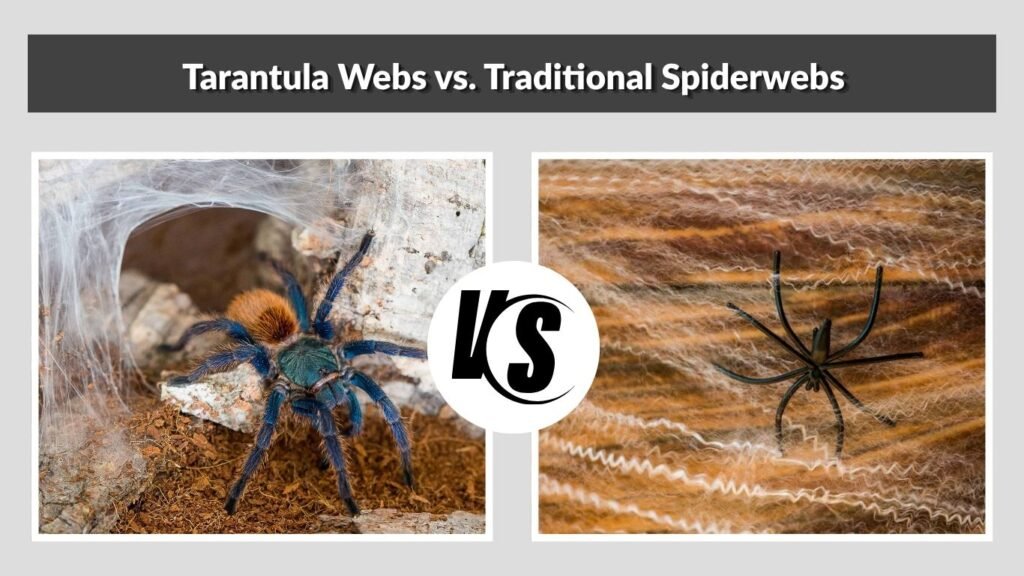
| Feature | Tarantula web | Orb-weaver web |
|---|---|---|
| Primary purpose | Shelter, sensing, molting, and reproduction | Capturing flying insects |
| Common shape | Mat, tunnel, sheet, or burrow lining | Circular or wheel-shaped web |
| Location | Ground, burrows, bark, and tree cavities | Between branches and other supports |
| Does it trap prey? | Usually not directly | Yes |
| Used as a permanent home? | Often | Sometimes |
| Webbing amount | Varies considerably by species | Usually extensive and organized |
FAQs
Do tarantulas catch insects in webs?
Most tarantulas do not trap insects in sticky webs. They are ambush predators that detect vibrations and rush toward nearby prey. Silk around a burrow entrance may alert the spider to an insect, but the tarantula captures it physically.
Do all tarantulas produce silk?
Yes, all tarantulas can produce silk through spinnerets located at the rear of the abdomen. However, the amount used varies between species and individuals. Some produce only thin layers, while heavy-webbing species create extensive sheets and tunnels.
Why did my tarantula cover its enclosure with webbing?
Heavy webbing can be normal behavior. The tarantula may be establishing a shelter, preparing to molt, creating trip lines, or arranging its environment. Avoid removing clean webbing because it provides security and helps the spider detect vibrations.
Why did my tarantula close its burrow with a web?
A tarantula may seal its burrow when preparing to molt, seeking privacy, or responding to environmental changes. Do not reopen the burrow or dig out the spider. Keep water available and wait for it to emerge naturally.
Is tarantula silk dangerous to humans?
The silk itself is not generally dangerous. However, webbing from many New World tarantulas may contain irritating urticating hairs. Avoid touching it with bare hands, wash after maintenance, and never touch your eyes while working around the enclosure.
