
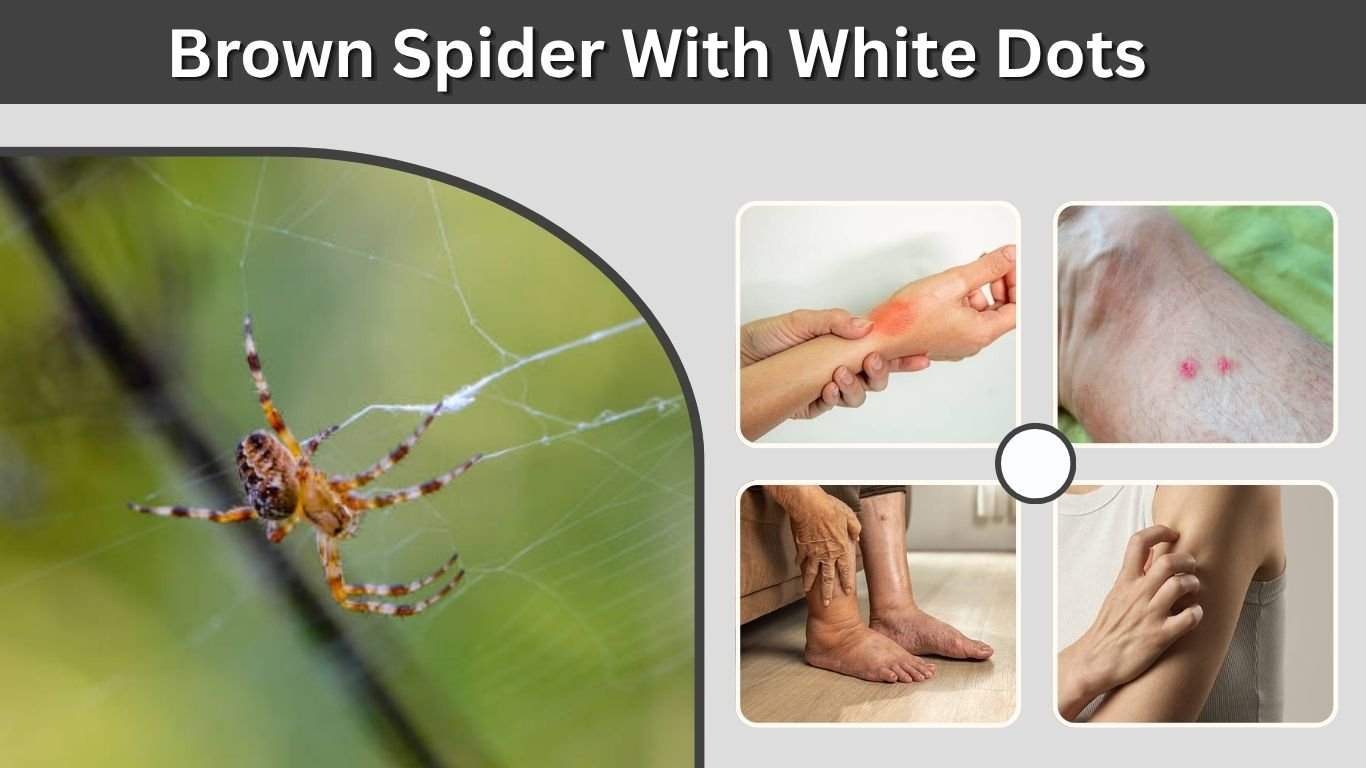
Finding a brown spider with white dots on its back or belly can make identification difficult. Many unrelated spider species have brown bodies and pale spots, and their colors may change with age, sex, lighting, or recent molting. Common possibilities include orb-weavers, jumping spiders, cobweb spiders, and wolf spiders. Most are harmless to people, but accurate identification requires examining the spider’s body shape, web, location, and markings.
What Is a Brown Spider With White Dots?
“Brown spider with white dots” is a visual description rather than the name of one particular species. Numerous spiders can appear brown, reddish-brown, tan, or nearly black while carrying cream, silver, gray, or white markings.
The dots may appear on the spider’s upper abdomen, underside, head, or legs. Some spiders have only one noticeable spot, while others display two, three, four, or several dots.
Examine the Body Shape
The spider’s overall shape provides more useful information than color alone.
- Large, rounded abdomen: Often an orb-weaver or cobweb spider
- Compact body and large front eyes: Usually a jumping spider
- Long legs and flattened body: Possibly a fishing or nursery web spider
- Strong, hairy legs: May be a wolf spider
- Small body in an irregular web: Often a cobweb spider
Look at the Web
Web structure can quickly narrow down the possibilities. Orb-weavers create organized, wheel-shaped webs, usually outdoors. Cobweb spiders make messy, three-dimensional webs in corners, sheds, garages, and beneath outdoor furniture.
Jumping spiders and wolf spiders do not use webs to capture prey. They actively hunt insects and may be seen walking across walls, fences, floors, or plants.
Note Where the Dots Appear
White dots on the back are usually natural abdominal markings. Pale dots on the underside may be markings surrounding the spider’s book lungs, spinnerets, or reproductive structures.
Light reflecting from short hairs can also create temporary white-looking spots. For this reason, photographs taken with a flash may make a spider appear more heavily spotted than it does in normal light.
Common Brown Spiders With White Dots
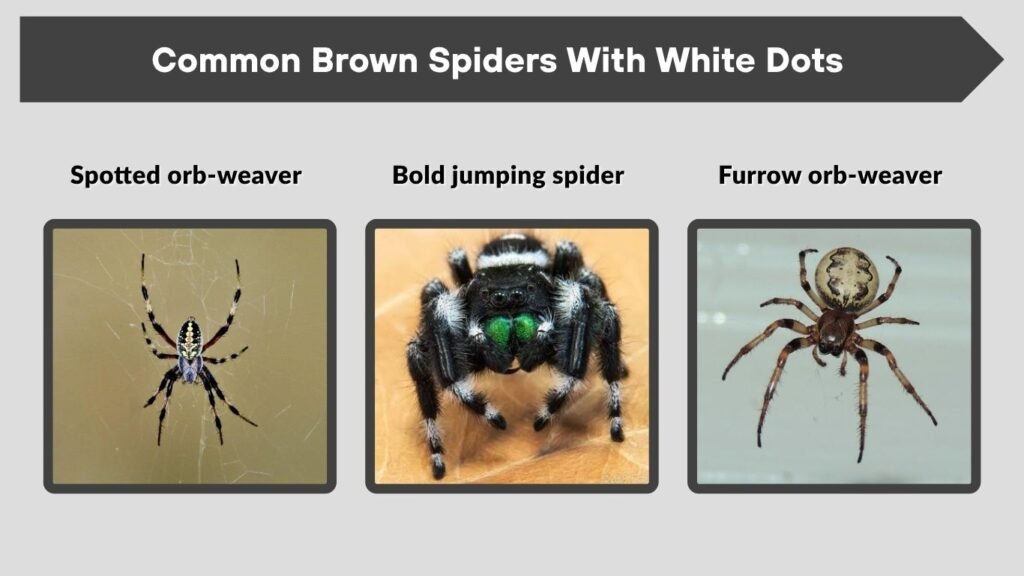
Several common spider groups may match this description. Their appearance can vary considerably, so no spider should be identified from one marking alone.
| Possible spider | Typical appearance | Common location | Risk to people |
| Spotted orb-weaver | Brown or reddish abdomen with pale spots | Gardens, porches and forests | Low |
| Bold jumping spider | Black or brown body with white abdominal spots | Walls, fences and windows | Low |
| Furrow orb-weaver | Brown patterned body with pale dots or lines | Near buildings and vegetation | Low |
| Cobweb spider | Mottled brown abdomen with cream markings | Homes, garages and sheds | Low |
| Wolf spider | Brown, hairy body with pale markings | Ground, basements and gardens | Low |
Spotted Orb-Weavers
Spotted orb-weavers are among the strongest possibilities, especially when the spider is large and sits in a circular web at night. Many have brown, rust-colored, or orange bodies with pale spots arranged across the abdomen.
These spiders commonly build webs near porch lights, trees, fences, and garden plants. They may hide during the day and rebuild or repair their webs after sunset.
Although their size can look intimidating, spotted orb-weavers are not considered dangerous. They usually retreat or drop from the web when disturbed.
Bold Jumping Spiders
Bold jumping spiders are normally recognized by their compact bodies, quick movements, and large forward-facing eyes. Adults are often black, but juveniles and some individuals may appear dark brown or reddish-brown.
Their abdomens commonly have one large central spot and two smaller spots. The spots can be bright white, cream, yellow, or orange depending on the spider’s age.
Jumping spiders do not create capture webs. They stalk flies, moths, mosquitoes, and other small arthropods before jumping onto them.
Furrow Orb-Weavers
Furrow orb-weavers have rounded abdomens covered with dark patterns, wavy lines, pale patches, and occasional white dots. Their legs are frequently banded with light and dark colors.
They build circular webs around porches, barns, bridges, windows, and vegetation. During daylight, the spider may hide in a crack or folded leaf connected to its web by a signal thread.
Common Cobweb Spiders
Common house or cobweb spiders are highly variable. Their abdomens may be tan, gray, brown, or nearly black, with irregular pale spots and streaks.
They are usually found in tangled webs around windows, ceiling corners, garages, storage areas, and outdoor structures. These spiders help reduce populations of flies, mosquitoes, ants, and other household pests.
Brown Spider With White Dots on Its Back
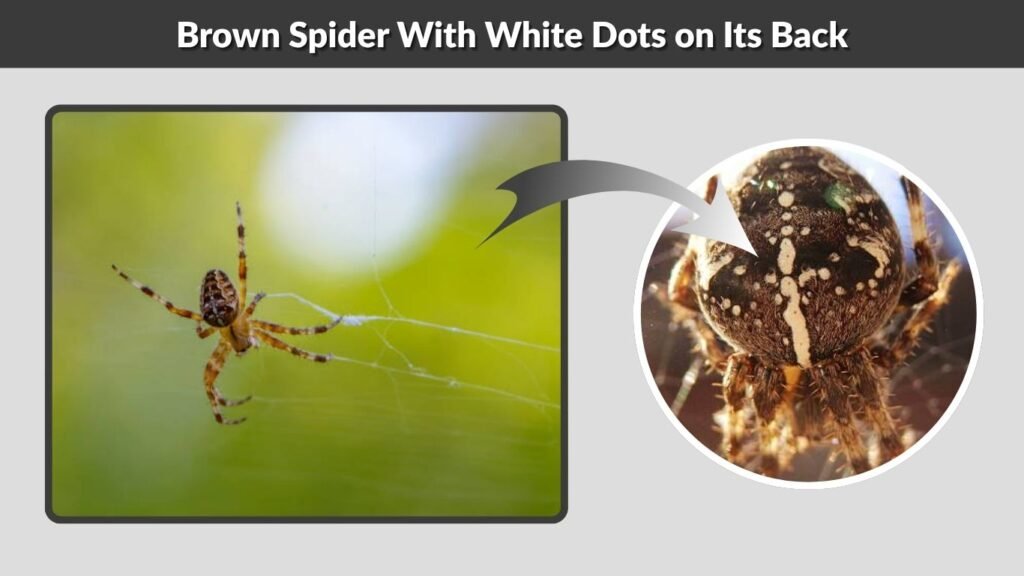
A brown spider with white dots on its back is often an orb-weaver or jumping spider. The arrangement of the dots can provide additional clues, but patterns vary within individual species.
One White Dot
A single white dot may be part of a larger pattern that has faded or become difficult to see. Some jumping spiders have a large central abdominal spot, while small orb-weavers may have one especially noticeable pale marking.
Check whether the spider has large front eyes and moves in short jumps. Those features strongly suggest a jumping spider.
Two or Three White Dots
Three abdominal spots are commonly associated with several jumping spiders. The typical arrangement includes one larger central spot and two smaller spots behind it.
Two white dots can also occur on the underside of orb-weavers and cobweb spiders. Identifying the spider requires determining whether the spots are truly on the back or visible through the side of the abdomen.
Four or More White Dots
Four, six, or numerous pale dots are common among patterned orb-weavers. These spiders frequently have large abdomens and banded legs.
A spider found in the center of a wheel-shaped web is almost certainly an orb-weaver, regardless of the exact number of spots.
Brown Spider With White Dots on Its Belly
Seeing two or four white dots underneath a spider can be confusing. The underside is less commonly photographed, and ordinary anatomical features may be mistaken for unusual markings.
Book Lungs and Natural Markings
Spiders breathe through structures called book lungs. The openings are located on the underside of the abdomen and may be surrounded by light patches. These paired areas can resemble two white dots.
Some orb-weavers also have symmetrical cream, yellow, or white markings on the belly. The shape may look like dots, brackets, curved lines, or a partial cross.
Could It Be a Widow Spider?
Juvenile widow spiders can be brownish and may have pale markings. However, widow identification should not be based only on white dots. Mature females usually have a glossy, rounded abdomen and a red or orange hourglass-shaped marking underneath.
Avoid handling any round-bodied spider in a tangled web when its identity is uncertain. Use a container to relocate it without direct contact.
Is a Brown Spider With White Dots Dangerous?
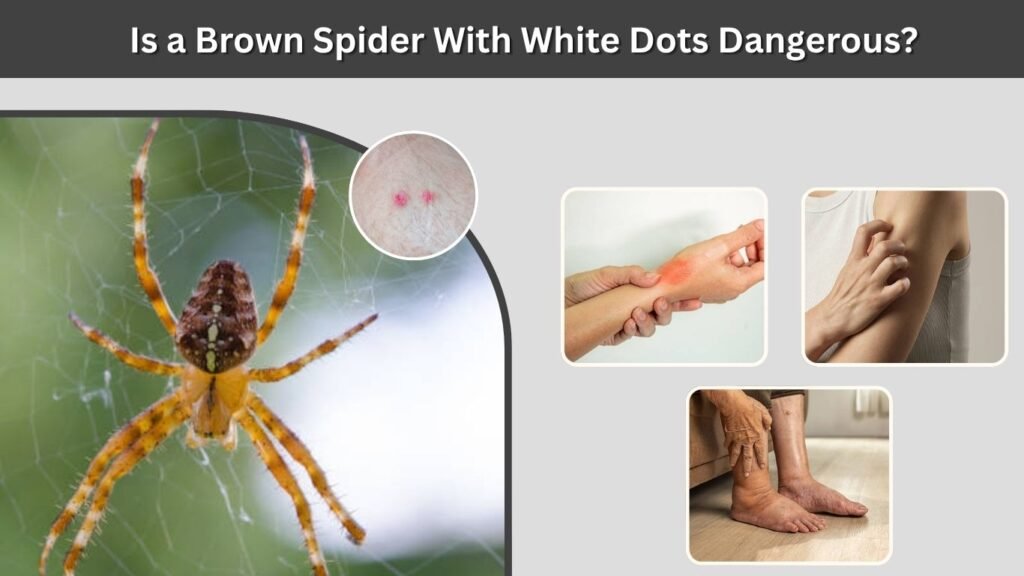
Most brown spiders with white dots are not medically significant. Orb-weavers, jumping spiders, wolf spiders, and common cobweb spiders generally bite only when trapped against the skin or handled roughly.
A typical minor spider bite may cause temporary pain, redness, itching, or localized swelling. Serious symptoms are uncommon but require medical attention.
Is It a Brown Recluse?
A brown recluse does not normally have distinct white dots covering its abdomen. It is generally plain tan to brown, with an unpatterned abdomen and a darker violin-like marking near the front of the body.
Many harmless spiders are incorrectly labeled as brown recluses simply because they are brown. A clearly spotted, hairy, heavily patterned, or banded spider is less likely to be a brown recluse.
When to Seek Medical Care
Seek medical advice when a suspected spider bite causes:
- Severe or worsening pain
- Rapidly spreading redness or swelling
- Muscle cramps or heavy sweating
- Difficulty breathing
- Vomiting, dizziness or weakness
- A darkening wound or damaged skin
- Signs of an allergic reaction
Children, older adults, and people with serious allergies may require faster evaluation.
How to Identify the Spider Accurately
Photograph the spider from a safe distance instead of attempting to pick it up. Useful photographs should show the top, underside if safely visible, legs, eyes, and surrounding web.
Record where it was found, its approximate size, whether it jumped, and what kind of web it occupied. Geographic location is especially important because spider species differ between regions.
A local university extension office, natural history museum, pest-control professional, or experienced arachnid identification group may be able to confirm the species from clear photographs.
FAQs
What is the most common brown spider with white dots?
Spotted orb-weavers and jumping spiders are two common possibilities. Orb-weavers have rounded abdomens and circular webs, while jumping spiders have compact bodies, prominent front eyes, and quick movements. Location, body shape, web type, and spot arrangement are needed for reliable identification.
Are brown spiders with white dots poisonous?
Spiders are venomous rather than poisonous because they inject venom through their fangs. Most brown spiders with pale spots have venom designed for small prey and are not dangerous to humans. Bites are uncommon and usually cause only mild, temporary symptoms.
What spider has two white dots on its back?
Several jumping spiders and orb-weavers can have two noticeable white abdominal spots. Cobweb spiders may also carry paired cream markings. The dots alone are insufficient for identification, so examine the spider’s eyes, body shape, leg pattern, web, and geographic location.
What spider has three white dots on its abdomen?
The bold jumping spider is well known for having three abdominal spots, often consisting of one large spot and two smaller ones. However, its markings can be orange in younger spiders and white in adults. Other jumping spider species may show similar patterns.
Should I remove a brown spider from my home?
A harmless spider can be captured using a cup and a stiff piece of paper, then released outdoors in a sheltered location. Avoid touching it directly. Frequent spider sightings may indicate gaps around doors, windows, vents, or an abundance of insect prey indoors.
