
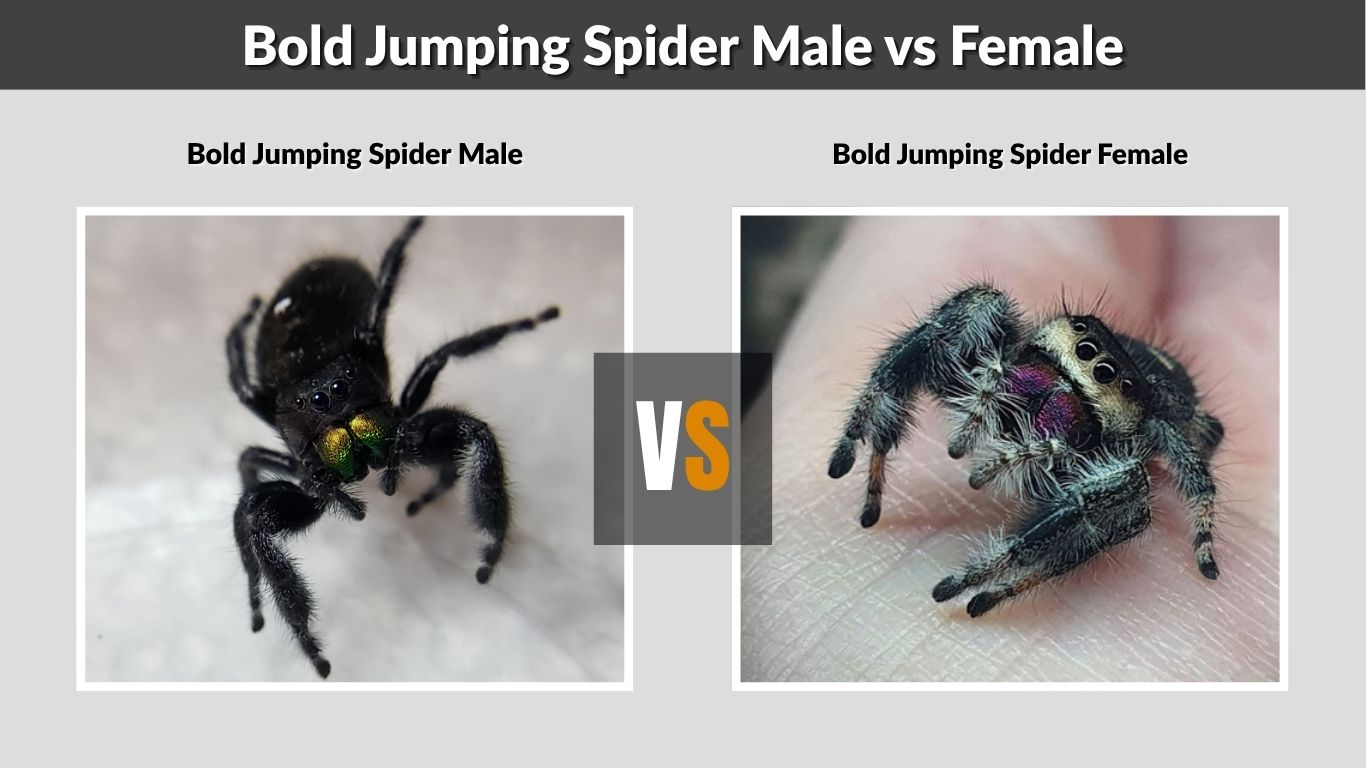
The bold jumping spider male vs female comparison is not always simple at first glance. Both sexes can look black, fuzzy, compact, and marked with bright abdominal spots. However, mature males and females show differences in pedipalps, body shape, leg proportions, behavior, and reproductive signs. This guide explains how to identify a male vs female bold jumping spider using clear, practical features.
Quick Answer: Male vs Female Bold Jumping Spider
When comparing a male vs female bold jumping spider, the most reliable clue is the pedipalps. These are the small leg-like appendages near the mouthparts. Mature males usually have enlarged, rounded pedipalps that look like tiny boxing gloves, while females have slimmer, more even pedipalps.
A female bold jumping spider is often larger, rounder, and heavier-bodied, especially when mature or gravid. A male is usually slimmer, leggier, and more active when searching for a mate. Color can help, but it should not be the only feature used because bold jumping spiders vary by age, molt stage, and individual pattern.
| Feature | Male Bold Jumping Spider | Female Bold Jumping Spider |
| Pedipalps | Enlarged, bulb-like tips in mature males | Slimmer and more uniform |
| Body shape | Often slimmer and more compact | Often rounder and heavier |
| Abdomen | Usually narrower | Usually wider and fuller |
| Behavior | More likely to roam for mates | More likely to stay near a retreat |
| Reproductive clue | No epigynum | Mature females have an epigynum underneath |
Why Bold Jumping Spiders Are Hard to Sex
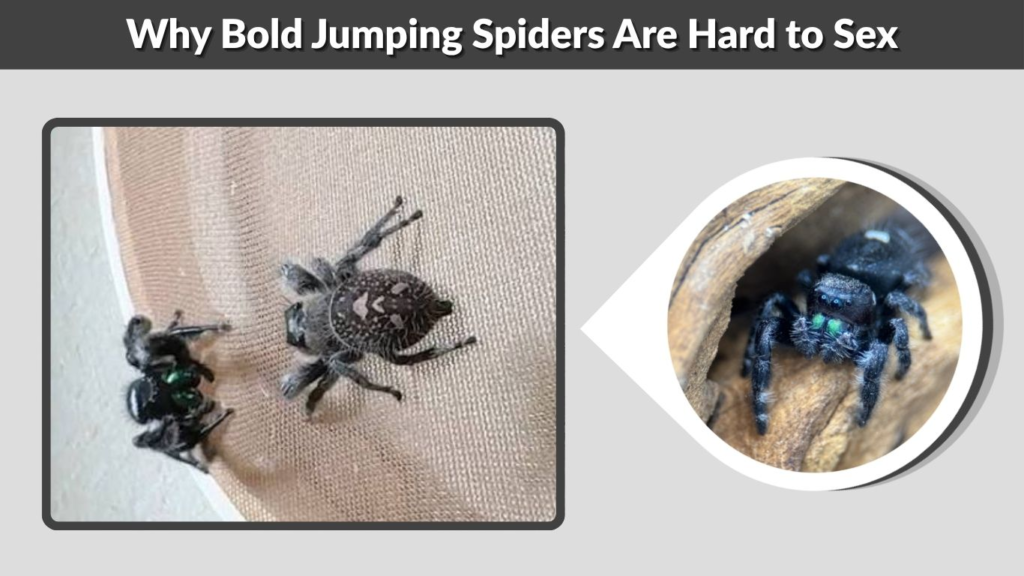
Bold jumping spiders, also called Phidippus audax, can be tricky to identify by sex because males and females share many of the same general features. Both have a compact body, strong front-facing eyes, fuzzy legs, and bright markings on the abdomen.
Age Changes the Appearance
Juvenile bold jumping spiders may have orange, yellow, or pale markings that change as they mature. A young spider may not show clear male or female traits yet. This is why many owners and observers cannot confidently sex a spider until it has reached maturity.
Color Is Not Always Reliable
Some people assume a darker spider is male and a lighter or browner spider is female. That can sometimes be true, but it is not a dependable rule. Bold jumping spiders can vary in shade, markings, and brightness. Lighting, camera angle, molt stage, and regional variation can all change how the spider appears.
Size Overlaps Between Sexes
Female bold jumping spiders are often larger, but size alone can mislead you. A large male may look bigger than a small female. A recently fed spider may also look rounder than usual, while a hungry or older female may look slimmer. For accurate identification, compare several traits together.
Pedipalps: The Best Way to Tell Male From Female
Pedipalps are the most useful feature when identifying a male vs female bold jumping spider. They sit near the front of the spider, close to the mouthparts, and look like a short extra pair of tiny legs.
Male Pedipalps
A mature male bold jumping spider has swollen pedipalps at the tips. These enlarged ends are often described as looking like boxing gloves. They are part of the male reproductive anatomy and become obvious after the final molt.
Look for:
- Rounded, bulbous pedipalp tips
- A thicker look near the mouthparts
- More noticeable movement during courtship
- A mature, fully developed body
Female Pedipalps
A female bold jumping spider has slimmer pedipalps. They usually look more even from base to tip and do not have the same enlarged “glove” shape seen in adult males.
Look for:
- Thin, straight, or fuzzy pedipalps
- No swollen bulb at the end
- A rounder abdomen in mature females
- Possible egg-sac guarding behavior
Important Note About Juveniles
Juveniles are difficult to sex because their reproductive structures are not fully developed. A young male may not yet have obvious swollen pedipalps. If the spider has not reached its final molt, any sex identification should be treated as a guess.
Body Size and Shape Differences
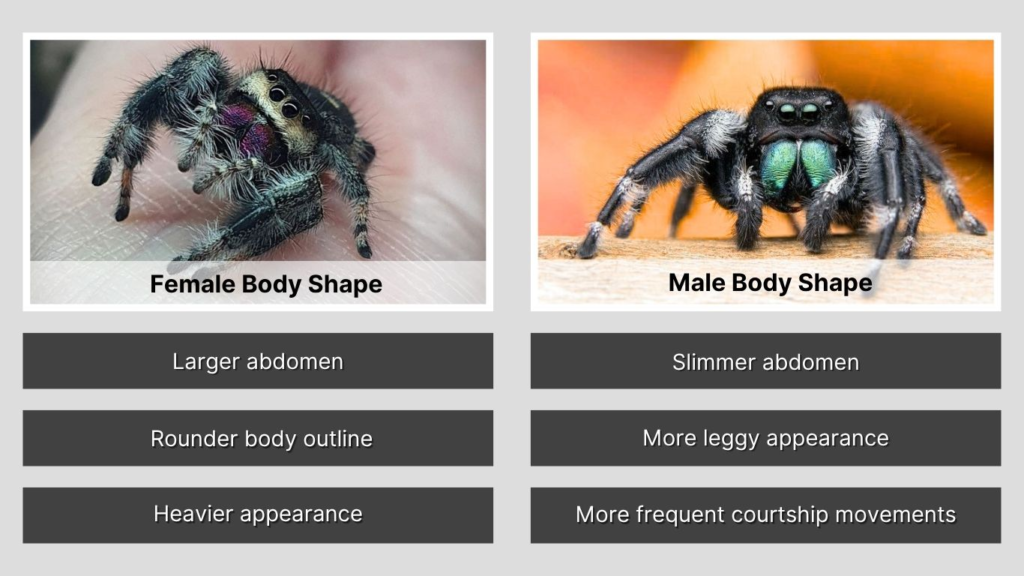
Body shape is another helpful clue in the bold jumping spider female vs male comparison. Females are generally more robust, while males often look slimmer and more agile.
Female Body Shape
A female bold jumping spider often has a fuller abdomen. This can become especially noticeable after feeding or when she is carrying eggs. Her body may look more rounded from above, and her overall appearance may seem stockier.
Common female traits include:
- Larger abdomen
- Rounder body outline
- Heavier appearance
- More settled behavior near web retreats
Male Body Shape
A male bold jumping spider usually has a narrower abdomen and a more streamlined look. Mature males may also appear to have relatively longer front legs, which they use during visual courtship displays.
Common male traits include:
- Slimmer abdomen
- More leggy appearance
- More active roaming
- More frequent courtship movements
| Body Clue | What It Suggests | Reliability |
| Swollen pedipalps | Mature male | High |
| Slim pedipalps | Female or immature spider | Medium to high |
| Large round abdomen | Often female | Medium |
| Small narrow abdomen | Often male | Medium |
| Egg sac guarding | Female | Very high |
| Roaming constantly | Often male | Low to medium |
Color and Marking Differences
Color is one of the first things people notice when looking at bold jumping spider male vs female pictures. Adult bold jumping spiders are usually dark with pale abdominal spots, but the exact color pattern can vary.
Typical Bold Jumping Spider Markings
Many bold jumping spiders have three light spots on the abdomen: one larger central spot and two smaller spots behind it. In adults, these spots are often white. In younger spiders, the spots may appear orange or yellow.
Male Color Traits
Males may look glossier, darker, and more sharply marked, especially around the face and front legs. Some mature males also show striking iridescent green or blue-green chelicerae, the mouthpart area below the eyes.
Female Color Traits
Females can also have iridescent chelicerae and bold markings, but they may appear a little duller, browner, or more mottled than males. However, this is not a strict rule. A female can still look dark, shiny, and colorful.
Why Pictures Can Be Misleading
When searching for bold jumping spider male vs female pictures, remember that image results may show different ages, lighting conditions, and even different species. A close-up photo of the front and underside is more useful than a distant top-view image.
Behavior Differences Between Male and Female Bold Jumping Spiders
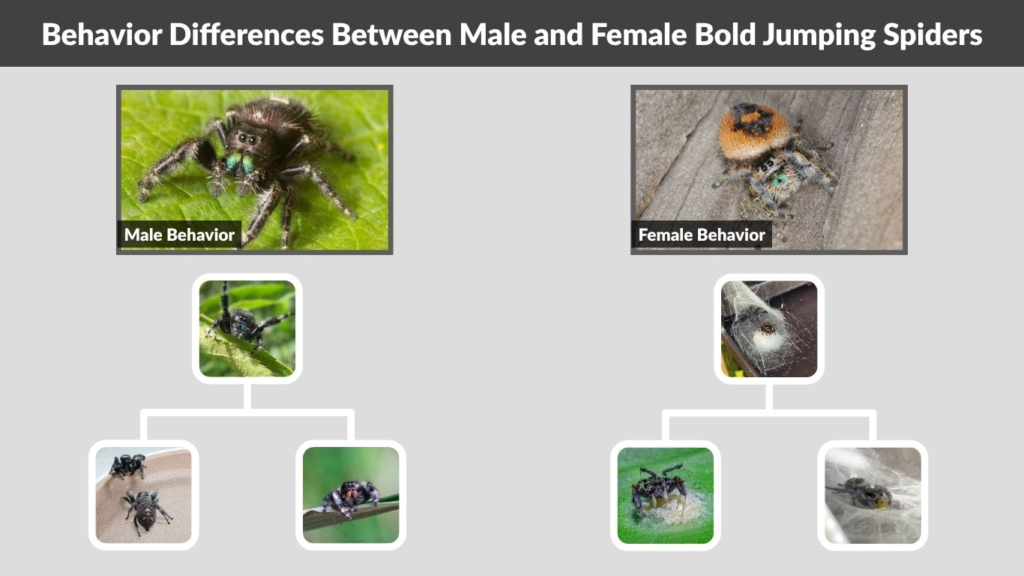
Behavior can support your identification, but it should not be used alone. A spider’s actions can change because of hunger, stress, temperature, enclosure size, light, or recent molting.
Male Behavior
Mature males often become more active because they are searching for females. They may pace, explore, wave their front legs, or show courtship movements. In captivity, a mature male may seem restless compared with a female.
Male behavior may include:
- More roaming
- Leg waving
- Courtship display movements
- Less interest in settling in one retreat
- Searching behavior around the enclosure
Female Behavior
Females are often more settled, especially once mature. A female may spend more time near her silk retreat, feed more heavily, and guard an egg sac if she produces one.
Female behavior may include:
- More time in or near a retreat
- Strong feeding response
- Nesting behavior
- Egg-sac guarding
- Defensive posture when protecting eggs
Reproductive Signs: Female Vs Male Bold Jumping Spider
Reproductive signs are some of the clearest differences between female and male bold jumping spiders, but they are usually visible only in mature spiders.
Female Epigynum
A mature female has an epigynum on the underside of the abdomen. This is the external reproductive structure. It may look like a small shiny or darker mark on the belly area. Seeing it clearly usually requires a safe view from below, such as when the spider is on clear plastic or glass.
Egg Sac Production
Only females produce egg sacs. A female may create a thick silk retreat and stay inside with the egg sac. Some females can produce infertile egg sacs even if they have not mated, so the presence of an egg sac confirms the spider is female but does not always confirm fertile eggs.
Male Maturity
A male reaches reproductive maturity after his final molt, when his pedipalps become fully developed. After this stage, he may focus more on finding a mate than eating heavily.
| Sign | Male | Female |
| Enlarged pedipalps | Yes, in mature males | No |
| Epigynum underneath abdomen | No | Yes, in mature females |
| Egg sac | No | Yes |
| Courtship display | Common | Usually receives or reacts to display |
| Guarding eggs | No | Yes |
How to Identify Sex Using Pictures
The keyword “bold jumping spider male vs female pictures” has search demand because visual comparison is often the easiest way for readers to learn. However, not every picture gives enough information.
Best Photo Angles
To identify the spider more confidently, use photos from different angles:
- Front view to see pedipalps
- Top view to compare body shape
- Side view to see abdomen fullness
- Clear underside view to check for epigynum
- Close-up image in natural light
What to Look for First
Start with the pedipalps. If the spider is mature and the pedipalps are swollen at the tips, it is likely male. If the pedipalps are slim and the spider has a fuller abdomen, it is more likely female.
Next, check the abdomen shape. A rounder abdomen supports female identification, while a narrow abdomen supports male identification. Finally, look for behavior clues such as roaming, courtship, nesting, or egg guarding.
Common Picture Mistakes
Many people misidentify bold jumping spiders from pictures because they focus only on color. This can lead to mistakes. A dark spider is not automatically male, and a large spider is not automatically female. The best identification uses several features together.
Male Vs Female Bold Jumping Spider for Pet Keepers
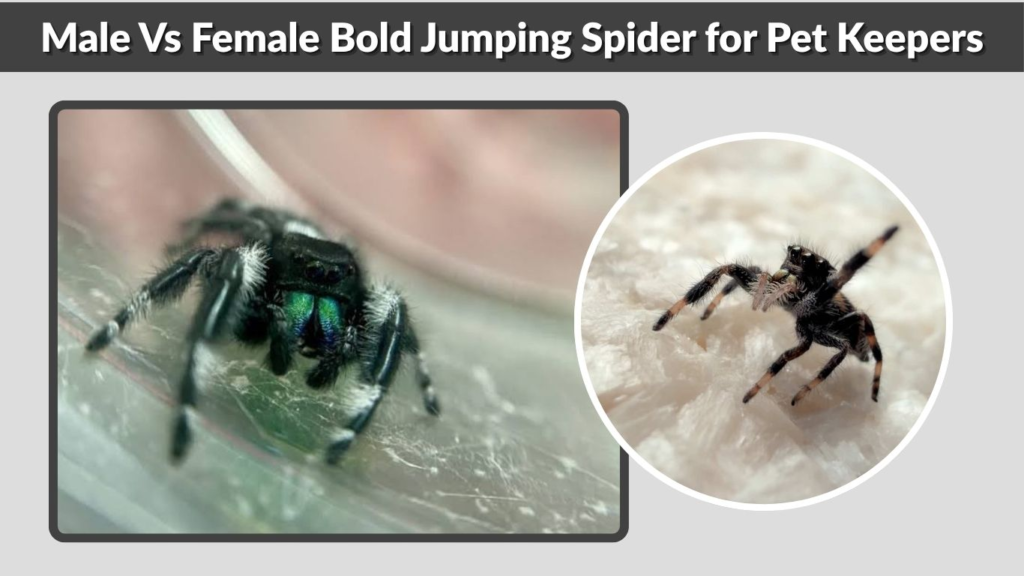
People who keep jumping spiders often want to know the sex because it can affect naming, breeding plans, enclosure expectations, and lifespan expectations.
Choosing a Male
A male bold jumping spider may be interesting to observe because of his activity and courtship behavior. However, mature males may roam more and may not live as long after reaching maturity. They can also be less focused on feeding during mating-search periods.
Choosing a Female
A female bold jumping spider is often preferred by keepers who want a spider that may live longer and settle more consistently. Females may also become gravid or produce egg sacs, which requires extra care and attention.
Breeding Considerations
Breeding should only be attempted by experienced keepers. Even when the spider’s sex is correctly identified, pairing can be risky. Females may reject males, and spiders can injure or eat each other if conditions are poor or timing is wrong.
Quick Identification Checklist
Use this checklist when comparing a male bold jumping spider vs female:
- Check the pedipalps first.
- Look for bulb-like tips to identify a mature male.
- Look for slim pedipalps and a fuller abdomen for a likely female.
- Do not rely only on color.
- Remember juveniles are hard to sex.
- Use clear photos from the front, top, and underside.
- Treat size as a clue, not proof.
- Egg-sac guarding confirms a female.
FAQs
Are male or female bold jumping spiders bigger?
Female bold jumping spiders are often bigger and rounder than males, especially when mature or gravid. However, size is not a perfect way to identify sex because individuals vary. A large male can overlap with a smaller female, so pedipalps and reproductive signs are more reliable.
How can I tell if my bold jumping spider is male?
Look closely at the pedipalps near the mouth. A mature male usually has swollen, rounded pedipalp tips that look like tiny boxing gloves. Males may also have a slimmer abdomen and show more roaming or courtship behavior, but pedipalps are the best clue.
How can I tell if my bold jumping spider is female?
A female usually has slimmer pedipalps, a rounder abdomen, and may show nesting or egg-sac guarding behavior. Mature females also have an epigynum on the underside of the abdomen. If you can safely view the spider from below, this can help confirm the sex.
Can you sex a juvenile bold jumping spider?
Juvenile bold jumping spiders are difficult to sex accurately. Their adult reproductive structures are not fully developed, and their colors may change as they molt. It is best to wait until the spider matures before making a confident male or female identification.
Do male and female bold jumping spiders act differently?
Yes, mature males often roam more because they search for females, while females may spend more time near retreats, feeding, nesting, or guarding eggs. Behavior can help, but it should not be the only clue because hunger, stress, temperature, and molt stage can also affect activity.
