
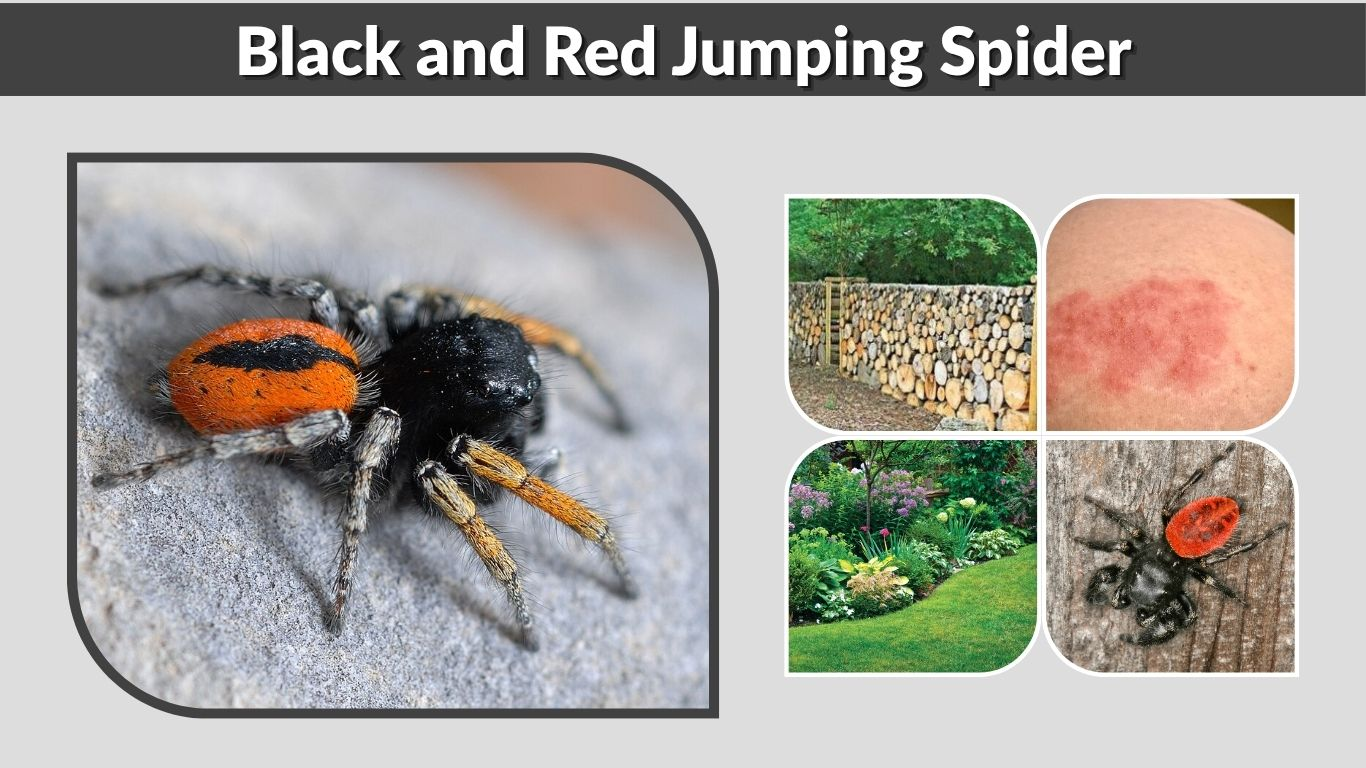
A black and red jumping spider is usually the red-backed jumping spider, also known as Johnson’s jumping spider. Its scientific name is Phidippus johnsoni, and it is one of the most eye-catching jumping spiders in western North America. With a dark body, bright red abdomen, large forward-facing eyes, and fuzzy legs, this small spider often gets attention in gardens, yards, trails, and even homes.
What Is a Black and Red Jumping Spider?
The black and red jumping spider most people notice is a real spider, not a rare exotic species. It belongs to the jumping spider family, a group known for excellent eyesight, quick movement, and short, accurate jumps.
Unlike web-building spiders that wait for insects to get trapped, jumping spiders actively hunt. They stalk prey, judge distance with their large eyes, and leap when close enough. Their movement can look curious or even playful because they often turn to face people, objects, or movement nearby.
This spider is commonly called:
- Red-backed jumping spider
- Johnson jumping spider
- Red and black jumping spider
- Black and red jumping spider
- Phidippus johnsoni
Its bold color pattern makes it easy to remember, but it can still be confused with other red or black spiders. The key difference is its compact, fuzzy jumping-spider body and large front-facing eyes.
Quick Identification Guide
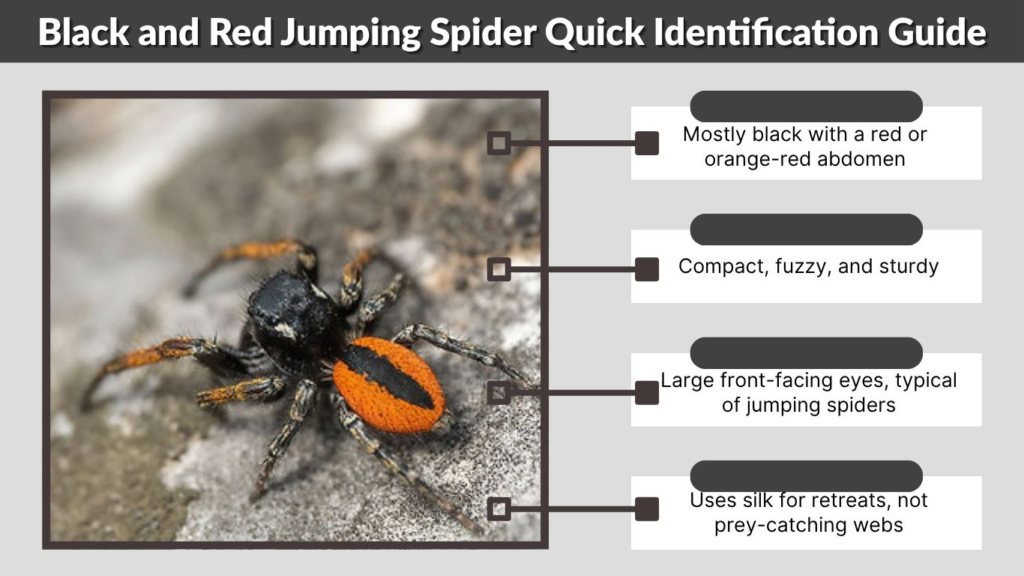
A red-backed jumping spider is small, sturdy, and colorful. Most adults are around the size of a fingernail, though exact size can vary. The body is usually black, while the upper abdomen is bright red or orange-red.
Male and female spiders can look slightly different. Males often have a more solid red abdomen. Females may have a red abdomen with a dark stripe or dark central marking. Both sexes can have shiny green or blue-green mouthparts, which are especially visible in close-up photos.
| Feature | What to Look For |
| Body color | Mostly black with a red or orange-red abdomen |
| Body shape | Compact, fuzzy, and sturdy |
| Eyes | Large front-facing eyes, typical of jumping spiders |
| Movement | Quick walking, sudden stops, short jumps |
| Web use | Uses silk for retreats, not prey-catching webs |
| Common ID | Red-backed jumping spider, Phidippus johnsoni |
The spider’s fuzzy appearance is another useful clue. Many jumping spiders have hairy legs and bodies, giving them a soft or velvet-like look. When you see a small spider that seems to “look back” at you, it may be a jumping spider.
Where Black and Red Jumping Spiders Live
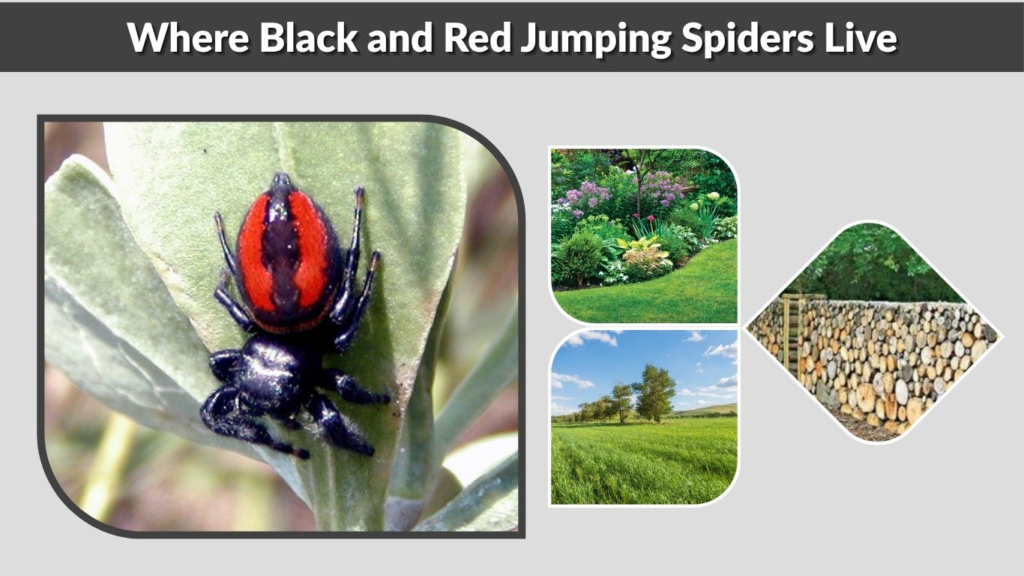
The red-backed jumping spider is most often associated with western North America. It is commonly reported in states such as California, Washington, Nevada, Arizona, and New Mexico. It may also be found in nearby western regions where the climate and habitat suit it.
These spiders often prefer dry, sunny, and open areas. You may see them on rocks, fences, tree trunks, garden walls, outdoor furniture, or low vegetation. They can also wander indoors, especially near windows, doors, or walls where small insects are present.
Common places to find them include:
- Gardens and backyard plants
- Dry grassland or scrubby areas
- Wood piles, rocks, and fences
- Exterior walls and windowsills
- Trails, open woodland edges, and sunny surfaces
They are not household pests in the same way ants, roaches, or termites can be. If one enters a home, it is usually wandering or hunting small insects. Many people choose to gently relocate them outside rather than kill them.
Is the Black and Red Jumping Spider Poisonous?
The black and red jumping spider is not considered dangerous to humans. Like most spiders, it has venom, but venom is not the same as being “poisonous.” Venom is injected through a bite and is mainly used to subdue small prey. Poison is harmful when touched, swallowed, or absorbed.
For humans, a jumping spider bite is usually not medically serious. These spiders are not aggressive and usually prefer to escape. A bite may happen if the spider is trapped against skin, squeezed, or handled roughly.
Possible mild bite symptoms may include:
- A small red spot
- Brief pain or pinching sensation
- Mild swelling
- Itching or irritation
- Temporary tenderness
People with allergies or unusual reactions should be more careful. If any bite causes severe pain, spreading swelling, dizziness, breathing trouble, or symptoms that worsen, medical advice is the safest option. However, serious reactions from jumping spiders are uncommon.
Black and Red Jumping Spider Bite: What to Do
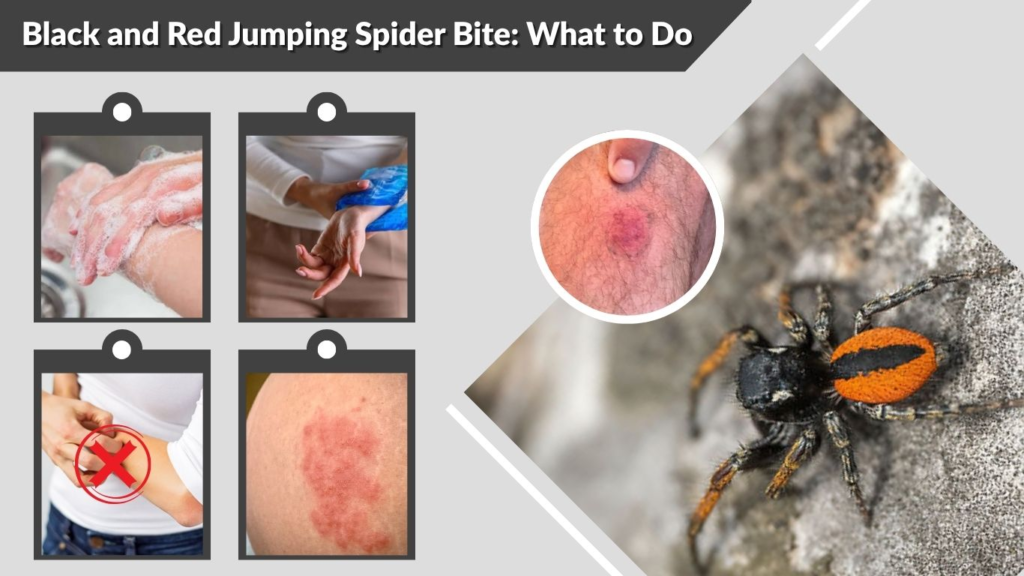
A bite from a red-backed jumping spider is usually minor, but basic care can help prevent irritation. First, wash the area gently with soap and water. Then apply a cool compress if there is swelling or discomfort.
Avoid scratching the bite, because scratching can irritate the skin or increase the risk of infection. If symptoms stay mild, the area usually improves on its own. If symptoms become intense or do not improve, contact a healthcare professional.
Simple first-aid steps:
- Wash the area with soap and water
- Apply a cold pack for short periods
- Keep the area clean and dry
- Avoid squeezing or scratching the bite
- Watch for unusual swelling, rash, or spreading redness
Many suspected spider bites are never confirmed as spider bites. Skin irritation, insect bites, allergies, and minor infections can look similar. Seeing the spider actually bite is the only certain way to know.
How This Spider Hunts and Jumps
Jumping spiders are active hunters. They do not build sticky webs to catch flying insects. Instead, they rely on vision, patience, and controlled jumps.
A red-backed jumping spider may sit still for a moment, turn toward movement, then slowly approach. When it gets close enough, it jumps onto the prey and uses venom to immobilize it. Before jumping, it may attach a silk line as a safety tether. This helps the spider recover if it misses or falls.
Its prey can include small insects and other arthropods. In gardens, this makes the spider useful because it helps reduce tiny pest populations naturally. It is not a replacement for pest control, but it is part of a healthy outdoor ecosystem.
This hunting style is one reason jumping spiders seem more alert than many other spiders. Their large eyes give them a wide field of vision and allow them to judge distance better than many web-building species.
Red-Backed Jumping Spider vs Similar Spiders
The black and red color pattern can cause confusion. Some people worry that any red and black spider is dangerous, but color alone is not enough for identification.
The red-backed jumping spider should not be confused with widow spiders. A black widow has a shiny rounded body, longer thinner legs, and a red hourglass marking on the underside of the abdomen. A jumping spider is fuzzier, stockier, and has large front-facing eyes.
It can also be confused with decorative Halloween spiders or animatronic toys, especially because searches for “black and red jumping spider” sometimes show Spirit Halloween products. Those product searches are separate from real spider identification.
Important differences:
- Jumping spiders are compact and fuzzy
- Widow spiders are smoother and more rounded
- Jumping spiders move actively and turn toward movement
- Widow spiders are usually found in messy, sheltered spaces
- Jumping spiders have large front-facing eyes
- Product-related spiders are toys, not biological species
Some jumping spiders may also have white markings along with red and black colors. A “red white and black jumping spider” may be a different species or a variation in pattern. Clear photos from the front and top are usually needed for accurate identification.
Male and Female Differences
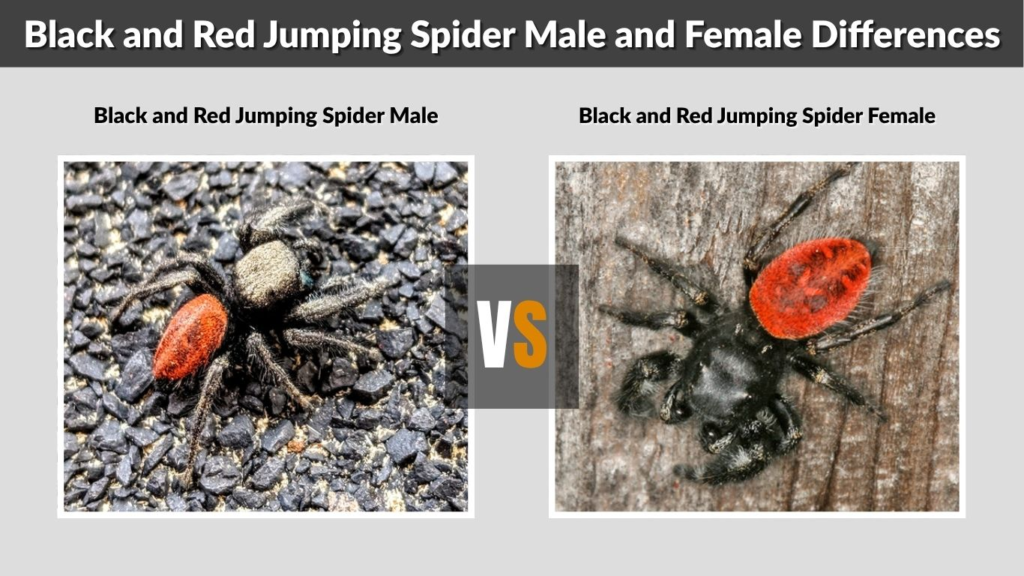
Male and female red-backed jumping spiders can share the same basic black and red look, but there are pattern differences. Males often appear more sharply colored, with a strong red abdomen against a black body. Females may show a darker stripe or marking running through the red abdomen.
Females may also look slightly larger or rounder, especially when mature. Like many spiders, females are often more robust. Males may be seen moving around more during mating season as they search for females.
Jumping spiders also use visual displays during courtship. A male may wave his legs, move in short patterns, or show off color and movement to get the female’s attention. These displays are one reason jumping spiders are popular among macro photographers and spider enthusiasts.
Are They Good or Bad for Gardens?
A red-backed jumping spider is generally good for gardens. It feeds on small insects and contributes to natural pest balance. It does not damage plants, chew leaves, eat wood, or infest food.
Because it is a hunter, it may patrol leaves, stems, walls, and rocks in search of prey. Seeing one in a garden usually means the area supports small insect life. It is best viewed as a beneficial predator rather than a pest.
Reasons to leave it alone:
- It helps control small insects
- It does not harm plants
- It is not aggressive toward people
- It does not create messy indoor webs
- It supports local biodiversity
If you are uncomfortable with spiders, use a cup and stiff paper to move it outdoors. Avoid handling it directly, especially if you are unsure of the species.
How to Identify One Safely
You do not need to pick up a spider to identify it. In fact, it is better not to handle spiders unless you know what they are and are comfortable doing so.
Use careful observation instead. Look at the body shape, eye position, color pattern, and movement. A phone photo taken from a safe distance can help. Try to capture the top of the abdomen and the front of the face.
Safe identification tips:
- Do not touch or squeeze the spider
- Take photos from more than one angle
- Look for the red abdomen and black body
- Check for large forward-facing eyes
- Note the location and behavior
- Compare with local jumping spider guides
If the spider is in a child’s room, bed, shoe, or clothing, relocate it outdoors gently. Most encounters are harmless, but reducing accidental contact is sensible.
Why People Search for This Spider
People search for black and red jumping spiders for several reasons. Some see one in their yard and want to know if it is dangerous. Others find a small spider indoors and want quick identification. Many are simply curious because the spider’s color is striking.
The search can also be mixed with Halloween product results. Terms like “red and black jumping spider animatronic” or “Spirit Halloween black and red jumping spider” usually refer to toy spiders, not the living species. For nature identification, the most relevant name is red-backed jumping spider or Phidippus johnsoni.
Using the scientific name helps avoid confusion. Many spiders can be red and black, but Phidippus johnsoni points to a specific jumping spider with a known appearance and range.
FAQs
Is a black and red jumping spider dangerous?
A black and red jumping spider is usually not dangerous to people. The red-backed jumping spider has venom for catching tiny prey, but it is not considered medically significant for humans. It is also not aggressive. Most will jump away or hide when disturbed rather than try to bite.
What is the name of the red and black jumping spider?
The spider is commonly called the red-backed jumping spider or Johnson jumping spider. Its scientific name is Phidippus johnsoni. It is a western North American jumping spider known for its black body, bright red abdomen, fuzzy legs, large eyes, and active hunting behavior.
Can a red-backed jumping spider bite?
Yes, it can bite, but bites are uncommon. A bite is most likely if the spider is trapped against skin or handled roughly. Symptoms are usually mild, such as slight pain, redness, itching, or swelling. Seek medical advice if symptoms become severe or unusual.
Where are black and red jumping spiders found?
They are most common in western North America, including areas such as California, Nevada, Arizona, New Mexico, and Washington. They often live in dry, sunny habitats, gardens, yards, rocks, fences, and open woodland edges. Occasionally, one may wander indoors while hunting.
Should I remove a black and red jumping spider from my house?
You can remove it if it makes you uncomfortable, but you usually do not need to kill it. Place a cup over the spider, slide paper underneath, and release it outdoors. Jumping spiders are beneficial predators that eat small insects and do not infest homes.
