
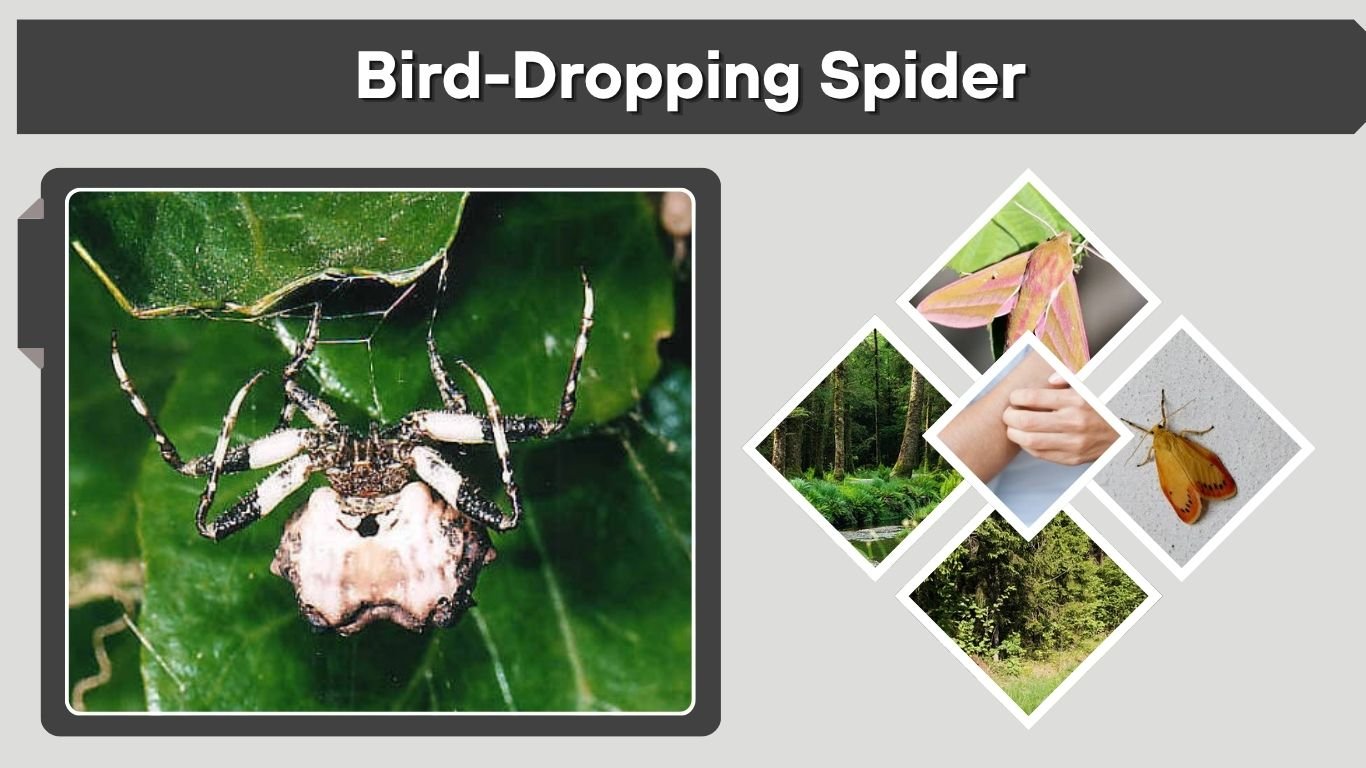
The bird-dropping spider is a remarkable orb-weaver known for looking almost exactly like a patch of bird waste. Its mottled white, brown, gray, and black body helps it remain unnoticed on leaves and branches during the day. At night, the spider becomes an active moth hunter, using chemical deception rather than a large circular web to attract prey. The name “bird-dropping spider” can refer to several spiders with similar camouflage, but it is especially associated with Celaenia excavata, a species found in Australia and New Zealand. Despite its unusual appearance and hunting behavior, it is not considered a significant danger to people.
What Is a Bird-Dropping Spider?
The bird-dropping spider, Celaenia excavata, is an orb-weaving spider in the family Araneidae. It is also sometimes called the death’s-head spider because markings on its abdomen may resemble a small skull. Another occasional name is orchard spider, reflecting its habit of hunting moths among fruit trees and garden vegetation.
Although related to spiders that construct large, wheel-shaped webs, an adult female bird-dropping spider uses a much simpler hunting system. She rests on vegetation during the day and hangs from a short silk line at night while waiting for male moths.
Bird-Dropping Spider Identification
- Large, rounded or irregularly shaped abdomen
- Mottled white, cream, gray, brown, and black markings
- Shorter, thick-looking legs compared with many orb-weavers
- Uneven body surface with bumps or depressions
- Resting posture that makes the legs difficult to see
- Adult females much larger than adult males
- Often found beside several round, brown egg sacs
A resting female may appear more like dried material or animal waste than a living spider. The body is usually compact, and the legs are folded closely against the sides. This posture completes the disguise by hiding the familiar outline of a spider.
Why Does It Look Like a Bird Dropping?
Its appearance is an example of masquerade. Camouflage generally makes an animal difficult to detect, whereas masquerade causes another animal to detect the object but misidentify it as something unimportant or unappealing.
Birds, wasps, lizards, and other predators may overlook the spider because bird waste is not normally recognized as prey. The spider enhances the effect by remaining motionless for long periods during daylight.
Similar defensive strategies occur in other unrelated spiders. For example, research on the orb-weaver Cyclosa ginnaga showed that its silver body and white silk decoration combine to resemble bird droppings. Experiments found that this disguise reduced attacks from predatory wasps, demonstrating that bird-dropping mimicry can provide genuine protection.
Bird-Dropping Spider Size
Female and male bird-dropping spiders differ dramatically in size. An adult female may reach approximately 12 millimeters in body length, while the adult male may measure only around 2.5 to 3 millimeters.
The female’s swollen abdomen makes her appear larger, especially when she is producing eggs. Her body may look nearly as wide as it is long. The tiny male has a more conventional spider-like shape and can be difficult to recognize as the same species.
Male vs. Female Bird-Dropping Spider
The female is responsible for the species’ famous appearance and moth-hunting behavior. She possesses the large, strongly patterned abdomen that provides protection through mimicry.
The male is much smaller, more mobile, and less noticeable. His adult life is largely focused on finding a female and mating. Because he lacks the female’s heavy body and large egg-producing abdomen, he does not resemble bird waste as convincingly.
This extreme size difference is called sexual dimorphism. It is common among orb-weavers, although the contrast is particularly striking in the bird-dropping spider.
Bird-Dropping Spider Habitat and Distribution
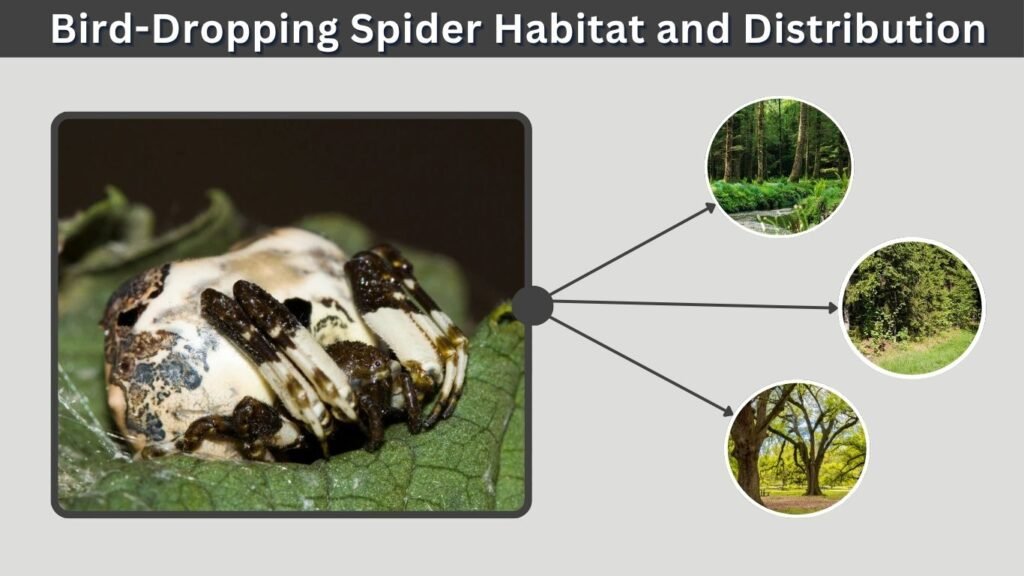
Celaenia excavata occurs across much of eastern and southern Australia. It has also been recorded in central Australia, including near Uluru. The species is present in New Zealand as well.
Suitable habitats include:
- Woodlands
- Forest margins
- Orchards
- Parks
- Suburban gardens
- Shrubs and hedges
- Areas with flowering plants
- Vegetation supporting moth populations
These spiders are moderately common in some suburban gardens but are easily overlooked because of their disguise. A person may mistake one for dirt, dried plant material, or a bird dropping and walk past without realizing that it is alive.
They often rest on exposed leaves, twigs, branches, fences, or nearby structures. Vegetation provides both daytime camouflage and a strong attachment point for hunting lines and egg sacs.
Does a Bird-Dropping Spider Build a Web?
The bird-dropping spider belongs to the orb-weaver family, but the adult female does not depend on a complete circular web for catching prey.
Instead, she creates a short silk line or simple framework. At night, she hangs from the thread with her front legs ready to seize an approaching moth. The reduced web supports the spider and allows her to respond quickly when prey comes close.
Daytime Resting Web
During daylight, the female may remain attached to a leaf or branch with only a few supporting silk threads. She folds her legs tightly around her body and stays almost completely still.
Unlike a large orb web, this resting arrangement does not draw much attention. The spider’s body supplies most of the visual disguise.
Nighttime Hunting Line
After dark, the female moves into a hunting position. She hangs beneath a short thread and waits for moths. The silk does not trap prey in the way a conventional sticky web does. Instead, the spider catches the insect directly with her powerful front legs.
Young bird-dropping spiders may use small, irregular webs and catch tiny insects before adopting the adult female’s specialized moth-hunting behavior.
How Does a Bird-Dropping Spider Catch Prey?
The bird-dropping spider uses aggressive chemical mimicry. A mature female releases airborne chemicals that imitate the sex pheromones produced by female moths.
Male moths detect these chemicals with their antennae and fly toward the source because they believe a potential mate is nearby. When a moth approaches closely enough, the spider reaches out, grabs it with her front legs, bites it, and injects venom.
This method resembles the strategy used by bolas spiders. However, a typical bolas spider swings an adhesive silk droplet toward a moth, while Celaenia excavata usually captures the approaching insect directly with its legs. The Australian Museum describes its diet as largely consisting of male moths attracted by the spider’s false chemical signal.
Why Chemical Mimicry Is Effective
Moths often rely more heavily on scent than sight when locating mates in darkness. A male can detect tiny quantities of pheromone from a considerable distance and follow the chemical trail through the air.
By copying this signal, the spider avoids the energy required to build and repair a large capture web. Rather than waiting for random insects, it brings suitable prey directly to its hunting position.
What Does a Bird-Dropping Spider Eat?
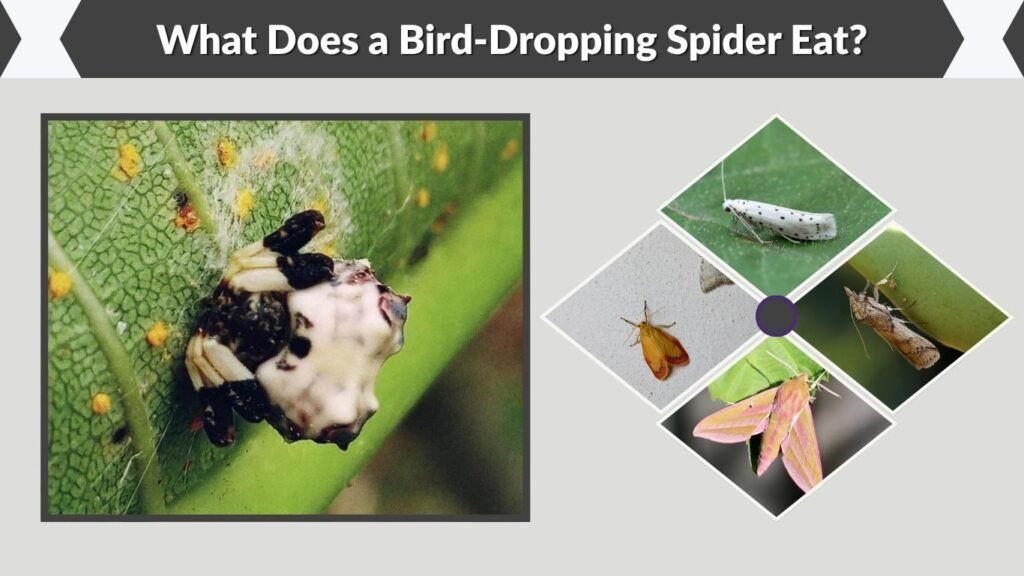
The bird-dropping spider feeds primarily on male moths. Its prey may include several nocturnal species that respond to the chemicals released by the female spider.
Its diet may include:
- Small nocturnal moths
- Orchard moths
- Leaf-eating moth species
- Agricultural moth pests
- Other small flying insects, particularly when young
After capturing a moth, the spider delivers a venomous bite that immobilizes it. She may wrap the prey in silk before feeding.
Because some moth larvae damage fruit trees, vegetables, and ornamental plants, bird-dropping spiders can be beneficial garden predators.
Bird-Dropping Spider Egg Sacs
The egg sacs are among the most noticeable features associated with this spider. A female may produce several round, marbled brown sacs and hang them together from strong silk threads.
Each sac can be approximately 12 millimeters across and may contain more than 200 eggs. Reports indicate that a female can produce as many as 13 egg sacs, creating a hanging cluster of brown spheres.
The female often remains near or beneath the group. Her own rounded, patterned body blends surprisingly well with the suspended sacs, making her harder for predators to identify.
What Do the Egg Sacs Look Like?
The sacs may appear:
- Round or slightly oval
- Brown, tan, or marbled
- Firmly wrapped in dense silk
- Suspended together in a row or cluster
- Similar in size to the female’s abdomen
A cluster may be mistaken for dried berries, plant growths, or insect galls. It should be left undisturbed whenever it does not create an immediate problem.
Bird-Dropping Spider Life Cycle
The life cycle begins when the female places eggs inside a protective silk sac. The eggs remain enclosed until the young spiderlings are sufficiently developed to emerge.
The basic stages are:
- Egg
- Spiderling
- Juvenile
- Adult
Young spiders undergo several molts as they grow. Each molt allows the body and legs to increase in size. Juveniles feed on smaller insects than adult females and may use simple webs to capture prey.
Once mature, females develop the distinctive swollen abdomen and begin using chemical mimicry to attract moths. Males remain tiny and actively search for females.
The exact timing of development depends on climate, food availability, and local seasonal conditions.
Is the Bird-Dropping Spider Venomous?
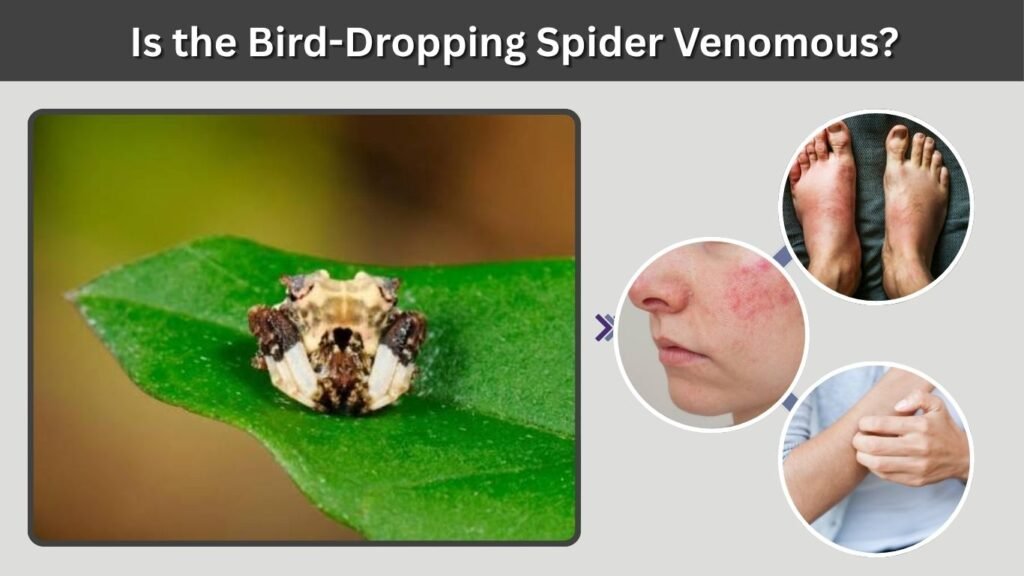
Yes. Like most spiders, the bird-dropping spider has venom that helps it subdue prey. It should be called venomous rather than poisonous because venom is injected through the fangs.
However, being venomous does not automatically mean that a spider is dangerous to humans. The bird-dropping spider’s venom is adapted for moths and other small prey.
Does a Bird-Dropping Spider Bite?
A bite is possible if the spider is trapped, squeezed, or handled. Nevertheless, it is not considered aggressive and normally relies on remaining still rather than defending itself.
Human bites appear to be uncommon. Reliable medical information about the effects is limited, and the species is not generally treated as a medically significant spider.
A possible bite may cause temporary symptoms such as:
- Local pain
- Redness
- Mild swelling
- Itching or irritation
The affected area should be washed with soap and water. A cold pack wrapped in cloth may reduce discomfort. Seek medical care if symptoms become severe, spread rapidly, show signs of infection, or include breathing difficulty, dizziness, vomiting, or facial swelling.
Is the Bird-Dropping Spider Dangerous?
For most people, the spider presents very little danger. It does not seek human contact, does not infest houses, and does not hunt pets or other large animals.
Its frightening reputation usually comes from its strange appearance rather than its medical importance. A female may look large when her abdomen is swollen, but she generally remains motionless unless disturbed or hunting.
Children and pets should still be discouraged from handling unfamiliar spiders. The safest approach is to observe the animal from a distance or move it gently with a container when relocation is necessary.
Bird-Dropping Spider vs. Bolas Spider
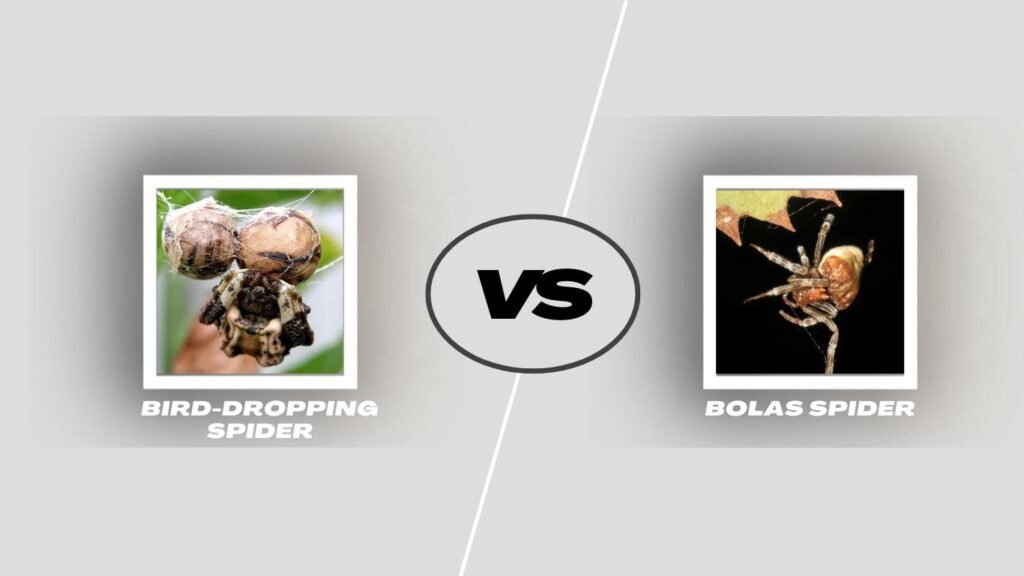
Bird-dropping spiders and bolas spiders share several characteristics. Both are specialized orb-weavers, many resemble bird droppings, and females can attract male moths by imitating female moth pheromones.
The main difference is their prey-capture technique. A bolas spider typically creates a sticky silk line and swings it toward a nearby moth. The Australian bird-dropping spider generally hangs from a silk thread and catches the approaching moth directly with its front legs.
The common names can sometimes overlap, which causes confusion. Not every spider that looks like bird waste is Celaenia excavata. The name may also be applied broadly to spiders in Mastophora, Cyclosa, and other groups with similar camouflage.
Bird-Dropping Spider in the Garden
Finding one in a garden is usually beneficial. The spider helps control moths without damaging leaves, flowers, fruit, or stems.
There is normally no reason to remove it. Avoid spraying broad-spectrum pesticides nearby because these products can kill the spider along with harmful plant pests.
When gardening, check leaves and branches carefully before pruning. A hanging group of brown egg sacs may have a camouflaged female resting immediately beneath it.
Interesting Bird-Dropping Spider Facts
- It resembles bird waste to discourage predators.
- It remains nearly motionless during daylight.
- Adult females hunt mainly at night.
- The female chemically imitates the scent of a female moth.
- Male moths approach expecting to find a mate.
- The spider catches prey directly with its front legs.
- Females are several times larger than males.
- One female may produce numerous large egg sacs.
- The species occurs in Australia and New Zealand.
- It is generally harmless and beneficial in gardens.
FAQs
Is a bird-dropping spider a type of bolas spider?
It is closely related to bolas spiders and uses similar chemical deception. However, it usually grabs moths directly rather than striking them with a sticky bolas line.
Why does the spider look like bird poop?
Its shape, markings, and resting posture help predators mistake it for bird waste. This form of masquerade reduces the likelihood of attack.
Where does the bird-dropping spider live?
Celaenia excavata lives across much of eastern and southern Australia, with records from central Australia and New Zealand. It commonly occupies gardens, woodlands, and orchards.
Can a bird-dropping spider hurt humans?
It can theoretically bite when handled or squeezed, but confirmed bites are uncommon. It is not considered a dangerously venomous or medically significant species.
Should I remove one from my garden?
Removal is usually unnecessary. The spider catches moths and does not damage plants. Leaving it undisturbed supports natural pest control and garden biodiversity.
