
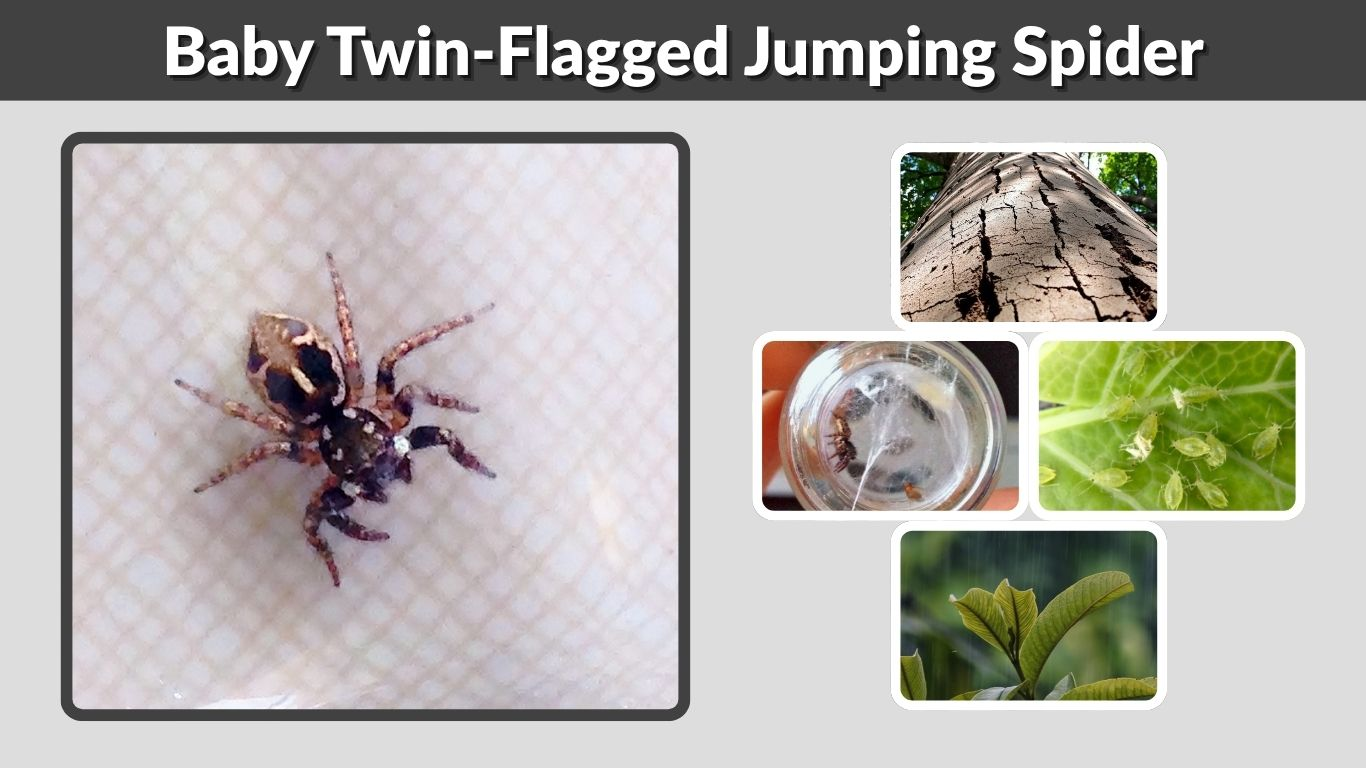
A baby twin-flagged jumping spider is a tiny spiderling of Anasaitis canosa, a small jumping spider known for its quick movement, sharp eyesight, and pale “flag-like” markings. These young spiders are very small, delicate, and active hunters. They live close to leaf litter, walls, fences, and garden areas where they can find tiny insects to eat.
What Is a Baby Twin-Flagged Jumping Spider?
A baby twin-flagged jumping spider is the early life stage of the twin-flagged jumping spider. Like other jumping spiders, it does not use a web to trap prey. Instead, it stalks small insects, watches them carefully, and jumps when it is close enough.
These spiderlings are much smaller than adults. A full-grown twin-flagged jumping spider is already tiny, so the baby stage can be very hard to notice without close observation. Many people see them as moving black, brown, or gray dots on walls, leaves, or outdoor surfaces.
Basic Overview
The twin-flagged jumping spider belongs to the jumping spider family, Salticidae. This family is famous for large front eyes, short hunting jumps, and curious behavior. Baby twin-flagged jumping spiders share the same basic hunting style as adults, but they need smaller prey and safer hiding places.
They are not dangerous to humans. Their tiny size and shy nature make them more likely to escape than bite. If found indoors, they can usually be moved outside gently with a cup and paper.
Baby Twin-Flagged Jumping Spider Identification
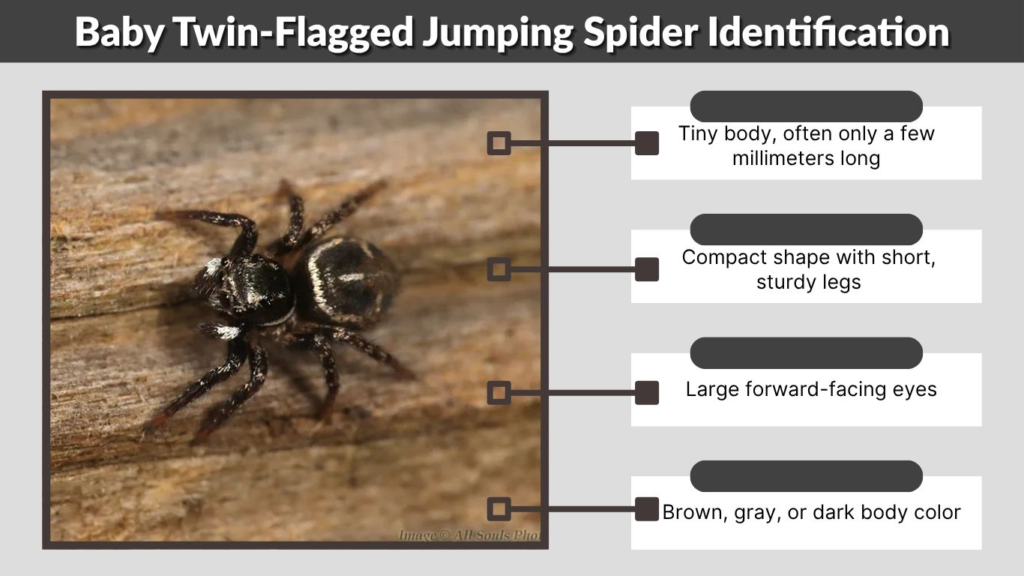
Identifying a baby twin-flagged jumping spider can be difficult because young spiderlings do not always show the strongest adult markings. Adults are known for pale, flag-like patches and active body movements, but babies may look more plain.
Baby spiders may appear brownish, grayish, or dark with tiny pale markings. Their large front eyes are often the easiest jumping-spider clue. They also move in short bursts, stop often, turn toward movement, and may jump when disturbed.
Identification Features
- Tiny body, often only a few millimeters long
- Compact shape with short, sturdy legs
- Large forward-facing eyes
- Quick stop-and-go movement
- Small jumps instead of long crawling
- Brown, gray, or dark body color
- Pale marks may be faint in young spiders
- Often seen on walls, bark, fences, leaves, or leaf litter
- Builds small silk retreats instead of prey-catching webs
A baby twin-flagged jumping spider may be confused with other baby jumping spiders. Size, markings, location, and movement can help, but exact identification is easier when the spider is older.
Baby Twin-Flagged Jumping Spider Size
The twin-flagged jumping spider is a small species even as an adult. Adults are commonly about 4–7 mm long, so baby spiderlings are much smaller. Newly emerged spiderlings may look like tiny specks moving across a surface.
Their small size helps them hide from predators and hunt very tiny insects. As they grow, they molt several times. After each molt, the body becomes slightly larger and the markings may become clearer.
| Life Stage | Approximate Size | What It Looks Like |
| New spiderling | 1–2 mm | Tiny moving dot |
| Young juvenile | 2–3 mm | Small dark jumper |
| Older juvenile | 3–5 mm | More visible body shape |
| Adult | 4–7 mm | Clearer markings and stronger features |
Size alone should not be used for exact identification. Many baby jumping spiders overlap in size. A very small spider may be a baby, but it may also be an adult of a tiny species.
Where Baby Twin-Flagged Jumping Spiders Live
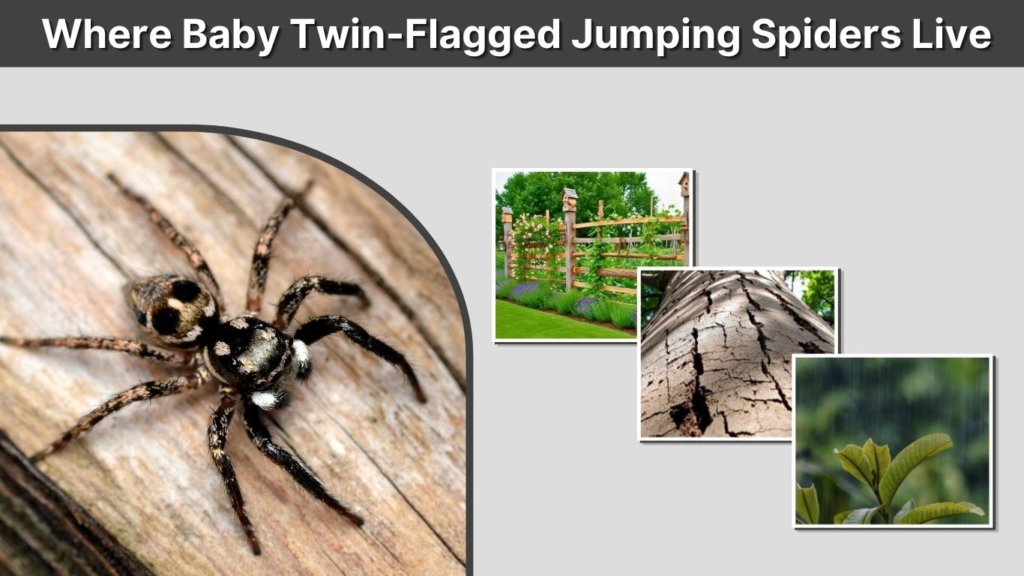
Baby twin-flagged jumping spiders are usually found in the same general places as adults. They may live around leaf litter, bark, garden plants, fences, walls, and outdoor structures. They prefer areas where tiny insects are available.
These spiders are commonly linked with warm regions, especially the southeastern United States and Mexico. In suitable habitats, they may appear around homes, gardens, and natural outdoor spaces.
Common Hiding Places
Baby twin-flagged jumping spiders may hide in:
- Leaf litter
- Garden plants
- Cracks in bark
- Fence surfaces
- Exterior walls
- Window frames
- Small silk retreats
- Under leaves
- Around outdoor lights where tiny insects gather
They do not need large webs. Their silk is mostly used for safety lines, resting retreats, and protection during molting. A baby spider may make a tiny silk shelter in a hidden corner before resting or shedding.
What Do Baby Twin-Flagged Jumping Spiders Eat?
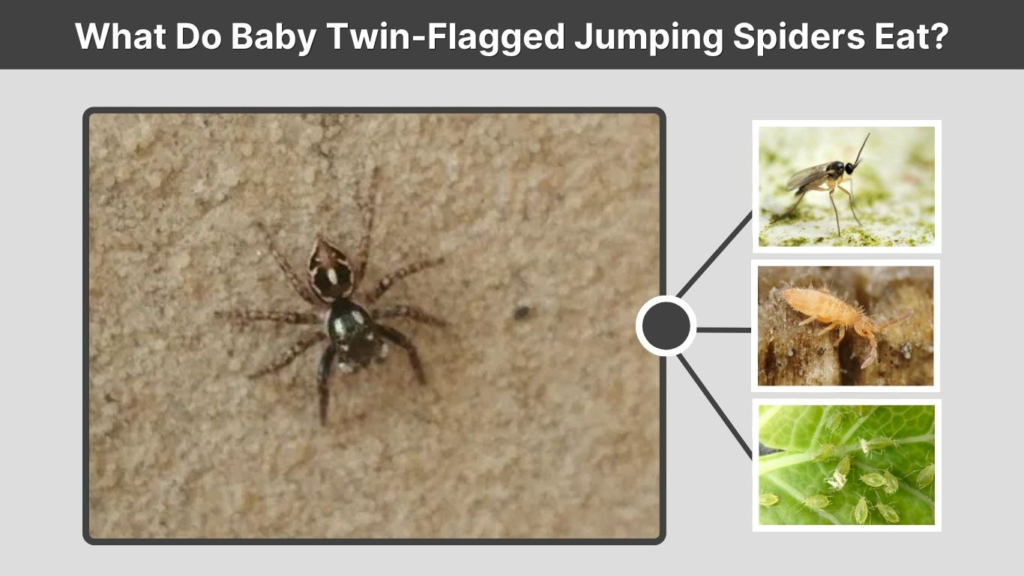
Baby twin-flagged jumping spiders eat very small live prey. Because they are tiny, they cannot handle large insects. Their prey must be small enough to catch safely.
In the wild, they may eat small flies, gnats, springtails, tiny aphids, young leafhoppers, and other very small arthropods. As they grow, they can catch larger prey.
Common Baby Diet
A baby twin-flagged jumping spider may eat:
- Fruit-fly-sized insects
- Tiny gnats
- Springtails
- Small aphids
- Tiny flies
- Small larvae
- Newly hatched insects
- Very small soft-bodied prey
They hunt with vision. They watch prey, move closer slowly, and then jump. Like other spiders, they do not chew solid food. They bite the prey, release digestive fluids, and drink the softened liquid.
For pet care, flightless fruit flies are often the easiest feeder for small jumping spiderlings. Wild-caught insects should be avoided because they may carry pesticides or parasites.
How Baby Twin-Flagged Jumping Spiders Hunt
Baby twin-flagged jumping spiders are active hunters from an early age. Even when very small, they use their eyes to track movement and judge distance.
They usually do not chase prey for a long distance. Instead, they stalk slowly and wait for the right moment. Before jumping, they may attach a silk line to the surface. This line works like a safety rope if they miss.
Hunting Behavior
Their hunting behavior often includes:
- Turning toward movement
- Freezing while watching prey
- Crawling slowly closer
- Raising the front part of the body
- Jumping suddenly
- Holding prey with the front legs
- Returning to a safe surface after feeding
This behavior makes them interesting to observe. Even young spiderlings can show the alert, curious style that jumping spiders are known for.
Baby Twin-Flagged Jumping Spider Life Cycle
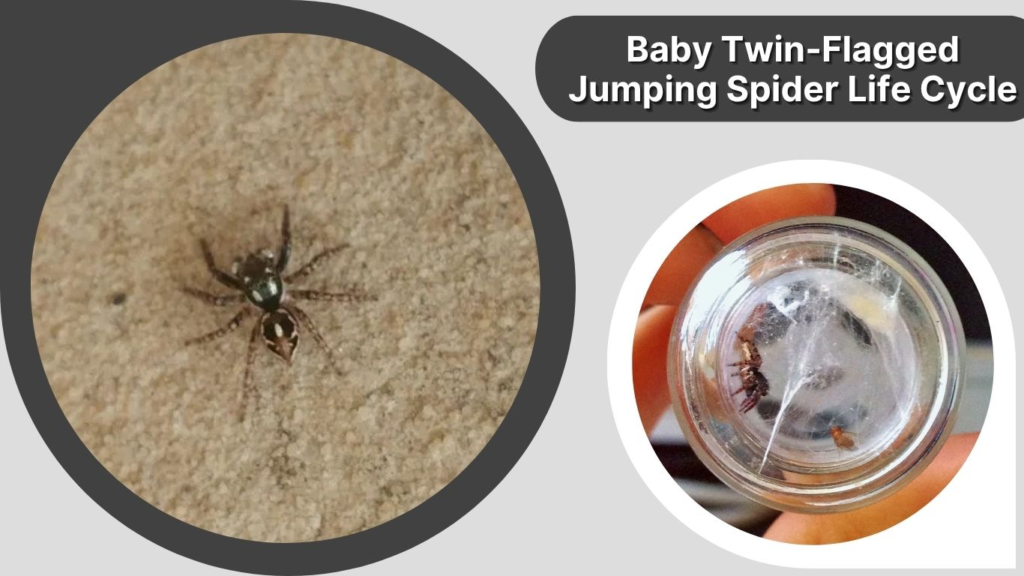
The life cycle begins when a female lays eggs inside a silk retreat. The spiderlings hatch and stay protected for a short time before dispersing. Once they leave the egg sac, they must find tiny prey and safe shelter.
Baby jumping spiders grow by molting. During molting, the spider sheds its outer skin. This is a risky time because the new body is soft. A spiderling may hide in a silk retreat before and after molting.
Growth Stages
The main stages include egg, spiderling, juvenile, subadult, and adult. A baby spider passes through several juvenile stages before maturity. Each stage makes the spider slightly larger and stronger.
Food, temperature, safety, and humidity can affect growth. A well-fed spiderling in a safe place may grow steadily. A spiderling with little prey or too much disturbance may grow more slowly.
Are Baby Twin-Flagged Jumping Spiders Dangerous?
Baby twin-flagged jumping spiders are not dangerous to people. They are extremely small and prefer to run or jump away when disturbed. Even adult twin-flagged jumping spiders are harmless to humans in normal situations.
A baby spiderling is too small to be a serious concern. It is not aggressive, and it does not infest homes like pests such as cockroaches or termites. If one appears indoors, it is usually just hunting small insects or wandering from outside.
Safety Notes
These spiders are best handled gently or not handled at all. Their small bodies can be injured easily. If you need to move one, use a soft brush, paper, or a small cup.
Do not spray pesticides just because you see a baby jumping spider. It may actually help reduce tiny insects around plants and walls.
Baby Twin-Flagged Jumping Spider as a Pet
A baby twin-flagged jumping spider can be kept by experienced small-spider keepers, but it is not the easiest species for beginners. Its tiny size makes feeding, misting, and enclosure control more difficult.
Larger pet species, such as regal or bold jumping spiders, are usually easier to observe and care for. Baby twin-flagged jumping spiders need very small food and escape-proof housing.
Pet Care Basics
For a baby twin-flagged jumping spider, the enclosure should be small, secure, and well ventilated. A large enclosure can make it hard for the spider to find food.
Useful care points include:
- Use a tiny escape-proof enclosure
- Add small anchor points for silk retreats
- Provide gentle ventilation
- Feed flightless fruit flies or tiny prey
- Mist lightly for water droplets
- Avoid deep water dishes
- Remove uneaten prey
- Do not disturb the spider during molting
Because the spider is so small, even small gaps can allow escape. Always check lid holes, ventilation mesh, and door spaces.
Molting Problems in Baby Twin-Flagged Jumping Spiders
Molting is one of the most important parts of a baby spider’s growth. Before molting, the spider may stop eating and stay inside its silk retreat. This is normal.
During this time, do not poke, shake, or open the retreat. Also remove live prey, especially crickets or other insects that could bite the spider.
A healthy molt allows the spider to grow. After molting, the new body is soft. The spider may stay hidden until its body hardens. Feeding too soon after a molt can be risky, so it is better to wait until the spider becomes active again.
Dry conditions may make molting harder. Light misting near the enclosure wall can help provide drinking droplets, but the enclosure should not be soaked.
Baby Twin-Flagged Jumping Spider vs Other Baby Jumpers
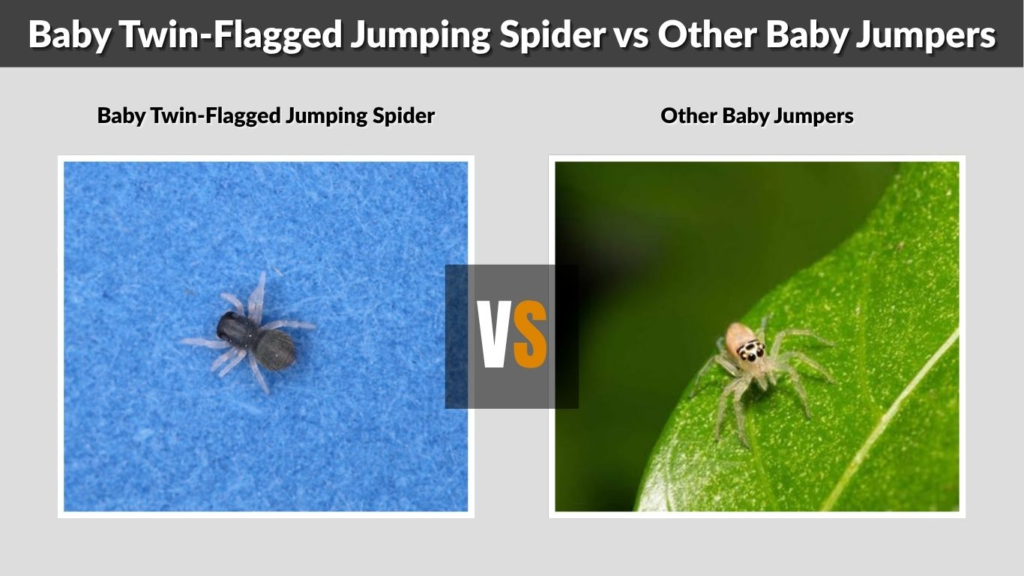
Baby twin-flagged jumping spiders can look similar to many other baby jumping spiders. Most spiderlings are small, fast, and not fully marked. This makes early identification tricky.
The twin-flagged jumping spider is often recognized more easily as it matures. Its pale flag-like markings and signaling behavior become more visible in older spiders.
Key Differences to Notice
When comparing baby jumpers, look at:
- Body shape
- Eye placement
- Movement style
- Habitat
- Region
- Early markings
- Adult spiders nearby
- Size compared with known species
A baby bold jumping spider may grow much larger than a baby twin-flagged jumping spider. A baby zebra jumping spider may stay small but often shows a different black-and-white pattern as it matures.
Why Baby Twin-Flagged Jumping Spiders Are Helpful
Baby twin-flagged jumping spiders are small predators. They help control tiny insects in gardens, yards, and around homes. They may eat gnats, flies, aphids, and other small pests.
They are part of a healthy outdoor ecosystem. Birds, reptiles, larger spiders, and insects may prey on them, while they hunt even smaller creatures. This makes them both predator and prey.
These spiders also help people notice the hidden life in gardens and walls. Their behavior is alert and active, and they are often more interesting than frightening once observed closely.
FAQs
How big is a baby twin-flagged jumping spider?
A baby twin-flagged jumping spider may be only 1–2 mm after leaving the egg sac. Older juveniles become larger after each molt. Since adults are only about 4–7 mm long, even a growing baby remains very small compared with many other spiders.
What does a baby twin-flagged jumping spider eat?
It eats tiny live prey such as fruit-fly-sized insects, gnats, springtails, aphids, and other small soft-bodied arthropods. In captivity, flightless fruit flies are often a suitable feeder. The prey should always be smaller than the spider’s body.
Is a baby twin-flagged jumping spider poisonous?
It is not dangerous to humans. Like most spiders, it has venom for subduing tiny prey, but baby twin-flagged jumping spiders are extremely small and not medically important. They usually escape when disturbed instead of biting.
Can I keep a baby twin-flagged jumping spider as a pet?
Yes, but it is better for experienced keepers. The spider is tiny, so it needs a secure enclosure, tiny prey, gentle misting, and careful monitoring. Larger jumping spiders are usually easier for beginners because they are easier to feed and observe.
Where do baby twin-flagged jumping spiders hide?
They may hide in leaf litter, bark cracks, garden plants, fences, exterior walls, window areas, and tiny silk retreats. They choose small protected spaces where they can rest, molt, and stay close to tiny insects for food.
