
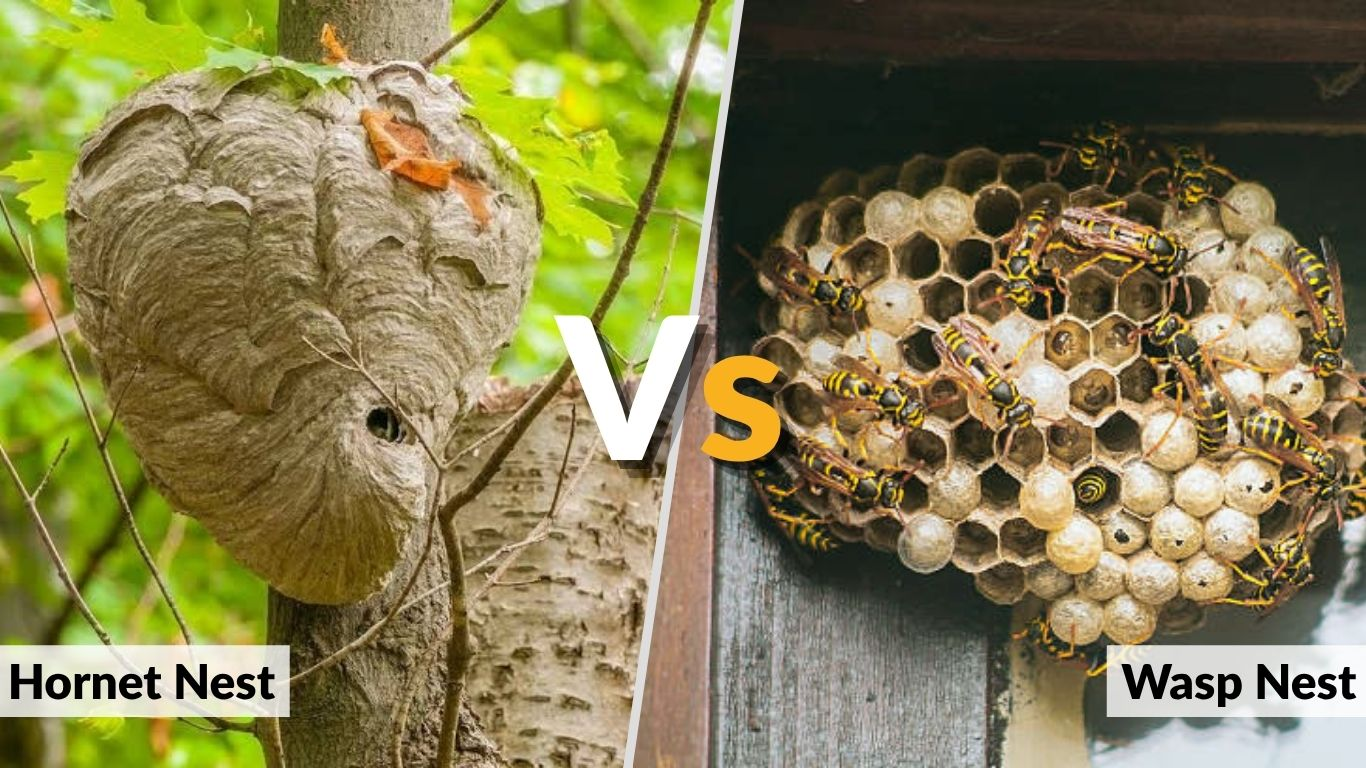
A hornet nest vs wasp nest can look similar at first because both are often made from papery material. However, their shape, location, size, and risk level can be very different. Hornets usually build larger enclosed nests, while many wasps, especially paper wasps, build open umbrella-shaped nests. Yellow jackets may nest underground, which adds more confusion. Learning the difference helps you identify the nest, understand the danger, and decide whether it should be removed.
Hornet Nest vs Wasp Nest: Quick Comparison
Hornets are actually a type of wasp, but people usually use the word “wasp” for paper wasps, yellow jackets, and similar stinging insects. When comparing a hornet nest vs wasp nest, the biggest clues are the nest’s shape and location.
| Feature | Hornet Nest | Wasp Nest |
|---|---|---|
| Shape | Large round or football-shaped nest | Often open umbrella-shaped or hidden |
| Outer covering | Usually enclosed | Paper wasps have open cells |
| Common location | Trees, shrubs, rooflines, buildings | Eaves, porch ceilings, wall voids, ground holes |
| Size | Often larger | Usually smaller, depending on species |
| Aggression | Often very defensive near nest | Varies by species |
| Nest material | Chewed wood paper | Chewed wood paper or hidden cavity nest |
The easiest way to tell them apart is this: if the nest is a large enclosed gray paper ball, it is likely a hornet nest. If the nest has visible open cells hanging under an eave, it is likely a paper wasp nest.
What Does a Hornet Nest Look Like?
A hornet nest usually looks like a gray or tan paper-covered ball. It may be round, oval, or football-shaped. Many hornet nests have a single entrance hole near the lower section. The inside contains layers of comb, but you usually cannot see those combs because the outer shell covers them.
Hornet Nest Identification
- Large gray or brown paper-like structure
- Round, oval, or football-shaped
- Enclosed outer shell
- One main entrance hole
- Often found hanging from trees, shrubs, or buildings
- May become basketball-sized or larger
Hornet nests are often more noticeable in late summer when the colony is large. Early in the season, the nest may be small and easy to miss.
What Does a Wasp Nest Look Like?
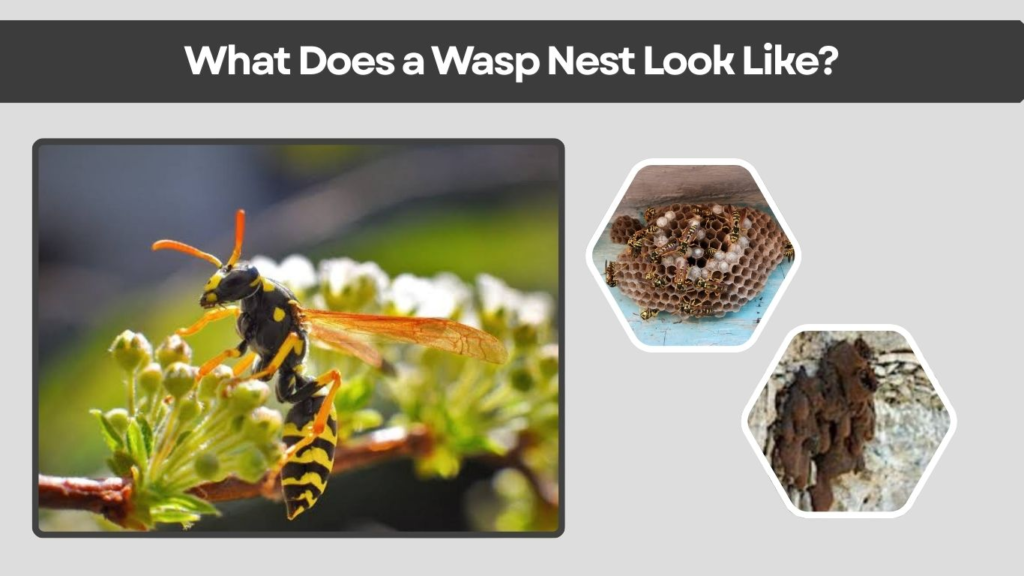
A wasp nest depends on the type of wasp. Paper wasps usually build open nests with visible hexagon-shaped cells. Yellow jackets may build hidden nests underground, inside walls, or in other cavities. Mud daubers build mud tubes rather than paper nests.
Common Wasp Nest Types
- Paper wasp nest: Open, umbrella-shaped nest with visible cells
- Yellow jacket nest: Often hidden in the ground, wall void, attic, or hollow space
- Mud dauber nest: Mud tubes or mud chambers on walls, ceilings, or sheds
- Aerial yellow jacket nest: Enclosed paper nest, similar to hornet nests
This is why the phrase “wasp nest” can be broad. Not all wasp nests look the same.
Paper Wasp Nest vs Hornet Nest
A paper wasp nest vs hornet nest is one of the easiest comparisons. Paper wasp nests are usually open and smaller. Hornet nests are enclosed and often larger.
Paper wasps build a single layer of open cells. The nest often hangs from a thin stalk under porch ceilings, deck rails, eaves, sheds, or outdoor furniture. You can usually see the individual cells from below.
Hornets build a covered nest with a protective paper shell. The combs are hidden inside. You normally see the outer shell and the entrance hole, not the cells.
Main Differences
- Paper wasp nests show open cells.
- Hornet nests have a closed outer cover.
- Paper wasp nests are often smaller.
- Hornet nests may be round or football-shaped.
- Paper wasps often hang under eaves.
- Hornets often nest in trees, shrubs, or high structures.
Bald Faced Hornet Nest vs Paper Wasp Nest
A bald faced hornet nest is usually large, gray, and enclosed. A paper wasp nest is open and umbrella-shaped. This keyword is common because bald faced hornets are black and white, aggressive near the nest, and often build visible nests around homes.
Bald faced hornets may attach nests to trees, roof edges, utility poles, shrubs, or buildings. The nest often looks like a gray paper football. Paper wasps usually build smaller open nests in sheltered spots.
| Feature | Bald Faced Hornet Nest | Paper Wasp Nest |
|---|---|---|
| Outer shell | Yes | No |
| Cell visibility | Hidden | Visible |
| Shape | Round or football-shaped | Umbrella-like |
| Typical size | Medium to very large | Small to medium |
| Defensive behavior | Strong near nest | Moderate to strong |
If the nest looks like a closed gray ball, treat it as more dangerous and avoid disturbing it.
Wasp vs Hornet vs Yellow Jacket Nest
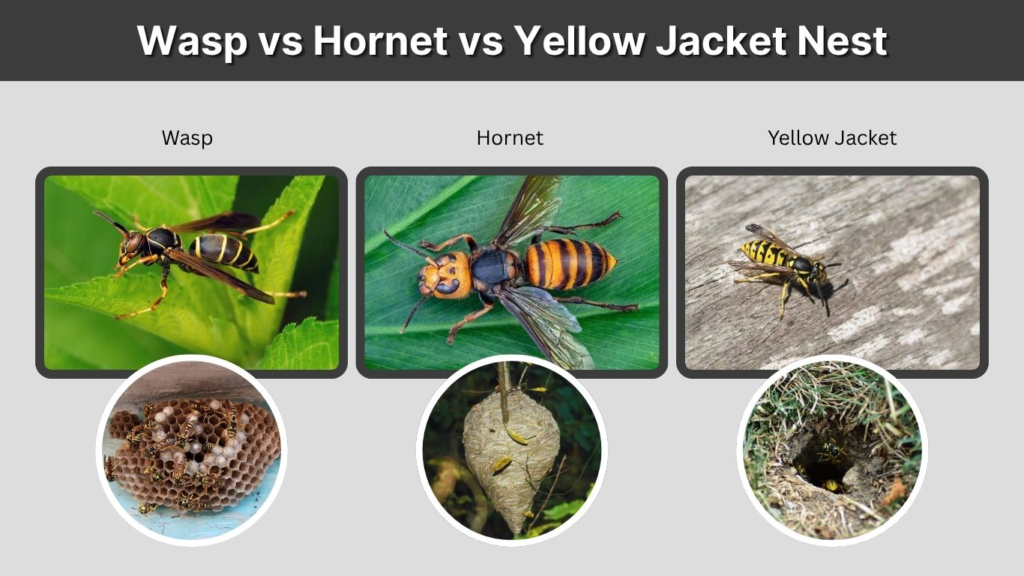
Yellow jackets make this topic more confusing because they are also wasps. Their nests can be underground, inside wall voids, or aerial. A yellow jacket nest may not be visible from the outside; you may only see insects flying in and out of a hole.
Yellow Jacket Nest Clues
- Many insects entering a ground hole
- Activity near wall cracks or siding gaps
- Hidden nest in an attic or wall void
- Smaller yellow-and-black insects
- Fast, defensive movement around the entrance
Hornets usually build above-ground enclosed nests. Paper wasps build open nests. Yellow jackets often build hidden nests in the ground or cavities.
Bee Nest vs Wasp Nest vs Hornet Nest
Many people also search for bee vs wasp vs hornet nest because they see flying insects around a structure and want to know what they are. Bees, wasps, and hornets can all sting, but their nests are different.
| Nest Type | Common Look | Common Location |
|---|---|---|
| Bee nest or hive | Wax comb, cluster of bees, honey storage | Tree hollow, wall void, hive box |
| Paper wasp nest | Open paper cells | Eaves, porches, railings |
| Hornet nest | Enclosed paper ball | Trees, shrubs, rooflines |
| Yellow jacket nest | Hidden paper comb | Ground holes, wall voids, attics |
| Mud dauber nest | Mud tubes | Walls, sheds, garages |
Honey bee nests are made from wax, not gray paper. If you see a large cluster of fuzzy bees or honeycomb, it may be a bee colony rather than a wasp or hornet nest.
Hornet Nest vs Wasp Nest Pictures: What to Look For
When looking at hornet nest vs wasp nest pictures, focus on the nest structure instead of just the insect. Many people misidentify nests because they only notice the flying insect.
Visual Clues
- Closed gray paper ball: hornet or aerial yellow jacket nest
- Open cells under an eave: paper wasp nest
- Hole in the ground with heavy traffic: yellow jacket nest
- Mud tubes on wall: mud dauber nest
- Wax comb or bee cluster: bee nest or hive
- Nest inside a wall crack: often yellow jacket, wasp, or bee colony
Pictures are helpful, but do not get too close to take one. Use zoom from a safe distance.
Ground Nest: Hornet or Wasp?
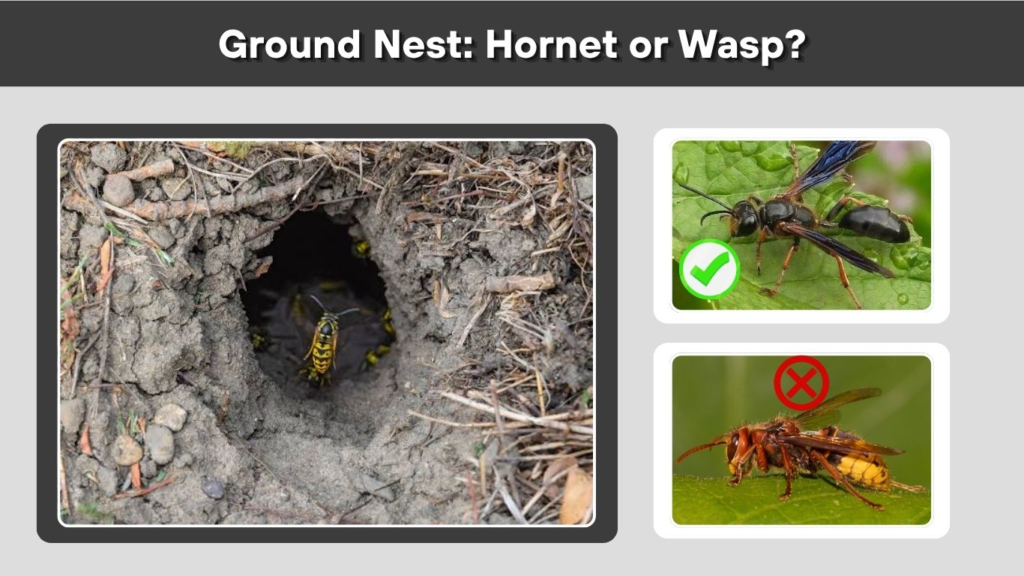
A nest in the ground is usually not a true hornet nest. Ground nests are most often yellow jackets, ground-nesting bees, or other wasps. Bald faced hornets usually build aerial nests above ground.
If you see insects flying in and out of a soil hole, do not block the entrance. Blocking the hole may force them to find another exit, especially if the nest connects to a wall, crawl space, or structure.
Ground Nest Safety Tips
- Do not mow directly over the nest.
- Keep children and pets away.
- Do not pour gasoline, bleach, or chemicals into the hole.
- Mark the area from a safe distance.
- Call a professional if the nest is near people.
Ground nests can be dangerous because people often step on them or disturb them without seeing the colony.
Where Hornets and Wasps Build Nests
Nest location is one of the best identification clues. Hornets often choose elevated, protected places. Paper wasps prefer sheltered overhangs. Yellow jackets often use hidden cavities.
Hornet Nest Locations
- Trees
- Shrubs
- Rooflines
- Sheds
- Barns
- Utility poles
- Attics
- Wall voids
Wasp Nest Locations
- Porch ceilings
- Deck railings
- Fence posts
- Eaves
- Garages
- Attics
- Ground holes
- Wall cracks
- Outdoor furniture
If the nest is high and enclosed, it may be a hornet nest. If it is open and attached to a ceiling or railing, it is likely paper wasps.
Which Nest Is More Dangerous?
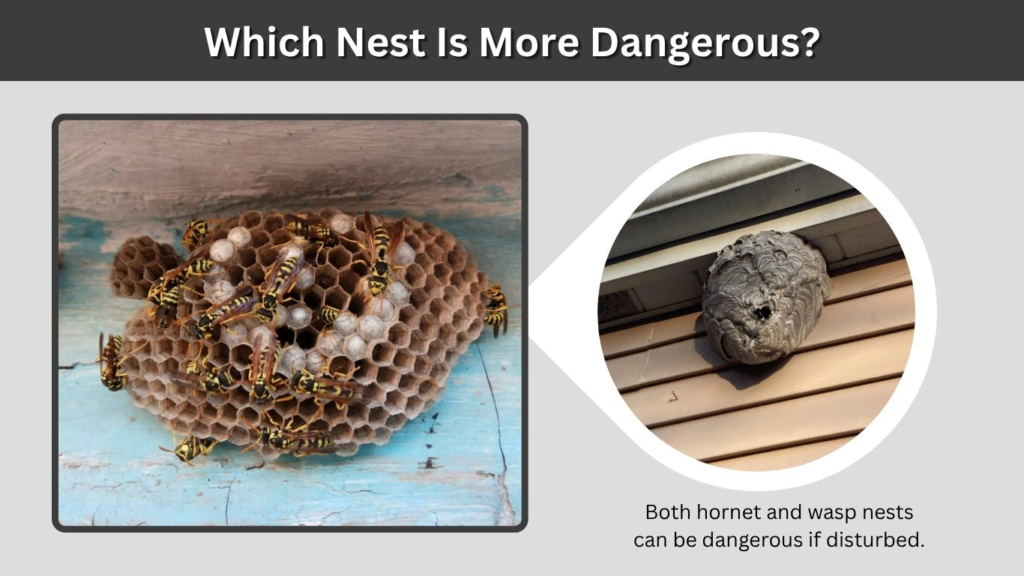
Both hornet and wasp nests can be dangerous if disturbed. The risk depends on the species, colony size, location, and how close people get to the entrance.
Hornets, especially bald faced hornets, are known for strong nest defense. Yellow jackets can also be highly aggressive, especially near ground nests in late summer and fall. Paper wasps may be less aggressive when left alone, but they still sting if the nest is threatened.
Higher-Risk Nest Situations
- Nest near a doorway
- Nest near a deck or patio
- Nest near children or pets
- Nest inside a wall or attic
- Nest near a walkway
- Ground nest in a lawn
- Large late-season nest
- Nest disturbed by mowing or trimming
Any active nest in a high-traffic area should be treated carefully.
How to Remove a Hornet Nest vs Wasp Nest
Removal depends on the nest type. Small paper wasp nests may sometimes be handled more easily than large hornet or yellow jacket nests, but any removal can be risky.
Safer Removal Guidelines
- Identify the nest before taking action.
- Avoid removing large active nests yourself.
- Do not knock down a live nest.
- Do not spray from a ladder.
- Do not block wall or ground entrances.
- Keep people and pets away.
- Call a professional for large, hidden, high, or aggressive nests.
Professional removal is usually best for hornet nests, yellow jacket nests, nests inside walls, and nests close to living areas.
Can You Leave the Nest Alone?
Sometimes, yes. If the nest is far from people and not causing problems, it may be better to leave it alone until cold weather. Many wasp and hornet colonies die out naturally after the season ends. Old paper nests are usually not reused.
However, if the nest is near doors, patios, playgrounds, pets, or work areas, waiting may not be safe. The colony may grow larger and more defensive as the season progresses.
FAQs
What is the main difference between a hornet nest and a wasp nest?
A hornet nest is usually larger and enclosed with a gray paper shell. A paper wasp nest is usually open, umbrella-shaped, and has visible cells.
Is a paper wasp nest the same as a hornet nest?
No. A paper wasp nest usually has open cells and no outer covering. A hornet nest is usually enclosed and round or football-shaped.
Do hornets or wasps nest in the ground?
Yellow jackets often nest in the ground, but bald faced hornets usually build aerial nests. If insects are flying from a ground hole, they are more likely yellow jackets than hornets.
Which is worse, a hornet nest or a wasp nest?
A large hornet nest or yellow jacket nest is usually more dangerous than a small paper wasp nest because the colony may be larger and more defensive. However, any active nest can be risky if disturbed.
Should I remove a hornet or wasp nest myself?
DIY removal can be dangerous, especially for large nests, ground nests, wall nests, or nests near people. Professional removal is the safest option for active nests in high-risk areas.
