
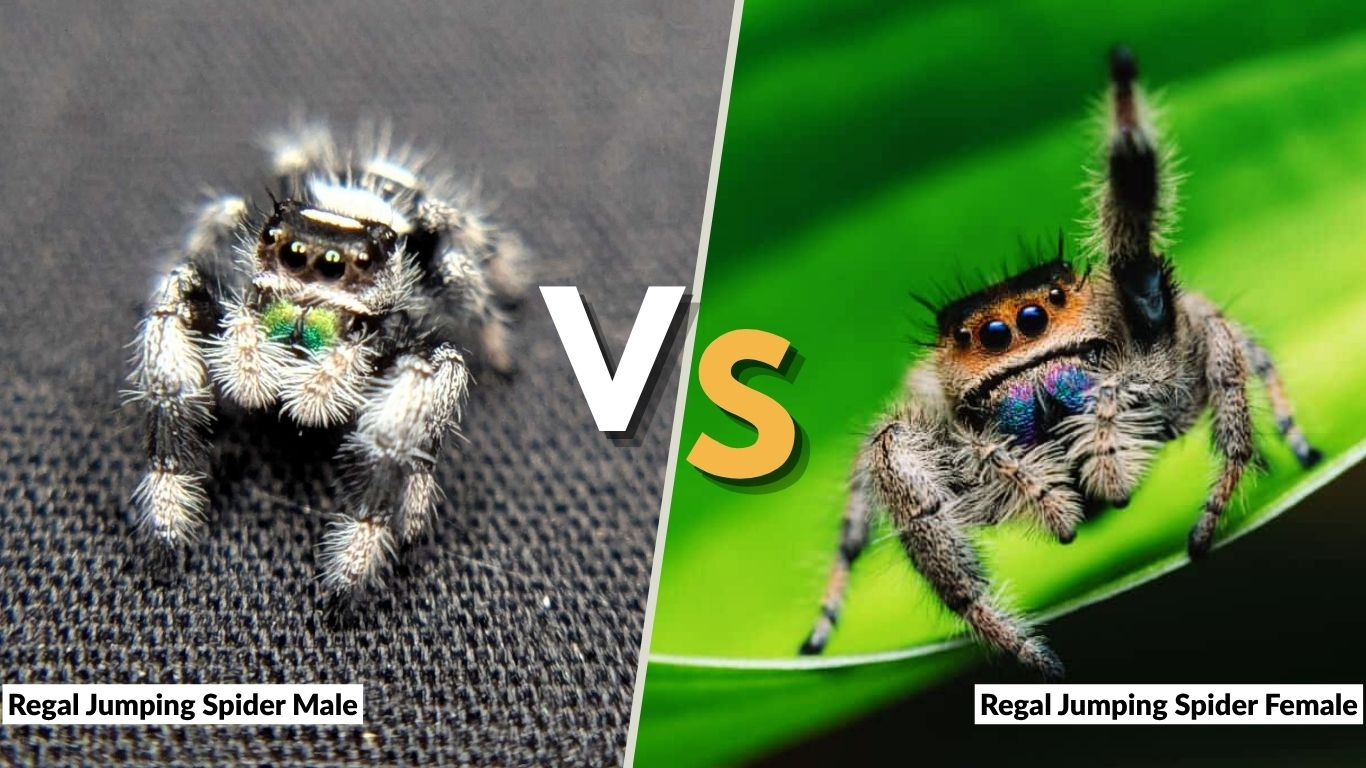
Regal jumping spider male vs female identification is usually based on color, size, body shape, markings, and maturity. Males are typically black with white abdominal markings and bright iridescent chelicerae, while females are often larger, rounder, and more variable in color. Female regal jumping spiders may be gray, tan, brown, orange, or a mix of shades, making them look very different from adult males.
What Is a Regal Jumping Spider?
The regal jumping spider, scientifically known as Phidippus regius, is one of the best-known jumping spiders in North America. It belongs to the family Salticidae, the jumping spider family. Like other jumping spiders, it has excellent vision, a compact body, and an active hunting style.
Instead of building a sticky web to catch prey, a regal jumping spider stalks insects and jumps when close enough. It uses silk for safety lines, resting shelters, molting, and egg-laying, but not as a prey-catching web. This active behavior is one reason regal jumping spiders are popular among spider keepers and macro photographers.
The species is strongly associated with the southeastern United States, the Greater Antilles, and the Bahamas. It is especially common in peninsular Florida, where it is one of the jumping spiders most frequently encountered. The University of Florida notes that Phidippus regius is the largest jumping spider in eastern North America.
Regal Jumping Spider Male vs Female at a Glance
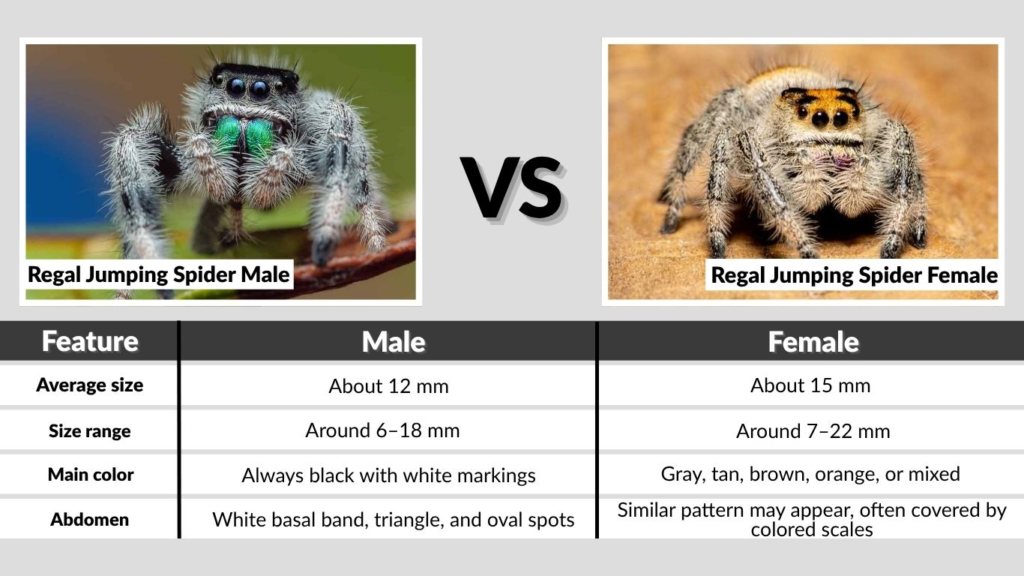
The fastest way to compare a male vs female regal jumping spider is to look at color and body shape. Adult males usually have a bold black-and-white appearance. Adult females are often larger and more colorful, with gray, tan, brown, or orange scales covering much of the body.
| Feature | Male Regal Jumping Spider | Female Regal Jumping Spider |
| Average size | About 12 mm | About 15 mm |
| Size range | Around 6–18 mm | Around 7–22 mm |
| Main color | Always black with white markings | Gray, tan, brown, orange, or mixed |
| Abdomen | White basal band, triangle, and oval spots | Similar pattern may appear, often covered by colored scales |
| Chelicerae | Large, bright green-blue-violet, very noticeable | Iridescent green or red-violet, usually less visible |
| Front legs | Often longer and more dramatic in large males | Leg fringes present but less distinct |
| Eye-area tufts | Absent | Four tufts of setae near dorsal eyes |
| Common role in breeding | Searches, courts, displays | Produces egg sacs, needs more feeding support |
The table gives a quick overview, but real identification can be tricky. Age, molt stage, lighting, nutrition, and regional variation can all affect appearance.
Male Regal Jumping Spider Appearance
Adult male regal jumping spiders are usually the easier sex to recognize. They are black with clear white markings on the abdomen. The typical male pattern includes a white band near the front of the abdomen, a central triangular white mark, and two oval white spots toward the rear.
Their first pair of legs may look especially bold because of alternating black and white fringes. In larger males, the first legs can be disproportionately long compared with smaller males. This gives mature males a striking, display-ready look.
Another major male feature is the chelicerae. The chelicerae are the mouthpart structures just below the front eyes. In males, they are large, enlarged, and brightly iridescent. Depending on the light, they can look green, blue, violet, or a mix of those colors.
Male traits often include:
- Black body color
- White abdominal markings
- Bold front-leg fringes
- Large iridescent chelicerae
- Slimmer body compared with mature females
- More wandering and courtship behavior as adults
Males can vary in size. Some mature males are much smaller than others, so size alone should not be the only identification clue.
Female Regal Jumping Spider Appearance
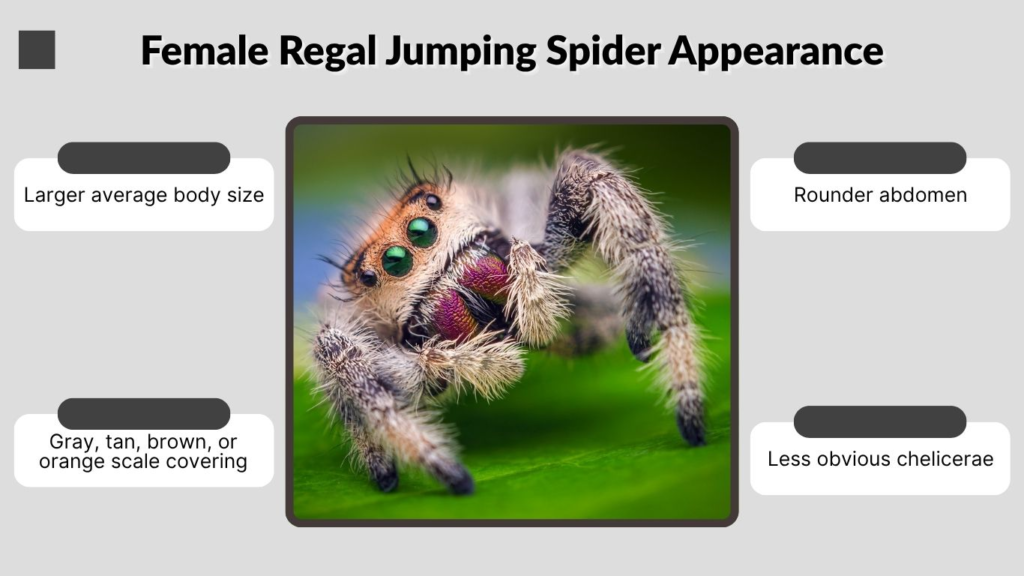
Female regal jumping spiders are usually more variable in color than males. Some females can have a pattern similar to males, but many are covered with colored scales. These scales may be gray, tan, brown, orange, or combinations of these colors.
Orange females are especially well known and often appear in photos of captive-bred regal jumping spiders. However, not every female is orange. Some females are pale gray, sandy brown, dark brown, or mixed with warm and cool tones.
Females also tend to have a heavier body shape, especially when well-fed or mature. Their abdomen may look larger and rounder than a male’s. A mature female may appear more robust because she carries more body mass and may eventually produce eggs.
Female traits often include:
- Larger average body size
- Rounder abdomen
- Gray, tan, brown, or orange scale covering
- Less obvious chelicerae
- Palps with long white hairs
- Four small tufts of setae near the dorsal eyes
- More time spent in retreats when mature or gravid
Female chelicerae can also be iridescent, but they are usually less noticeable than in males. This is partly because the palps often cover them.
Size Difference Between Male and Female Regal Jumping Spiders
Female regal jumping spiders are larger on average, but the size difference is not always simple. Adult males average about 12 mm, with a range of roughly 6 to 18 mm. Adult females average about 15 mm, with a range of roughly 7 to 22 mm. These measurements come from the University of Florida’s profile of the species.
This means a large male can be bigger than a small female. A well-fed female may also have a longer-looking body because of a large abdomen. BugGuide notes that female body length may be longer due to a larger abdomen, while leg and carapace lengths can be smaller compared with large males.
For identification, use size as a supporting clue rather than the main rule. A large, round, orange spider is likely female. A black spider with white markings and bright green-blue chelicerae is likely male. But a small juvenile or subadult can be harder to sex.
Color Differences in Male and Female Regal Jumping Spiders
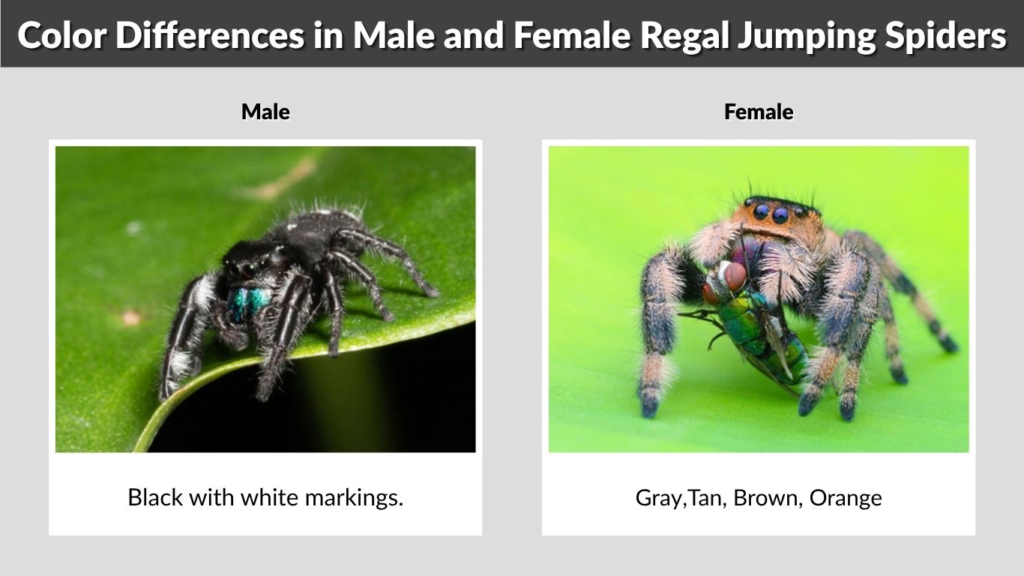
Color is often the most useful clue in adult spiders. Male regal jumping spiders are consistently black with white markings. This makes them look bold and high-contrast.
Females are more flexible in appearance. Their color may be:
- Gray
- Tan
- Brown
- Orange
- Creamy beige
- Mixed gray and orange
- Mixed tan and brown
Some females still show markings similar to males, but the colored scales can soften or cover the black areas. In southern Florida and the Greater Antilles, more colorful females are especially common. This explains why many pet-regal jumping spiders sold or photographed online are orange females.
Lighting can change how the spider looks. Under bright light, scales may look pale or golden. Under dim light, the same female may look brown or gray. Freshly molted spiders can also look different from older individuals.
Chelicerae: One of the Best Sexing Clues
Chelicerae are one of the most beautiful features of regal jumping spiders. These are the paired structures below the front eyes, near the fangs. In both sexes, they can be iridescent, but they are usually more dramatic in males.
Male chelicerae are enlarged and visibly green-blue-violet. They are part of the male’s overall display appearance and may help with recognition between sexes. In females, the chelicerae may be green or red-violet, but they are often partly hidden by the palps.
If you are trying to identify male vs female regal jumping spider traits, look at the front of the face:
- Big, bright, exposed green-blue chelicerae often suggest male
- Less visible chelicerae covered by fuzzy palps often suggest female
- Iridescence alone does not prove sex because both can show it
- Chelicerae should be combined with body color and shape
This feature is easiest to see in a clear close-up photo taken from the front.
Behavior Differences Between Males and Females
Male and female regal jumping spiders share the same basic hunting style. Both use strong vision to locate prey, then jump to capture it. Both also use silk retreats for resting and safety.
The biggest behavioral difference appears during maturity and breeding. Adult males are more likely to wander in search of females. They may display with leg movements, body posture, and courtship dances. Their bold front legs and bright chelicerae help make these displays more visible.
Females may become more retreat-focused, especially when preparing to molt, lay eggs, or guard an egg sac. A mature or gravid female may spend more time hidden in a thick silk retreat.
Male behavior may include:
- More roaming
- Courtship dances
- Leg waving and display
- Searching for females
- Less long-term interest in egg-related shelter
Female behavior may include:
- More feeding before egg production
- More retreat-building
- Egg sac production
- Guarding eggs
- More defensive behavior near eggs
These are general patterns, not strict rules. Individual spiders can behave differently depending on age, stress, hunger, and environment.
Juvenile Regal Jumping Spider Male vs Female
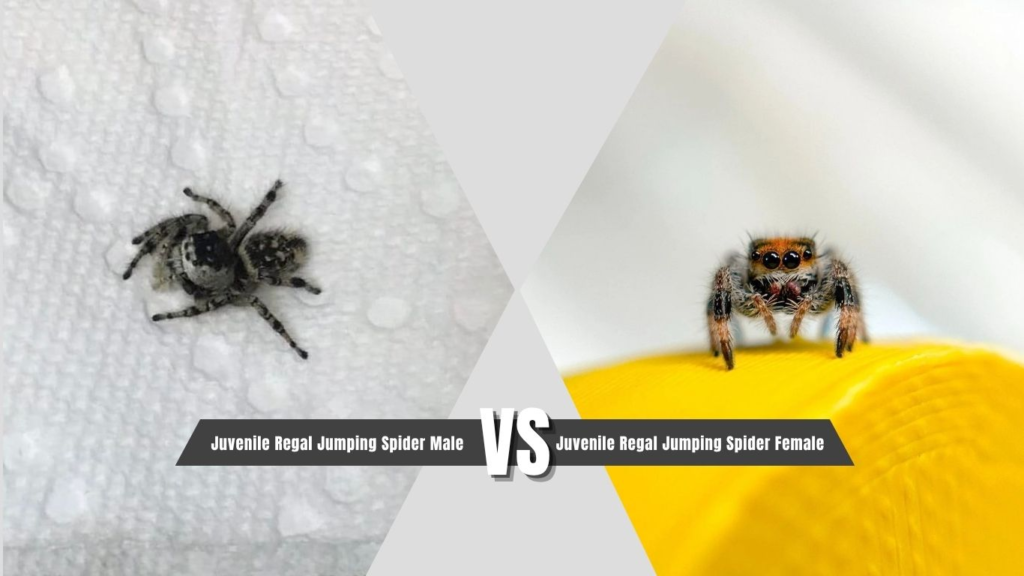
Juvenile regal jumping spiders can be harder to sex than adults. Young spiders may not show fully developed adult colors, size, or reproductive features. However, Phidippus regius is unusual because it can sometimes be sexed earlier than many other spiders.
In southern populations, juvenile females may begin developing colored scale cover as early as the third instar. Males, on the other hand, stay stark black and white throughout their life cycle. This can help experienced keepers make early guesses.
Still, sexing juveniles is not always certain. A young spider may change significantly after later molts. If you are buying or caring for a juvenile regal jumping spider, treat early sex identification as a likely guess unless confirmed by an experienced keeper or by mature characteristics.
Male vs Female Regal Jumping Spider as Pets
Both male and female regal jumping spiders can be kept as pets, but many keepers prefer females because they are often larger, more colorful, and longer-lived. Males can be active, bold, and beautiful, but they may spend more time roaming once mature.
A female may be better for someone who wants a larger display spider. An orange or tan female can be especially attractive in a planted or decorated enclosure. A male may be better for someone who likes high-contrast black-and-white markings and vivid green-blue chelicerae.
Pet comparison:
- Females are often larger and more colorful
- Males are often more active as adults
- Females may live longer after maturity
- Males may wander more when sexually mature
- Females may produce infertile eggs even without recent mating
- Both need small prey, ventilation, climbing space, and safe moisture
If keeping one as a pet, avoid housing males and females together except under careful breeding supervision. Jumping spiders are predators, and cannibalism can happen.
Breeding Differences
The difference between male and female regal jumping spiders matters most for breeding. A mature male must court the female carefully. Courtship may include leg displays, movement patterns, and positioning. If the female is receptive, mating may occur. If she is not receptive or is hungry, the male may be at risk.
Females can produce egg sacs after mating. They build thick silken nests and guard the eggs. The University of Florida notes that females may lay several batches of eggs, with the first batch averaging 183 eggs and later batches declining in number.
Because females can produce large numbers of spiderlings, breeding should not be done casually. Spiderlings need tiny prey, careful humidity, separation as they grow, and secure containers. A single successful egg sac can create more young spiders than a beginner is prepared to raise.
Common Misidentification Problems
Regal jumping spiders can be confused with other Phidippus species, especially bold jumping spiders and canopy jumping spiders. All can look dark, hairy, and strong-bodied, and some have similar white markings.
The University of Florida notes that Phidippus audax and Phidippus otiosus occur through much of the same range and can look similar to Phidippus regius. Pattern details on the abdomen can help separate them, but confident species identification may require a clear photo and regional knowledge.
Common mistakes include:
- Calling every black jumping spider a male regal
- Calling every orange jumping spider a female regal
- Confusing bold jumping spiders with regal jumping spiders
- Trying to sex immature spiders too early
- Using size alone instead of multiple clues
- Relying on one blurry photo
For best results, compare the body color, abdominal markings, chelicerae, leg fringes, location, and maturity level together.
Is One Sex More Dangerous?
Neither male nor female regal jumping spiders are considered dangerous to humans. Jumping spiders are generally beneficial predators. The University of Florida states that jumping spiders are harmless, beneficial creatures, though larger species such as Phidippus regius can deliver a painful bite if held tightly.
A bite may feel like a sharp sting, but it usually fades quickly and does not require special treatment. These spiders do not seek out people to bite. Most bites happen when a spider is trapped, pinched, or handled roughly.
To avoid bites:
- Do not squeeze the spider
- Avoid grabbing it with bare fingers
- Move it with a cup and paper if needed
- Give it space during molting
- Do not disturb a female guarding eggs
For pet keepers, gentle handling and short supervised interactions are safer than frequent handling.
How to Tell the Sex of Your Regal Jumping Spider
To tell whether your regal jumping spider is male or female, start with mature color. A black spider with crisp white abdominal markings, bold front legs, and very visible green-blue chelicerae is likely male. A larger spider with a rounder abdomen and gray, tan, brown, or orange scales is likely female.
Next, look at the face. Males usually show more exposed, enlarged, iridescent chelicerae. Females may show fuzzy palps that partly hide the chelicerae. If the spider is mature, body shape can also help. Females often look heavier, especially in the abdomen.
Use this simple checklist:
- Is the spider mature?
- Is it black and white or covered with colored scales?
- Are the chelicerae large and very visible?
- Is the abdomen slim or round?
- Are the front legs especially long and dramatic?
- Is the spider roaming often or staying near a retreat?
- Is there evidence of an egg sac or gravid abdomen?
If the spider is still young, wait for more molts before making a final decision.
FAQs
Are male or female regal jumping spiders bigger?
Female regal jumping spiders are larger on average. Adult females average about 15 mm, while adult males average about 12 mm. However, size varies a lot. A large male may be bigger than a small female, so size should be used with color, markings, chelicerae, and body shape.
What color is a male regal jumping spider?
An adult male regal jumping spider is typically black with white markings on the abdomen. It often has a white basal band, a central triangular white mark, and two oval white spots near the rear. Males also have enlarged iridescent chelicerae that may look green, blue, or violet.
What color is a female regal jumping spider?
A female regal jumping spider may be gray, tan, brown, orange, or mixed in color. Some females have markings similar to males, but many have colored scales covering much of the body. Orange females are especially popular in photos and the pet trade, but not all females are orange.
Can juvenile regal jumping spiders be sexed?
Sometimes, but juvenile sexing is less reliable than adult sexing. In southern populations, young females may develop colored scale cover early, while males remain black and white. Still, young spiders can change after later molts, so sex identification is more certain after maturity.
Which is better as a pet, male or female regal jumping spider?
Both can make interesting pets. Females are often preferred because they are larger, more colorful, and may live longer after maturity. Males are striking, active, and have bold black-and-white markings with bright chelicerae. The better choice depends on whether you prefer color, size, or activity.
