
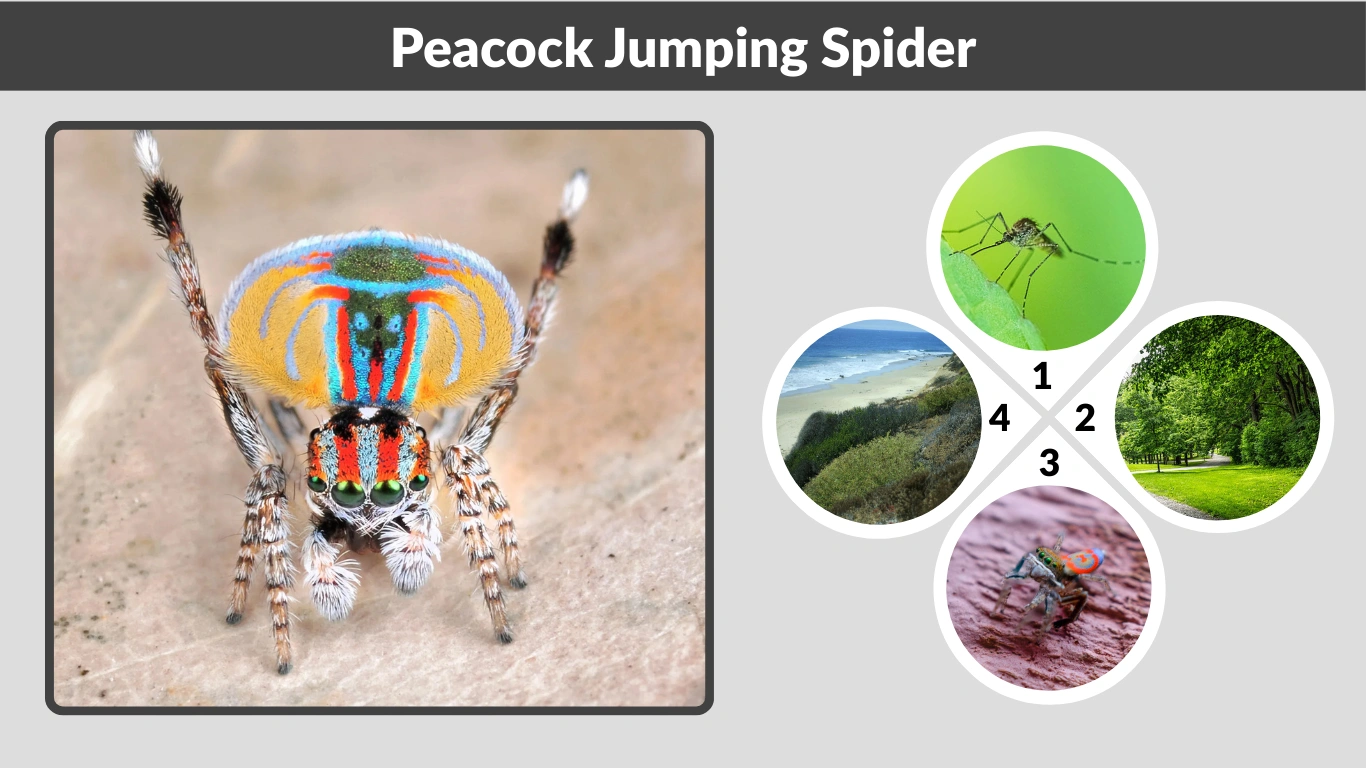
Peacock jumping spiders are among the most visually striking spiders in the world. Famous for their brilliant colors and elaborate mating dances, these tiny arachnids belong to the genus Maratus and are native mainly to Australia. Despite their small size, they have captured global attention from scientists, photographers, and nature lovers because of their complex courtship displays and excellent vision. Understanding their appearance, behavior, and natural life helps reveal why these spiders are so unique.
What Is a Peacock Jumping Spider?
A peacock jumping spider is a small jumping spider from the genus Maratus, a group that includes dozens of closely related species. They are called “peacock” spiders because many males display brightly colored, fan-shaped abdomens that resemble a peacock’s tail. These spiders belong to the family Salticidae, which is known for excellent eyesight and active hunting behavior.
Unlike web-building spiders, peacock jumping spiders hunt by stalking and pouncing on their prey. They are harmless to humans and spend most of their lives close to the ground among leaves, grass, and low vegetation. New species of peacock jumping spiders continue to be discovered, making them an important subject of modern spider research.
Peacock Jumping Spider Identification

Physical Appearance
Peacock jumping spiders are very small, usually measuring between 3 and 6 millimeters in length. Their bodies are compact and fuzzy, with short legs adapted for jumping. Females are typically brown or gray with subtle markings that help them blend into the environment.
Males, however, are often brilliantly colored. Depending on the species, males may display bright red, blue, green, orange, or purple scales arranged in complex patterns. These colors are not produced by pigments alone but by microscopic structures that reflect light, creating an iridescent effect.
Distinctive Peacock Display
The most famous feature of peacock jumping spiders is the male’s courtship display. During mating rituals, the male raises and spreads a flap on his abdomen, forming a fan-like shape. He then waves his legs, vibrates his body, and moves rhythmically in front of the female.
These dances are not just visual. Males also produce vibrations that travel through the ground or plant surfaces. The combination of movement, color, and vibration plays a major role in attracting females and distinguishing one species from another.
Types of Peacock Jumping Spiders
The genus Maratus includes many species, each with its own unique color patterns and courtship styles. Some of the best-known peacock jumping spiders include Maratus volans, which has bright red and blue flaps, Maratus splendens, known for shimmering rainbow colors, and Maratus robinsoni, which features bold stripes and fan markings.
Scientists continue to identify new species across Australia, especially in isolated habitats. While they share general traits, each species differs in abdominal design, leg movements, and dance sequences, which helps prevent cross-breeding between closely related spiders.
Habitat and Natural Range

Peacock jumping spiders are native almost entirely to Australia, where they inhabit a wide range of environments. They are commonly found in grasslands, coastal scrub, open forests, and sand dunes. Some species live in leaf litter, while others prefer low shrubs or ground-level vegetation.
These spiders favor sunny, dry habitats where they can hunt visually during the day. They often hide beneath leaves, bark, or small debris when resting or avoiding predators. Because of their tiny size, they rely heavily on camouflage and quick movements to survive.
Behavior and Movement
Hunting Behavior
Peacock jumping spiders are active daytime hunters. Instead of building webs to trap prey, they rely on exceptional eyesight to locate insects such as flies, ants, and small beetles. Once a target is spotted, the spider slowly approaches, carefully adjusting its position before launching a precise jump.
Their jumps are powered by hydraulic pressure rather than muscle strength, allowing them to leap many times their body length. After landing on their prey, they quickly deliver a venomous bite to immobilize it.
Courtship and Mating Dances
Courtship is where peacock jumping spiders truly stand out. When a male encounters a female, he begins an elaborate display that combines visual signals, leg movements, and vibrations. He raises his colorful abdominal fan, spreads it wide, and moves it from side to side while lifting and waving his front legs.
At the same time, the male sends rhythmic vibrations through the ground or plant surface using his abdomen and legs. Each species has its own unique “dance routine,” which helps females recognize suitable mates. Females closely watch and sense these displays before deciding whether to accept or reject the male. If the female is not impressed, the male may retreat quickly to avoid being attacked.
Peacock Jumping Spider Life Cycle
The life cycle of a peacock jumping spider begins when a female lays eggs inside a small silk sac hidden under leaves, bark, or soil debris. The egg sac protects the developing spiderlings from drying out and from predators. After several weeks, tiny spiderlings hatch and remain near the sac for a short time.
As they grow, spiderlings molt repeatedly, shedding their outer skin to increase in size. Juveniles already resemble miniature adults but lack bright coloration. Males develop their vivid colors and abdominal flaps only after their final molts. Most peacock jumping spiders live for about one year, with their adult stage focused mainly on feeding and reproduction.
Diet and Feeding Habits

Peacock jumping spiders feed on a variety of small insects and other arthropods. Common prey includes flies, mosquitoes, ants, moths, and tiny beetles. Their excellent eyesight allows them to judge distance accurately before jumping.
Once they capture prey, they inject venom to immobilize it and then consume the liquefied tissues. By feeding on many pest insects, peacock jumping spiders play a useful role in natural ecosystems.
Are Peacock Jumping Spiders Dangerous?
Peacock jumping spiders are not dangerous to humans. Their venom is designed to subdue tiny insects and is not medically significant to people. Bites are extremely rare and usually occur only if a spider is trapped or handled roughly.
If a bite does happen, it is typically mild, causing slight redness or irritation similar to a mosquito bite. These spiders are shy by nature and prefer to flee rather than defend themselves.
Peacock Jumping Spider as a Pet
Some spider enthusiasts keep jumping spiders, including peacock spiders, as pets. Because of their small size, they require only a tiny enclosure with good ventilation, light, and hiding places. They feed on fruit flies or other very small insects.
However, peacock jumping spiders are delicate and short-lived, and many species are found only in the wild. Ethical collection, local regulations, and conservation concerns should always be considered before keeping any wild spider.
Interesting Facts About Peacock Jumping Spiders
Peacock jumping spiders can see colors and details far better than most other spiders. Their bright colors are produced by microscopic scales that reflect light rather than by pigments alone. Scientists frequently discover new Maratus species, showing how diverse this group really is. Despite their tiny size, their dances are among the most complex courtship displays known in arthropods.
Peacock Jumping Spider vs Other Jumping Spiders

| Feature | Peacock Jumping Spider | Typical Jumping Spider |
| Coloration | Extremely bright, iridescent | Usually dull or patterned |
| Courtship | Elaborate dances and fans | Simple movements |
| Fame | Globally popular | Less well-known |
| Habitat | Mostly Australia | Worldwide |
Conservation and Threats
Many peacock jumping spider species live in limited habitats. Land development, agriculture, and climate change can threaten these small, localized populations. Because new species are still being discovered, habitat protection is important to preserve their diversity.
FAQs
What makes peacock jumping spiders so colorful?
Their colors come from microscopic scales that reflect and bend light. These structural colors create bright blues, reds, and greens that change appearance depending on the angle of light.
Where do peacock jumping spiders live?
Most peacock jumping spiders are native to Australia. They live in grasslands, open forests, coastal scrub, and areas with low vegetation and leaf litter.
Are peacock jumping spiders poisonous?
They are venomous like most spiders, but not poisonous or dangerous to humans. Their venom only affects small insects.
How long do peacock jumping spiders live?
Most live for about one year. Their life cycle includes egg, spiderling, juvenile, and adult stages, with adulthood focused on reproduction.
Can you keep a peacock jumping spider as a pet?
Some people do, but they are delicate, short-lived, and often protected by conservation ethics. Captive care requires tiny live food and careful handling.
