
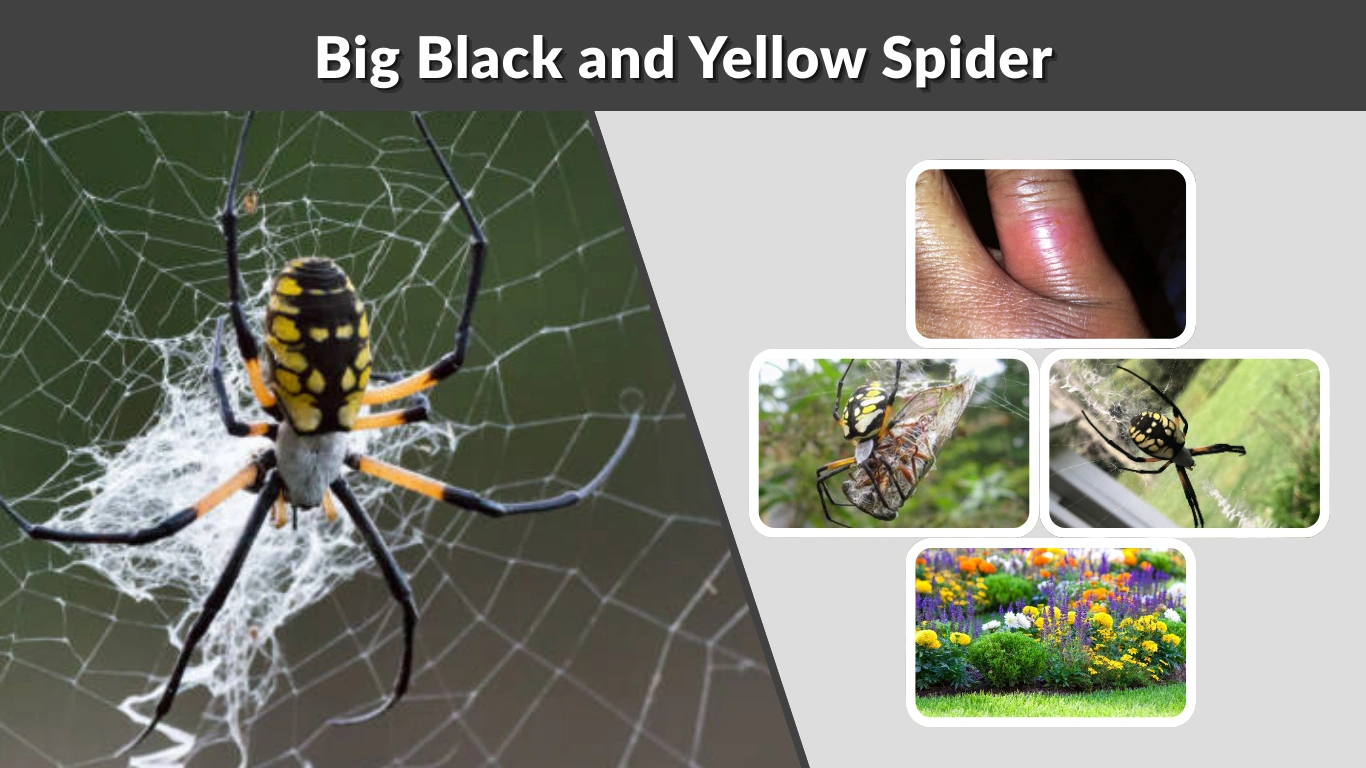
The big black and yellow spider is one of the most easily recognized spiders found across North America and in several similar forms worldwide. Its bold coloration, long banded legs, and large circular web make it highly noticeable in gardens, fields, porches, and wooded edges. Most sightings refer to members of the Argiope genus—large, harmless orbweavers that thrive in sunny outdoor environments. These spiders reach their full size in late summer and early fall, when their webs and bright patterns become especially visible. Although they appear intimidating, they are gentle and beneficial predators that help control insect populations.
Core Appearance Features of the Big Black and Yellow Spider

- Striking yellow-and-black body patterns that make the spider easy to spot
- Large size and wide leg span that create a dramatic outdoor presence
- Symmetrical body shape with a thick abdomen and long, thin legs
- A resting posture centered in a round web where the spider hangs head-down
- Strong contrast between body and leg colors that enhances visibility
Leg Patterns and Structural Features
Yellow and Black Striped Legs
The spider’s legs are one of its most defining features. Each leg is marked with alternating bands of black and yellow, giving it a striking striped appearance. These bands help the spider blend into reflections of sunlight and vegetation, offering camouflage despite its bold colors.
Long-Leg Variations
In many regions, larger females develop exceptionally long legs, which can make them appear even bigger than they are. These long limbs help stabilize the spider as it hangs in its web and also assist in sensing vibrations from prey.
Color Shifts in Different Regions
Depending on climate and region, the legs may show small variations—richer yellows in warmer climates, lighter tones in northern states, or faint brownish shading in juveniles. These natural variations still fall within the classic black-and-yellow appearance.
Body Markings and Color Forms

Black–Yellow–White Variants
Many individuals display additional white patches or lighter yellow tones along the abdomen, creating a three-color pattern. These forms are especially common in states like Florida, California, and Texas.
Spotted, Fuzzy, and White-Head Types
Some spiders show tiny yellow or black spots rather than large blocks of color. Others may appear slightly fuzzy due to fine leg hairs. Occasional white-headed variants also exist, especially in maturing females.
Full-Body vs. Back-Only Patterning
While most spiders have patterns covering the entire abdomen, some may concentrate their yellow markings on the top (dorsal) side only. Others have more evenly distributed patterns from front to back. These differences are normal within the species.
Web Style and the Zigzag Stabilimentum

The giant black and yellow spider is famous for the impressive orb web it creates. These webs can reach two to three feet across and are often built between sturdy supports such as shrubs, porch rails, tall plants, or fence posts. Positioned in sunny, open areas, the web reflects light and attracts flying insects.
A distinctive feature of the web is the zigzag stabilimentum—a white, ladder-like silk structure running vertically through the center. Its purpose is still studied, but it appears to strengthen the web and make the spider more visible to larger animals, preventing accidental destruction. Some theories suggest it may also attract insects by reflecting UV light.
The spider typically rests head-down in the center of the web, directly aligned with the stabilimentum. This position allows immediate reaction when prey becomes trapped. The web is usually rebuilt or repaired daily, ensuring strength and effectiveness throughout the season.
Quick Identification Guide
- Recognizable by its bold yellow-and-black abdomen
- Long, striped legs extending outward from the center of the web
- A thick, oval body, especially noticeable in mature females
- A large orb-shaped web with a clear white zigzag
- Calm, non-aggressive behavior, staying still unless disturbed
Venom, Bite, and Human Safety

Are They Poisonous?
Despite their large size and bright colors, these spiders are not dangerous. Their venom is mild and not harmful to humans or pets. They prefer to avoid confrontation and rarely bite unless handled roughly.
Bite Symptoms and Treatment
A bite may cause minor redness, itching, or swelling, similar to a mild bee sting. Symptoms fade quickly without medical treatment. Serious reactions are extremely rare.
Regional Concerns (e.g., MN, Wisconsin, Ontario)
Cold-weather states sometimes produce smaller individuals, but their venom and behavior remain the same—non-aggressive and harmless. Reports of danger or strong venom are misconceptions.
Garden, Porch, and Front-Door Sightings

These spiders often appear around porches, railings, and front doors because artificial lights attract insects. The spiders are not seeking shelter—they are positioning themselves near the best food source. Their webs may span between posts, flowerpots, lights, and nearby shrubs.
Garden environments provide ideal hunting conditions. Tall plants, open spaces, and steady insect traffic help these spiders build strong, productive webs. They also choose locations with good sunlight exposure, which strengthens their silk and enhances camouflage.
Homeowners often encounter these spiders suddenly when stepping outside, especially in late summer. While their size can be surprising, they are simply waiting for prey and pose no threat to people or pets.
United States Distribution
Southern States (GA, SC, NC, AL, TN, KY)
The big black and yellow spider is abundant throughout the southern United States. In Georgia, South Carolina, and North Carolina, it thrives in warm, humid landscapes and is frequently found in gardens, around homes, and along woodland edges. Alabama, Tennessee, and Kentucky also host large populations, particularly in late summer when fully grown females reach their peak size. The spider’s bright coloration and large webs become especially noticeable on fence lines, porch corners, and outdoor walkways.
Texas Regions (including South East TX)
In Texas, including the southeast region, these spiders are extremely common due to long warm seasons that support extended growth. They often construct webs along tall grasses, near barns, across garden beds, and around exterior home structures. The state’s climate allows them to reach impressive sizes, making sightings frequent in both rural and suburban areas.
Midwest & Northern States (MI, WI, MN, OH, MO, IN, IA, IL)
In the Midwest and northern states—such as Michigan, Wisconsin, Minnesota, Ohio, Missouri, Indiana, Iowa, and Illinois—the spiders are active mainly during summer. Because the warm season is shorter, these individuals may be slightly smaller, but their patterns and behaviors remain the same. Their webs often appear across garden paths, shrubs, decks, and between light posts.
Eastern & Western States (PA, CT, CA)
In the eastern states like Pennsylvania and Connecticut, these spiders often live near wooded edges, yards, and meadow areas. Sightings peak from mid-July to early September. In California, they occur in sunny, dry yards, along fences, and around garden structures. Their bright patterns stand out strongly against lighter backgrounds, making them easy to spot.
Distribution Across Canada
The big black and yellow spider appears most commonly in southern Ontario, where long summer days and warm temperatures create ideal conditions. They tend to build webs on garden plants, shrubs, and outdoor structures. While Canadian specimens may be slightly smaller than those in southern U.S. states, their iconic yellow-and-black pattern is unmistakable. Because the warm season is short, sightings typically occur between July and early September. Outside Ontario, they may occasionally appear in nearby regions with suitable microclimates.
Similar Spiders Worldwide
Beyond North America, closely related species can be found across many countries. In Australia, the St. Andrew’s Cross spider shares the same bright colors and builds a distinctive X-shaped silk pattern in its web. These spiders occupy garden spaces, tall grasses, and eave corners.
In South Africa, various Argiope relatives display similar yellow-and-black patterns, building wide orb webs in sunny open areas. They contribute significantly to insect control in local ecosystems.
In Thailand and parts of Southeast Asia, similar orbweavers appear in tropical environments, often showcasing intense yellow stripes and large body shapes. Although different species, their appearance, behavior, and hunting techniques strongly resemble the North American black-and-yellow garden spider.
Behavioral Traits and Seasonal Patterns

- They rely on their webs to capture insects, reacting instantly to vibrations.
- They often shake their webs when threatened, creating a visual blur to deter predators.
- Their size increases dramatically during late summer, making sightings more common.
- They repair or rebuild their webs daily, keeping them strong and functional.
- They hide or retreat during cold or windy conditions but remain nearby.
Additional Observations and Rare Traits
- Late summer individuals may appear exceptionally large, leading to frequent “giant spider” reports.
- Some spiders may show unusual markings, including pale spots, dimmer yellow patches, or subtle color shifts.
- Red-legged variants occur occasionally due to regional pigmentation.
- Dream interpretations involving black-and-yellow spiders are common due to their striking appearance, but the meaning varies individually.
- Rare morphs with unusually bright white or pale yellow heads do occur but remain within normal species variation.
FAQs
What is the big black and yellow spider commonly seen in gardens?
It is most often the black-and-yellow garden spider, a large orbweaver known for its vivid colors, long legs, and circular web. This species is harmless and beneficial to outdoor environments.
Are black-and-yellow spiders dangerous or poisonous?
No. Their venom is mild and not medically significant. They rarely bite unless trapped or handled. Most reactions resemble a mild bee sting and fade quickly.
Why do they build webs near front doors and porches?
Porch and doorway lights attract insects, providing an abundant food source. The spider isn’t seeking shelter—only a strategic hunting position.
What does the zigzag web pattern mean?
The zigzag, also known as the stabilimentum, may strengthen the web, reflect light to attract prey, or help prevent accidental damage by making the web more visible.
How can I safely remove one without harming it?
The easiest method is to gently move the supporting branch or object rather than touching the spider. Relocate the entire web frame to a nearby shrub or fence to keep the spider protected.
