
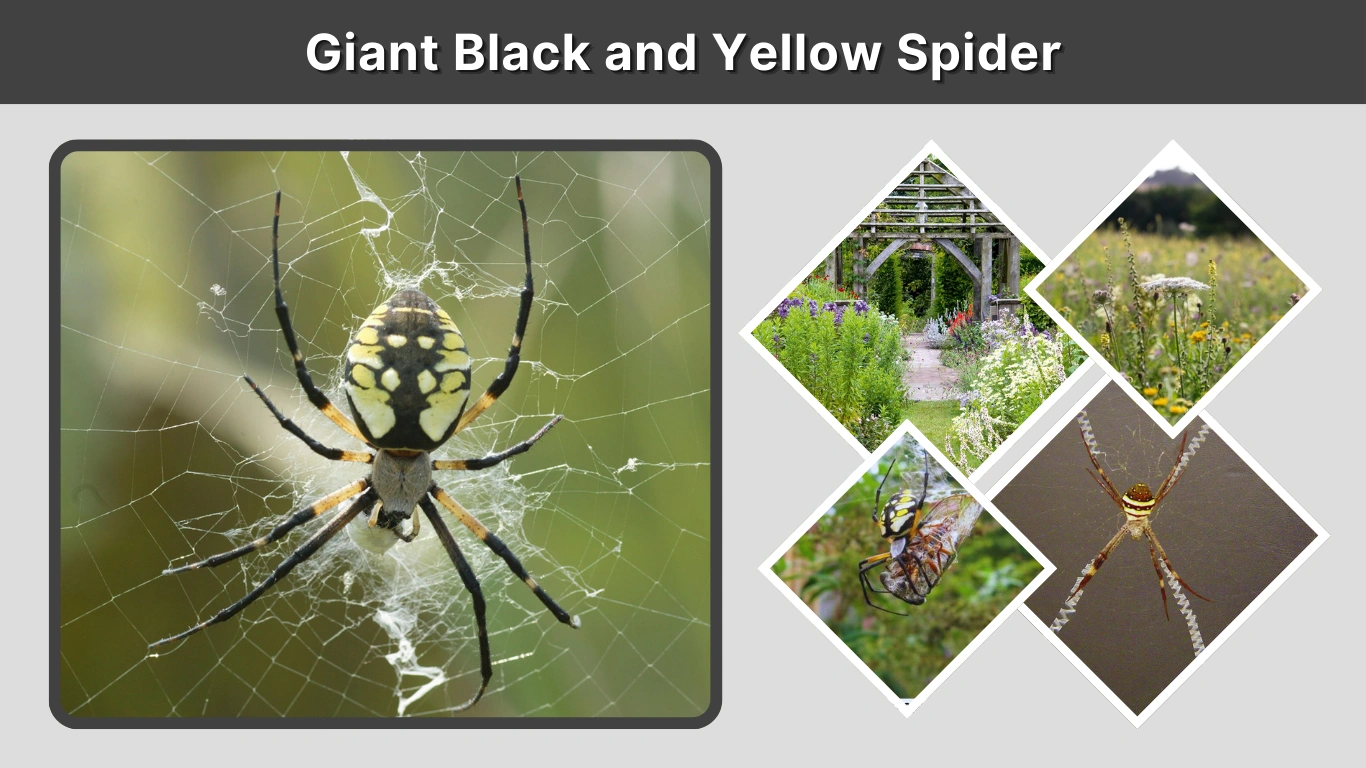
The giant black and yellow spider, often known as the black-and-yellow garden spider or yellow garden orbweaver, is one of the most recognizable large spiders in North America. Its striking coloration, large size, and wide circular webs make it a common sight in gardens, fields, and sunny outdoor spaces. Although intimidating at first glance, this spider is harmless to humans and plays a crucial role in controlling insect populations. Many sightings across Texas, Florida, Alabama, Georgia, Ontario, and even California describe the same species: Argiope aurantia, though similar species appear in other countries.
Identification

Key Visual Traits
- Shiny black abdomen with bright yellow patches
- Long legs with yellow and black banding
- A distinctive zig-zag stabilimentum (white silk pattern) in the center of the web
- Females with tall, oval-shaped abdomens
- Males much smaller, brownish, and rarely noticed
- Typically found hanging head-down in the middle of the web
These visual cues make the species easy to distinguish from other garden spiders.
Variations & Look-Alikes
Several similar species share parts of the same color pattern, which can confuse identification:
- The banded garden spider has more horizontal stripes
- The wasp spider (in Europe) shows stronger yellow-and-black contrast
- In Australia, St Andrew’s Cross spiders display an “X” pattern in their webs rather than the ladder-style silk
These species resemble the giant black and yellow spider but differ in web style or pattern.
Size & Appearance

Females of this species reach 1 to 1.1 inches in body length and can appear 2.5 to 3 inches across when legs are spread. Their vivid coloration helps them appear much larger, creating the “giant” effect often described in sightings. Males are tiny by comparison, usually only a quarter of the female’s size, and rarely noticed except during mating season. The abdomen’s shape is usually rounded or slightly elongated, with crisp yellow blocks on a dark background.
This spider’s dramatic appearance is not a sign of aggression. Instead, the bold coloration and size are defensive traits designed to warn predators and attract insect prey.
Geographic Range
United States
Texas: Very common in backyards, fields, fences, and garden areas. Most “giant black and yellow spider Texas” results refer to this species.
Alabama: Abundant in warm months, especially near porches and shrubs.
Florida: Thrives in warm, humid environments. Webs often appear large and dense.
Georgia: Common across rural and suburban landscapes throughout summer.
Minnesota: Present late in the season; populations peak in late summer.
California (including Orange County): Sightings that mention a “shell-like” abdomen usually refer to orbweavers with naturally domed patterns, including Argiope and closely related species.
Canada
Ontario: Found mainly in southern regions where summers are long enough for full development.
Australia
The North American species does not live in Australia, but several Australian Argiope species share the same bold yellow-and-black appearance, leading many people to describe them similarly.
Habitat

The giant black and yellow spider prefers sunlit, open spaces where flying insects are plentiful. Common habitats include gardens, tall grass, meadows, along fencelines, around sheds, and between shrubs. They build their webs 1–4 feet above the ground, often across paths or between sturdy plants. These webs may be reconstructed daily depending on weather, prey activity, and damage. Despite their size, these spiders avoid indoor spaces and almost never enter homes.
Behavior
This species is a classic orbweaver, relying on large, circular webs to trap prey. The spider waits motionless in the center, head facing downward, responding instantly to web vibrations. When threatened, it often shakes the web rapidly, creating a blurred visual effect that confuses predators. Their prey consists of moths, beetles, flies, grasshoppers, and even wasps. By consuming large numbers of pests, they act as natural control agents in gardens.
During the breeding season, males cautiously approach the female’s web to mate. Females produce one or more egg sacs, which are strong, papery, and placed near the web. Each sac may contain hundreds of eggs. Spiderlings hatch inside but overwinter within the sac, emerging in spring.
Bite Facts
Despite their intimidating appearance, giant black and yellow spiders are not dangerous to humans or pets. They are shy and bite only when handled or threatened. A bite, if it occurs, typically causes mild redness, itching, or discomfort similar to a bee sting. Symptoms rarely last more than a few hours. These spiders are far more interested in catching insects than interacting with people.
They do not have medically significant venom, and there are no verified cases of serious reactions caused by this species. Most encounters involve the spider simply retreating or remaining still in its web.
Comparison Table

| Feature | Black-and-Yellow Garden Spider | Banded Garden Spider | St Andrew’s Cross Spider |
| Colors | Bright yellow and black | White, brown, yellow bands | Yellow, black, white |
| Web | Large orb with zig-zag | Orb with vertical stripes | Web with “X” silk pattern |
| Range | North America | North America, especially west | Australia and Asia |
| Size | Up to 1.1 in body length | Slightly smaller | Similar in size |
| Danger | Harmless | Harmless | Harmless |
This comparison helps distinguish the giant black and yellow spider from similar species found in the U.S. and abroad.
FAQs
What is the giant black and yellow spider commonly found in gardens?
It is usually the black-and-yellow garden spider (Argiope aurantia), a large orbweaver known for its bold colors and impressive web. It is harmless and helps reduce pest insects.
Are these spiders venomous or dangerous?
No. Their venom is mild and not medically important. Most people experience little to no reaction if bitten, and bites are rare because the spider avoids confrontation.
Why do they build zig-zag patterns in their webs?
The zig-zag structure, called a stabilimentum, may reflect light to attract prey, strengthen the web, or make the spider appear larger to predators. Its exact purpose is still studied, but it is a defining feature of the species.
Do they come inside houses?
Almost never. They prefer outdoor habitats with vegetation and stable anchor points. If found near homes, they are usually on porches, window frames, or garden structures, not indoors.
How can I move one if it’s in an inconvenient spot?
Gently relocate the entire web frame using a long stick or gloved hand. Place it on nearby shrubs or a fence. Avoid touching the spider directly, as moving the web minimizes stress and maintains its structure.
