
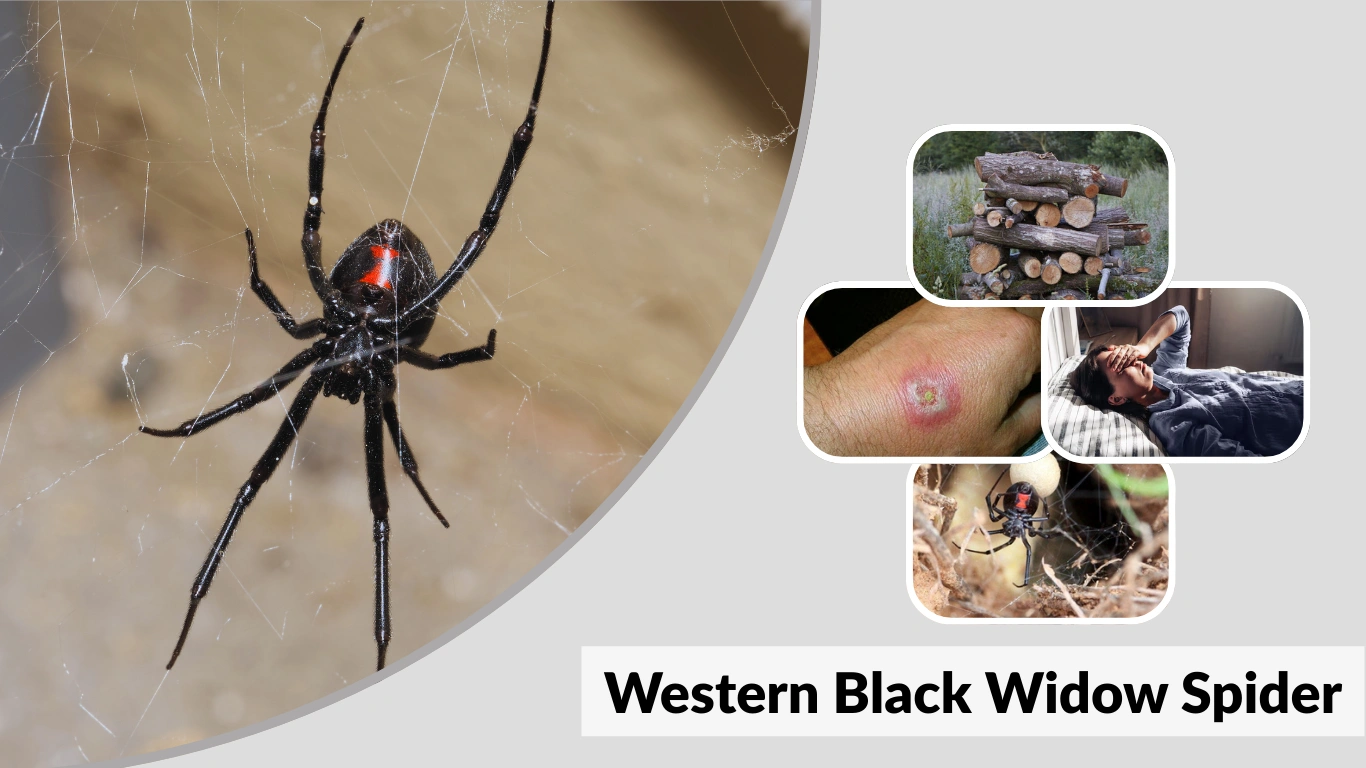
The western black widow is one of North America’s most recognized spiders, known for its glossy dark body and iconic hourglass marking. Although famous for its medically significant bite, it is far less aggressive than its reputation suggests. This guide explores how to identify the species, where it’s found, how dangerous it really is, and how to distinguish adults, juveniles, males, and females—along with insights into its habits and behavior.
What a western black widow looks like

Adult female western black widow
The adult female is the most distinctive form of the species. She has a rounded, bulbous abdomen and a glossy jet-black body. On the underside of the abdomen lies the signature red hourglass marking, usually bright and sharply defined. Females generally measure between 13–16 mm in body length, though their long legs make them appear larger. They spin irregular, sticky cobwebs in sheltered corners and often remain hidden inside the web’s retreat.
Adult male vs female (differences)
Males are far smaller—typically 3–6 mm—with longer legs relative to their body size and a more elongated shape. Their coloring differs as well: instead of a solid black body, males are often brownish or gray with light striping or spots. This contrast makes them look like a completely different species to the untrained eye. Males rarely bite and are significantly less dangerous due to their smaller venom glands. They are also more mobile, often wandering at night in search of females during mating season.
Juvenile western black widow
Juveniles look nothing like adult females. They start out tan or light brown, with yellow, white, or orange striping across the abdomen. As they molt and grow, they gradually darken, eventually developing the familiar black coloration. The hourglass marking may appear incomplete or lightly colored in earlier stages. This changing appearance is a frequent source of misidentification, especially when juveniles are mistaken for harmless house spiders.
Quick identification checklist
- Shiny, smooth black abdomen (adult female)
- Red, well-defined hourglass on underside
- Irregular, messy cobweb in dark sheltered spaces
- Brown or striped juveniles gradually turning black
- Small, lighter males with patterned bodies
Range and habitat

Where western black widows live
Western black widows are native to western North America. Their range spans from southern Canada throughout the western United States and into Mexico. They thrive in deserts, scrublands, suburban yards, agricultural areas, and coastal regions. Because they favor human-made structures, encounters are common around homes, sheds, and outdoor equipment.
Preferred habitats
These spiders seek dark, sheltered, cluttered spaces. Common hiding locations include:
- Woodpiles and lumber stacks
- Storage boxes and garages
- Under outdoor furniture
- Around foundations and crawlspaces
- Rock piles or garden debris
Their presence increases where prey insects are abundant, especially near outdoor lighting.
Western black widow bite and venom

How dangerous is the western black widow?
The western black widow is venomous, not poisonous. Its venom contains a potent neurotoxin known as α-latrotoxin, which affects the nervous system. Despite this, serious reactions are less common today thanks to modern medical care. Most healthy adults recover fully, though young children, elderly individuals, and those with underlying conditions may experience more severe symptoms. Widow bites remain rare, as the spiders only bite when pressed or trapped against the skin.
What happens during a bite?
Many bites occur when someone reaches into a dark area such as a woodpile, storage box, or gardening glove. The bite may feel like a sharp pinprick or sometimes go unnoticed initially. Pain often escalates within 30–60 minutes, spreading to nearby muscles. Symptoms may include:
- Intense localized pain
- Muscle cramping or spasms
- Sweating
- Nausea or mild fever
- Abdominal rigidity
While alarming, these symptoms typically peak within a few hours and slowly subside.
First aid and medical care
Immediate care should focus on cleaning the wound with soap and water, applying a cold pack, and staying calm. Avoid attempting to capture or crush the spider. Most cases can be managed with over-the-counter pain relief, but seek medical attention if symptoms worsen or involve difficulty breathing, severe muscle cramps, or chest pain. Antivenom may be used in hospitals for serious cases, though it is typically reserved for patients with severe systemic reactions.
Long-term effects
Most people fully recover within 24–72 hours. Some may experience lingering soreness or fatigue for several days. Long-term complications are rare, and fatal outcomes are exceedingly uncommon with modern treatment.
Behavior and life cycle

Daily and seasonal habits
Western black widows are nocturnal hunters. During daylight, females remain hidden in their web retreat, emerging at night to repair webs or capture prey. Seasonal activity increases during warm months, especially late spring through early fall.
Mating and reproduction
Males use silk vibrations to communicate with females during courtship. After mating, the female lays eggs in silken sacs, each containing several hundred eggs. Spiderlings disperse shortly after hatching by ballooning—riding air currents on fine silk threads. Only a small percentage survive to adulthood due to predation.
Ecological role
Despite their notoriety, western black widows help regulate insect populations. They prey on flies, beetles, mosquitoes, and other small arthropods, forming an important part of the local ecosystem. Larger predators such as birds, centipedes, and wasps may feed on them.
Western black widow vs other black widow species

Western vs general “black widow”
The term “black widow” refers to a group of Latrodectus species, not just one. The western species is the most common widow in western North America and differs in coloration, markings, and distribution from its southern and northern counterparts.
Western vs southern black widow
Southern black widows often have a more complete, hourglass-shaped red marking and deeper coloration, while western widows may show slight variation in marking shape. The southern species is more common in the southeastern U.S., with limited overlap in the Southwest. Both species are medically significant, though behavior and habitats are largely similar.
Comparison table
| Feature | Western Black Widow | Southern Black Widow | Notes |
| Hourglass color | Bright red | Bright red | Shape varies slightly |
| Female size | 13–16 mm | 12–15 mm | Similar range |
| Male pattern | Brownish with stripes | Light patterns | Both smaller and less dangerous |
| Core range | Western North America | Southeastern U.S. | Overlap in Southwest |
| Bite severity | High, rarely fatal | High, rarely fatal | Similar venom strength |
Prevention and control
Reducing encounters
Removing clutter and debris is the easiest way to discourage black widows. Move woodpiles away from buildings, keep storage areas tidy, and reduce insect populations around outdoor lighting.
Safe inspection and cleanup
Wear gloves when working in storage areas or handling items left outdoors. Shake out shoes, gloves, or towels left outside. Use a flashlight before reaching into dark spaces.
When removal is needed
If spiders appear near children’s play areas or high-traffic household locations, removal is recommended. Relocation is possible using a container and cardboard, though professional pest control may be necessary for widespread infestations.
FAQ
How big does a western black widow get?
Adult females typically reach 13–16 mm in body length, with long legs increasing their overall size. Males are much smaller, measuring only 3–6 mm.
Are western black widows poisonous?
They are venomous, meaning they inject venom through a bite. Their venom is powerful, but serious reactions are uncommon with proper medical care.
How do I tell the difference between western and southern black widows?
Location is the easiest clue—western widows dominate the West, southern widows the Southeast. Western widows may also show subtle differences in the hourglass shape.
What should I do if I find one indoors?
Do not handle it directly. Use a container to relocate it outdoors or contact pest control if multiple spiders are present.
Do juveniles have dangerous venom?
Juveniles can bite but deliver much smaller amounts of venom. Adult females pose the greatest medical risk.
