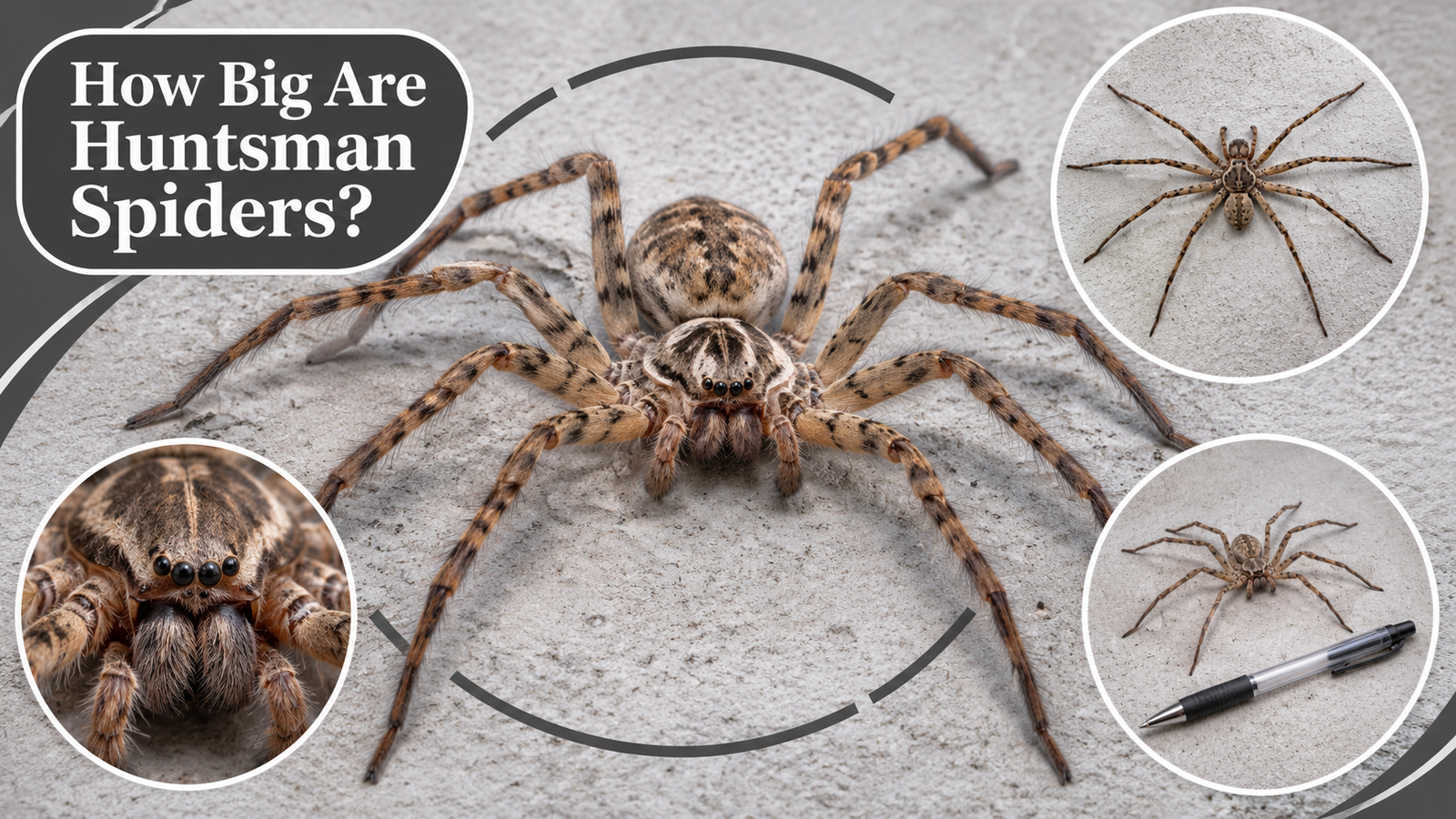
Huntsman spiders are known for their long, sideways-spreading legs and quick movements. Their broad stance can make one seem enormous when it appears on a wall or floor. But “huntsman spider” refers to a large family of species, and their sizes vary. Many have a leg span of around 7 to 15 centimeters (about 3 to 6 inches), while the giant huntsman spider from Laos can reach around 30 centimeters (nearly 12 inches) across its legs. To understand how big a huntsman really is, it helps to distinguish its body length from its full leg span.
How Big Are Huntsman Spiders on Average?
Many huntsman spiders have a body around 2 to 3 centimeters long, though the exact size depends on the species and how the spider is measured. Their legs make them look considerably larger: a common huntsman may have a leg span of approximately 7 to 15 centimeters, or about 3 to 6 inches. Some Australian species can reach around 15 to 16 centimeters across the legs.
These measurements are general guides, not a single size limit for every huntsman spider. The family includes many species found in Australia, Asia, Africa, and warmer parts of other regions. A huntsman in one location may be noticeably smaller than a species found elsewhere.
A spider’s posture also changes how large it appears. Huntsman spiders hold their legs out to the sides, giving them a wide profile. When one spreads its legs against a wall, it may cover a larger area than a spider with the same body length that holds its legs close together.
Body Length vs. Leg Span
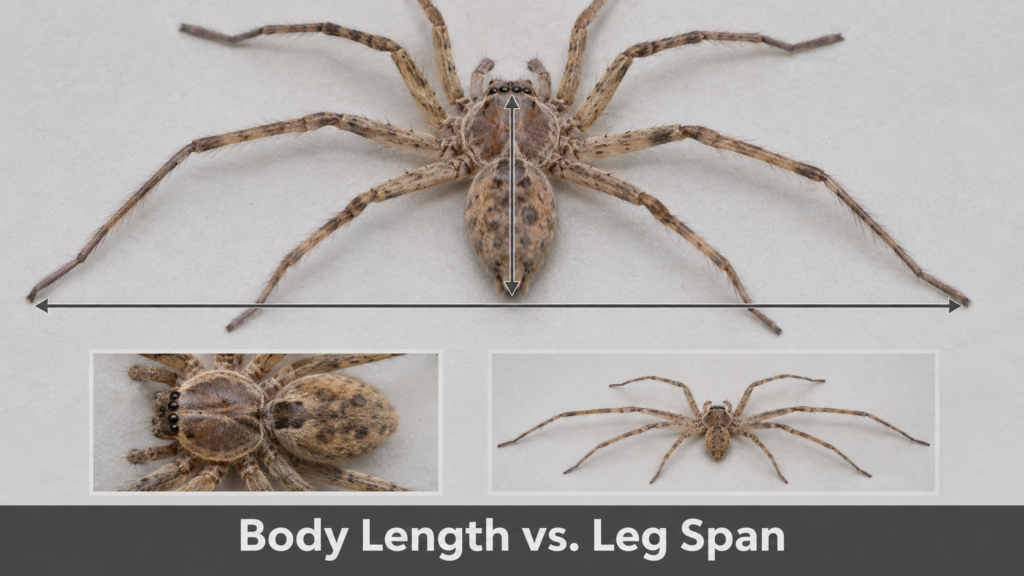
Body length measures the spider’s main body, from the front section to the end of the abdomen. It does not include the legs. Leg span measures the distance from the tip of one extended leg to the tip of the leg on the opposite side.
These numbers describe different things. For example, the pantropical huntsman spider (Heteropoda venatoria) has an adult body length of about 2.2 to 2.8 centimeters, while its leg span is roughly 7 to 12 centimeters. Its legs can make it look several times wider than its body is long.
Leg span can also be difficult to measure consistently. A live spider may keep its legs partly folded, while a preserved specimen may be positioned with them fully extended. Measurements in articles and identification guides may therefore differ slightly, even when they refer to the same species.
When comparing huntsman spiders, check whether the number refers to body length or leg span. A spider described as 3 centimeters long may still span 10 centimeters or more with its legs extended.
The Giant Huntsman Spider: The Largest by Leg Span
The giant huntsman spider (Heteropoda maxima) is the largest known huntsman by leg span. It was described from specimens found in Laos, where it lives in a region that includes caves. Its leg span can reach around 30 centimeters, or about 12 inches, while its body is much shorter.
A span of 30 centimeters is close to the length of a standard ruler. That does not mean the spider has a 30-centimeter-long body: most of that distance comes from its widely spread legs. This distinction explains why some descriptions call it the largest spider by leg span, even though it is not the heaviest spider.
The giant huntsman is an unusual species, not the size people should expect from every huntsman they encounter. It is native to Southeast Asia, and most huntsman spiders seen elsewhere are much smaller. A large spider in an Australian house, for example, may be a local huntsman, but that does not make it a giant huntsman.
How Big Are Huntsman Spiders in Australia?
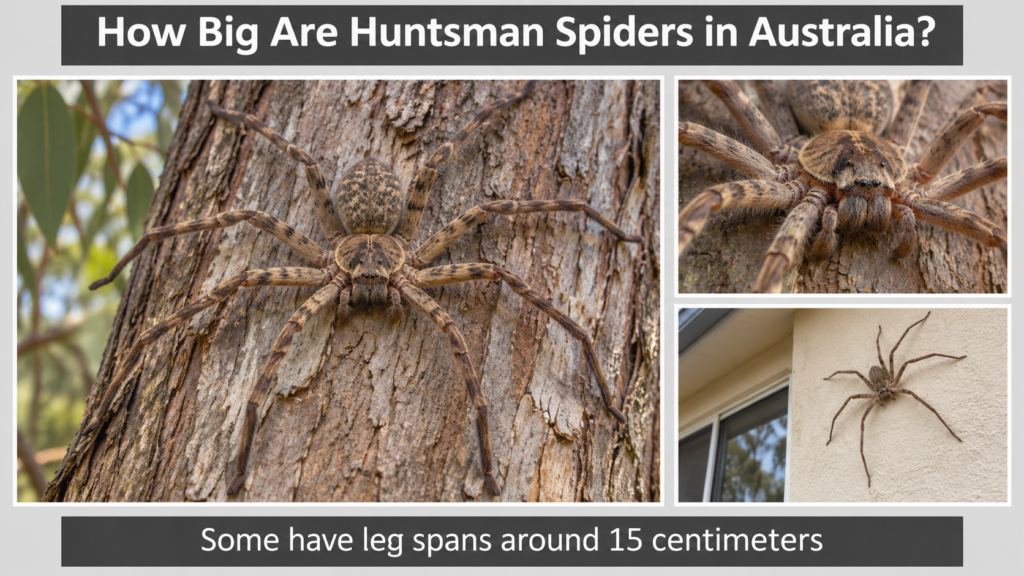
Australia has many huntsman species, and their sizes vary. Some have leg spans around 15 centimeters, while particularly large Australian species may approach or exceed 20 centimeters, depending on the species and the measurement used. Some female huntsman spiders have bodies around 2 centimeters long, while males of the same group may be slightly smaller.
People may describe an Australian huntsman as “hand-sized” because its legs can spread across a broad area. This is a visual comparison rather than a precise measurement. The spider’s body may still be only a few centimeters long.
Australia’s variety of climates and habitats supports many huntsman species. Some are often seen on tree trunks or under bark, while others may wander into garages, sheds, or homes. A species’ usual size depends on its identity, age, and sex, so location alone cannot give an exact measurement.
Why Huntsman Spiders Look So Large
Huntsman spiders have a flattened body and legs that extend outward rather than pointing mostly forward and backward. This side-spreading stance is called laterigrade. It helps the spider move sideways and tuck itself into narrow spaces such as gaps under bark.
Their legs are long compared with their body size. When a huntsman holds them flat against a wall, the full outline is easy to see, which makes the spider seem especially wide. A spider moving across a ceiling or wall may also look larger because there is little nearby for comparison.
Perspective can add to the effect. Seeing a huntsman close to your face, on a pale wall, or suddenly emerging from behind a piece of furniture can make it seem much larger than it would in a photograph. A nearby object, such as a ruler placed beside the spider without touching it, gives a more reliable size reference.
Are Female Huntsman Spiders Bigger Than Males?
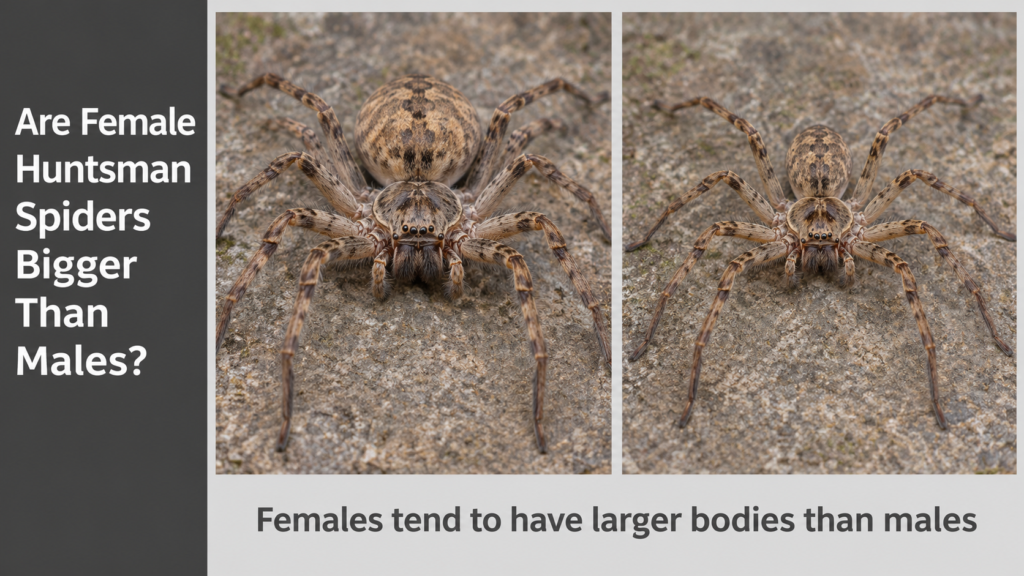
In many spider species, females tend to have larger bodies than males, but size differences vary among huntsman species. A female may look broader or heavier, while a male may have longer-looking legs in proportion to his body. These are general patterns, not reliable rules for identifying sex from a quick glance.
Age also matters. Young huntsman spiders are smaller and grow as they molt. Spiders shed their external skeleton as they develop, and a newly molted spider may look paler or softer before its outer covering hardens.
Without a clear view and specialist knowledge, it can be difficult to determine a huntsman’s sex or age from size alone. A large spider is not necessarily female, and a small one is not necessarily male.
How Does a Huntsman Compare With a Human Hand?
A typical huntsman’s leg span may be similar to the width of a person’s palm, though this varies by species and individual. A very large huntsman can extend beyond the width of a hand. The giant huntsman’s reported maximum span of around 30 centimeters is longer than many adults’ hand spans.
Comparisons can be misleading because people use “hand-sized” in different ways. Some mean the spider’s leg span is about as wide as their palm; others include their fingers. The body itself is much smaller than the full spread of the legs.
For a useful comparison, state the measurement directly: body length in centimeters or inches, followed by leg span. This avoids making a spider sound larger or smaller depending on how someone interprets a hand-size description.
Do Large Huntsman Spiders Enter Homes?
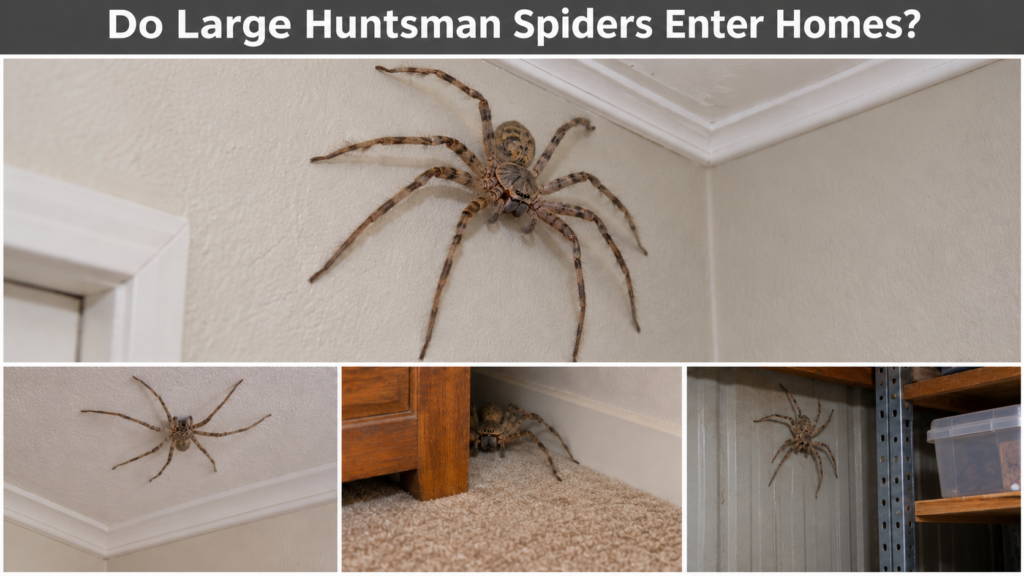
Some huntsman spiders wander indoors, especially where a home connects to outdoor habitat or offers places to shelter. They may appear on walls, ceilings, behind furniture, or in garages and sheds. They do not build large webs to catch prey; huntsman spiders are active hunters that search for insects and other small animals.
A spider indoors is not automatically a sign of an infestation. It may have entered through a gap, an open door, or an item brought inside. If you see one, avoid grabbing it. If you want to move it, a container and stiff card can help you guide it outside without direct contact. If you cannot do so safely, contact a local pest professional.
Are Huntsman Spiders Dangerous Because of Their Size?
Their large appearance does not automatically mean they are highly dangerous. Huntsman spiders generally avoid people and may run away when disturbed. Like other spiders, they can bite if trapped or handled, so it is sensible to keep a safe distance and avoid picking one up.
If a spider has bitten someone and the person develops severe or worsening symptoms, seek medical advice. When identification matters, a clear photograph taken from a safe distance may help a local expert identify the spider.
Frequently Asked Questions
What is the maximum size of a huntsman spider?
The giant huntsman spider (Heteropoda maxima) can reach about 30 centimeters, or nearly 12 inches, in leg span. Its body is much shorter than its full spread.
How big is a normal huntsman spider?
Many huntsman spiders have a body length of around 2 to 3 centimeters and a leg span of roughly 7 to 15 centimeters. Size varies between species and regions.
Are huntsman spiders bigger than tarantulas?
Some huntsman spiders have a very wide leg span, but tarantulas are generally heavier and bulkier. Size comparisons depend on whether you mean body length, leg span, or weight.
Can a huntsman spider fit in your hand?
A smaller huntsman may fit within the outline of a palm, while a large individual may span across or beyond a hand. Do not pick one up to check its size.
Why does a huntsman spider look bigger on a wall?
Its long legs spread out sideways, creating a wide outline. A plain wall also makes it easier to see the full span, which can make the spider appear larger.
A Simple Way to Understand Huntsman Spider Size
Huntsman spiders are often much wider than their body length suggests. Many have a leg span of about 7 to 15 centimeters, while the giant huntsman from Laos can approach 30 centimeters. The exact size depends on species and measurement method. When someone describes a huntsman as “huge,” check whether they mean its body length or its spread-out legs—that difference makes the size much clearer.
