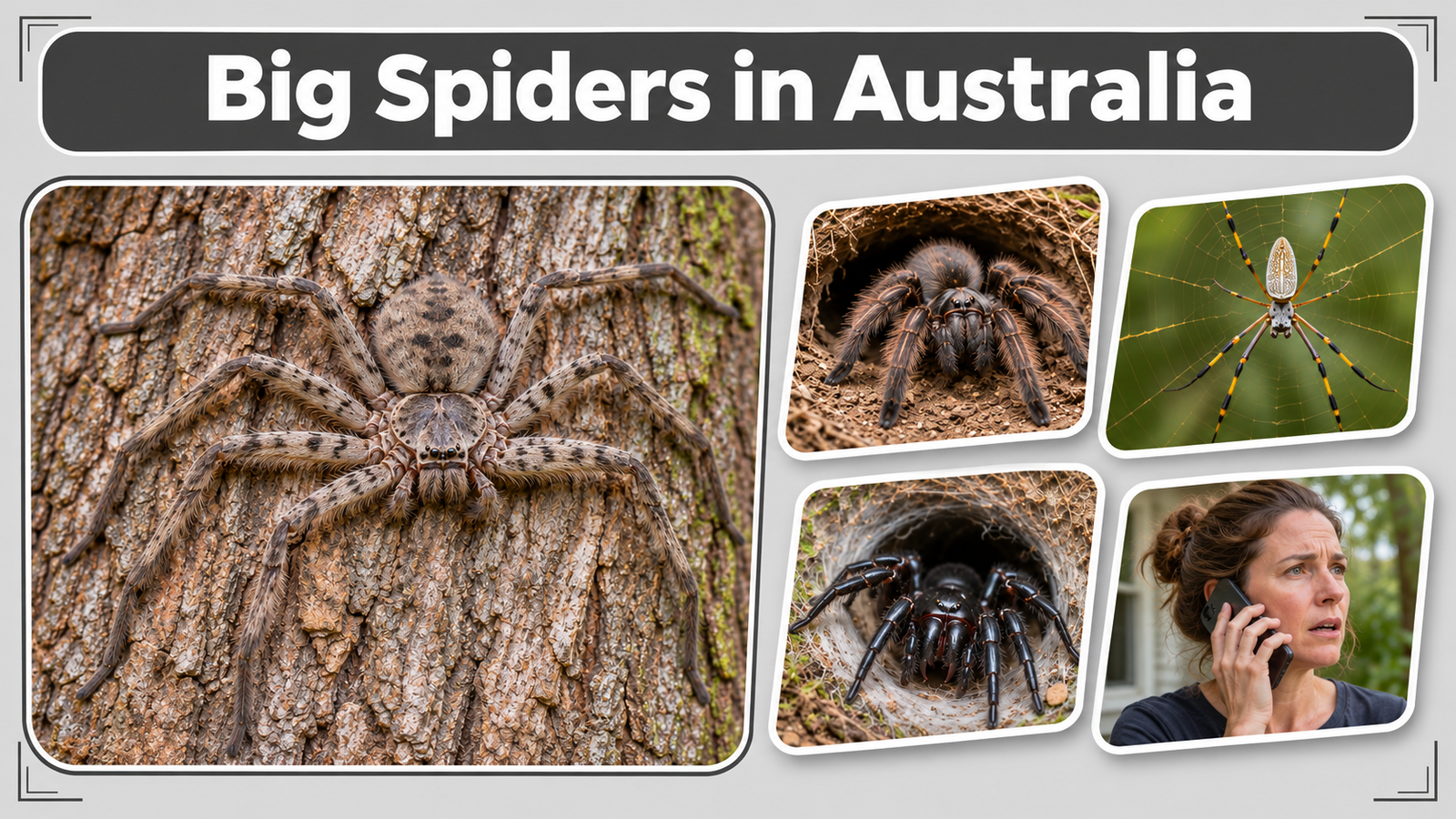
Some of the biggest spiders in Australia are huntsman spiders, native tarantulas, and golden orb-weavers. A huntsman can span up to 15 cm across its legs, while some Australian tarantulas can reach about 20 cm. Around homes, a large, flat spider on a wall is often a huntsman, while a long-legged spider sitting in a broad, circular garden web may be a golden orb-weaver. Size alone tells you little about bite risk. A stocky funnel-web can have a much smaller leg span than a huntsman and still pose a greater medical risk.
How Big Are Australian Spiders?
Spider measurements usually refer to either body length or leg span. Body length measures the spider from the front of its body to the end of its abdomen, excluding its legs. Leg span measures how far its legs reach across. That distinction explains how a huntsman with a body around 2 cm long can look palm-sized on a wall. The sizes below are approximate, and each group includes species that differ in appearance and size.
| Spider group | Approximate size | Best clue from a distance |
|---|---|---|
| Huntsman | Up to 15 cm leg span | Flat body and legs that extend sideways |
| Australian tarantula | Up to about 20 cm leg span in the largest species | Thick, hairy body and substantial legs |
| Golden orb-weaver | About 2–4 cm body length for females in commonly described species | Large circular web with a golden sheen |
| Garden orb-weaver | About 2–3 cm body length for females in common examples | Broad abdomen and a circular web often built after dusk |
| Garden wolf spider | About 1.5–2.2 cm body length | Runs along the ground and may carry a round egg sac |
| Funnel-web spider | About 1–5 cm body length across Australian species | Stout body, shiny front section, and a silk-lined retreat |
| Mouse spider | Size varies by species and sex | Stocky build, broad head region, and heavy jaws |
7 Large Spiders You May See in Australia
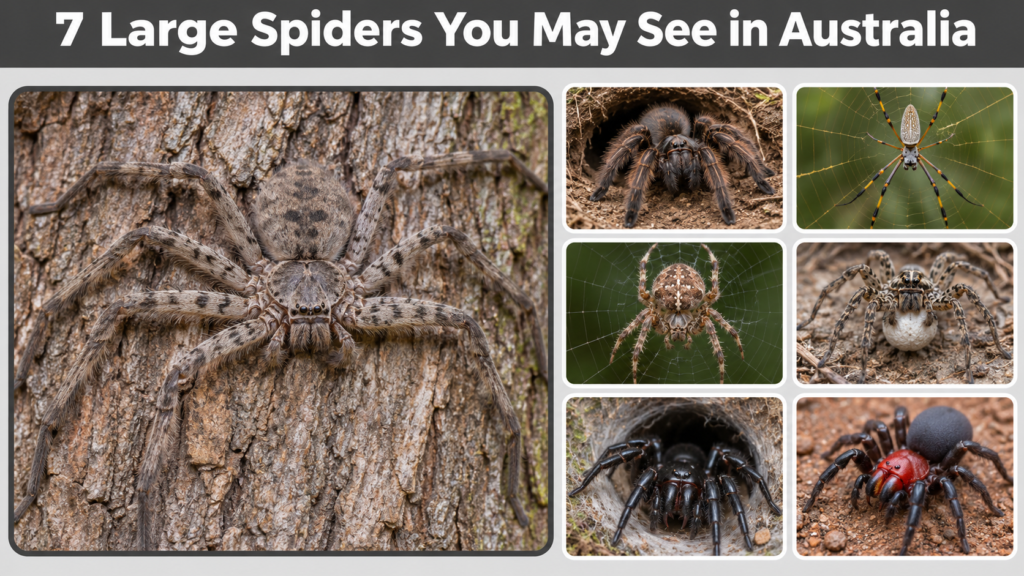
A spider’s location is often the quickest clue. There’s a good chance a flat, sideways-legged spider behind a curtain belongs to a different group from a heavy-bodied spider at ground level or a long-legged female hanging between garden shrubs. Start with where you found it, then look at the legs, body shape, and any nearby web from a comfortable distance.
1. Huntsman Spiders
Huntsman spiders have flattened bodies and legs that spread sideways, giving them a crab-like stance. Many are brown or grey, and some have banded legs. Their wide stance makes them look especially large on a wall. They move quickly and can tuck into narrow gaps behind curtains, under loose bark, and around window frames.
Huntsmen actively hunt insects and other small arthropods. If a large spider runs across a wall and disappears behind a picture frame, its shape and movement both point toward a huntsman. A large, circular capture web in the same room would belong to another spider.
2. Australian Tarantulas
Australia has native tarantulas, sometimes called barking or whistling spiders. They have thick, hairy bodies and sturdy legs. Some reach about 20 cm across the legs, making them among the biggest Australian spiders by leg span. Their heavy build gives them a very different outline from a flattened, long-legged huntsman.
Australian tarantulas are mainly ground-dwelling and often shelter in burrows. The entrance or surrounding silk may be easier to see than the spider itself. A large hairy spider crossing an exposed indoor wall is more consistent with a huntsman, while a robust spider at the mouth of a ground retreat warrants a closer look from a distance.
3. Golden Orb-Weaving Spiders
Female golden orb-weavers have long legs and build large, strong, wheel-shaped webs. In suitable light, their silk can show a golden sheen. Look for webs between trees, shrubs, or other supports with enough open space for the spider to stretch its silk across a gap.
A female may sit near the centre of the web during the day, making her easy to spot from a distance. Males are much smaller and may be present on the same web. If a large spider has stretched a circular web across a garden path, the shape and colour of the silk offer better clues than the spider’s body colour alone.
4. Garden Orb-Weaving Spiders
Garden orb-weavers often have a broad, rounded or angular abdomen, with colours that help them blend into bark, leaves, and stems. Many build a circular web after dusk. A common encounter is walking outside in the evening and finding a web stretched between plants where the path was clear earlier.
Look around the edges of the web for the spider’s daytime retreat. A garden orb-weaver may spend daylight hours tucked into foliage or another sheltered spot. Its stockier shape and evening web-building habit can help distinguish it from a long-legged golden orb-weaver resting openly in its web during the day.
5. Wolf Spiders
Wolf spiders are ground hunters, and many have brown or grey markings that blend into soil, mulch, and leaf litter. Some are fairly small, while others look substantial as they run across a path or disappear under a pot. The garden wolf spider is one example you may encounter around yards and other open ground.
A female carrying a round egg sac attached to the rear of her abdomen offers a useful identification clue. After the eggs hatch, the young may ride on her back. A patterned spider moving along the ground with either of these features is a strong candidate for a wolf spider.
6. Funnel-Web Spiders
Australian funnel-web spiders occur in eastern Australia. They are generally stocky, with a glossy front body section, and can live in silk-lined retreats in sheltered places. Some use burrows in the ground, while others use spaces in trees or rotting wood. The Sydney funnel-web is one member of this group.
A hole in the garden, even one with silk around it, gives you limited information about what lives inside. Keep your hands clear of the entrance. If someone is bitten by a suspected funnel-web or an unidentified large black spider, treat it as an emergency and call 000 in Australia.
7. Mouse Spiders
Australian mouse spiders are sturdy, burrowing spiders with broad heads and prominent jaws. Some males are easier to recognise because of their colour. The male red-headed mouse spider, for example, can have a bright red head region. Other mouse spiders are dark and can be difficult to distinguish from funnel-webs at a glance.
Mouse spider bites are uncommon, but serious effects have been reported. A suspected bite requires emergency care and the same pressure immobilisation first aid used for funnel-web bites. If you see a stocky black spider on the ground, a photo taken from a safe distance is more useful than trying to turn it over or handle it.
What Is That Big Spider in Your House?
A large, flat spider with sideways-pointing legs on an indoor wall or ceiling is often a huntsman. A patterned spider running across the floor or patio might be a wolf spider. A glossy, stocky black spider at ground level is harder to assess, particularly in eastern Australia, where funnel-webs occur. If you want help identifying it, keep your distance and take a photo that shows the whole body and legs. Include the suburb or region and mention whether you found it in a web, in a retreat, or out in the open.
What to Do After a Bite From a Large Australian Spider
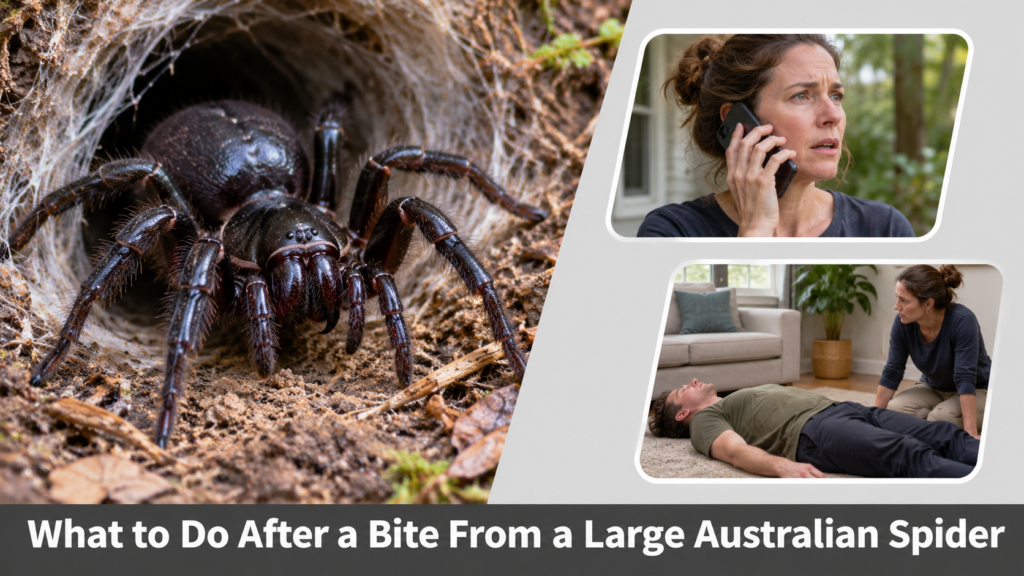
If someone is bitten by a suspected funnel-web, mouse spider, or unidentified large black spider in Australia, call 000 immediately. Keep the person lying down and still. Follow the emergency operator’s instructions. For a suspected funnel-web or mouse spider bite on a limb, use a pressure immobilisation bandage and keep the limb still with a splint if available. Leave the bandage on for medical staff. Give the operator the time of the bite and any symptoms you’ve noticed.
Frequently Asked Questions
1. What is the biggest spider in Australia?
Some native Australian tarantulas reach about 20 cm across their legs, putting them among the country’s largest spiders. Huntsman spiders can reach about 15 cm across and are more familiar around homes.
2. Do big spiders regularly enter Australian houses?
Huntsman spiders sometimes enter homes and are especially noticeable when they sit on open walls or ceilings. How often you see one depends on where you live, what shelter is nearby, and where spiders can get inside.
3. What is the big spider with a golden web in Australia?
A large spider in a wheel-shaped web with a golden sheen is likely a golden orb-weaver. The silk’s colour is often easier to see when sunlight hits the web at an angle.
4. How can you tell a huntsman from a funnel-web?
A huntsman usually has a flatter body and long legs that extend sideways. A funnel-web typically has a thicker build and a glossy front body section. Where you find the spider can provide another clue, though a photograph may be needed for reliable identification.
5. Are the biggest Australian spiders the most dangerous?
Bite risk depends on the species. Huntsman spiders can have a much wider leg span than funnel-webs, while some funnel-web and mouse spider bites can cause serious medical effects.
