Brown recluse spiders are smaller than many people expect. Their slender legs can make them appear larger, especially when one suddenly runs across a floor or hides inside a storage box. Adult brown recluses typically have bodies around one-quarter to one-half inch long, while the full width including their legs is commonly around an inch. However, size changes with age, sex, and leg position. This guide explains how big brown recluse spiders get, compares them with black widows, and shows which features help distinguish them from similar brown spiders.
How Big Do Brown Recluse Spiders Get?
An adult brown recluse (Loxosceles reclusa) is small to medium-sized. Its body has a front cephalothorax and rear abdomen. Body length differs considerably from total width with the legs extended.
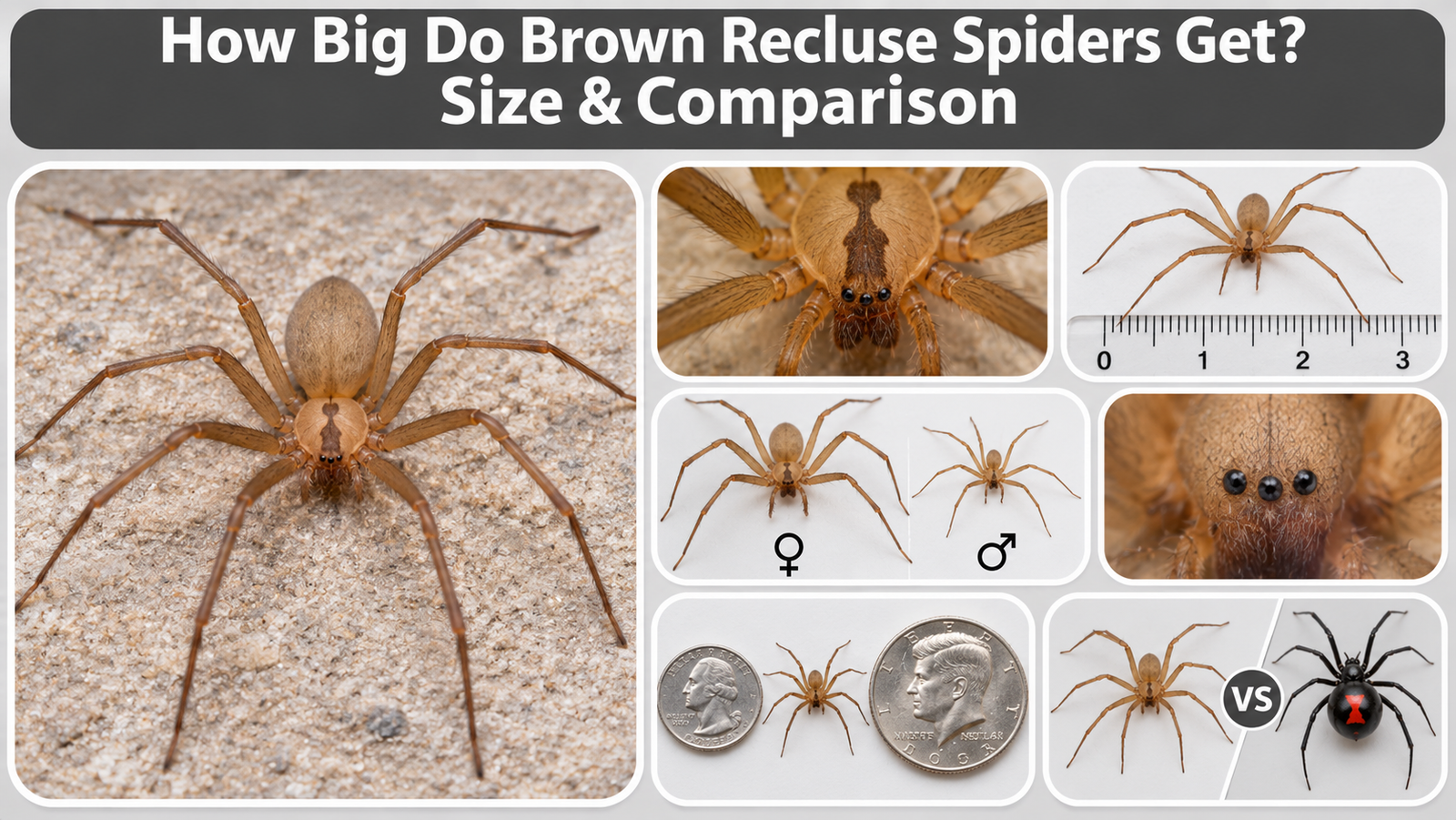
Average Brown Recluse Body Size
Adult brown recluses measure approximately ¼–½ inch (6–13 mm) in body length, often around 7–12 mm. Their oval abdomens are plain, and color ranges from tan to medium brown.
How Big Are Brown Recluses Including Their Legs?
Including legs, an adult is usually about 1 inch across and may appear larger with legs fully extended. Texas A&M compares its footprint to a U.S. quarter or half-dollar. Leg posture affects appearance.
| Measurement | Typical adult brown recluse |
| Body length only | About ¼–½ inch (6–13 mm) |
| Overall size with legs | Commonly around 1 inch across |
| Common visual comparison | U.S. quarter, sometimes approaching a half-dollar footprint |
| Appearance | Small oval body with long, thin legs |
These are approximate identification ranges, not an exact size limit for every spider.
Are Male and Female Brown Recluse Spiders Different Sizes?
Females usually have slightly larger bodies. University of Florida reports average body lengths of about 9 mm for females and 8 mm for males. Males can have proportionally longer legs despite smaller bodies.
Female Brown Recluse Size
Females have fuller abdomens and may look heavier than males, especially after feeding. They often remain sheltered and produce egg sacs in crevices. Abdomen size alone cannot confirm the species or sex.
Male Brown Recluse Size
Males are slimmer, often with long legs and enlarged reproductive pedipalps near the mouth. They may wander while searching for females. Neither sex should be identified by size alone.
Brown Recluse vs. Black Widow Spider Size
Brown recluses and black widows are medically important but differ in shape. Female black widows have shiny, rounded abdomens; recluses are flatter-looking and uniformly brown. Female black widows are usually somewhat larger overall.
Size Comparison Between the Two Spiders
| Feature | Brown recluse | Female black widow |
| Typical body length | ¼–½ inch | Around ½ inch |
| Total size including legs | Often about 1 inch | About 1½ inches |
| Body shape | Oval, relatively slender | Bulbous, rounded abdomen |
| Color | Tan to brown | Usually glossy black |
| Distinctive marking | Possible violin-shaped mark | Red underside hourglass |
Black widow males are much smaller than mature females and may have lighter markings, so they should not be compared with adult female measurements without noting the difference.
How to Identify a Brown Recluse Beyond Its Size
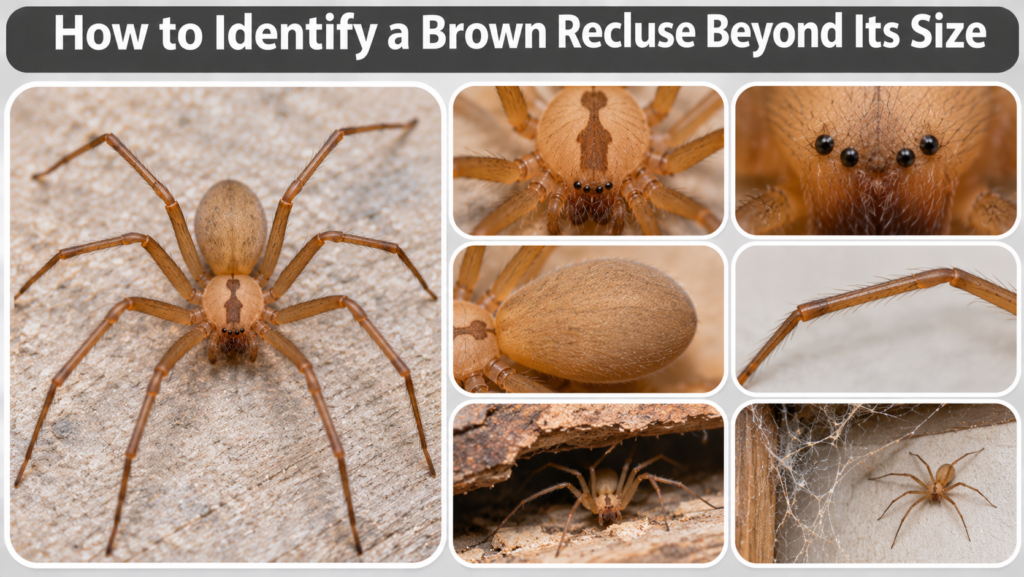
Many harmless spiders fit similar measurements. Specialists check eyes, legs, markings, and shape. A dark violin-shaped marking helps but cannot confirm identification alone.
Important Brown Recluse Identification Features
- Six eyes: Arranged in three separate pairs, unlike the eight eyes of most spiders.
- Plain legs: Usually uniformly colored without obvious bands or heavy spines.
- Violin-shaped marking: Often visible on the cephalothorax, pointing toward the abdomen.
- Plain abdomen: Generally lacking conspicuous stripes or spotted patterns.
- Fine body hairs: The spider does not have the coarse, hairy appearance of many wolf spiders.
- Secretive behavior: Often hides in crevices and moves around at night.
Do not handle a spider to count its eyes. A clear photograph taken from a safe distance can help a qualified expert confirm the species.
What Spiders Are Bigger Than a Brown Recluse?
Brown recluses are frequently confused with much larger spiders. Wolf spiders, southern house spiders, and certain hunting spiders may appear in garages, basements, or yards. Their color can be similar, but body structure, markings, eye arrangement, and web habits differ. Seeing a large brown spider does not automatically indicate a large recluse.
Common Brown Recluse Look-Alikes
- Wolf spiders: Often larger and hairier, with stripes and large forward-facing eyes.
- Southern house spiders: Males have long legs and resemble recluses, but possess eight clustered eyes.
- Grass spiders: Have striped bodies and build obvious funnel-shaped webs.
- Huntsman spiders: Some are much broader with sideways-oriented legs.
- Tarantulas: Far heavier and hairier, with a dramatically larger body.
A spider several inches across is unlikely to be an ordinary brown recluse, though it still deserves cautious identification.
Does Brown Recluse Size Affect Bite Danger?
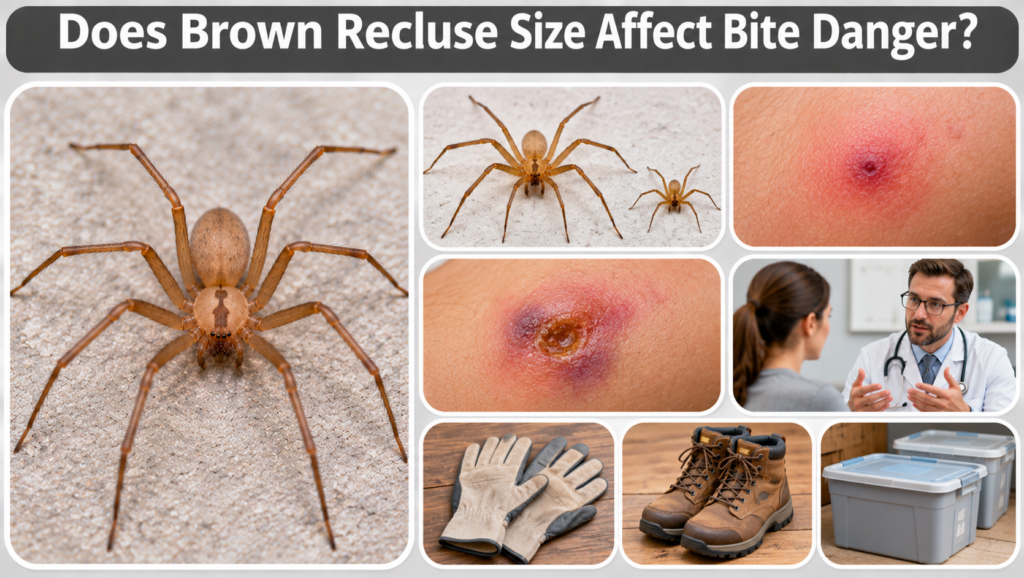
A larger spider is not automatically more dangerous than a smaller one. Brown recluse venom can sometimes injure skin tissue, but bite severity depends on several factors, including the amount of venom injected and the person’s response. These spiders are typically shy and usually bite when trapped against skin inside clothing, bedding, or stored objects.
How to Avoid Accidental Brown Recluse Bites
- Shake out shoes, gloves, and clothing that have been stored for a long time.
- Wear gloves when moving boxes, firewood, or clutter.
- Keep stored belongings inside sealed containers.
- Check undisturbed corners in garages, sheds, and closets.
- Reduce clutter and seal gaps where spiders can enter.
If you suspect a brown recluse bite, clean the area and seek prompt medical advice. A worsening wound, fever, significant pain, or other systemic symptoms require professional evaluation. Do not assume every unexplained skin lesion is a spider bite.
FAQs
1. How big is a full-grown brown recluse spider?
A full-grown brown recluse typically has a body about ¼–½ inch long. Including its legs, it is usually around an inch across in a normal position. The exact measurement varies, and males may have longer-looking legs than females.
2. How big do brown recluse spiders get, including legs?
With their legs included, brown recluse spiders are often comparable to a U.S. quarter and may occupy a somewhat larger footprint. Leg position changes the apparent width, so size comparisons should be treated as approximate rather than precise measurements.
3. Are brown recluse spiders bigger than black widows?
Usually not when comparing adult brown recluses with mature female black widows. Female black widows often reach about 1½ inches across with extended legs, while a brown recluse is commonly around an inch. Male black widows are much smaller than females.
4. Can a brown recluse be two inches long?
A verified adult brown recluse is not normally two inches in body length. A spider appearing that large is more likely another species or has been measured across unusually stretched legs. Check additional identification features rather than relying on apparent size.
5. Are baby brown recluse spiders dangerous?
Young brown recluses are much smaller and paler than adults, but size alone is not a reliable measure of bite risk. Avoid handling unfamiliar spiderlings and take precautions in storage areas where adult recluses may also be hiding.
