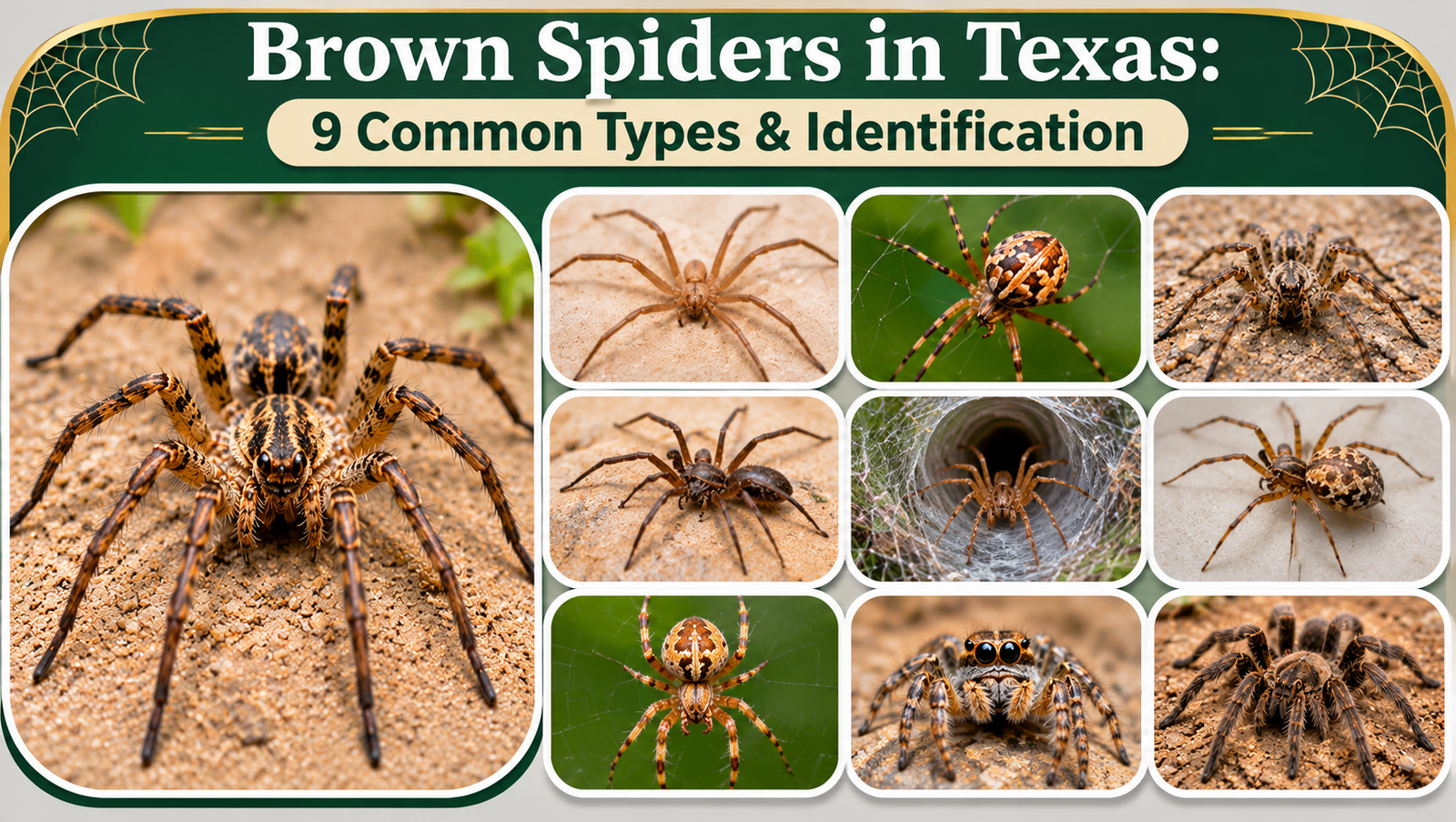
Brown spiders are common throughout Texas, appearing in gardens, garages, bedrooms, sheds, and grassy areas. Some are tiny and pale, while others are large, hairy, or marked with dark stripes. Most are harmless predators that help control insects, but Texas also has medically important brown recluse and brown widow spiders. Knowing the differences can prevent unnecessary fear and help you identify a spider safely. This guide covers nine types of brown spiders in Texas, their identifying features, habitats, regional distribution, and potential bite risks.
9 Common Types of Brown Spiders in Texas
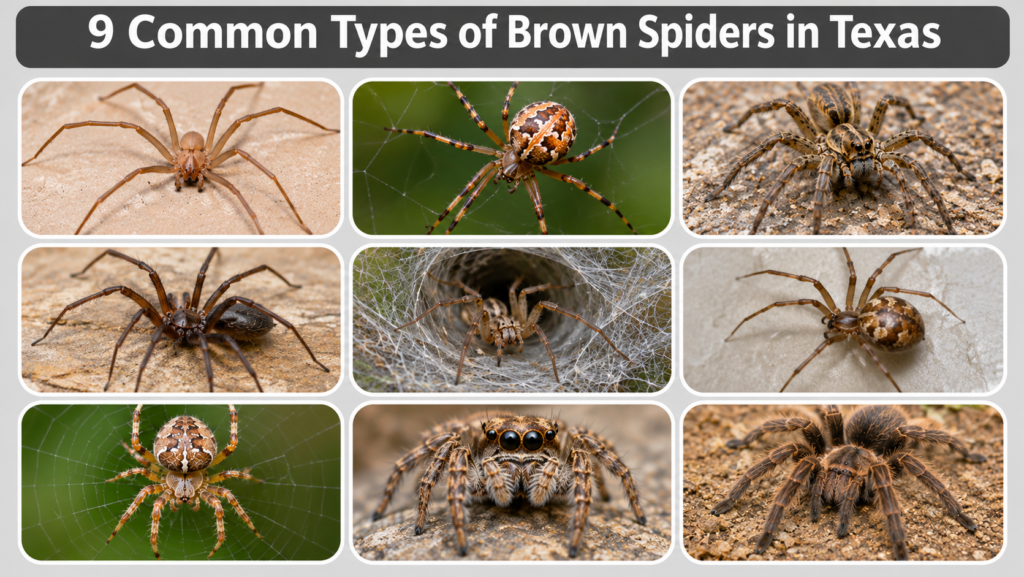
Texas supports a wide variety of spiders with brown coloring, and size alone does not identify a species. Some hunt on the ground, others build webs, and a few hide in crevices. The following nine types include familiar household spiders, backyard hunters, and species that deserve extra caution. Several names describe entire groups rather than one species.
1. Brown Recluse Spider (Loxosceles reclusa)
The brown recluse is tan to dark brown with slender, uniformly colored legs. It has six eyes arranged in three pairs and often a violin-shaped marking. The marking alone is unreliable. Recluses hide in closets, boxes, woodpiles, and garages. Bites can cause serious tissue injury, usually when the spider is trapped against skin.
2. Brown Widow Spider (Latrodectus geometricus)
Brown widows live around outdoor furniture, fences, and sheltered corners in parts of Texas. Females have a rounded, mottled abdomen, banded legs, and an orange or yellowish underside hourglass. Their egg sacs resemble spiky balls. Brown widows are shy, but bites can be medically significant.
3. Wolf Spiders (Family Lycosidae)
Wolf spiders are common in Texas lawns and gardens. Many have hairy bodies, dark stripes, and strong running legs. They chase prey rather than building capture webs. Females may carry egg sacs or spiderlings on their backs. Wolf spiders are generally not dangerous.
4. Southern House Spider (Kukulcania hibernalis)
Southern house spiders inhabit older buildings, barns, and window frames. Females are stockier and darker; males have long legs and are often mistaken for recluses. Southern house spiders have eight clustered eyes and create webbing radiating from a crevice.
5. Grass Spiders (Agelenopsis Species)
Grass spiders are small to medium brown spiders with stripes and long legs. They build sheetlike funnel webs across grass, shrubs, and building corners. They rush from the funnel when prey lands nearby. Prominent, elongated spinnerets help distinguish them from recluses.
6. Common House and Cobweb Spiders
Cobweb spiders, including Parasteatoda and Steatoda, may appear brown or gray-brown in quiet indoor corners. They have rounded, often mottled abdomens and build tangled webs. Most are harmless insect predators, although web shape alone does not confirm identification.
7. Spotted Orb-Weaver Spiders (Neoscona Species)
Many orb-weavers are brown or reddish brown with lighter markings. They create circular webs between shrubs, fences, and porches. Some rebuild webs regularly and hide during daylight. They catch flying insects and rarely trouble people. Exact identification often needs a clear photograph.
8. Brown Jumping Spiders (Family Salticidae)
Many Texas jumping spiders are small and brown, blending into bark or walls. Compact bodies, large forward-facing eyes, and sudden jumps identify the group. They actively hunt without capture webs and rarely bite unless handled.
9. Texas Brown Tarantulas (Aphonopelma Species)
Tarantulas are among Texas’s largest brown spiders, sometimes spanning several inches. They shelter in burrows or under rocks. Wandering males appear in yards during mating periods. Bites usually are not medically serious, but defensive hairs can irritate skin and eyes.
How to Identify Brown Spiders in Texas
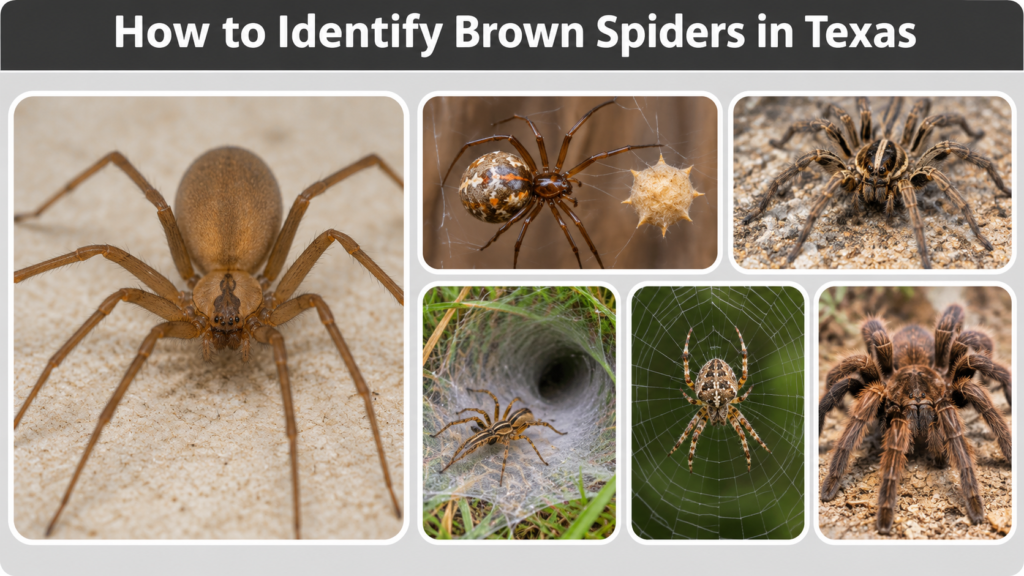
Many harmless spiders resemble dangerous ones. A photograph showing the body, legs, and web is more useful than color alone. Never handle unfamiliar spiders for inspection. A local extension specialist can help identify them.
Small Brown Spiders vs. Large Brown Spiders
Small brown spiders may be jumping spiders, cobweb spiders, young grass spiders, or recluses. Large ones are often wolf spiders, southern house spiders, orb-weavers, or tarantulas. Long legs can make a small-bodied spider look large.
Quick Identification Clues
- Six eyes in three pairs: A key recluse characteristic, best checked by an expert.
- Rounded abdomen and spiky egg sacs: Strong clues for a brown widow.
- Hairy body and dark stripes: Often seen in wolf spiders.
- Flat sheet with a funnel: Typical of grass spiders.
- Circular, wheel-shaped web: Usually indicates an orb-weaver.
- Very large, hairy body: Suggests a tarantula.
No single clue establishes an identification, particularly in a blurry photograph.
Where Are Brown Spiders Found in Texas?
Brown spiders live throughout Texas, but species differ by habitat. A Dallas garage, Houston garden, and El Paso desert may host different spiders. Brown recluses occur in parts of Texas; farther west, other recluse species may be present.
Brown Spiders by Texas Region
- North Texas, Dallas–Fort Worth: Wolf spiders, grass spiders, house spiders, and brown recluses.
- Central Texas, Austin, San Antonio: Wolf spiders, southern house spiders, orb-weavers, and recluses.
- East Texas and Houston: House spiders, orb-weavers, and other species; brown widows occur in parts of Texas.
- South Texas: Widows, orb-weavers, and hunting spiders in warm habitats.
- West Texas and El Paso: Tarantulas, wolf spiders, and desert spiders; recluse-like species are not necessarily L. reclusa.
Local observations are more reliable than broad citywide claims about which species is most common.
Are Brown Spiders in Texas Poisonous or Dangerous?
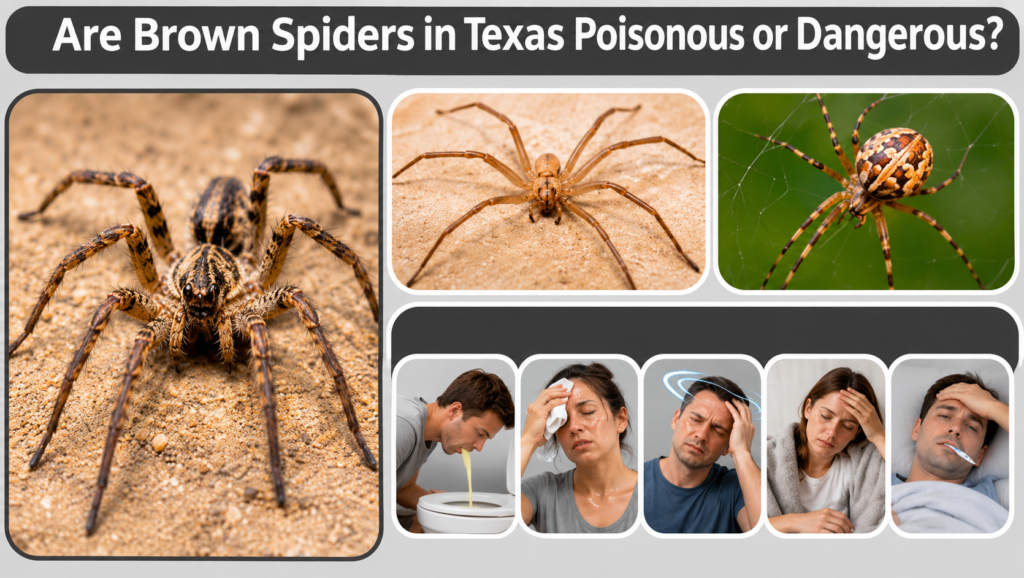
Almost all spiders use venom on prey, but most Texas brown spiders are not dangerous to people. Recluse and widow spiders are the main medical concerns. Recluse bites can damage tissue, while widow bites may cause serious pain and systemic symptoms. Both generally avoid people.
When to Seek Medical Attention
Get prompt medical advice after a suspected recluse or widow bite, especially with:
- Increasing or severe pain, cramps, or unusual muscle stiffness.
- A worsening wound, blister, or area of damaged skin.
- Vomiting, sweating, dizziness, weakness, or fever.
- Difficulty breathing, fainting, or rapidly developing systemic symptoms.
Do not diagnose a spider bite from a skin lesion alone; infections and other conditions can look similar. Clean the site, use a wrapped cold compress, and seek professional evaluation when concerned.
How to Keep Brown Spiders Out of Your House
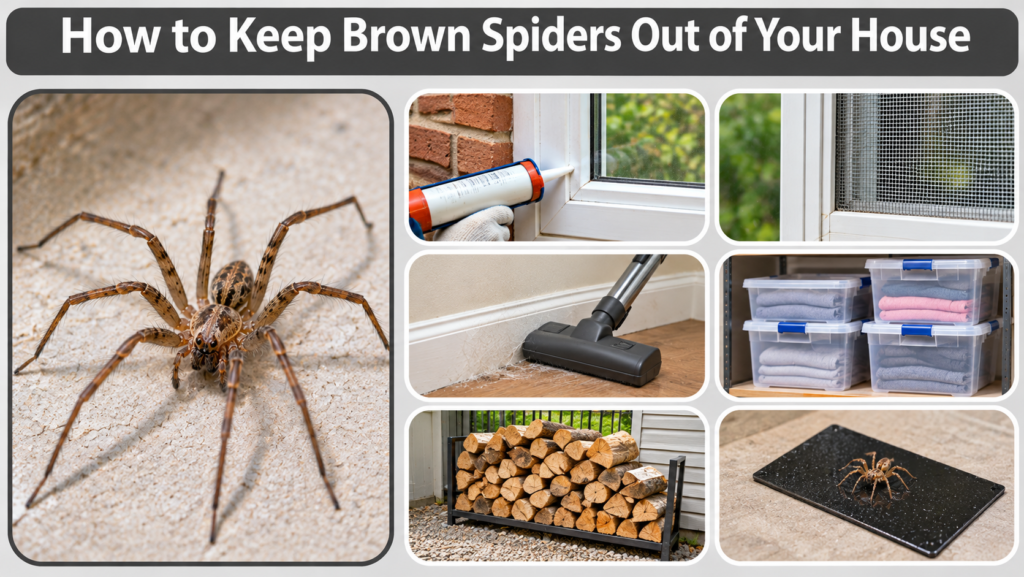
Spiders enter homes seeking food or shelter. Reducing clutter and insect prey can discourage them. Pay attention to garages, closets, and storage spaces. Seal entry gaps, repair screens, and inspect firewood before bringing it indoors.
Simple Spider Prevention Tips
- Vacuum corners, under furniture, and along baseboards.
- Store clothing and boxes in closed containers.
- Shake out shoes and gloves stored in garages or sheds.
- Seal cracks around doors, windows, and utility openings.
- Move firewood and debris away from the house.
- Use sticky monitoring traps in inaccessible spots away from children and pets when a recurring indoor problem is suspected.
For suspected widow or recluse infestations, consider professional identification and targeted pest management.
FAQs
1. Are there brown recluse spiders in Texas?
Yes. Brown recluse spiders are native to parts of Texas and can occur in houses, garages, sheds, and stored materials. They prefer quiet, undisturbed spaces. However, many spiders mistaken for recluses are harmless species, so identification should rely on more than brown color.
2. Are brown widow spiders common in Texas?
Brown widows are established in parts of Texas, but their local abundance varies. Look for mottled brown coloring, banded legs, an orange underside hourglass, and distinctive spiky egg sacs. Avoid handling them because females can deliver medically significant bites.
3. What are the most common small brown spiders in Texas homes?
Common possibilities include cobweb spiders, young grass spiders, small jumping spiders, and southern house spiders. Brown recluses also occur in suitable locations. Size and color alone cannot confirm the species; body proportions, eyes, behavior, and web type provide better clues.
4. What is the biggest brown spider in Texas?
Tarantulas in the genus Aphonopelma are among the largest brown spiders in Texas. Some have leg spans of several inches. Despite their intimidating size, they are usually shy. Their defensive hairs can irritate skin and eyes, so they should be left undisturbed.
5. Are brown spiders in Houston, Austin, or San Antonio dangerous?
Most brown spiders in these cities are harmless insect predators. Brown recluse or widow spiders may also be encountered, depending on location and habitat. Avoid direct handling and get expert identification when uncertain, especially if the spider was found in clothing or storage.
