
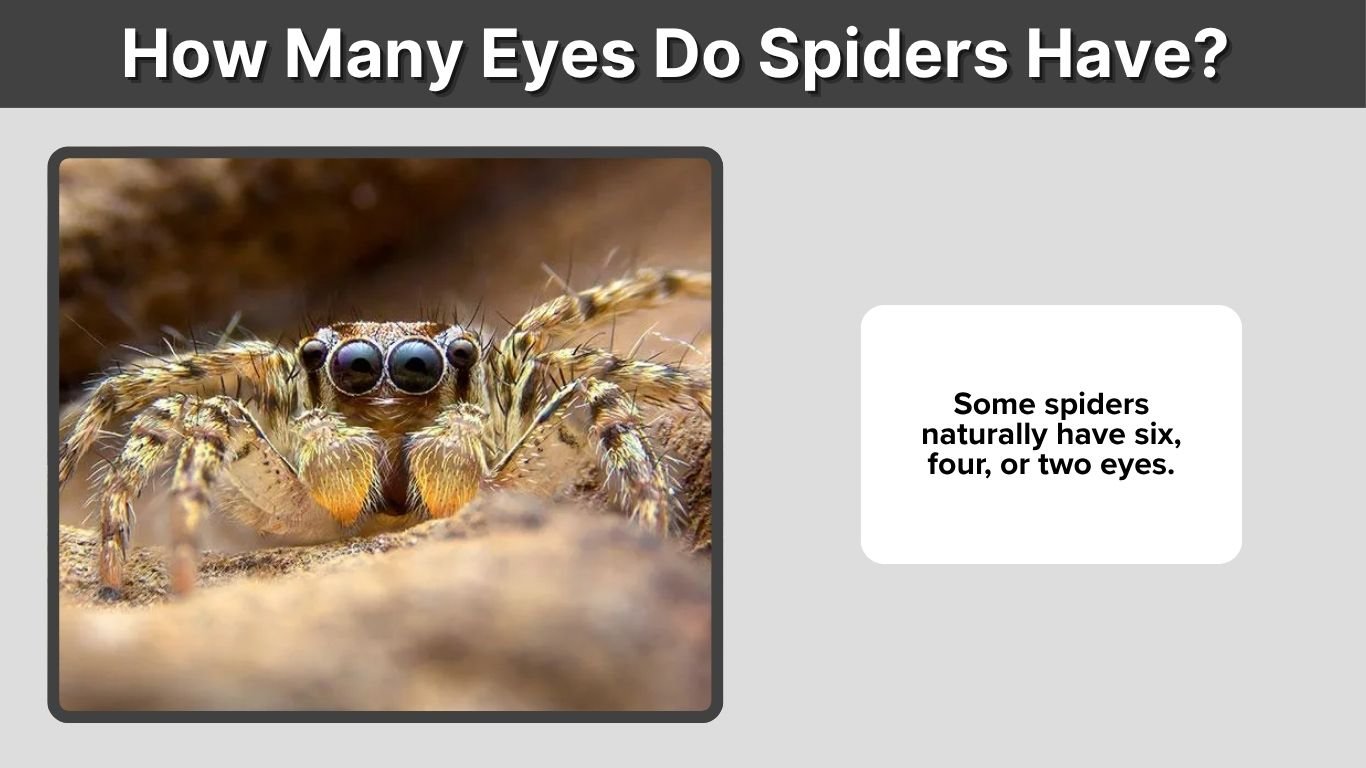
How many eyes do spiders have? Most spiders have eight eyes, but the exact number varies between species. Some spiders have six, four, two, or even no functional eyes at all. Their eye arrangement is also remarkably diverse and can help experts identify different spider families. Jumping spiders rely heavily on excellent vision, while many web-building spiders depend more on vibrations than sight. This guide explains spider eye numbers, how their vision works, and the eye patterns of jumping spiders, black widows, wolf spiders, brown recluses, and more.
How Many Eyes Do Spiders Have?
Most of the world’s spiders have eight eyes arranged in two or more rows across the front and sides of the cephalothorax. However, eight is not a universal rule. Evolution has produced spiders with fewer eyes, particularly species living underground, inside caves, or in habitats where vision provides little advantage. Eye arrangement can be as important as eye number.
Do Most Spiders Have Eight Eyes?
Yes. Eight eyes are the most common arrangement among spiders. Unlike humans, spiders do not use all their eyes in exactly the same way.
Some eyes may specialize in detecting movement, while others provide better detail or help the spider judge distance. The usefulness of each pair depends greatly on whether the spider actively hunts or waits for prey in a web.
Can Spiders Have Fewer Than Eight Eyes?
Yes. Some spiders naturally have six, four, or two eyes. A few cave-dwelling species have greatly reduced eyes or may effectively be blind.
Having fewer eyes does not necessarily put a spider at a disadvantage. Species living in darkness may rely more heavily on touch, web vibrations, air movement, and chemical signals than vision.
How Do Spider Eyes Work?
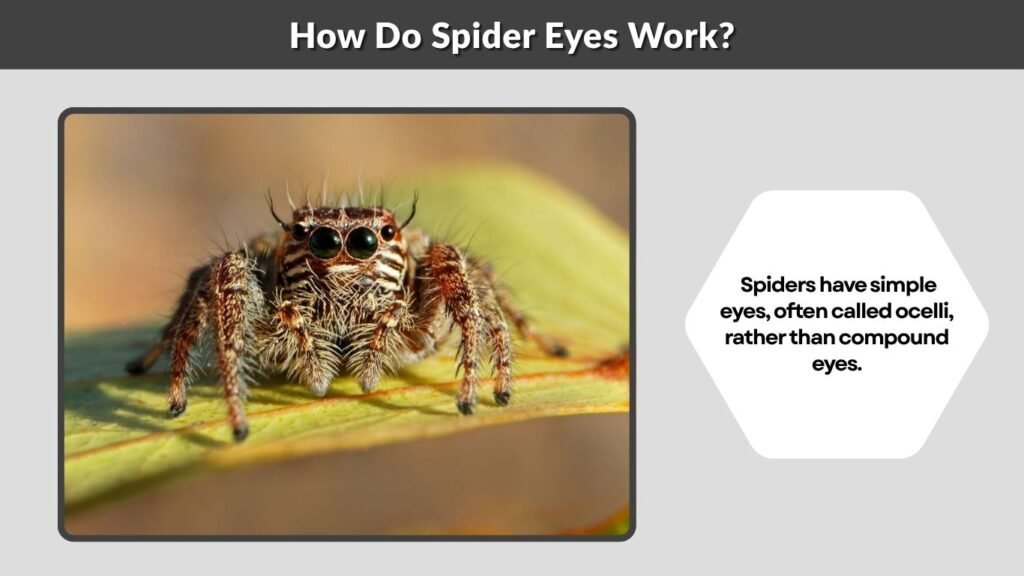
Spider eyes are different from the compound eyes found on many insects. Each spider eye is essentially a simple eye with a single lens. Despite this relatively simple structure, certain spiders—especially jumping spiders—have remarkably sophisticated vision. Different pairs of eyes may perform separate functions, allowing a spider to combine detailed sight with broad awareness of surrounding movement.
Do Spiders Have Compound Eyes?
No. Spiders have simple eyes, often called ocelli, rather than compound eyes.
Compound eyes contain numerous individual visual units and are common among insects such as flies and bees. A spider’s individual eye instead has one lens. Having several separate eyes allows the animal to collect visual information from different directions.
Primary and Secondary Spider Eyes
Many spiders have a pair of principal eyes and several secondary eyes.
The principal eyes can provide sharper visual information, while secondary eyes are often especially useful for detecting movement. The exact abilities differ dramatically among spider groups. In jumping spiders, this visual system is highly developed compared with many web-building species.
How Many Eyes Do Different Spiders Have?
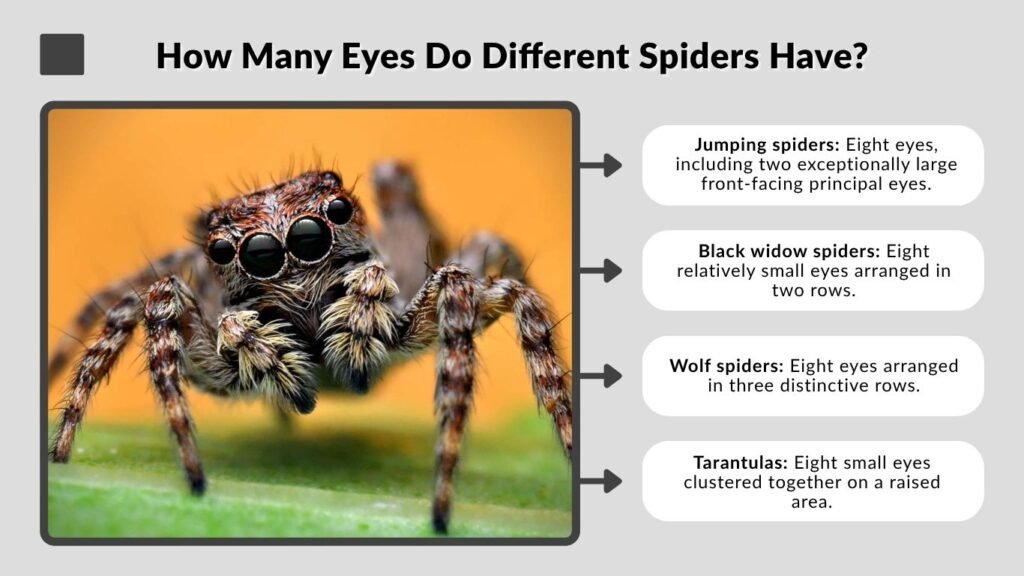
Although eight is the typical answer to how many eyes do spiders have, several well-known spiders break or modify that pattern. Eye number and arrangement are useful identification clues because related spiders often share characteristic patterns. However, viewing these tiny structures usually requires a close photograph, magnifying lens, or microscope.
Common Spiders With Eight Eyes
Many familiar spiders have eight eyes, including:
- Jumping spiders: Eight eyes, including two exceptionally large front-facing principal eyes.
- Black widow spiders: Eight relatively small eyes arranged in two rows.
- Wolf spiders: Eight eyes arranged in three distinctive rows.
- Tarantulas: Eight small eyes clustered together on a raised area.
- Orb-weaver spiders: Usually eight eyes arranged in characteristic groups.
- Huntsman spiders: Eight eyes, generally positioned in two rows.
- Hobo spiders: Eight eyes arranged across the front of the cephalothorax.
Spiders With Six or Fewer Eyes
Some notable exceptions include:
- Brown recluse: Six eyes arranged as three pairs.
- Woodlouse spider: Six eyes.
- Some cellar spiders: Certain species have six rather than eight.
- Cave spiders: Some species have reduced numbers of eyes.
- Blind cave spiders: A few highly specialized species have lost functional vision almost entirely.
These exceptions explain why saying that every spider has eight eyes would be inaccurate.
How Many Eyes Do Jumping Spiders Have?
Jumping spiders have eight eyes, but their visual system is considerably more advanced than that of many other spiders. Because they actively stalk prey and jump accurately onto targets, eyesight plays an important role in hunting, navigation, courtship, and recognizing objects. Their unusually large forward-facing eyes give these tiny spiders their familiar expressive appearance.
Why Are Jumping Spider Eyes So Large?
The two large central eyes provide high-resolution vision. These principal eyes help a jumping spider examine prey, estimate distances, recognize potential mates, and prepare precise jumps.
The eyes cannot move around like human eyeballs, but internal structures involved in vision can shift, allowing the spider to examine different parts of its visual field.
What Do the Other Six Eyes Do?
The additional six eyes provide broader peripheral awareness. They are especially useful for detecting motion approaching from the sides or behind.
Together, the eight eyes create an effective surveillance system: secondary eyes notice movement, while the large principal eyes can turn their attention toward an interesting object for more detailed inspection.
How Many Eyes Do Wolf and Black Widow Spiders Have?
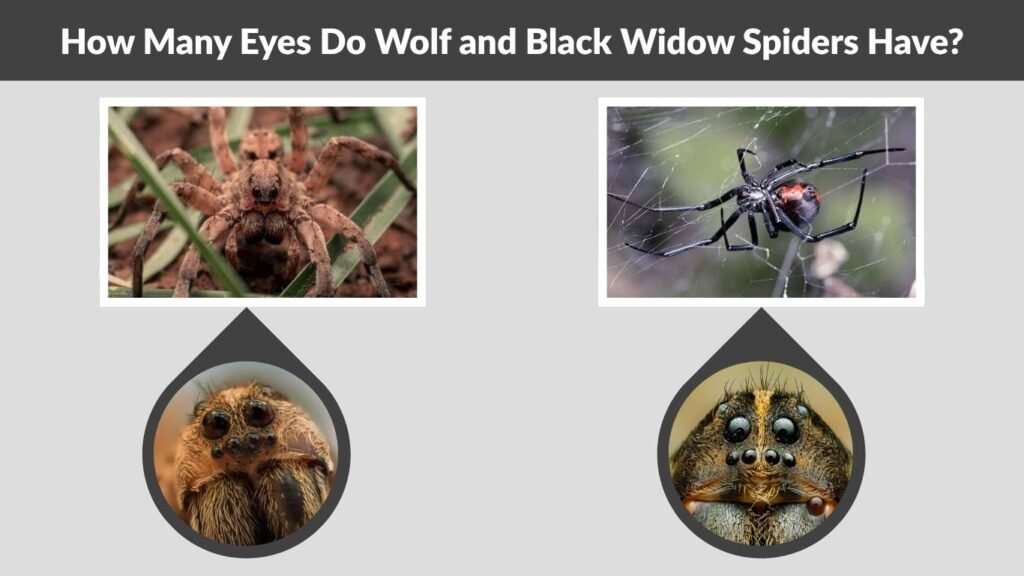
Both wolf spiders and black widows have eight eyes, but their arrangements are very different. This demonstrates why counting eyes alone is not enough for spider identification. The position and relative size of individual eyes can provide much more useful information when distinguishing one spider family from another.
Wolf Spider Eyes
Wolf spiders have one of the easiest eye patterns to recognize. Their eight eyes are organized in three rows.
Four relatively small eyes form the lowest row, two large forward-facing eyes occupy the middle, and another pair sits higher and farther back. The large eyes support the wolf spider’s active nighttime hunting lifestyle.
Black Widow Eyes
Black widow spiders also have eight eyes, but they are considerably smaller and usually arranged in two rows.
Black widows depend heavily on their webs to detect prey. Vibrations traveling through silk tell the spider when an insect has become trapped, meaning detailed eyesight is generally less important than it is for visually oriented hunters such as jumping spiders.
How Many Eyes Do Brown Recluse Spiders Have?
Brown recluse spiders are particularly interesting because they have only six eyes. Those eyes are arranged in three pairs, technically known as dyads. This unusual arrangement is sometimes used as one characteristic for identification. However, people should not attempt to identify a potentially medically significant spider using eye number alone.
Brown Recluse Eye Arrangement
The six eyes are arranged roughly as:
- One pair toward the front
- One pair toward the left side
- One pair toward the right side
The paired pattern helps distinguish recluse spiders from many common eight-eyed household species.
Is Eye Count Enough for Identification?
No. Spider identification should consider body shape, markings, leg structure, geographic location, web type, and eye arrangement together.
For example, many harmless brown spiders are incorrectly labeled brown recluses based solely on coloration. Examining multiple anatomical features provides a much more reliable identification.
Why Do Spiders Have So Many Eyes?
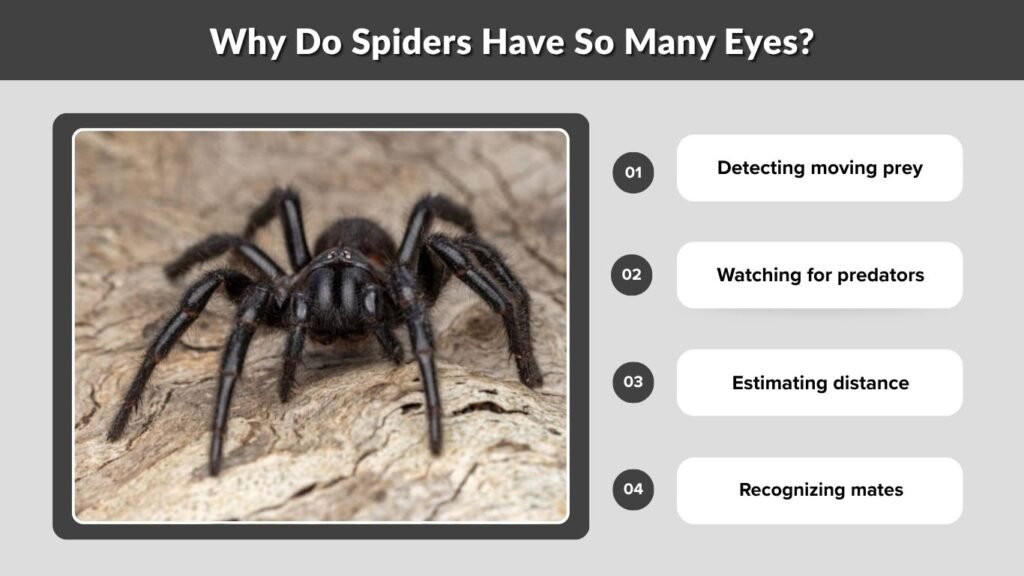
Multiple eyes allow spiders to gather information from different parts of their surroundings without turning their entire bodies. However, having many eyes does not automatically mean excellent eyesight. Some eight-eyed spiders see relatively poorly, while jumping spiders use their eight-eye system to produce some of the most impressive vision among arachnids.
Different Eyes Perform Different Jobs
Depending on the species, individual eyes may help with:
- Detecting moving prey
- Watching for predators
- Estimating distance
- Navigating surroundings
- Recognizing mates
- Hunting in low light
- Monitoring a wider field of view
This division of visual tasks is particularly advanced among active hunting spiders.
Hunters vs. Web-Building Spiders
Active hunters tend to depend more heavily on vision because they must locate and approach prey.
Web-building spiders can rely more on vibrations. A struggling insect produces movements in silk that quickly alert the spider. As a result, some web-building species do not require the detailed vision seen in jumping spiders.
Can Spiders See Clearly?
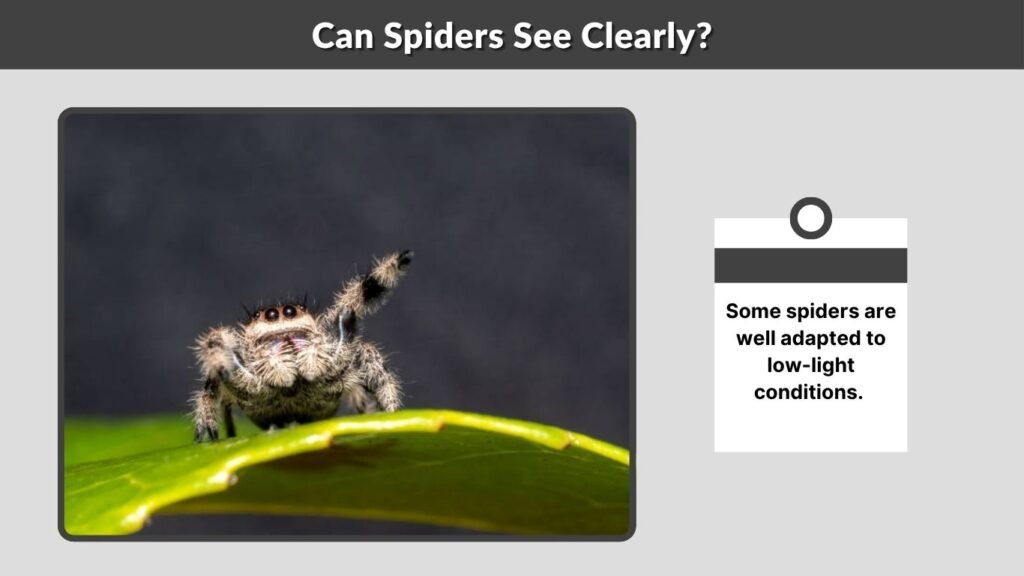
Spider vision ranges from remarkably good to extremely limited. Jumping spiders can detect considerable detail and use visual information for complex behaviors, while some other species mainly notice changes in light and movement. Habitat and hunting strategy have strongly influenced how vision has evolved among different spider groups.
Can Spiders See Colors?
Some spiders can distinguish colors. Jumping spiders are particularly well studied, and color vision varies among species.
Color can play a role in identifying prey and during courtship. Male jumping spiders sometimes display brightly colored body parts while performing elaborate movements to attract females.
Can Spiders See in the Dark?
Some spiders are well adapted to low-light conditions. Wolf spiders, for example, frequently hunt at night and possess sensitive eyes that help them detect prey.
Others compensate for limited nighttime vision by relying heavily on vibrations, touch, and chemical information from their environment.
Interesting Facts About Spider Eyes
Spider vision shows how diverse animals can solve the same problem in very different ways. Eight eyes may seem excessive from a human perspective, but each pair can contribute different information. At the same time, spiders that barely rely on sight demonstrate that vision is only one of many sensory systems available to these successful predators.
Quick Spider Eye Facts
- Most spiders have eight eyes.
- Some spiders have six, four, or two.
- Certain cave spiders have severely reduced or absent functional eyes.
- Spiders have simple eyes rather than compound eyes.
- Jumping spiders have some of the best vision among spiders.
- Brown recluse spiders have six eyes in three pairs.
- Wolf spiders have eight eyes arranged in three rows.
- Black widows have eight eyes.
- Tarantulas typically have eight small eyes.
- Eye arrangement can help identify spider families.
FAQs
1. How many eyes do most spiders have?
Most spiders have eight eyes, usually arranged in two or more rows. However, eye number differ among species. Some spiders naturally possess six, four, or two eyes, while certain cave-adapted species have reduced or nonfunctional eyes because vision offers little advantage in permanently dark environments.
2. How many eyes do jumping spiders have?
Jumping spiders have eight eyes. Their two large forward-facing principal eyes provide detailed vision, while the six secondary eyes help detect movement around them. This sophisticated system supports accurate jumping, active hunting, navigation, predator detection, and the complex visual courtship displays performed by many jumping spider species.
3. How many eyes do black widow spiders have?
Black widow spiders have eight eyes, generally arranged in two rows of four. Their eyes are much less visually prominent than those of jumping or wolf spiders. Black widows rely heavily on vibrations traveling through their webs to detect trapped prey and possible disturbances around their retreats.
4. How many eyes do wolf spiders have?
Wolf spiders have eight eyes arranged in three rows. Four small eyes form the lowest row, two noticeably large eyes sit above them, and another pair occurs farther back. Their well-developed vision helps these active hunters locate prey instead of depending primarily on webs for capturing food.
5. How many eyes do brown recluse spiders have?
Brown recluse spiders have six eyes, not eight. The eyes are arranged in three pairs, making their pattern different from that of most spiders. Eye arrangement can support identification, but it should be combined with body characteristics, geographic range, and other features rather than used alone.
