
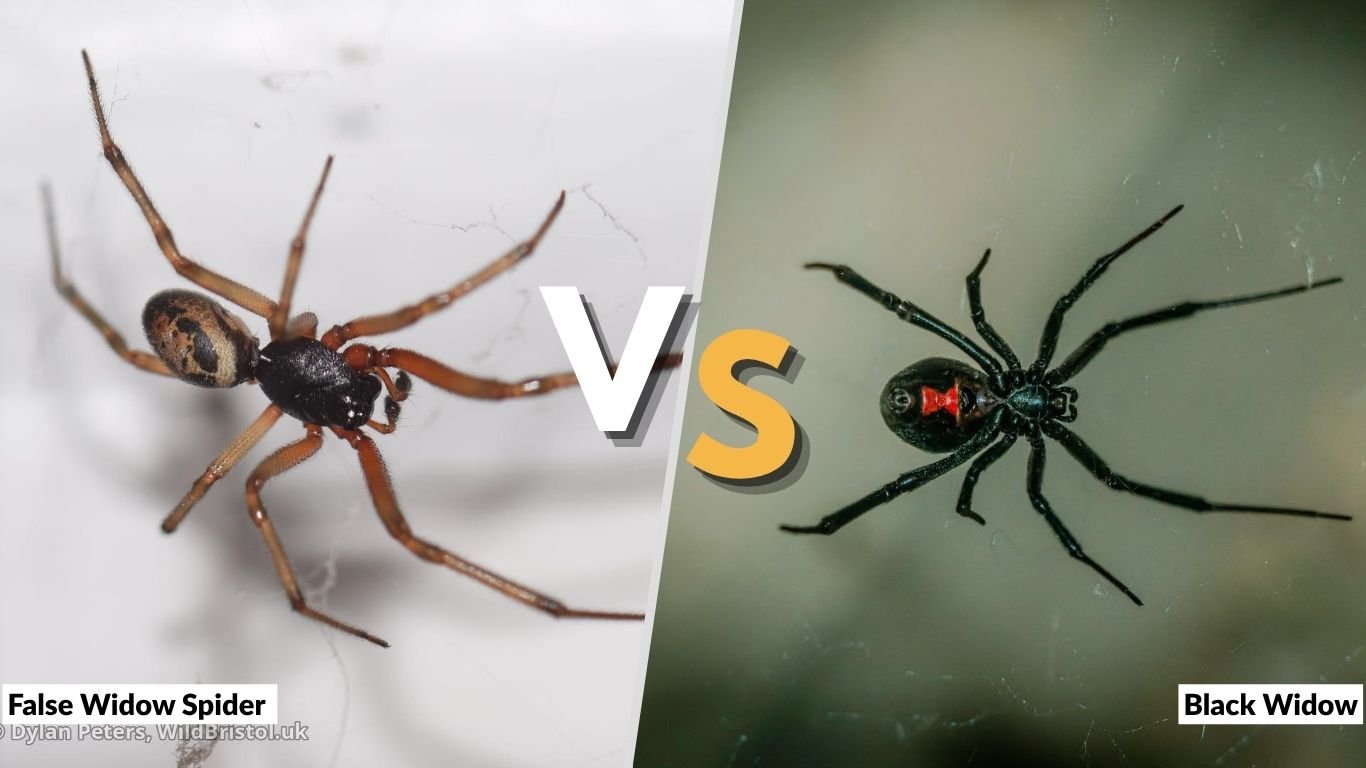
False widow spiders and black widows can look surprisingly similar because both often have dark, rounded abdomens and build irregular cobwebs. However, they belong to different genera and differ significantly in markings, distribution, behavior, and the typical effects of their bites. False widows belong mainly to the genus Steatoda, while true black widows belong to Latrodectus. Although both are venomous, black widow venom is generally considered more medically significant. Understanding their color, size, web, habitat, and bite symptoms can make identification much easier.
False Widow Spider vs Black Widow Identification
At first glance, a shiny dark false widow may resemble a black widow. Looking carefully at the abdomen, markings, legs, and geographic location usually provides better clues. Identification should consider several characteristics together because color alone is unreliable, particularly among juveniles and males.
Key Identification Differences
- False widow: Usually dark brown, reddish-brown, or purplish-black
- Black widow: Adult females are often glossy black
- False widow: Frequently has cream, tan, or pale abdominal markings
- Black widow: Many adult females have a red or orange hourglass underneath
- False widow: Usually lacks a classic red hourglass
- Black widow: Abdomen is typically very rounded and glossy
- False widow: Abdomen can also be rounded but may show distinctive dorsal patterns
- Both: Build irregular three-dimensional cobwebs
The exact appearance varies considerably among species.
Noble False Widow vs Black Widow
The noble false widow, Steatoda nobilis, is one of the species most frequently confused with black widows.
Females usually have a bulbous brownish abdomen containing a pale cream marking that may resemble a skull or leaf. Their legs often appear reddish-brown.
Adult female black widows tend to be darker and may have a conspicuous red hourglass-shaped marking on the underside of the abdomen.
False Widow vs Black Widow Size
Both groups contain relatively small spiders, although their rounded abdomens and long legs can make them appear larger. Females are generally noticeably larger-bodied than males in both groups.
Size should therefore be used together with coloration and markings rather than as the sole identification feature.
Typical Size Differences
Female noble false widows commonly have body lengths around 9–14 mm, excluding the legs.
Female black widows vary by species but are often approximately 8–13 mm in body length, with the legs making their overall span considerably larger.
Consequently, there can be substantial size overlap between them.
Male vs Female False Widow
Female false widows typically have larger, more rounded abdomens.
Males generally have:
- Smaller bodies
- Narrower abdomens
- Proportionally longer legs
- More obvious wandering behavior
- Different abdominal patterns
Males often leave their webs while searching for females, making them more likely to appear unexpectedly inside buildings.
False Widow vs Black Widow Bite
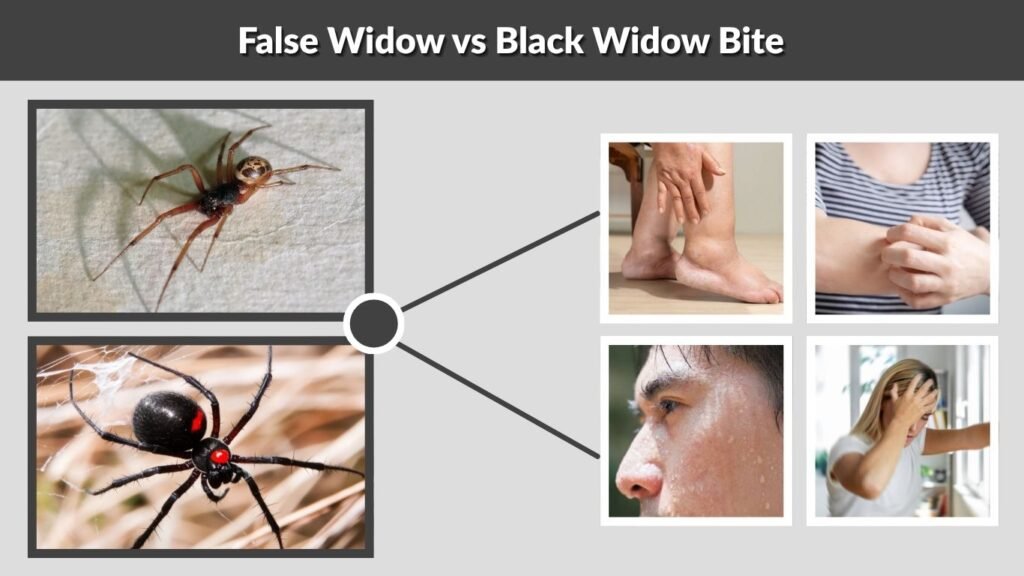
The most important difference between the two groups involves their medical significance. Both possess venom used to immobilize prey, but true widow spiders have venom capable of causing more substantial neurological symptoms in humans.
False widow bites are generally less severe, although painful reactions can occur.
False Widow Bite Symptoms
A false widow bite may cause:
- Local pain
- Redness
- Swelling
- Tenderness
- Burning
- Itching
- Tingling
- Occasionally pain extending beyond the bite
Some people report headache, nausea, fatigue, or generally feeling unwell.
Serious reactions are uncommon, and many suspected spider bites cannot be definitively linked to a spider.
Black Widow Bite Symptoms
Black widow bites can produce more significant systemic effects because their venom contains potent neurotoxic components.
Possible symptoms include:
- Immediate or developing pain
- Muscle cramps or spasms
- Abdominal or back pain
- Sweating
- Nausea
- Restlessness
- Elevated heart rate
- General weakness
Severity varies greatly. A suspected black widow bite accompanied by significant symptoms warrants medical assessment.
Which Bite Is More Dangerous?
A true black widow bite is generally considered more medically significant than a false widow bite.
However, an individual’s reaction cannot be predicted purely from the spider’s name. Children, older adults, people with underlying medical problems, and anyone developing severe symptoms should receive appropriate medical attention.
Difficulty breathing, facial or throat swelling, fainting, or severe worsening symptoms require urgent care.
Habitat and Geographic Range
Geography can provide an important identification clue. False widows and black widows have different distributions, although several species have expanded beyond their original ranges through international transportation and trade.
Both groups frequently use sheltered locations protected from weather.
Where False Widow Spiders Live
False widows may occupy:
- Houses
- Garages
- Garden sheds
- Fences
- Window frames
- Roof spaces
- Outdoor furniture
- Stone walls
- Other protected crevices
The noble false widow is particularly well established in the UK and Ireland.
Where Black Widow Spiders Live
Various black widow species occur across North America and many other parts of the world.
They commonly use sheltered, relatively undisturbed locations such as woodpiles, sheds, garages, outdoor structures, debris, and spaces beneath objects.
Distribution depends on the particular Latrodectus species.
False Widow vs Black Widow Web
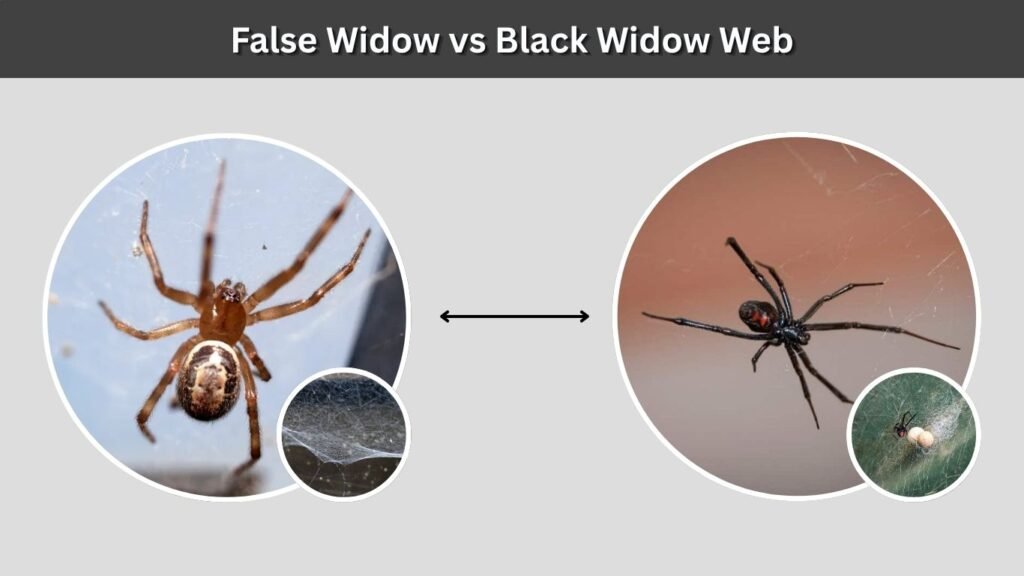
Neither spider builds the classic circular web associated with garden orb-weavers. Instead, both belong to the cobweb spider family Theridiidae and construct irregular three-dimensional networks of silk.
This similarity is one reason they can be difficult to distinguish simply by looking at the web.
What Does a False Widow Web Look Like?
False widow webs commonly have:
- Tangled silk threads
- Strong structural lines
- Sticky prey-catching strands
- A protected retreat
- Webbing around corners and crevices
The spider may remain hidden during daylight before becoming more active at night.
Black Widow Web
Black widow webs are also irregular and tangled rather than symmetrical.
The silk can feel surprisingly strong compared with the delicate-looking threads. Females generally remain close to established webs where they capture insects and other small arthropods.
A messy web alone cannot confirm whether its owner is a false widow or black widow.
Other Spiders vs False Widows
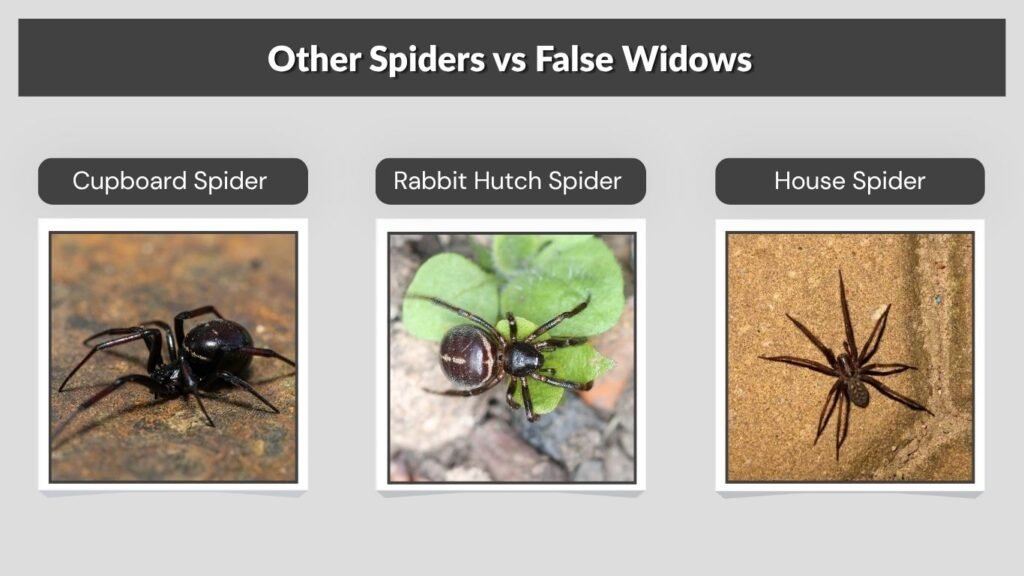
Several common spiders are mistaken for false widows. Some are actually members of the same genus, while others only share a dark color or similar household habitat.
Careful identification prevents unnecessary concern.
Cupboard Spider vs False Widow
The cupboard spider, Steatoda grossa, is itself a species of false widow.
It tends to have a dark rounded abdomen and may appear relatively plain compared with the more strongly patterned noble false widow.
Therefore, “cupboard spider vs false widow” is not a comparison between completely separate groups.
Rabbit Hutch Spider vs False Widow
The rabbit hutch spider, Steatoda bipunctata, also belongs to the false widow group.
It is typically smaller and often has characteristic pale markings across its abdomen.
Like other Steatoda species, it constructs tangled webs in sheltered locations.
House Spider vs False Widow
Common or giant house spiders usually have longer legs, less bulbous abdomens, and different webs.
House spiders are often seen running across floors when searching for mates, whereas female false widows tend to remain close to their webs.
Cellar Spider vs False Widow
Cellar spiders are easy to distinguish because they have extremely long, thin legs and comparatively small bodies.
Their delicate appearance contrasts strongly with the more compact, rounded abdomen of a false widow.
Behavior and Risk to Humans
Neither false widows nor black widows normally seek out humans. Spiders use venom primarily for capturing prey, and biting a person provides them with no feeding advantage.
Most bites occur through accidental close contact.
When Bites May Occur
A bite becomes more likely when a spider is:
- Trapped against the skin
- Hidden inside clothing or footwear
- Accidentally squeezed
- Handled directly
- Disturbed in an enclosed hiding place
Wearing gloves while moving stored materials and shaking out seldom-used outdoor clothing can reduce accidental encounters.
What to Do After a Suspected Bite
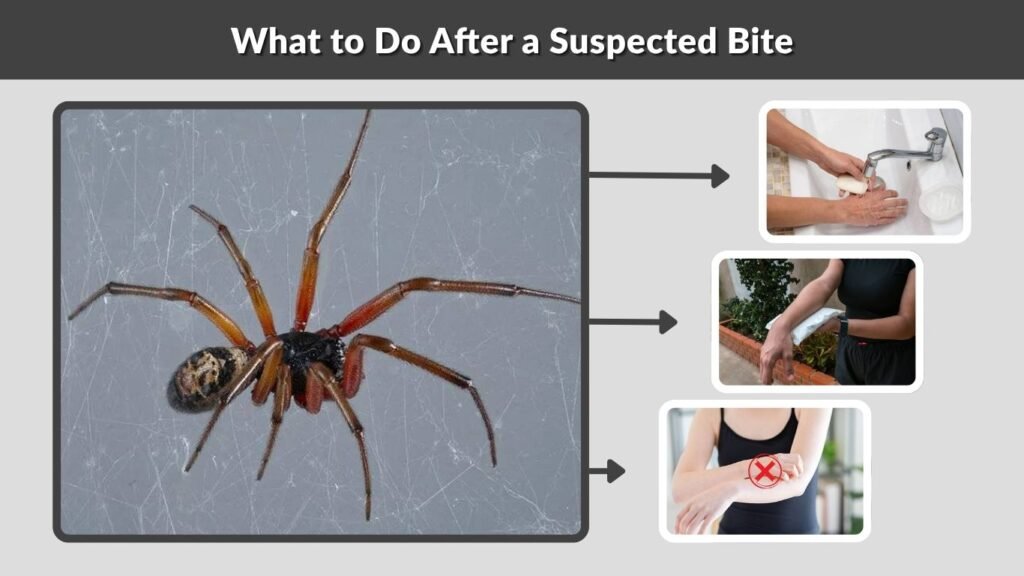
If a bite produces only mild local symptoms, basic first aid is generally appropriate initially. Do not cut the skin, squeeze the wound, or attempt to suction venom.
Basic First Aid
- Wash the area with soap and water.
- Apply a wrapped cold pack intermittently.
- Avoid scratching the bite.
- Monitor swelling and pain.
- Use appropriate pain relief if normally safe for you.
- Seek medical advice if symptoms worsen.
If you can safely photograph the spider, an image may help with identification. Do not risk another bite trying to capture it.
FAQs
Is a false widow the same as a black widow?
No. False widows belong to the genus Steatoda, while true black widows belong to Latrodectus. They are related but distinct spiders.
Which is more dangerous, a false widow or black widow?
Black widow bites are generally more medically significant and are more likely to produce systemic neurological symptoms. False widow bites usually cause localized pain and swelling.
How can I tell a false widow from a black widow?
Look at the markings. False widows commonly have cream or tan patterns, while many adult female black widows have a distinctive red hourglass underneath the abdomen.
Is a cupboard spider a false widow?
Yes. The cupboard spider, Steatoda grossa, is one of the spiders commonly described as a false widow.
Can false widow spiders kill humans?
Life-threatening reactions to false widow bites appear to be very rare. Most reported bites cause localized or moderate symptoms, although any severe allergic or systemic reaction requires urgent medical attention.
