
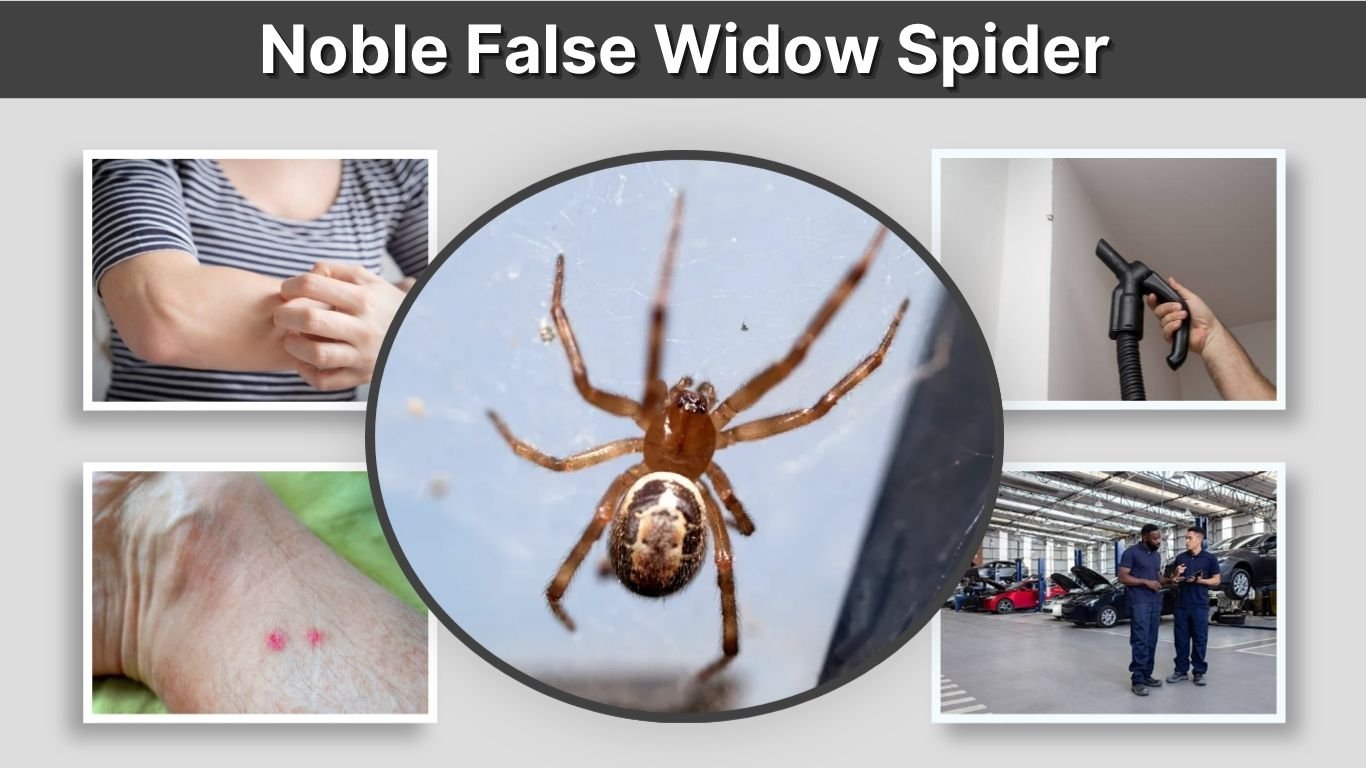
The noble false widow spider is a dark, glossy spider known for its rounded abdomen and pale cream markings. Scientifically called Steatoda nobilis, it is one of the best-known false widow species and is now established across much of the UK and Ireland, as well as parts of Europe and other regions. Although it is venomous, it is generally not aggressive toward people. Most bites cause localized pain and swelling, while more serious reactions are uncommon. Knowing its appearance, habitat, web, size, and bite symptoms can make identification easier.
What Is a Noble False Widow Spider?
The noble false widow belongs to the cobweb spider family Theridiidae, the same family that contains true widow spiders. Despite similarities in body shape, it belongs to the genus Steatoda rather than Latrodectus. It usually lives around buildings, gardens, fences, sheds, and other sheltered places where it constructs irregular webs.
Scientific Classification
- Common name: Noble false widow spider
- Scientific name: Steatoda nobilis
- Family: Theridiidae
- Order: Araneae
- Genus: Steatoda
- Type: Cobweb spider
- Venomous: Yes
- Generally aggressive: No
The word “false widow” refers to its resemblance to true widow spiders rather than indicating that the two are the same.
Why Is It Called a False Widow?
Noble false widows have rounded abdomens, relatively slender legs, and dark coloration that can resemble black widow spiders.
However, they do not normally possess the distinctive red hourglass associated with many female black widows.
False widows also differ in markings, geographic distribution, behavior, and the typical medical effects of their bites.
Noble False Widow Spider Identification
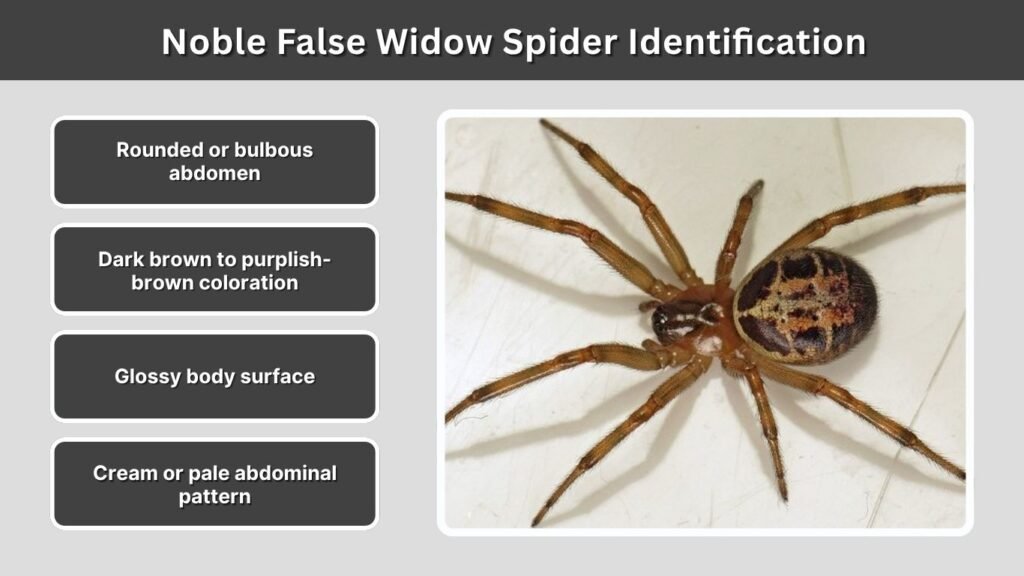
Identification can sometimes be difficult because coloration and abdominal patterns vary between individuals. Females generally appear more robust than males, while males have smaller abdomens and proportionally longer legs. The pale abdominal pattern of a noble false widow is often useful, but it should not be considered identical in every spider.
Identification Features
Look for the following characteristics:
- Rounded or bulbous abdomen
- Dark brown to purplish-brown coloration
- Glossy body surface
- Cream or pale abdominal pattern
- Reddish-brown legs
- Relatively small cephalothorax
- Irregular cobweb
- Females larger-bodied than males
The pale marking on the abdomen is sometimes described as skull-like, leaf-shaped, or cream-colored, although the pattern can become faint in older individuals.
Noble False Widow Spider Size
Females are larger than males.
The female’s body is generally around 9–14 mm long, excluding the legs, although individual size varies. Males usually have smaller bodies but longer-looking legs.
With the legs included, an adult can appear considerably larger than its body measurement suggests.
Noble False Widow vs Other False Widows
Several Steatoda species may occur around homes, and they can be difficult to distinguish without close examination.
The noble false widow often has a more obvious cream-colored abdominal pattern than some related species. Other false widows may appear more uniformly dark or have different arrangements of pale markings.
Accurate species identification may require an experienced spider identifier, particularly when dealing with juveniles.
Where Do Noble False Widow Spiders Live?
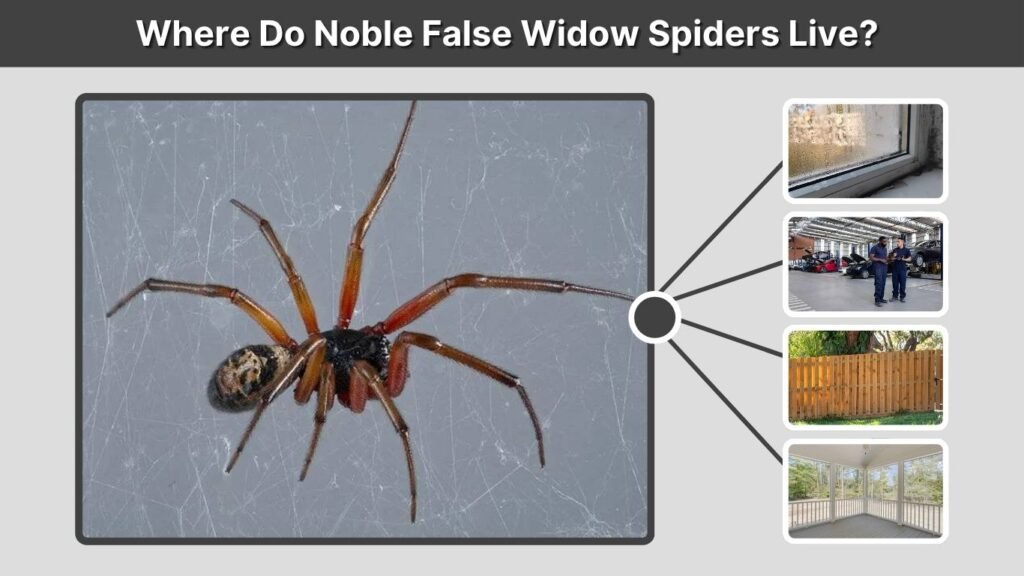
The noble false widow is strongly associated with human-made structures. Warm, protected locations can provide excellent shelter and reliable populations of insects to capture. The spider typically remains close to its web rather than actively roaming through rooms in search of people.
Common Habitats
Noble false widows may be found around:
- Window frames
- Garden sheds
- Garages
- Fences
- Walls
- Conservatories
- Roof spaces
- Porches
- Outdoor furniture
- Utility structures
They prefer locations that provide anchor points for webs and some protection from severe weather.
Noble False Widow Spiders in the UK
The noble false widow has become well established in the UK, particularly in southern regions, although its distribution has expanded.
Urban environments can provide favorable conditions because buildings offer relatively warm microhabitats.
The spider may be noticed around exterior walls and windows, but finding one near a house does not mean occupants are likely to be bitten.
Noble False Widow Spiders in Ireland
The species is also established in Ireland and has attracted attention as sightings have increased.
As elsewhere, it often occurs around human structures.
Most spiders remain in or near their webs, where they capture flies and other arthropods. Bites are much less common than simple encounters with the spider.
Noble False Widow Spider Web
Like other cobweb spiders, noble false widows do not construct the circular webs associated with orb-weavers. Their webs are irregular structures made from strong silk and positioned around sheltered corners or gaps.
The web serves both as a prey-catching device and as a protected retreat.
What Does the Web Look Like?
Typical features include:
- Irregular tangled silk
- Strong supporting threads
- A sheltered retreat nearby
- Webs in corners or crevices
- Sticky capture threads
- Dead insect remains beneath the web
The spider often remains hidden during daylight and becomes more active after dark.
What Do Noble False Widows Eat?
Their diet consists largely of insects and other small arthropods captured in the web.
Common prey can include flies, mosquitoes, moths, ants, small beetles, and other spiders.
After prey becomes entangled, the spider immobilizes it with silk and venom before feeding.
Are Noble False Widow Spiders Venomous?
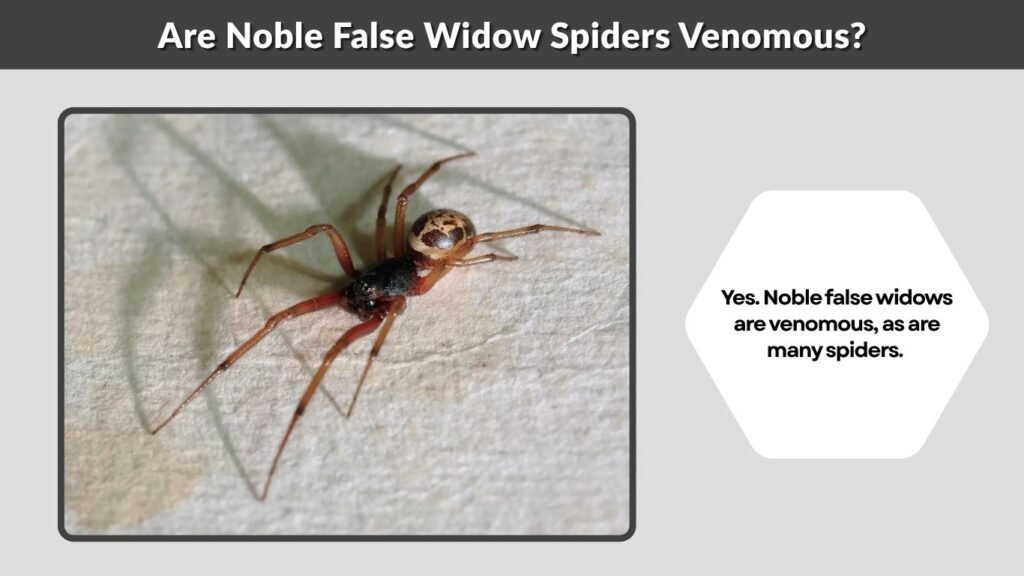
Yes. Noble false widows are venomous, as are many spiders. Venom is used primarily to immobilize prey rather than to attack humans.
Calling them “poisonous” is technically inaccurate because poison generally causes harm when touched, eaten, or absorbed, while venom is delivered through a bite or sting.
Are Noble False Widows Dangerous?
For most people, a bite is expected to cause localized symptoms rather than a life-threatening reaction.
However, bite severity can vary. Rarely, a person may develop more substantial symptoms or an allergic reaction.
The spider should therefore be treated with reasonable caution, but its presence should not automatically be considered a medical emergency.
Noble False Widow Spider Bite
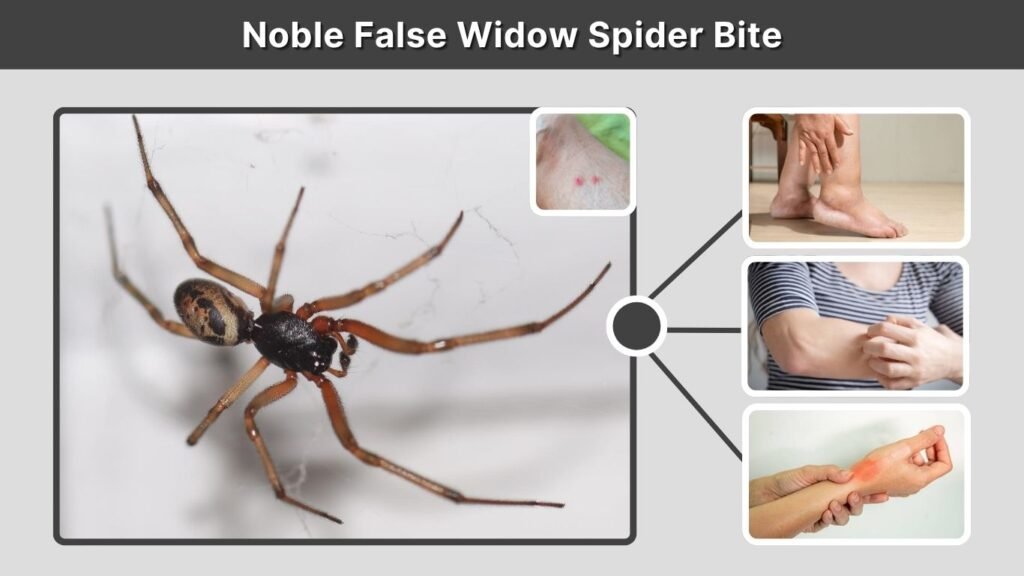
A noble false widow generally bites only when it is trapped against the skin, handled, squeezed, or accidentally disturbed. Because the spider usually remains within its web, normal encounters do not commonly lead to bites.
The effects of a confirmed bite can vary considerably from one person to another.
Common Bite Symptoms
Possible symptoms include:
- Immediate or developing pain
- Redness
- Local swelling
- Tenderness
- Burning sensation
- Itching
- Mild numbness or tingling
- Warmth around the bite site
Some people may experience pain that extends beyond the immediate bite area.
Less Common Reactions
Less commonly reported effects may include fatigue, headache, nausea, sweating, muscle discomfort, or generally feeling unwell.
Many suspected spider bites are never confirmed by identifying the spider, so an unexplained skin lesion should not automatically be attributed to a noble false widow.
Infection and other skin conditions can produce similar symptoms.
Noble False Widow Bite Treatment
Most mild bites can initially be treated with straightforward first aid. The area should be monitored because worsening symptoms may require medical assessment.
There is no reason to cut the skin or attempt to remove venom manually.
Basic First Aid
After a suspected bite:
- Wash the area gently with soap and water.
- Apply a wrapped cold pack for short periods.
- Keep the affected area clean.
- Avoid scratching or squeezing it.
- Monitor redness, swelling, and pain.
- Use suitable over-the-counter pain relief if normally safe for you.
- Seek medical advice if symptoms become progressively worse.
Avoid applying harsh chemicals or intentionally breaking any blister that develops.
When to Seek Urgent Help
Get urgent medical attention if the person develops:
- Difficulty breathing
- Swelling of the lips, tongue, face, or throat
- Fainting or severe dizziness
- Severe or rapidly increasing pain
- Extensive swelling
- Repeated vomiting
- Severe weakness
- Rapidly spreading redness
- Fever with worsening skin symptoms
Breathing problems or facial and throat swelling can indicate a serious allergic reaction.
Noble False Widow Egg Sacs and Life Cycle
Noble false widows reproduce through eggs contained inside silk sacs. Females can remain around a suitable web for extended periods, while males are more likely to wander when searching for mates.
Warm, protected buildings may help some spiders survive seasonal temperature changes.
Egg Sacs
Females produce silk sacs containing multiple eggs.
The sacs are usually maintained within protected portions of the web. Young spiderlings emerge after development and eventually disperse to establish their own webs.
The number of offspring and timing of reproduction vary according to temperature, food, and other environmental conditions.
Lifespan
Female noble false widows can live considerably longer than males, potentially surviving for several years under favorable conditions.
Males generally have shorter adult lives because much of their reproductive period is spent searching for females.
Indoor and sheltered habitats may increase survival by protecting spiders from weather extremes.
How to Prevent Noble False Widows Around the Home
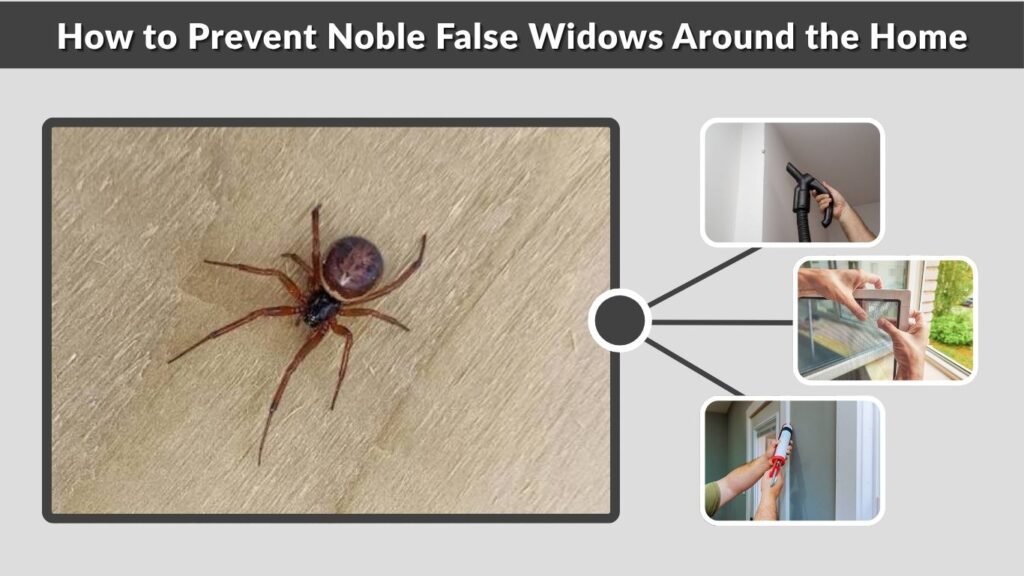
Completely eliminating spiders from outdoor areas is neither practical nor usually necessary. However, reducing sheltered web sites and sealing building openings can decrease the likelihood of unwanted indoor encounters.
Prevention Tips
- Seal gaps around windows and doors.
- Repair damaged screens.
- Remove clutter from sheds and garages.
- Vacuum unwanted indoor webs.
- Wear gloves when moving stored outdoor items.
- Shake out rarely used clothing or footwear.
- Keep storage containers closed.
- Reduce unnecessary insect attraction around entrances.
Avoid handling an unidentified spider with bare hands.
FAQs
Is the noble false widow spider dangerous?
It is venomous, but most bites produce localized effects such as pain, redness, and swelling. Serious reactions appear to be uncommon, although severe symptoms require medical attention.
How big is a noble false widow spider?
Adult females usually have bodies roughly 9–14 mm long, excluding the legs. Males are typically smaller-bodied.
How do you identify a noble false widow?
Look for a rounded dark abdomen, glossy appearance, reddish-brown legs, irregular web, and a variable cream-colored pattern on the upper abdomen.
Are noble false widow spiders found in the UK?
Yes. Steatoda nobilis is established in the UK and is particularly associated with buildings and other sheltered environments.
Can a noble false widow bite you?
Yes, but bites are relatively uncommon. They are most likely when a spider is trapped against the skin, squeezed, or directly handled.
